Anthropic September 2026 Threat Report: How AI Misuse Is Becoming Operational

Anthropic’s September 2026 threat-intelligence report argues that malicious AI use is moving beyond one-off prompts toward repeatable operations. In the cases the company describes, actors combined models with parallel agents, persistent memory, scheduled runs, connectors, and human approval to sustain reconnaissance, content production, surveillance, or fraud-related work.
The report covers activity Anthropic says it identified and disrupted between December 2025 and August 2026. Its seven harm areas include cyber operations, influence operations, surveillance, scams and fraud, biological misuse, conventional-weapons work, and illicit model distillation. These are selected notable cases observed through one provider, not a representative census of global AI-enabled crime.
That distinction should shape how the report is read. It provides unusually detailed evidence about how accounts used a model, but Anthropic’s visibility becomes limited when content or tools move to another platform. Real-world reach, damage, and attribution are stronger in some cases than others.
Three takeaways
- AI often accelerated existing goals—research, coding, classification, persuasion, and repetition—rather than inventing a new criminal objective.
- Humans remained involved in consequential decisions such as selecting targets, approving output, obtaining access, distributing material, and monetizing results.
- Defenders should correlate identity, tools, content, timing, and downstream distribution instead of relying on a detector that guesses whether one passage was AI-written.
The operational changes that matter
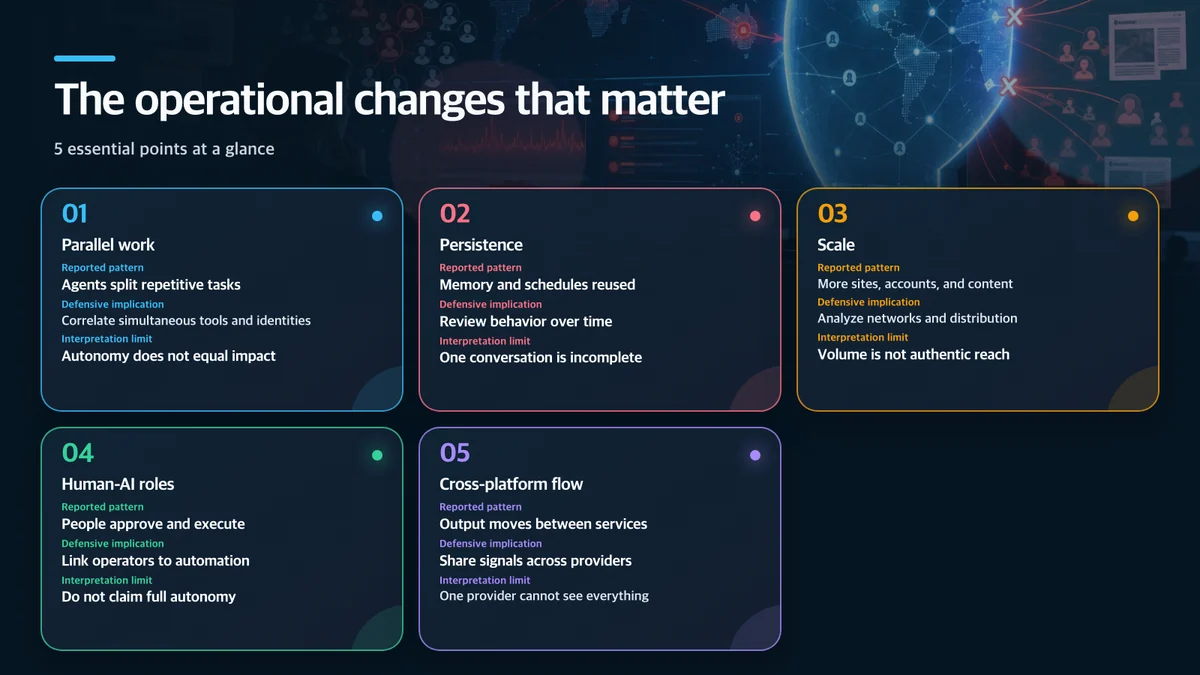
The Anthropic September 2026 threat report details nine influence-operation cases that targeted audiences on six continents. The reported activity included fabricated news properties, coordinated inauthentic accounts, impersonation, and high-volume political content. Anthropic also says many networks attracted little authentic engagement or were disrupted while being built. Production scale and social impact are not interchangeable.
The unit of defense is a workflow, not a prompt
A refusal system evaluates a request at one moment. Several cases in the report instead used files that preserved doctrine, approved sources, prohibited words, or operating rules across sessions. Schedules and multiple agents kept the workflow moving, while humans reviewed output and decided what to do next.
Defensive systems therefore need longitudinal context. Useful questions include whether one identity repeatedly accesses the same sensitive theme, whether multiple accounts share a template and schedule, which external tools receive the output, and whether an account’s behavior changes after a refusal. Those signals still require human review; a shared phrase or common tool alone is not proof of abuse.

Cyber operations: capability is not the same as harm
Anthropic describes actors using AI for reconnaissance, software development, vulnerability research, and management of repeated technical tasks. Parallel agents and project memory reportedly increased the speed and persistence of some workflows. This article intentionally omits exploit instructions, malware implementation details, operational infrastructure, and indicator lists.
The defensive lesson is that repetitive technical work can be scaled with fewer people. It does not follow that every generated hypothesis worked, every target was breached, or a more autonomous workflow caused greater damage. Incident analysis should measure verified access, affected systems, dwell time, data exposure, and recovery cost separately from how many steps a model performed.
Humans still make critical choices. They select targets and objectives, obtain or purchase access, review output, and decide how to use it. Calling an operation “fully autonomous” can obscure those accountable decisions and exaggerate the evidence.
Influence operations: follow the network
Detecting whether a single post sounds synthetic is a weak defense. The cases emphasize combinations of invented personas, deceptive news sites, synchronized schedules, repeated editorial rules, and source laundering. Those relationships can remain visible even when each article reads naturally.
Newsrooms, campaigns, platforms, and researchers should inspect provenance, legal ownership, correction history, source links, hosting relationships, and synchronized distribution. A cluster of sites that cite one another while hiding the original source deserves scrutiny. But new outlets, translation artifacts, or frequent posting are not proof by themselves; conclusions should rest on multiple behavioral and infrastructure signals.
The report also reinforces a measurement caution. A system can produce thousands of items while failing to reach genuine users. Defenders should distinguish content created, accounts deployed, impressions generated, authentic engagement, cross-platform breakout, and measurable change in public behavior.
Controls for U.S. organizations
Organizations should govern agent permissions as carefully as user accounts. Require multifactor authentication, disable unused connectors, and separate read access from write or send authority. High-impact actions—emailing, pushing code, bulk exporting data, publishing, changing accounts, or running unattended schedules—should have additional approval and audit controls.
Defensive priorities include:
- detect unusual bulk reads, writes, exports, and off-hours activity
- correlate repeated templates, tool calls, and connector changes across identities
- require human review and source checks before external publication
- revoke connected mail, storage, repository, and messaging tokens during an incident
- preserve privacy-respecting audit logs and define retention in advance
- share relevant signals with providers and authorities through established channels
- test whether new rules overblock journalists, researchers, red teams, or other legitimate users
For election-related influence, provenance and cross-platform coordination matter more than an AI-text score. Political organizations should secure staff accounts, maintain approval chains for scheduled publishing, and monitor newly connected automation without collecting unnecessary data about ordinary supporters.
What the report cannot establish alone
Much of the evidence comes from Anthropic’s account telemetry, conversations, and internal investigation. The company can see activity during production but may lose visibility once material leaves its service. Some attributions are expressed with varying confidence, and some real-world effects could not be independently confirmed.
The report is therefore useful primary evidence about misuse observed on Anthropic’s systems, but it does not establish prevalence across the whole market. The company’s claims about disrupted accounts and improved safeguards would also benefit from independent auditing and longer-term outcome data.
The most credible conclusion is not that AI has made every attack autonomous. It is that existing actors can operate more continuously, generate more variants, and maintain structured workflows with fewer people. Defenders need to focus on permissions, behavioral continuity, connected tools, and verified impact.
Sources and use notice
This article provides high-level defensive analysis only. It omits operational intrusion steps, malware implementation, infrastructure addresses, and indicator lists. Numbers and cases are attributed to Anthropic’s internal investigation where independent confirmation is unavailable. No official charts, screenshots, logos, or third-party copyrighted media are reproduced.