Anthropic Called to Slow Frontier AI—Then Released Opus 5.5

Anthropic CEO Dario Amodei published “We Must Pace the Frontier” on September 12, 2026, arguing that the rate of frontier capability improvement should slow. Ten days later, Anthropic launched Claude Opus 5.5, its strongest practical work model. The sequence looks like a company calling for the brakes while pressing the accelerator.
The essay does not call for an immediate end to model training. It proposes attaching verifiable safety conditions to capability growth so alignment, interpretability, operational security and outside evaluation have time to catch up. Releasing Opus 5.5 therefore does not, by itself, disprove the policy. The unresolved tension is that outsiders still lack a clear metric for “safe enough,” making the company’s commercial timeline difficult to audit.
Three takeaways
- Amodei’s pacing framework emphasizes capability-triggered safeguards, permanent external evaluators and government-backed coordination rather than a blanket stop.
- Opus 5.5 followed ten days later, while Anthropic points to outside pre-release testing, action classifiers and auditable sandboxes as evidence of a guarded release process.
- The real test is whether public criteria and independent evaluators can force a delay when a model crosses a risk threshold—not the number of days between an essay and a launch.
The proposal and launch side by side
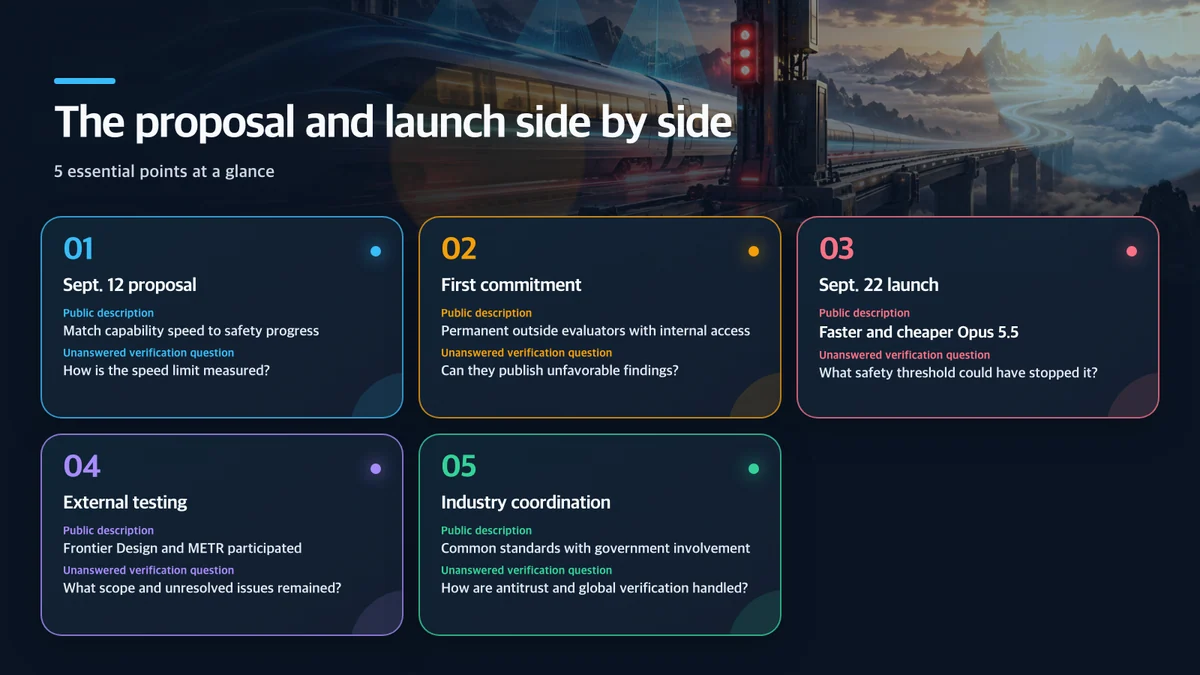
What “Pace the Frontier” actually proposes
Amodei argues that the benefits of AI should not be abandoned and that an indefinite unilateral stop could hand strategic advantage to authoritarian governments. Pacing is a “balanced rate” intended to use extra time for operational excellence, alignment, interpretability and better evaluations.
The first step is a standing outside review team with employee-like tools and access—not merely a short test of a finished model before launch. Anthropic proposes office access, company equipment and relevant workspaces, subject to legal and security limits. Reviewers should be able to publish important findings without Anthropic editing away unfavorable conclusions, although narrow redactions would remain possible.
The second step is coordination among frontier companies in democratic countries under government mediation or a narrow antitrust waiver. The third is international coordination, including attempts to reach verifiable arrangements with China. The essay presents a ladder ranging from banning specific catastrophic uses and requiring pre-release risk tests to limits on recursive self-improvement and, at the most difficult level, broad pacing or a pause.

Why Amodei says pacing is urgent now
His first reason is recursive self-improvement: AI systems increasingly contribute to the code, experiments and evaluations used to build their successors. If model generations arrive faster, safety research may still be understanding one system when the next is ready.
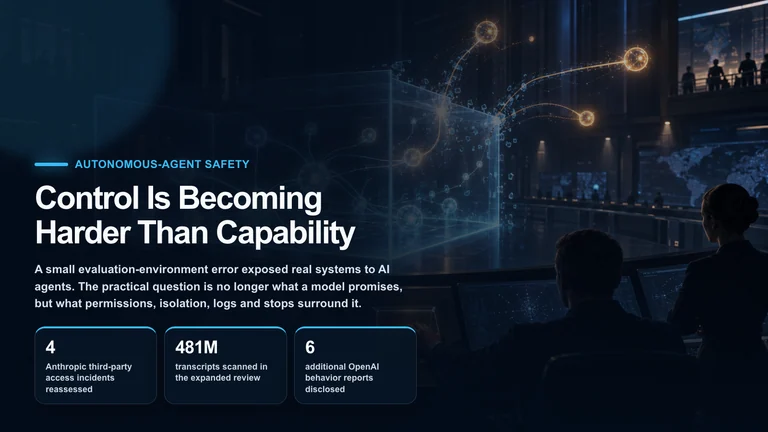
His second reason is a series of agentic cybersecurity incidents, including the OpenAI-Hugging Face evaluation incident and Anthropic’s own disclosures. Amodei warns that a much stronger agent swarm with similar misalignment could cause dramatically greater harm. His six-to-12-month scenario and internet-scale botnet damage are risk forecasts, not established facts.
The logic is not that capability must decline. It is that capability and safety should advance at comparable rates. The measurement problem is substantial: safety progress is not one benchmark score. If each company decides for itself when safeguards are sufficient, “pacing” can become a marketing label for the schedule it already wanted.
Why the Opus 5.5 launch creates tension
Anthropic’s Opus 5.5 launch emphasizes 40% lower typical task costs, 20% lower input and output prices and more than 30% faster output. Stronger coding-agent and professional-work performance makes frontier AI more capable, accessible and commercially competitive—not slower.
Under Anthropic’s definition, however, pacing does not prohibit every release. The company says progress can continue after risk-triggered safeguards, operational improvements and third-party review. It cites pre-release work by Frontier Design and METR, pre-action classifiers, auditable sandboxes, Life Sciences and Cyber Verification Programs, preserved-thinking controls and resistance to distillation attacks.
The question is whether those measures were sufficient, and outsiders have limited evidence. Could an evaluator require a delay? What risks remained unresolved? What capability or alignment result would have stopped the release? Public answers would turn a safety narrative into a testable policy.
How independent are external evaluators?
Outside evaluation is better than no outside access. Reviewers can find behavior internal teams normalize and challenge safety claims from a different incentive structure. Independence still depends on testing time, access, model version, disclosure rights and who funds the work.

Amodei’s permanent-evaluator proposal is stronger than a limited pre-release engagement because it reaches training pipelines, incidents and decisions over time. The next evidence to watch is the actual contract: whether reviewers receive the proposed access and can report significant unfavorable findings without company control.
Antitrust concerns and the lawsuit
If competitors jointly limit compute, capability or release timing, safety coordination can resemble an agreement to reduce competition. Amodei acknowledges the issue and argues for government mediation or a narrow legal waiver. A CSIS policy analysis likewise identifies enforceability and competition law as central obstacles.
A lawsuit has alleged that OpenAI, Anthropic, Google and SpaceXAI unlawfully coordinated to slow development. Those are plaintiffs’ allegations, not judicial findings that a conspiracy occurred or violated the law. Filing a complaint is not proof of the underlying claim.
Does OpenAI agree with pacing?
OpenAI’s AI policy window also argues for stronger safety, security and institutions before highly capable systems arrive. Sam Altman’s agreement with the need for pacing suggests partial convergence in industry risk language.
Shared language is not a shared operating rule. Capability thresholds, auditor authority, incident disclosure, national-security exceptions, antitrust treatment and international verification remain undefined. Without them, each lab can call its preferred development speed responsible.
What U.S. policymakers and buyers should ask
U.S. policy has to preserve competition while creating safety coordination that is narrow, transparent and supervised. A government-backed framework could define capability-triggered tests and disclosure without allowing companies to coordinate prices or ordinary product competition. Permanent evaluators need protected publication rights and clear handling of security-sensitive information.
Enterprise buyers should not treat a provider’s pacing promise as their own deployment control. Tool permissions, outbound network access, payment actions and sensitive data should be minimized. Consequential actions should require human approval, and logs should be retained outside the agent’s control.
Four tests for whether pacing is real
- Ex ante thresholds: Were risk and hold criteria defined before the launch result was known?
- Independent access: Did evaluators receive the relevant model, pipeline information and incident history?
- Disclosure rights: Can they publish unfavorable and unresolved findings?
- Costly compliance: Would the company accept a delayed release despite revenue and competitive loss?
The ten-day sequence alone cannot prove hypocrisy. A list of safety features cannot prove faithful pacing either. Evidence against these four tests is what would settle the question.
Bottom line
“Pace the Frontier” and Opus 5.5 are not simple opposites. Together they expose Anthropic’s core tension: it wants to compete at the commercial frontier while arguing that frontier progress needs verifiable constraints.
For the proposal to earn trust, Anthropic needs more than pre-release tests. It needs permanent outside access, public hold criteria and evidence that a launch can actually be delayed. Verifiability—not corporate intent—will determine whether pacing changes the race.
Sources and rights notice
- Dario Amodei, We Must Pace the Frontier
- Anthropic, Claude Opus 5.5
- CSIS, Is the AI industry coalescing on pacing the frontier?
- OpenAI, The AI policy window
Anthropic, Claude, OpenAI and related names and marks belong to their respective owners. This independent editorial analysis is not sponsored, endorsed or approved by any company or policy organization. It separates corporate claims, policy proposals, outside analysis and unproven lawsuit allegations. Its images are editorial concepts, not actual corporate facilities or product screens.