Was Claude Opus 5.5 Nerfed? What the Evidence Actually Shows

Within days of Claude Opus 5.5’s launch, posts on X, Reddit and GitHub claimed that the model no longer felt as capable as it did at release. Users described more corrections, missed instructions and behavior that resembled an older model. Those experiences matter, especially to developers who use Claude Code against the same repositories every day. They are not, by themselves, proof that Anthropic downgraded Opus 5.5.
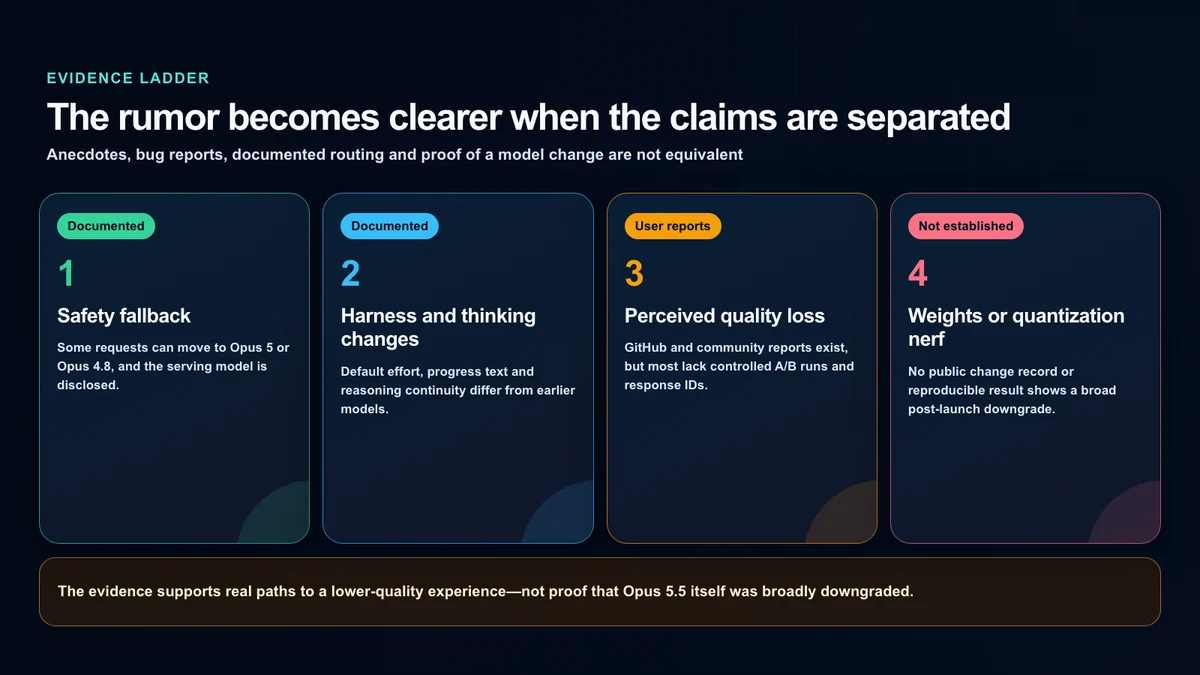
The evidence available as of September 27, 2026 supports a narrower conclusion. There is no public proof that Anthropic broadly reduced Opus 5.5’s weights, quantization quality or serving compute after launch. There are, however, documented ways to receive a lower-quality experience: automatic safety fallback to Opus 5 or Opus 4.8, a different default effort level, changes to thinking display and continuity, long-session context problems, and infrastructure faults. A useful fact check has to separate those mechanisms from a true model downgrade.
The short version
- X, Reddit and GitHub contain real degradation reports, but the public examples generally lack matched prompts, response IDs, serving-model logs and repeated A/B runs.
- Claude apps and Claude Code can automatically switch some Opus 5.5 requests to Opus 5 or Opus 4.8; memory, files, connectors and web results can trigger the classifier.
- Opus 5.5 defaults to
mediumeffort. Opus 5 defaulted tohigh, so an unspecified comparison does not hold reasoning effort constant.
“Nerf” is being used for three different claims
The strongest claim is that Anthropic silently changed model weights, used more aggressive quantization or reduced the compute allocated to Opus 5.5. Proving that requires stable snapshots or a controlled set of repeated tests with the same harness, settings and serving model. The public reports reviewed for this article do not meet that threshold.
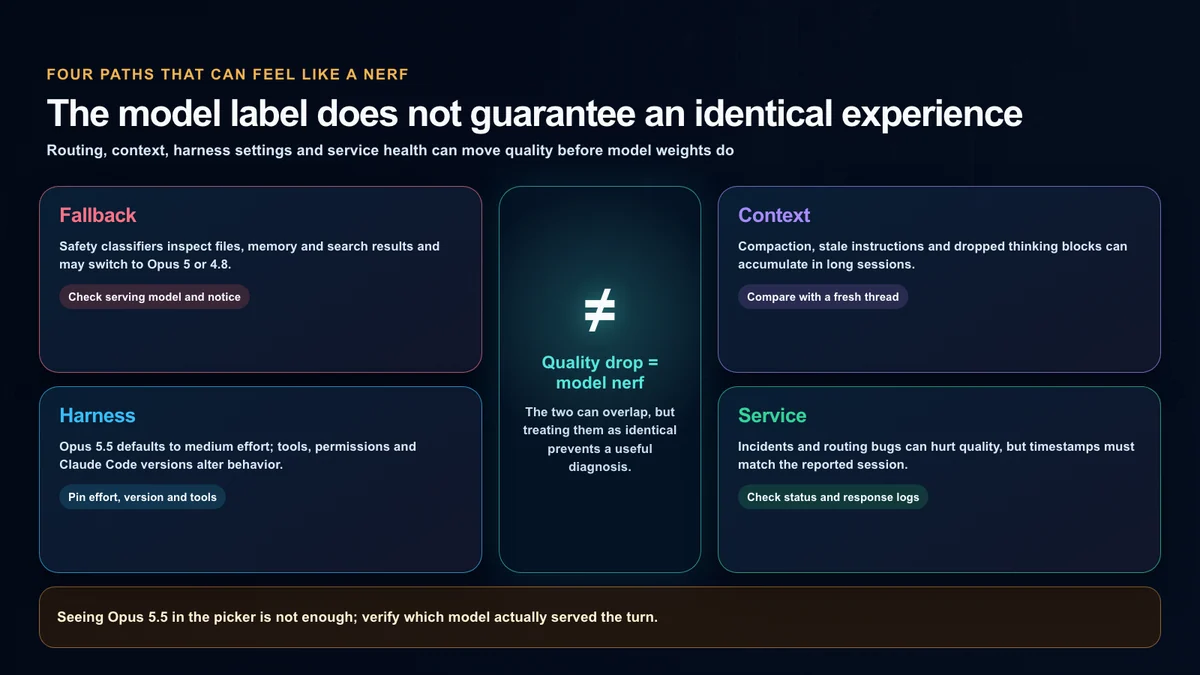
A second possibility is that the user selected Opus 5.5 but a different model served a particular request. Anthropic calls this fallback and documents when it can occur. A fallback response may feel weaker, but it is not evidence that Opus 5.5 itself was altered.
The third category covers everything around the model: default effort, Claude Code versions, permissions, tools, context compaction, memory, service incidents and routing bugs. Users see only the final response, so all three categories can feel like “the model got dumber.”
What X establishes—and what it does not
Anthropic announced Opus 5.5 on X on September 22. The post is a primary source for the launch and product availability, not evidence that serving quality stayed identical across every request after launch.
Early reactions also included strong praise, with one public post describing the model as substantially better than Opus 5. That captures launch-day sentiment but is not an independent benchmark. “Please do not nerf it” posts appeared almost immediately as well, showing that expectations formed partly from distrust created by earlier model experiences.
Timing and metadata matter. A post that says quality declined does not disclose the full conversation, model returned for the turn, effort level, Claude Code version or tool state. It can be a valid report of a bad experience without being a log of a server-side model change.
Reddit shows both the rumor and skepticism about it
The r/ClaudeCode thread “Opus 5.5 nerfed?” says the model initially felt excellent and then required repeated corrections. Replies pointed out that the post arrived extremely soon after launch and treated it as a recurring launch ritual or satire. The thread is useful precisely because it contains the claim and the immediate objection: one difficult session cannot establish a sustained regression.
A separate “please do not nerf” discussion shows the deeper concern. Some users expect every hosted model to degrade and proposed a daily benchmark to track Opus 5.5 over a month. That is a sensible direction, but at this stage it is a testing proposal rather than a completed result. The Hacker News launch discussion likewise mixes highly positive reports with predictions of a later nerf.
These sources explain why the rumor spread. They do not establish a weights change, and upvotes are not a quality measurement.
The GitHub issue is a report, not a controlled result
On September 23, a user filed Claude Code issue #96205, titled “Opus 5.5 performance degradation.” The report describes a sharp decline during one day on Windows using Claude Code 2.1.280. It carries bug, platform:windows and area:model labels.
This is a legitimate signal worth investigating. It could reflect a platform regression, fallback, a service problem or a model issue. But the issue does not include a reproducible prompt, paired outputs, response IDs, serving-model data, effort settings, token counts or repeated runs. Its error section is empty, and there is no controlled baseline. That means the issue is not proof that nothing happened, but it cannot support a system-wide nerf claim.
The strongest documented explanation is safety fallback
Anthropic’s model-switching help article says Opus 5 and 5.5 run automated safety classifiers on every request. The classifier checks more than the user’s latest message. It can inspect memory, connector content, web search results and files that Claude reads.
The documented outcomes include:
- Some higher-risk cybersecurity requests can fall back to Opus 4.8.
- Some dual-use biology requests involving areas such as virology, toxicology or molecular design can fall back to Opus 5.
- A narrow set of frontier-LLM development requests can fall back to Opus 5.
- Requests that attempt to extract internal reasoning can be blocked without fallback.
Automatic switching can be enabled by default across Claude web, mobile, desktop and Claude Code. Anthropic says the switch is disclosed with a notice and the response is labeled with the model that answered. After a fallback, the model picker can remain on the lower model. Selecting Opus 5.5 again may trigger the same fallback when the original flagged request remains in conversation history.
Users can disable Switch models when a message is flagged under the relevant capability or model settings. That prevents an automatic lower-model response, but the flagged request can stop instead. This is documented routing, not a hidden change to Opus 5.5 weights. Missing the notice can nevertheless make it feel exactly like a sudden nerf.
API customers can verify the serving model
The Claude API refusals and fallback documentation provides a more observable path. Automatic fallback is not the API default; developers opt in or implement a retry. When fallback is configured, three response fields matter:
- Top-level
modelidentifies the model that produced the returned message. - A
fallbackcontent block records the handoff between models. usage.iterationsrecords each attempt, including afallback_messageentry and per-model token use.
Only a safety-classifier refusal triggers this fallback. Rate limits, overload and server errors are returned as their own failures rather than silently invoking a lower model. After fallback, sticky routing can send later requests in the same conversation directly to the fallback model for approximately one hour. A later response may have no new fallback content block, so teams need to check both the returned model and usage.iterations.
The default effort changed from high to medium
Anthropic’s Opus 5.5 change guide states that the new model defaults to medium effort. Opus 5 defaulted to high. If a test omits the parameter for both models, it compares different reasoning settings.
Opus 5.5 uses adaptive thinking at all times; it cannot be disabled. Anthropic also says it tends to think more at a given effort, especially at xhigh and max. A tight max_tokens value can therefore leave less room for the final answer. Fair tests should set effort and output limits explicitly rather than carrying an old configuration forward.
The migration also changes forced tool use and computer-use tool compatibility. A team that only swaps the model ID can encounter errors or different tool behavior and interpret them as lower reasoning quality. Model, harness and settings have to be versioned together.
Thinking-display changes can look like a stalled or weaker agent
Opus 5.5 returns short progress notes between tool calls in thinking blocks rather than ordinary text blocks. Under the default display: "omitted" setting, an application can appear silent between tool calls even while work continues. A progress UI that used to show active narration may look stalled after migration without any model-quality change.
Thinking blocks are also tied to the model and conversation. When an Opus 5.5 conversation switches to most lower fallback models, the earlier thinking blocks may be dropped because the receiving model cannot read them. Anthropic’s API documentation identifies Fable 5.1 and Mythos 5.1 as exceptions that can preserve Opus 5.5 blocks. The request can still succeed, so the user may see no explicit error while plan continuity becomes weaker.
A report that the model “forgot its plan halfway through” should therefore check model switching, compaction and thinking continuity before attributing the result to changed weights.
A long-running thread is not the same test as a fresh one
An old Claude Code session can contain abandoned requirements, stale file paths, failed tool outputs, memories and compacted summaries. Selecting a new model does not make that accumulated state disappear. The visible prompt can be identical while the effective input is very different from a clean launch-day conversation.
For U.S. teams, the fastest diagnosis is to preserve the failing thread and rerun the same task in a fresh conversation. Pin the repository commit, Claude Code version, effort, tools and permissions. Record whether fallback is configured and whether the top-level API model matches the requested one. If only the long thread fails, that is a real reliability problem, but context and harness behavior become more likely causes than a global model downgrade.
Subscription users have less server-side telemetry than API customers. They should record the visible model label, switching notice, app or Claude Code version and whether the same prompt succeeds in a fresh conversation. Enterprise API teams should retain response IDs and routing fields subject to their data-retention policy.
Infrastructure has degraded Claude quality before
Anthropic’s 2025 postmortem of three quality incidents documents a context-window routing error, output corruption and a TPU compiler problem. Those infrastructure bugs intermittently reduced response quality even though the underlying model weights were not intentionally downgraded. Anthropic also acknowledged that its automated evaluations did not immediately capture what users were reporting.
The company said it does not lower model quality because of demand, time of day or server load. That is its official denial of deliberate demand-based nerfing. The same postmortem shows why the absence of a weights change does not guarantee an unaffected user experience: routing and serving defects can still reduce quality.
“No public proof of a nerf” and “no quality incident occurred” are different conclusions. Establishing the latter requires response IDs, region and platform data, status history and repeated test results.
How to run a meaningful 20–30 trial comparison
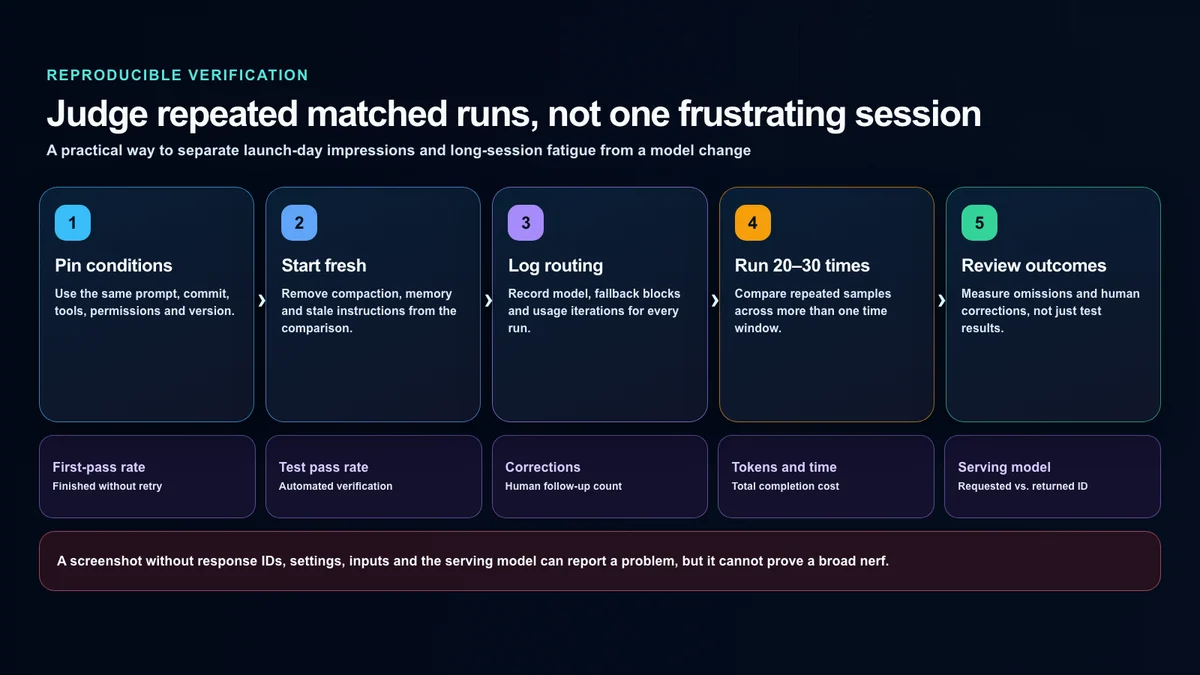
A single failed coding task or screenshot cannot separate sampling variance from a systemic change. A stronger test is feasible for individuals and teams:
- Select at least 10 tasks with known answers, tests or review criteria.
- Pin the prompt, repository commit, Claude Code version, tools and permissions.
- Use fresh conversations and specify effort and output limits.
- Record timestamp, response ID, requested model and serving model for each run.
- Run 20–30 matched trials across more than one time window.
- Compare first-pass success, tests passed, omissions, human corrections, tokens and completion time.
API users should retain the response model, fallback blocks and usage.iterations. They should also test with fallback disabled where policy allows, because that separates a refusal or routing decision from Opus 5.5 output. Consumer-app users cannot obtain the same telemetry, but fresh-thread comparisons and visible switch records still improve a report substantially.
Current verdict
The public record as of September 27 supports five findings:
- Documented: Some Opus 5.5 requests can fall back to Opus 5 or Opus 4.8 after a safety-classifier refusal.
- Documented: Opus 5.5 defaults to
mediumeffort, unlike Opus 5’shighdefault. - Documented: Thinking presentation and reasoning continuity across model switches changed.
- Documented: X, GitHub, Reddit and Hacker News contain degradation reports and anticipatory nerf concerns.
- Not established: Anthropic broadly reduced Opus 5.5 weights, quantization quality or serving compute after launch.
It is too strong to declare every complaint false, and equally too strong to call the model itself nerfed. Check the serving model and effort first, repeat the task in a clean thread, then gather matched trials. If a statistically consistent regression remains, a report with response IDs and pinned conditions would materially improve the evidence.
Sources and rights notice
- Anthropic, Claude Opus 5.5 launch announcement
- Anthropic Help Center, why Claude switched models with Opus 5 or 5.5
- Claude Platform, refusals and fallback
- Claude Platform, what’s new in Opus 5.5
- Anthropic, 2025 quality-incident postmortem
- GitHub, Claude Code issue #96205
- Reddit, Opus 5.5 nerfed?
- Reddit, Dear Anthropic please do not nerf
- Hacker News, Claude Opus 5.5 launch discussion
- Anthropic’s official Opus 5.5 launch post on X
Anthropic and Claude names and marks belong to their respective owners. Zoogom.com is an independent editorial site and is not sponsored, endorsed or approved by Anthropic. This article distinguishes official documentation from single-user reports and community sentiment. It does not reproduce X screenshots, official charts or third-party photographs.