Gemini 4 Argon Features Pricing and Access Guide
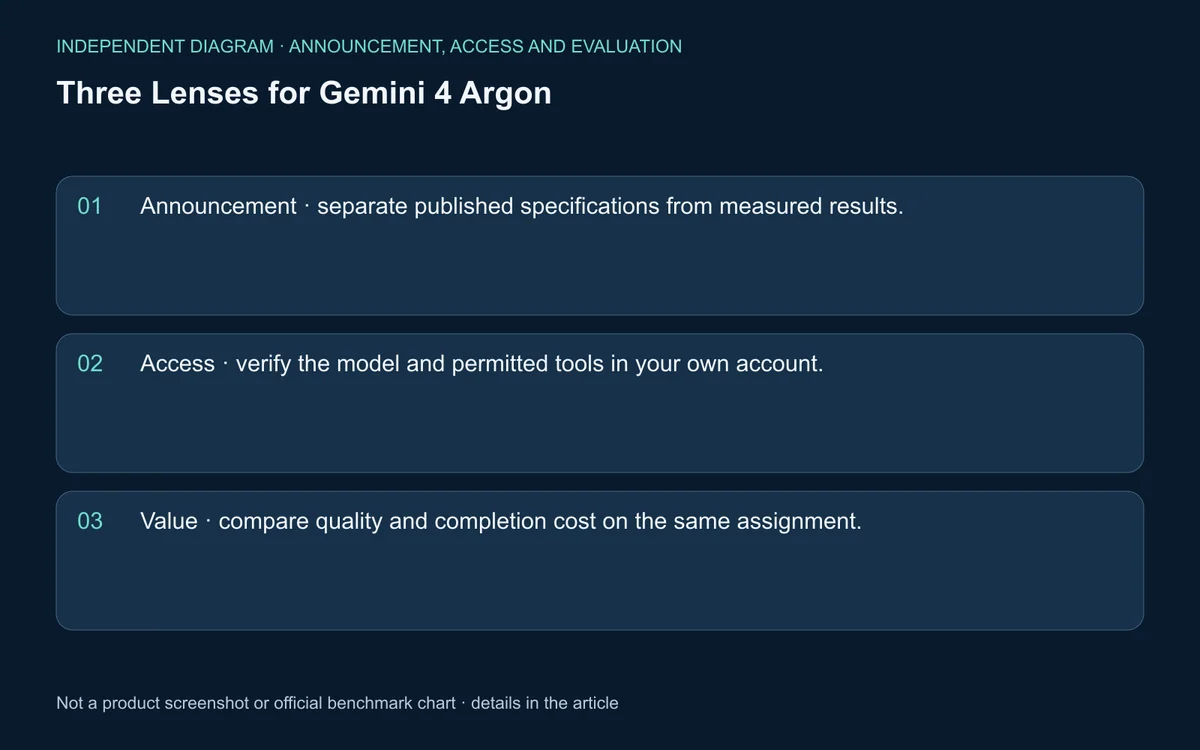
A useful introduction to Gemini 4 has to answer two questions: what does the model aim to do, and what can a reader actually access? Gemini 4 Argon is a candidate for demanding, extended assignments. An announcement alone does not establish availability in your account.
This guide uses official Google and Google DeepMind material checked on October 1, 2026. The workflow examples and evaluation approach below are our proposals, not results from hands-on testing.
What Gemini 4 Argon is meant to do
Google announced Argon on September 30. Google DeepMind’s model page highlights extended software work, professional document tasks and defensive security.
For a team evaluating it, the interesting question is continuity: can a system carry a requirement from reading the source material through planning, implementation and checking the result? A polished first answer is only part of that assignment. This is why we would evaluate longer jobs separately from short conversations.
Model capability is also different from a complete working system. Repository access, document permissions, an execution environment and human approval still need to be designed. Greater capability is not a reason to automatically widen permissions.
The million-token figure concerns output
The announcement specifies a one-million-token output ceiling. It should not be presented as the input context size or a target for every response.
More output room does not remove the need for readable deliverables. One experiment is to request conclusions, evidence locations, unresolved questions and follow-up work as separate parts. If a lengthy deliverable is necessary, define checkpoints and a condition for stopping.
The available serving route’s input restrictions, reasoning accounting and time limits require their own documentation. A headline maximum is not a specification for every product built around the model.
Reading coding scores without promising a winner
Google DeepMind’s published results put Argon at 77.9% on DeepSWE v1.1 and 55.0% on FrontierSWE v2. These are provider-reported figures, not experiments repeated by this publication.
The gap between those scores is not itself a measure of a quality drop. Different tests can use different assignments and success criteria. Before treating a percentage as relevant, establish what the evaluation measures.
On your codebase, check whether a change resolves the issue, preserves existing tests, stays within the requested scope and avoids creating a new security problem. A comparison with GPT or Claude should use the same repository, instructions and acceptance conditions. This is a proposed evaluation method, not a claim that we have established a model ranking.
Announced pricing and the cost of finishing
The announced introductory rates are $2 for a million input tokens and $10 for a million output tokens. The footnote gives subsequent rates of $4 and $20 respectively. This article does not fix a general API release date or the end of the introductory period.
As a hypothetical calculation, 100,000 input tokens and 10,000 output tokens without caching would cost $0.30 at the introductory rates or $0.60 at the subsequent rates. Those totals apply only the announced token rates. They are not actual invoices and exclude tools, storage, additional processing, taxes and account-specific conditions.
The more useful comparison is the cost of completing an accepted assignment. Record retries, failed runs and human correction time as well as token consumption. An inexpensive first response need not produce an inexpensive finished result. Treat an API rate and a consumer subscription allowance as separate questions.
Phased access is not universal availability
The Fairwind Program manages Argon access for approved partners. That route is different from unrestricted access by an ordinary user.
Do not infer that every account in the United States, Korea or Japan can select Argon under the same subscription. Plans to broaden access and the options available in your own account must be checked separately. Revisit the actual model selection and API information before making a deployment decision.
For defensive security work, record authorization as well as purpose. Limit an evaluation to systems you control or have explicit permission to test. Keep execution privileges and the recipients of findings narrow; a model’s judgment does not replace approval to inspect or change a live service.
An evaluation for US teams
A useful US-oriented pilot might combine a support case, an engineering change and an internal business document. Use synthetic or redacted records first, then check whether dates, dollar amounts, units and named parties survive the complete workflow.
For document work, ask the reviewer to distinguish a statement in the source from a proposed action. For software, verify that the system preserves identifiers rather than making an apparently helpful but incompatible change. These are practical test suggestions, not claims about US account availability or compliance with a particular law.
A bounded pilot before adoption
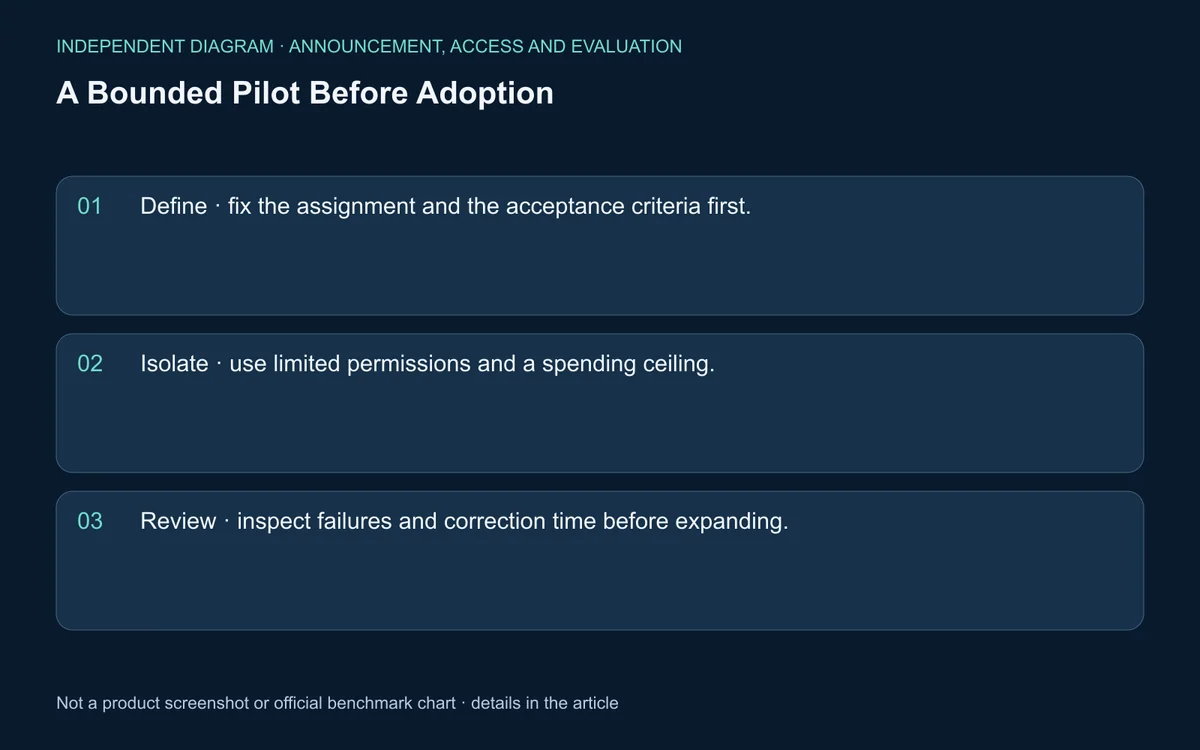
We propose starting with a small, controlled evaluation.
- Select 12 representative assignments and fix acceptance criteria, prohibited actions and spending ceilings.
- Compare identical inputs in a read-oriented or isolated environment with the model already in use.
- Inspect accuracy, total usage, elapsed time and human corrections before expanding permissions.
Twelve is an illustrative sample size, not a Google benchmark population. Keep the criteria fixed while reviewing results, and retain failures for future version comparisons. That makes the decision less dependent on expectations attached to a model name.
Gemini 4 Argon deserves evaluation, but specifications alone do not settle adoption. The decision is whether it can finish the work you need, whether the result is verifiable, and whether access and completion cost fit your operation.
Sources and editorial note
This is an independent explanation, not a Google or Google DeepMind endorsement. Minimal verified facts are separated from our analysis, hypothetical calculations and test proposals. We have not translated the complete source article or used direct quotations. The diagrams are explanatory concepts, not product screenshots or official benchmark charts.
Sources: Google announcement · Google DeepMind model page · Fairwind Program