Gemini 4 Rollout Rumors: October Claims vs. Confirmed Access
When can you actually use Gemini 4? The evidence supports a narrower answer than the release chatter suggests: the model has been announced and initial limited access has begun, but a public release date remains unconfirmed. October predictions are a separate category.
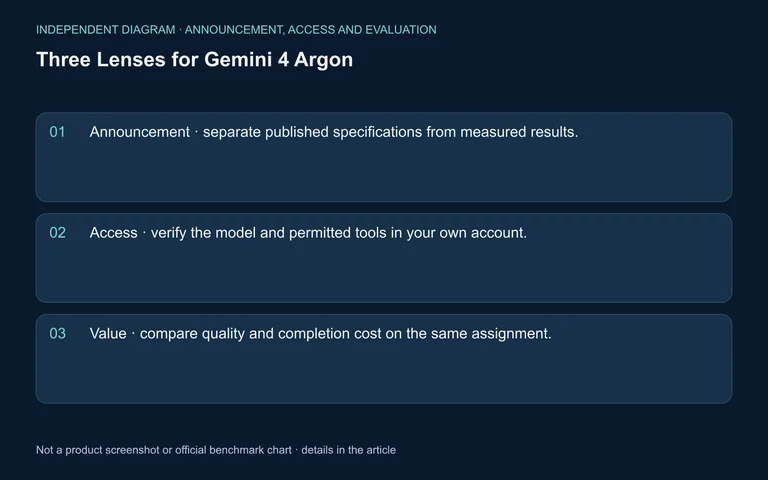
This article compares 10 key X posts with Google’s announcement, checked on October 1, 2026 KST. Start with three mobile-friendly visuals, then read the original posts below to see the context behind each claim.
The 30-second version
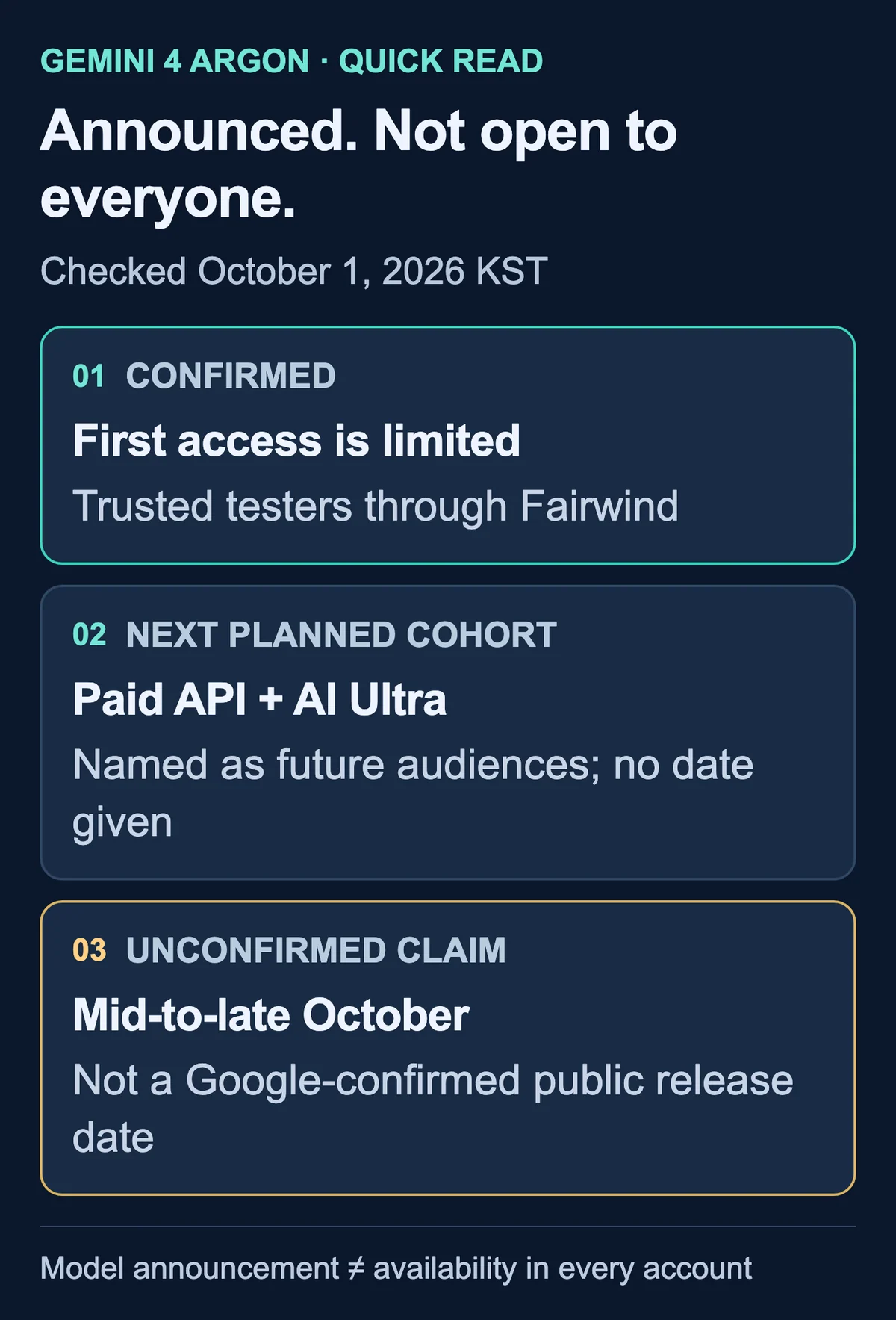
- Confirmed now: an initial trusted-tester cohort through Fairwind.
- Planned next: Google AI Ultra subscribers and customers using the paid API are the first intended groups for broader access.
- Still undated: that expansion and access for the general public.
Google’s official announcement describes gathering feedback and iterating before widening access. Naming AI Ultra as a future audience does not establish that every Ultra subscriber can use the model today.
The cover is a conceptual illustration of uncertainty and access stages. It is not a Google product screen or an actual launch calendar.
The comparison: a prediction is not a rollout notice
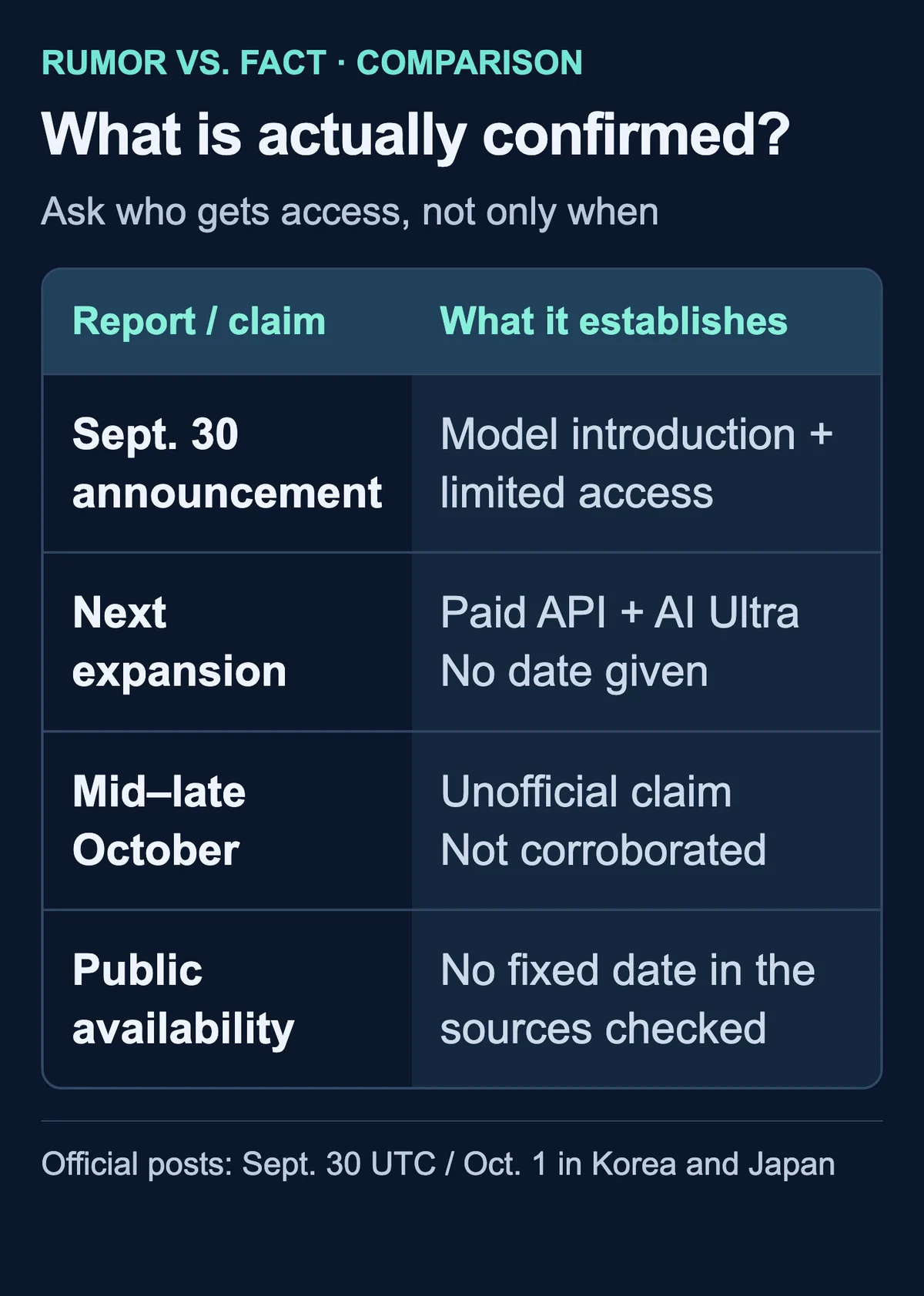
The October narrative contains several different claims. A September 5 forecast pointed to the following month. A September 12 post allowed both October and late September. A September 28 post then claimed a mid-to-late October target.
The September 12 and September 28 posts came from the same author. They are not two independent confirmations. Nor does a late-September announcement validate a forecast about access for ordinary users.
A useful release claim needs an audience and an access route as well as a date. Announcement, restricted testing, paid-account expansion and free consumer availability may be separate milestones.
The timeline: what changed, and what did not
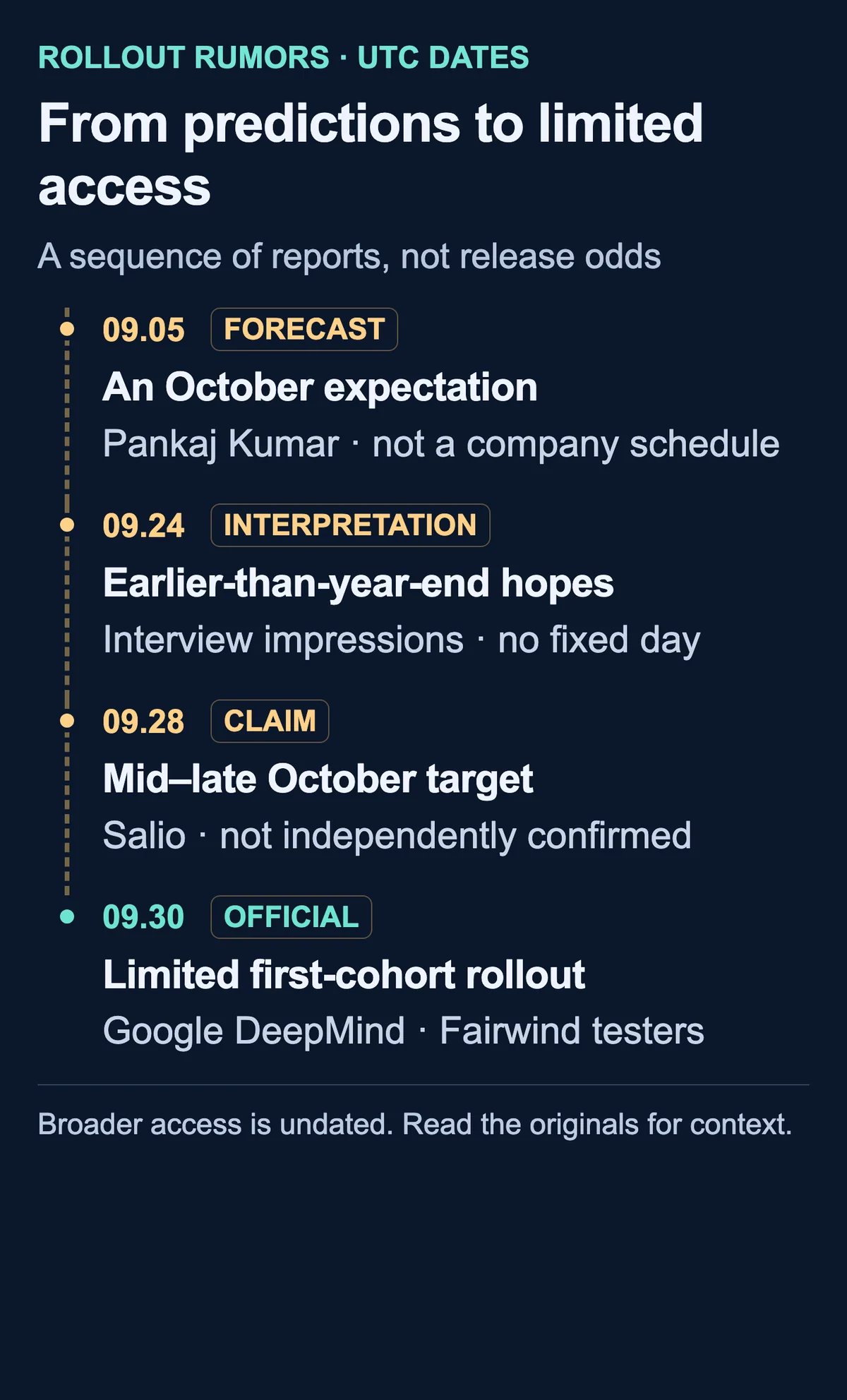
The timeline selects four major developments; the original-source section includes all 10 posts. It charts the sequence of reports, not prediction accuracy or a numerical chance of release.
X dates below use UTC. Google DeepMind posted at 20:03 UTC on September 30, corresponding to 05:03 on October 1 in Korea and Japan. Those different calendar dates do not establish separate national rollouts. For US readers, the UTC timestamp is a reference point, not a promise of simultaneous access across time zones.
Official originals: the audience matters
Google DeepMind · September 30 UTC · initial access
The important detail is the first cohort: trusted testers through Fairwind. This is evidence of an initial restricted rollout, not a notice that all application and API accounts are eligible.
Google · September 30 UTC · model introduction
Google’s post establishes the announcement. It does not, by itself, establish your region, subscription eligibility or API permissions. Read it alongside the DeepMind post and the official article for the access boundaries.
Arena · September 30 UTC · evaluation-platform announcement
Arena introduced Argon in its own evaluation results. That is not the same event as Google granting general access in its application or API. This article does not reproduce leaderboard scores or present the attached material as an independently verified benchmark review.
Rumor originals: where the dates came from
Pankaj Kumar · September 5 UTC · an October forecast
The post describes an alleged internal checkpoint and expects public access the following month. A checkpoint is a saved development state. A claim about one does not establish the company’s service-release schedule.
Salio · September 12 UTC · two possible windows
The post mentions October and possible late-September timing. A forecast with alternative windows is not an official notice fixing the audience and date. Its other performance and development claims are not treated here as verified facts.
Lentils · September 14 UTC · an alleged checkpoint
Material described as internal model results does not confirm a public rollout day. The provenance of an alleged checkpoint and the date of consumer availability are separate questions. This article does not authenticate leaked specifications or videos.
Captain Insight · September 23 UTC · the limit of the date evidence
The text checked for this post discusses alleged demonstrations. It does not state an October 1 rollout date. If this link is offered as proof of a specific day, check whether the linked text actually supplies that day.
This is a finding about the verified text, not a claim that every attached video, reply or edit contains no date. Those materials were not comprehensively authenticated.
Jessica Lessin · September 24 UTC · interview impressions
The post shares interview notes and the author’s sense of a release before year-end, including an interpretation of the interviewee’s body language. An interviewer’s reading is useful context, but it is not a dated company commitment.
kimmonismus · September 24 UTC · near-term expectations
This post circulates expectations of a release earlier than year-end, drawing on interview reporting. Retelling the same story does not independently confirm a particular launch day. A shorter summary can spread further without adding evidence.
Salio · September 28 UTC · the mid-to-late October claim
The author claims a target in the middle or latter part of October. This research did not independently authenticate internal material establishing that target. It remains something to watch, not a confirmed basis for a subscription purchase or migration deadline.
What US users should check next
To determine whether you can use the model, check that official eligibility includes your region and tier, and that your application or API route actually lets your account select and request it. An undated plan to start with AI Ultra does not establish current access or justify upgrading solely for this model.
A later official notice specifying the audience, region, route and date would resolve the open questions. Until then, the defensible summary is limited first access confirmed; mid-to-late October unconfirmed; public release date undated.
Original display and research scope
This is independent analysis of 10 publicly discovered X posts and one official announcement, not an exhaustive X archive or a reconstruction of private or deleted material. Official X embed information was compared with a public full-text mirror. Attached media and claimed insider status were not comprehensively authenticated.
Original posts are displayed through X’s live embedding service. The article does not reproduce their text and media as standalone screenshots or full translations. Network restrictions or a change in a post’s public availability may prevent display; the original link remains the alternative. An author’s claim is distinct from this article’s assessment. The article does not imply sponsorship or approval by Google, X or the people whose posts are shown.