Why Skilled Trades Are Gaining Appeal in the AI Era
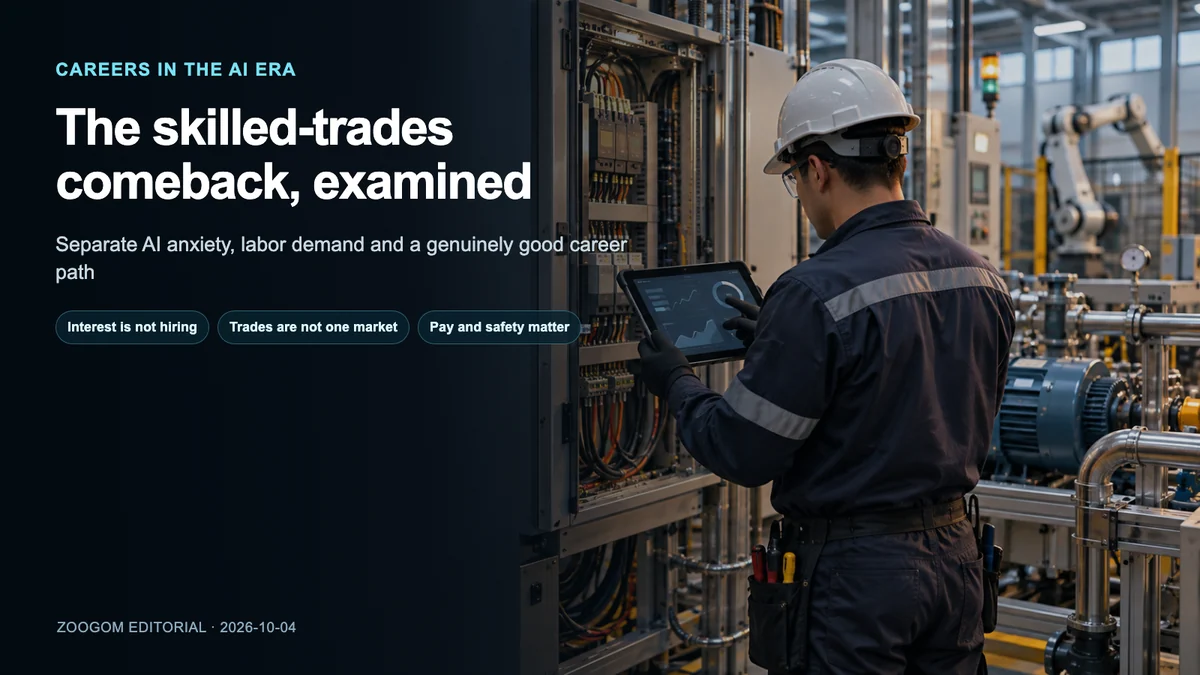
The career story of the AI boom has acquired a surprising second act. As generative systems write reports, summarize research and produce software, electricians, industrial mechanics, HVAC technicians, welders and other skilled field workers look newly resilient. Young people are asking whether a paid apprenticeship might be a better risk than a large college bill and an entry-level office job whose tasks are rapidly changing.
There is a real shift worth examining, but “AI is making blue-collar work popular” is too neat. An attitude survey is not an enrollment count. Enrollment is not a completed credential. A projection of openings is not a starting wage, and a labor shortage is not proof of a good job. This guide separates those signals, compares actual US occupations and shows how to test a career path before investing time or money.
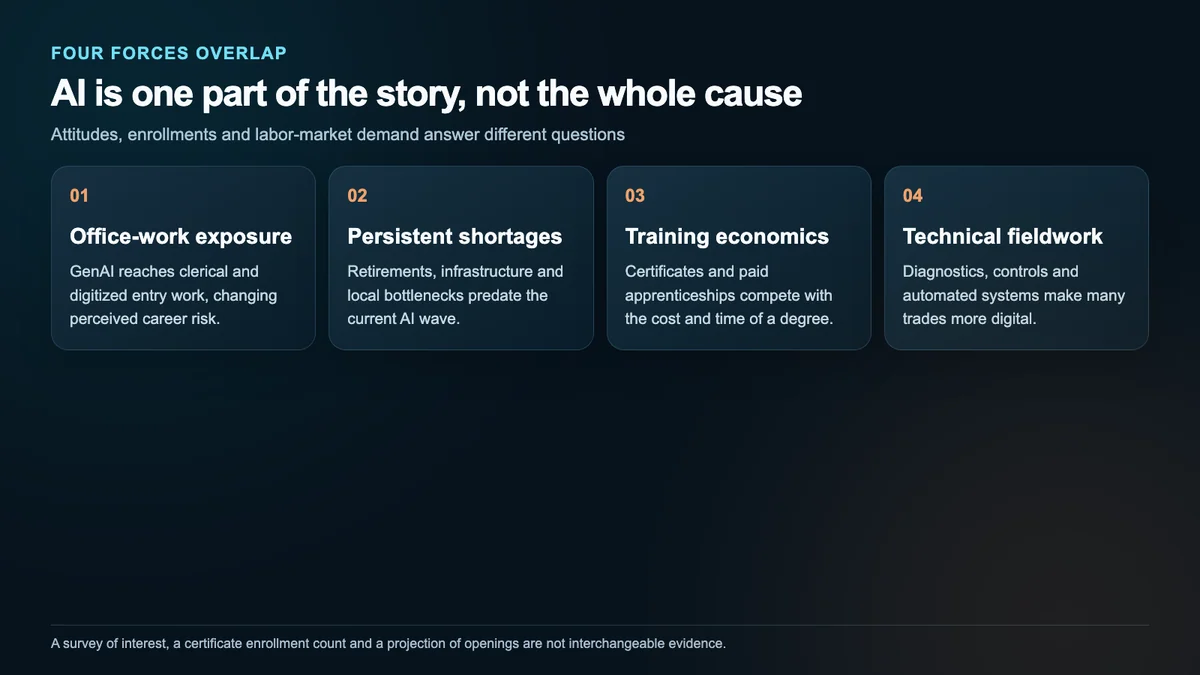
The short answer is that four forces overlap
AI anxiety is one force. Persistent shortages caused by retirements, infrastructure needs and local training bottlenecks are another. The economics of education have made shorter credentials and earn-while-you-learn routes more visible. At the same time, many trades have become more technical as buildings, factories and energy systems add sensors, controls and software.
Those forces did not begin together. The retirement problem and the difficulty of staffing construction and maintenance long predate the latest chatbots. Generative AI acts partly as an attention shock: it changes which career risks feel immediate, even before it changes the number of jobs. Treating it as the sole cause obscures what employers and training providers still have to fix.
AI exposure does not equal job elimination
The International Labour Organization’s 2025 refined exposure index estimates that one in four workers worldwide holds an occupation with some exposure to generative AI, while 3.3% fall in the highest exposure category. Clerical occupations remain the most exposed. The more likely broad outcome in the analysis is transformation of work, not a clean replacement of whole jobs.
Exposure means that a model can perform or assist with some tasks associated with an occupation. It does not incorporate every reason an employer keeps a person: legal responsibility, physical access, customer trust, workflow redesign, error cost and the pace of adoption. A job can be highly exposed and still grow. A job can have low GenAI exposure and still be changed by conventional automation, robotics or offshoring.
Why field work looks comparatively durable
Cross-country research finds substantial AI-task overlap in high-skill white-collar occupations, while jobs built around manual strength tend to have less direct exposure. Digital information is easier to copy into a model than a crowded mechanical room, an old house with undocumented wiring or a production line that fails differently each time.
The advantage is not simply “working with your hands.” The durable part is situated judgment: diagnosing an unfamiliar system, moving safely through a changing environment, coordinating with other crews and accepting responsibility for a physical result. Routine physical work in a controlled setting may be easier to automate than a desk job that involves negotiation, accountability or complex human relationships.
Worker anxiety helps explain the new attention
Pew Research Center’s 2025 survey of US workers found 52% worried about future workplace AI use and 32% expecting it to reduce their job opportunities. Younger workers were more likely to feel overwhelmed. Those responses help explain why a visibly physical occupation can feel like a hedge.
They do not show that those workers enrolled in a trade program, accepted a field job or stayed in it. General anxiety can redirect web searches and conversations long before it changes employment. The safest claim is that AI has altered perceived risk; the magnitude of actual career switching must be measured separately.
A commercial Gen Z survey is a signal, not a verdict
A 2026 Thumbtack-commissioned survey reported that nearly half of respondents ages 16 to 30 were learning a trade or seriously considering one, and 30% said AI made them more interested. The Pollfish study covered 1,000 US respondents on July 20–21, reported a 3.1-point margin of error and did not apply post-stratification weighting.
This is useful evidence of attitudes, with important boundaries. Thumbtack is a company with a commercial interest in local services. “Considering” covers a wide range of commitment, and an online survey does not verify applications, completions or employment. It supports the claim that the idea has cultural momentum, not that half of Gen Z is about to enter the trades.
Enrollment data show behavior, but not the reason
The National Student Clearinghouse Research Center’s spring 2025 update found enrollment at public two-year institutions with a vocational focus up 11.7% year over year and nearly 20% above spring 2020, reaching about 871,000 students. Undergraduate certificate enrollment rose 4.8% from the previous spring and stood 20% above 2020.
That is stronger behavioral evidence than a preference poll. It still does not isolate AI as the cause, and a certificate category includes more than construction and mechanical trades. Labor demand, pandemic disruption, tuition, program availability and individual circumstances all matter. Enrollment also precedes completion, placement, pay and retention.
The trades are not one labor market
“Skilled trades” is a useful umbrella for talking about training outside a conventional four-year degree, but it is a poor forecasting unit. Licensing, capital investment, geographic demand, union density, physical risk and the share of repair versus new construction differ sharply.
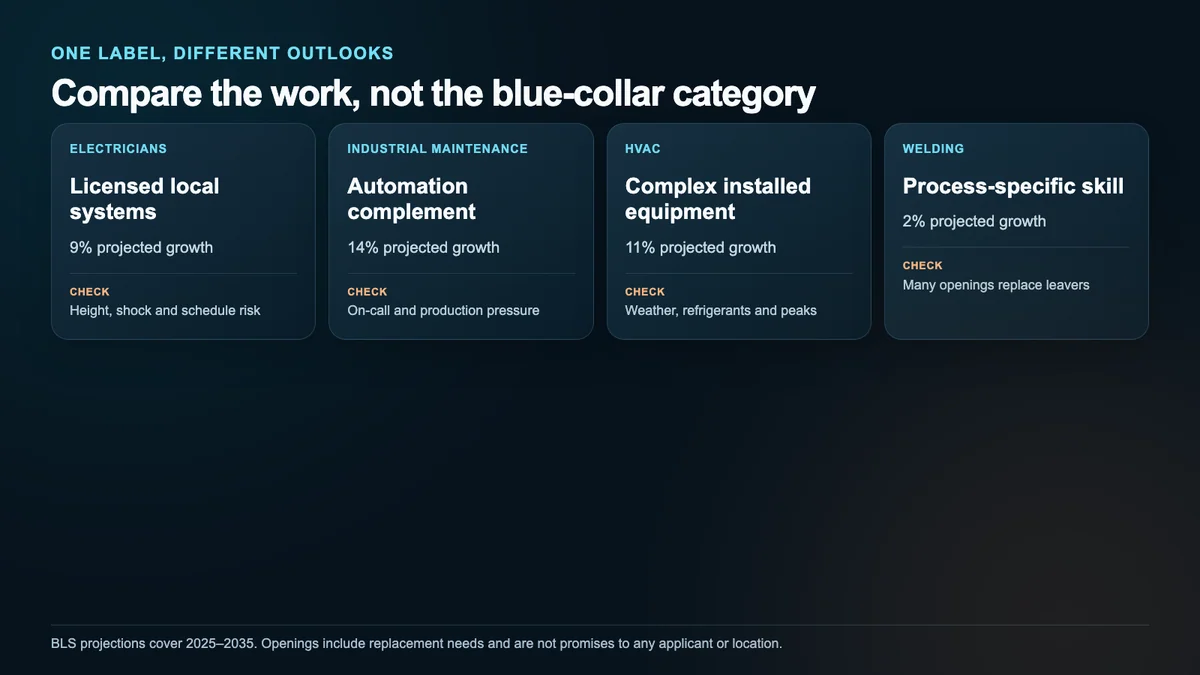
Four examples make the variation clear:
- Electrical work combines local installation, code compliance, troubleshooting and a credential ladder.
- Industrial maintenance grows with complex production equipment, even as predictive maintenance changes the task mix.
- HVAC depends on installed buildings, weather, refrigerant rules and increasingly sophisticated controls.
- Welding ranges from highly customized certified work to repetitive production tasks that are easier to robotize.
A headline about a “trade shortage” should never substitute for an occupation and location.
Electricians combine local work with a credential path
The Bureau of Labor Statistics electrician profile reports median annual pay of $63,190 in May 2025, projected employment growth of 9% from 2025 to 2035 and about 72,700 openings per year on average. Many openings reflect replacement as well as growth. Training commonly involves an apprenticeship, and licensing requirements vary by state and locality.
Electrical systems are not immune to technology. Prefabrication, better design software and automated testing can reduce some hours. Electrification, renewable-energy connections, data centers and aging installed systems can add others. The durable advantage is not that wires defeat AI; it is the combination of regulated work, physical installation and accountable diagnosis.
Industrial maintenance can grow with automation
The BLS outlook for industrial machinery mechanics, maintenance workers and millwrights lists 2025 median pay of $64,100, projected growth of 14% through 2035 and roughly 51,900 openings each year. The agency specifically connects demand to the need to keep increasingly automated manufacturing equipment operating.
This is the clearest example of automation creating complementary work. Robots, conveyors, sensors and control systems increase the cost of downtime and the value of fast diagnosis. Predictive systems may prevent some failures and reduce routine checks, so the technician who can interpret data, align equipment and repair electrical and mechanical causes has a stronger position than someone limited to one repetitive task.
HVAC demand comes with conditions and seasonality
The BLS profile for heating, air-conditioning and refrigeration mechanics and installers shows median annual pay of $61,010 in 2025, 11% projected growth and about 40,600 openings per year through 2035. More sophisticated climate-control systems and construction activity contribute to demand.
The occupation can also involve outdoor heat, cramped spaces, peak-season overtime, on-call service and handling regulated refrigerants. Controls and connected equipment add digital work, but employers differ in whether they pay for that training. A national median says little about a first-year helper’s wage in a specific metro area.
Welding shows why not every trade is booming
The BLS welding outlook gives 2025 median pay of $53,750 and only 2% projected growth through 2035, despite about 40,300 annual openings. Many of those openings are expected because workers leave the occupation or labor force, not because the occupation is rapidly expanding.
Process, material, certification and industry matter. A pipe welder working on variable field joints occupies a different market from an operator feeding standardized parts into a production cell. Robot programming, setup, inspection and rework can become higher-leverage tasks, while repetitive beads face more automation pressure.
AI and robots change field jobs from the inside
A technician can use AI to summarize service histories, search a long manual, draft a customer explanation or prioritize a parts list. Computer vision can flag defects or missing protective equipment. Predictive models rank machines for inspection. Robots handle repeatable welding, lifting and inspection paths.
The human role moves toward verification and exceptions. A sensor may be wrong, a suggested procedure may not match the machine revision and a safe shutdown may conflict with production pressure. Someone must decide whether the equipment can run, lock it out when it cannot and explain the decision. That combination of digital fluency, physical skill and authority is more defensible than simply being outside an office.
Technology can improve or degrade job quality
Research on AI and job quality describes potential benefits such as removing dangerous or tedious tasks, while also examining work intensification, monitoring and reduced autonomy. The same wearable that warns about a hazardous zone can become a tool for tracking every pause.
Ask how workers participate in deployment. Who validates a false alarm? Can a person override the schedule when safety requires it? What data are collected and how long are they kept? Does time saved by automation create training and recovery time, or merely a faster quota? A “smart factory” label does not answer those questions.
Safety remains the hardest counterweight
The BLS Census of Fatal Occupational Injuries chart for 2024 recorded 1,032 fatal injuries in construction and extraction occupations, a rate of 12.6 per 100,000 full-time equivalent workers. Installation, maintenance and repair occupations recorded 437 and a rate of 8.9. The comparable rate for professional and related occupations was 0.6.
Broad occupational categories do not describe every employer, but the contrast is too large to hide behind career enthusiasm. Ask about recent incidents, fall protection, lockout procedures, heat plans, vehicle exposure, reporting rights and whether a new worker can stop a job without retaliation. Lower GenAI exposure does not compensate for preventable injury.
A paid apprenticeship can change the education equation
The federal Registered Apprenticeship career-seeker guide describes a structured route with a paid job, wage increases, workplace mentorship, classroom instruction and a portable, nationally recognized credential. That combination can reduce the opportunity cost of training compared with paying tuition while out of the labor force.
The label still needs inspection. Verify that the program is registered, who employs the apprentice, the starting wage, guaranteed progression, related-instruction cost, tool expenses, completion rate and what happens during a layoff. An apprenticeship is most valuable when the training and credential remain useful beyond one supervisor or contractor.
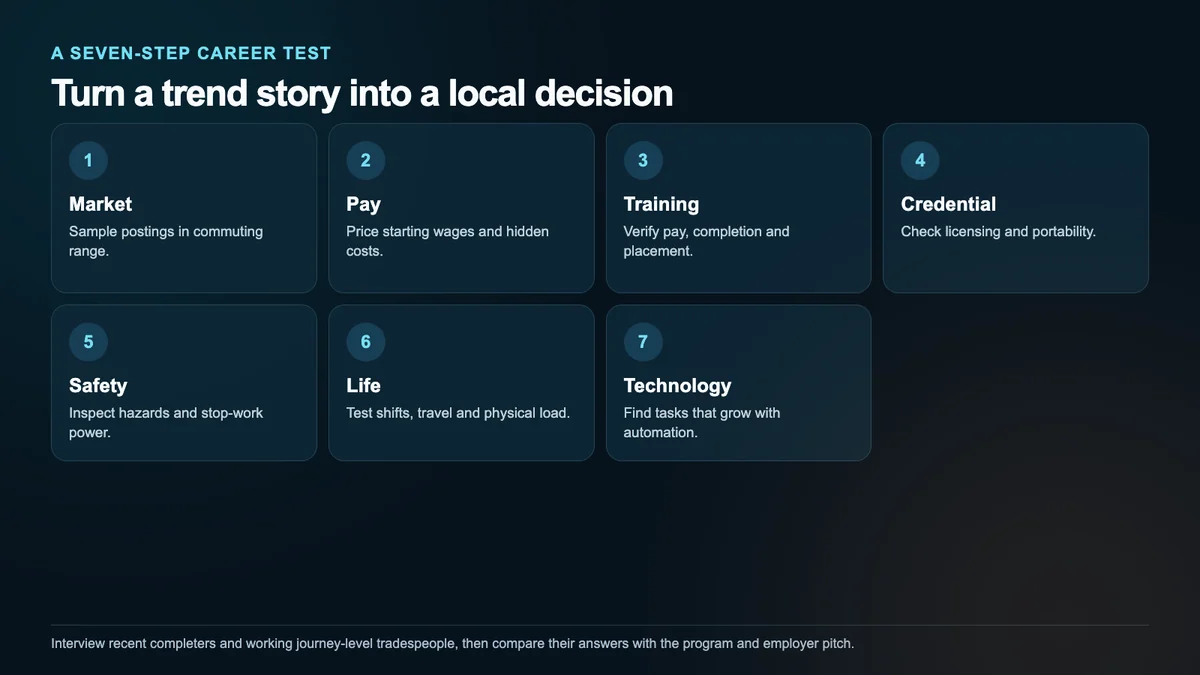
Run a seven-step local career test
Before enrolling, turn the national story into a local dataset.
- Collect 30 to 50 postings within a commute you can sustain.
- Separate entry pay from journey-level pay, overtime and per diem.
- Price tuition, tools, transportation and income during training.
- Verify which licenses or certifications are legally required and portable.
- Ask about the dominant hazards, recent incidents and stop-work authority.
- Test the lifestyle: shifts, travel, weather, confined spaces and physical load.
- Identify the path from repetitive work into diagnostics, controls, estimating, supervision or instruction.
Talk with recent graduates, workers three years into the job and experienced journey-level people. Ask employers and the training program the same questions. Differences between their answers are information, not an inconvenience.
Starting pay matters more than a national headline
Marketing often blends a senior worker’s base wage, heavy overtime, hazard premiums and self-employment revenue into one impressive number. Build a first-year budget instead. Include unpaid travel, seasonal slowdowns, union dues, boots, tools, certification renewals and the possibility that overtime is available only when the schedule is least convenient.
Then map progression. What specific competency or license moves pay after one, three and five years? Are increases contractual, discretionary or dependent on changing employers? Benefits, health coverage, retirement contributions, paid leave and predictable scheduling belong in the comparison. A lower hourly offer with paid training and a clear ladder can outperform a higher number with unstable hours.
The best hedge is a stack of transferable skills
The strongest path combines a physical domain with skills that travel: blueprint reading, measurement, electrical safety, controls, documentation, basic data analysis and clear communication. It also gives the worker a route from execution to diagnosis and from diagnosis to planning or leadership.
Avoid framing the decision as college versus trades for everyone. Some technical careers benefit from an associate or bachelor’s degree; some degree holders later add a license; some apprentices eventually manage projects or own firms. The useful question is which sequence produces a durable skill stack with the least avoidable debt and the best fit for the person.
Who may thrive and who may not
Skilled field work may fit someone who likes observable problems, repeated safety discipline, tangible results and learning by doing. It still requires reading, math, digital systems, documentation and customer communication. Choosing it because you “hate school” can be a costly misunderstanding; the learning continues throughout the career.
It may be a poor fit for someone whose health makes sustained physical exposure risky or who needs fully remote work and a highly predictable schedule. A ride-along, job shadow or short pre-apprenticeship can reveal more than a viral salary video. Fit is a combination of the body, the household schedule, the local market and the employer—not a personality slogan.
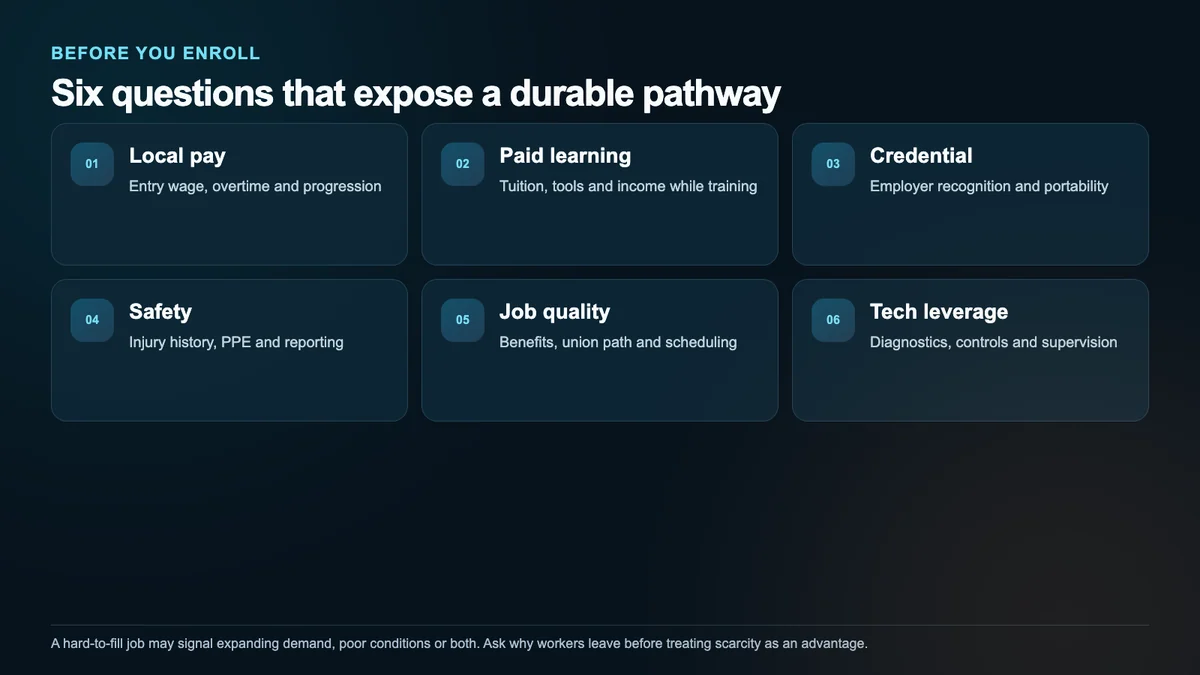
Six questions to answer before committing
- Local pay: What do true beginners earn, and what hours are required to reach the advertised number?
- Paid learning: Who covers tuition, tools and the income gap during training?
- Credential value: Does the license or certificate travel across employers and states?
- Safety: What incidents recur, and can any worker stop unsafe work?
- Job quality: What are the benefits, union pathway, scheduling and layoff history?
- Technology leverage: Can the role progress into diagnostics, controls, quality, estimating or supervision?
The comeback is real only if the jobs improve
AI has made an old imbalance easier to see. Some digitized entry-level office tasks are changing quickly, while society still needs people who can install, maintain and repair physical systems. Training data, job projections and public conversation all provide pieces of a renewed skilled-trades story.
Yet scarcity alone is not a career benefit. A job can be hard to fill because demand is expanding, because experienced workers are retiring, because conditions drive people away or because all three are true. The durable opportunity is not any job that AI cannot currently do. It is a path that converts technical change into better skill, bargaining power, safe work and a life a person can sustain.