What the White House order renaming AI to SI actually changes
Executive Order 14434 was signed September 29 2026 and appeared in the Federal Register on October 2. It directs executive departments and agencies to use Super Intelligence and SI in future non-statutory communications. This guide separates confirmed events, attributed claims, technical limits, and the evidence still needed for a practical decision.
The short answer: the terminology changed, not the technology
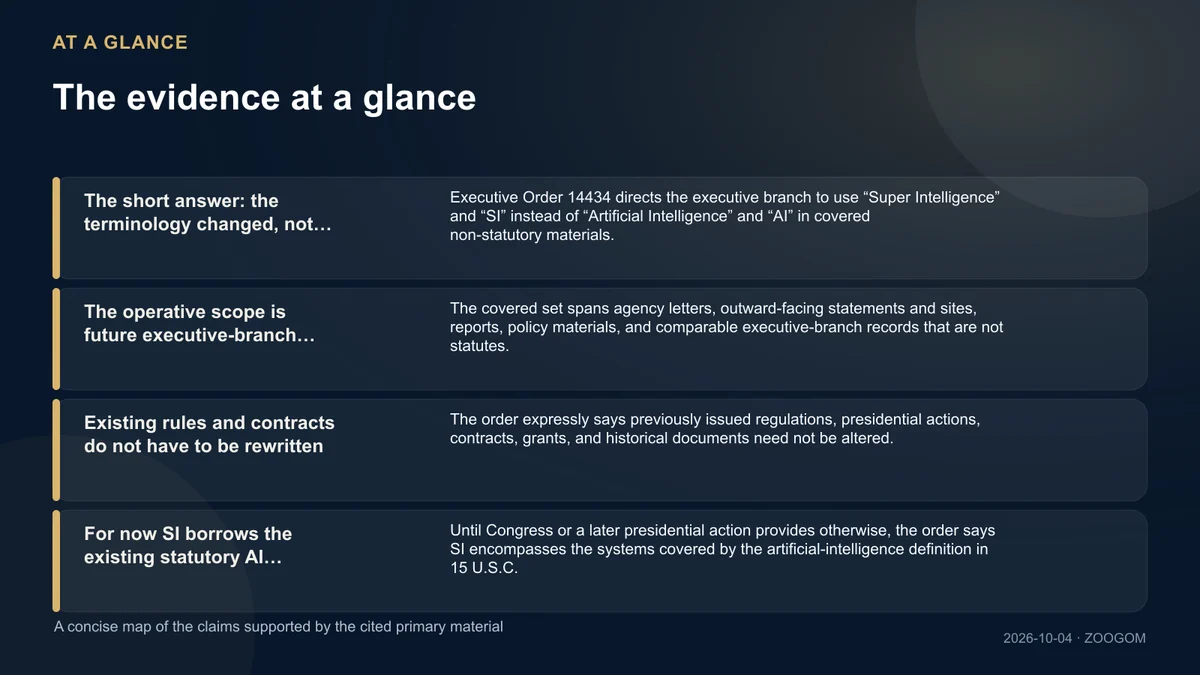
Executive Order 14434 directs the executive branch to use “Super Intelligence” and “SI” instead of “Artificial Intelligence” and “AI” in covered non-statutory materials. It does not certify that current systems have become scientifically superintelligent.
The same model can therefore receive a new administrative label without any change in weights, benchmark performance, autonomy, or safety. Those properties still require technical evidence.
The operative scope is future executive-branch communication
The covered set spans agency letters, outward-facing statements and sites, reports, policy materials, and comparable executive-branch records that are not statutes. The direction is also limited by what existing law permits.
It does not ban companies, universities, journalists, Congress, courts, or state governments from using AI. It also does not compel the rest of the world to adopt the abbreviation SI.
Existing rules and contracts do not have to be rewritten
The order expressly says previously issued regulations, presidential actions, contracts, grants, and historical documents need not be altered. An older procurement document does not become invalid merely because it says AI.
Transition materials may use both terms when a new agency document cites an older legal instrument. Procurement and legal teams should not infer a change in obligations, deliverables, or risk tests from the label alone.
For now SI borrows the existing statutory AI definition
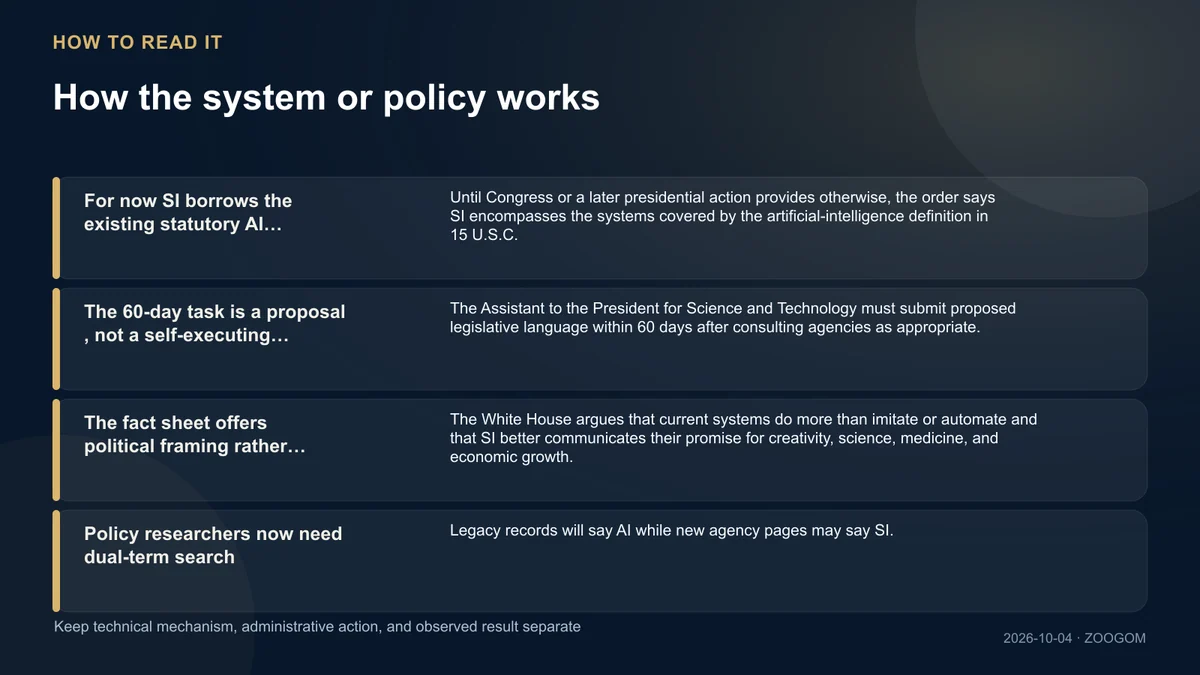
Until Congress or a later presidential action provides otherwise, the order says SI encompasses the systems covered by the artificial-intelligence definition in 15 U.S.C. 9401(3). The name grows more ambitious while the immediate legal set remains anchored to familiar language.
That bridge also separates the order’s SI from the research use of “superintelligence,” which often means broadly exceeding human capability. The two concepts should not be treated as automatic synonyms.
The 60-day task is a proposal, not a self-executing statute
The Assistant to the President for Science and Technology must submit proposed legislative language within 60 days after consulting agencies as appropriate. The proposal is also to identify additional executive action that may be needed.
Submitting language does not enact it. Congress may debate, modify, reject, or never take it up. Around late November 2026, the relevant question will be whether a proposal appeared and what it covers—not whether a new statute automatically took effect.
The fact sheet offers political framing rather than a capability test
The White House argues that current systems do more than imitate or automate and that SI better communicates their promise for creativity, science, medicine, and economic growth. That is the administration’s policy rationale.
The documents do not publish a benchmark threshold or scientific consensus showing that deployed models surpass people across general intelligence. Administrative optimism and empirical capability should remain separate columns.
Policy researchers now need dual-term search
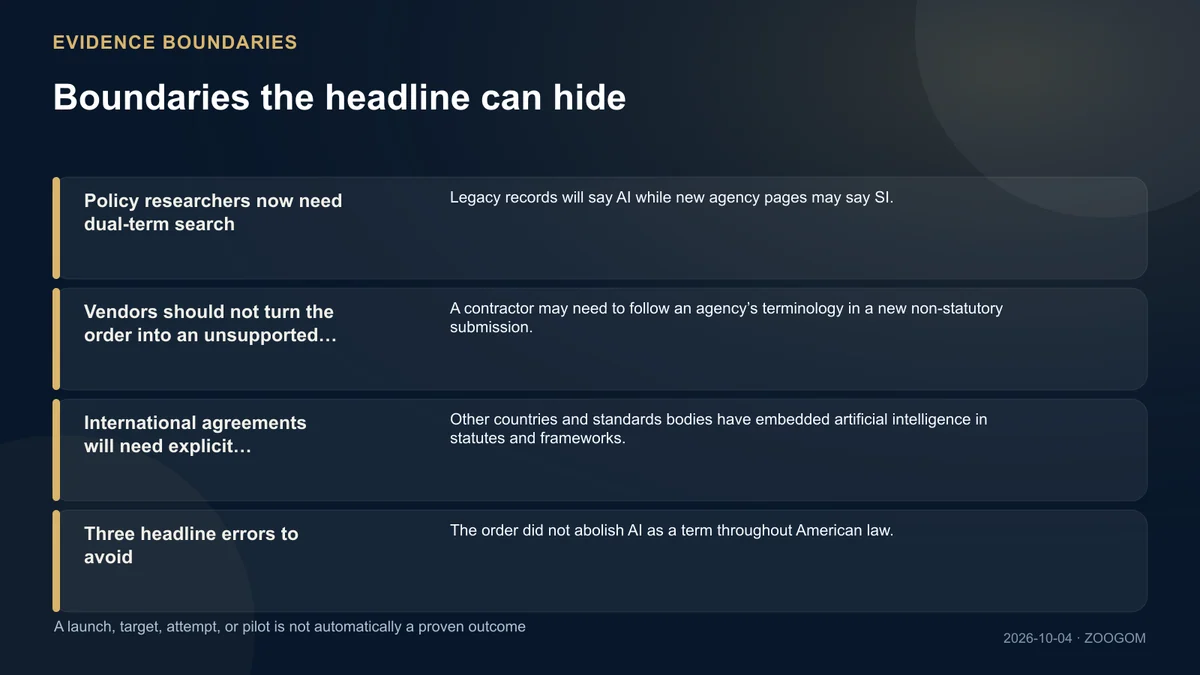
Legacy records will say AI while new agency pages may say SI. Anyone tracking procurements, grants, enforcement, guidance, or public comments should search both abbreviations and both full phrases.
SI can also collide with other technical meanings. Preserve the issuing agency, publication date, document type, quoted term, and operative definition rather than storing only the acronym.
Vendors should not turn the order into an unsupported product claim
A contractor may need to follow an agency’s terminology in a new non-statutory submission. That does not justify telling consumers that an ordinary model has achieved superintelligence.
When quoting the government, say “systems the executive branch calls SI” and retain precise model and risk terminology in cards, contracts, and safety documentation. Marketing language does not replace measurable limits.
International agreements will need explicit definitions
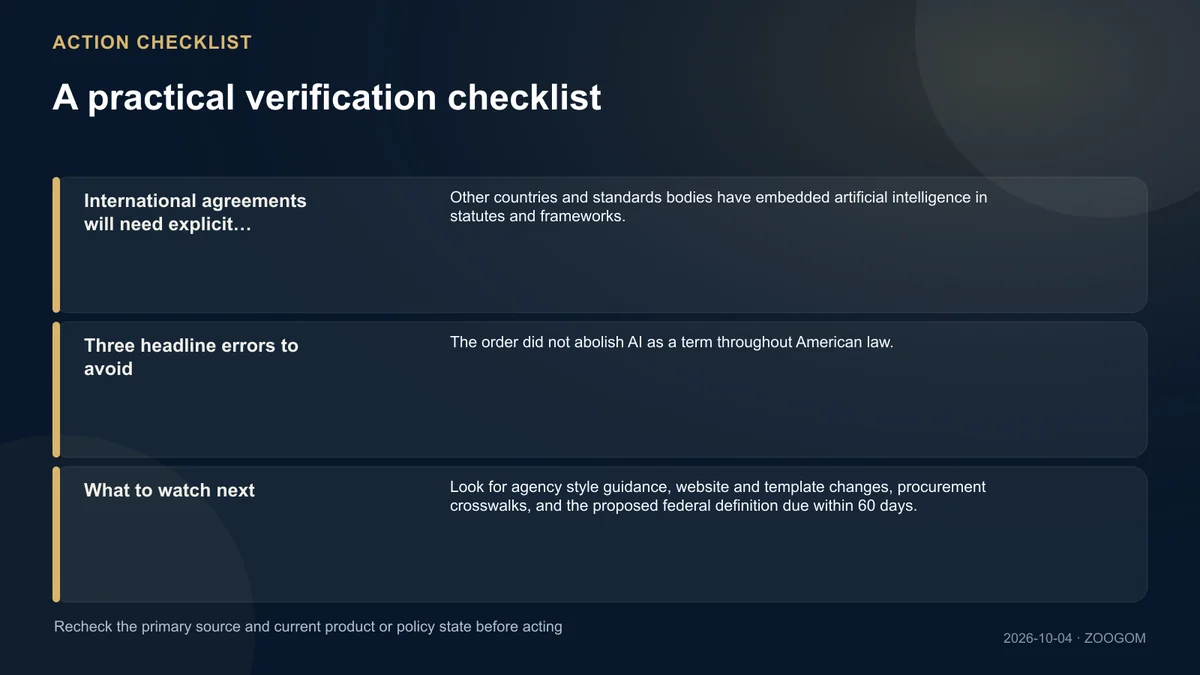
Other countries and standards bodies have embedded artificial intelligence in statutes and frameworks. A U.S. executive-branch label change can create apparent disagreement where the covered technologies remain the same.
Joint statements and technical agreements should define the included systems, capabilities, risk tiers, and responsible parties. Translation should not be allowed to silently expand or narrow a legal commitment.
Three headline errors to avoid
The order did not abolish AI as a term throughout American law. It did not prove that existing models exceed human intelligence. And it did not retroactively replace every occurrence in a regulation, contract, grant, or historical record.
The accurate summary is narrower: the U.S. executive branch has adopted SI as its preferred name for the existing federal AI category in future non-statutory communication, subject to law.
What to watch next
Look for agency style guidance, website and template changes, procurement crosswalks, and the proposed federal definition due within 60 days. The key design choice will be whether the proposal defines SI by capability, autonomy, application, risk, or a combination.
The order can materially change records, search, and public messaging. It cannot establish safety or performance by naming alone; real systems still have to be evaluated under their deployment conditions.
Copyright, trademark, and image notice
Company and product names may be trademarks of their respective owners. Unless otherwise credited, visuals are AI-generated conceptual backgrounds or original editorial designs and information graphics. Any quotations or third-party assets are identified with the applicable author, source, and usage information at the point of use or in the source list.
Sources and the next facts to verify
The links below are the primary and official materials used for fact-checking. Linking a source does not mean reproducing its prose, imagery, or page design.