AI robots move into daily life What Korea the US and Japan are testing
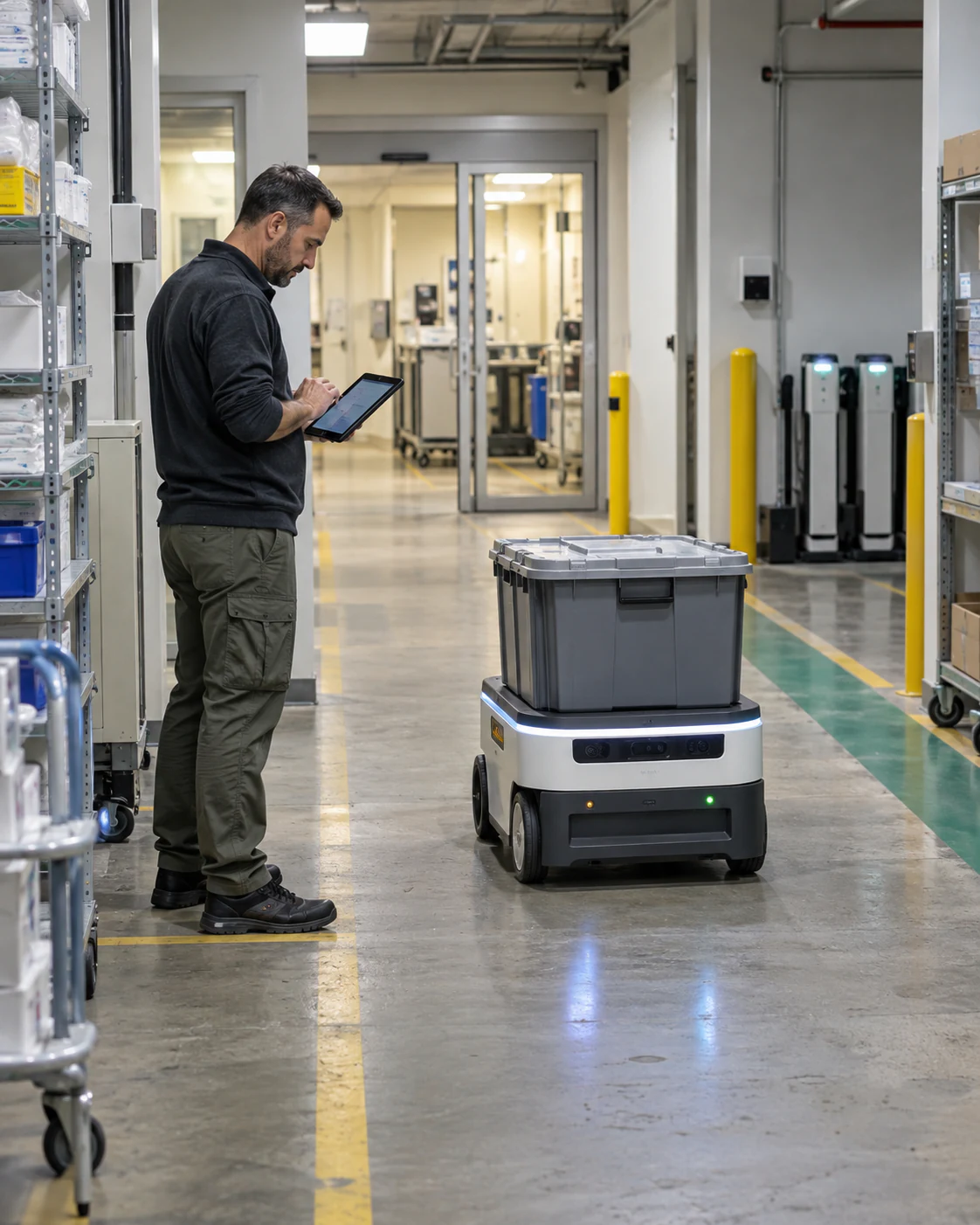
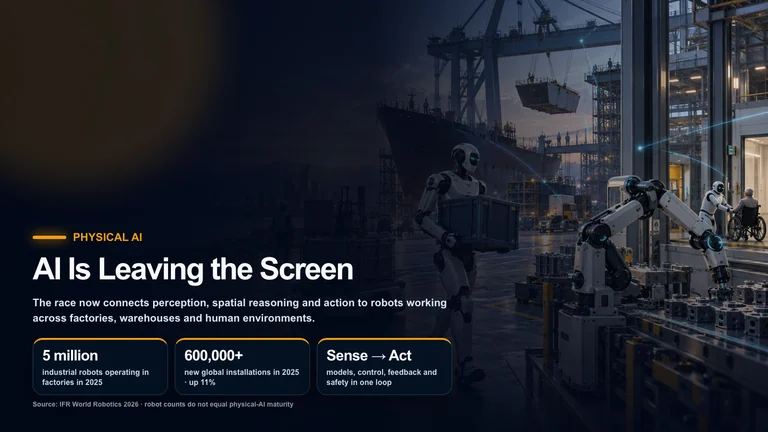
An AI robot entering daily life does not have to be a humanoid walking through the front door. It may be a mobile cart carrying supplies through a hospital, a camera unit checking store shelves, an autonomous device inspecting a building, or a machine that helps a worker hold a difficult posture. What connects these systems is that AI must sense and act in the physical world.
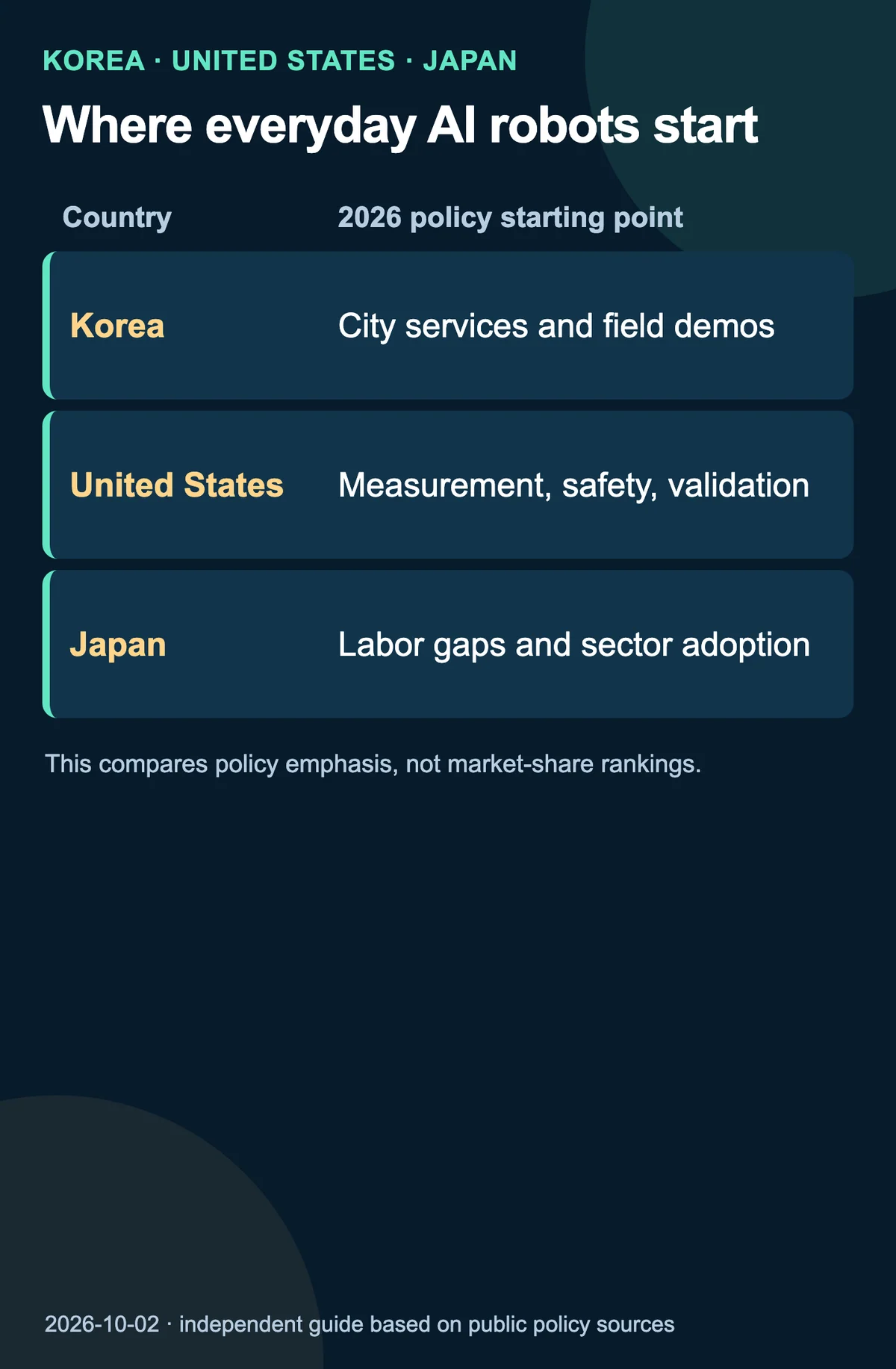
The important question in 2026 is not simply whether a larger model can plan a task. It is whether the whole system can repeat a useful task around people without creating a larger safety, privacy or maintenance burden. Korea is putting visible city services and public demonstrations near the center. The United States is investing in measurement and validation for real manufacturing. Japan is linking deployment roadmaps to labor shortages in specific sectors. Those are policy starting points, not a market ranking.
Physical AI has consequences that a chatbot does not
A wrong chatbot answer can usually be corrected on a screen. A wrong robotic action can strike a person, damage inventory or stop a production line. A useful evaluation therefore has at least 4 layers.
- Sensing: Cameras, range sensors, force sensors and microphones observe the environment.
- Decision: A model interprets people, objects, task order and exceptions.
- Action: Motors and controllers turn a plan into movement, grasping or a safe stop.
- Operations: Batteries, networks, maps, cleaning, repairs, security and human intervention keep the service alive.
The operations layer is where many impressive demonstrations stop becoming services. Lighting changes, reflective floors, elevator doors and a child running across a route can all change performance. “It can do this once” and “it can do this every day” are separate claims.
Korea starts with services people can see in a city
The official Seoul announcement says Smart Life Week 2026 is scheduled for October 6 through 8 at COEX. The publishing body is listed as Seoul Metropolitan Government (source S1). As of this article’s October 2 research date, the event has not happened yet. Its announced program places physical AI and robots alongside AI administration, mobility and services for a future city.
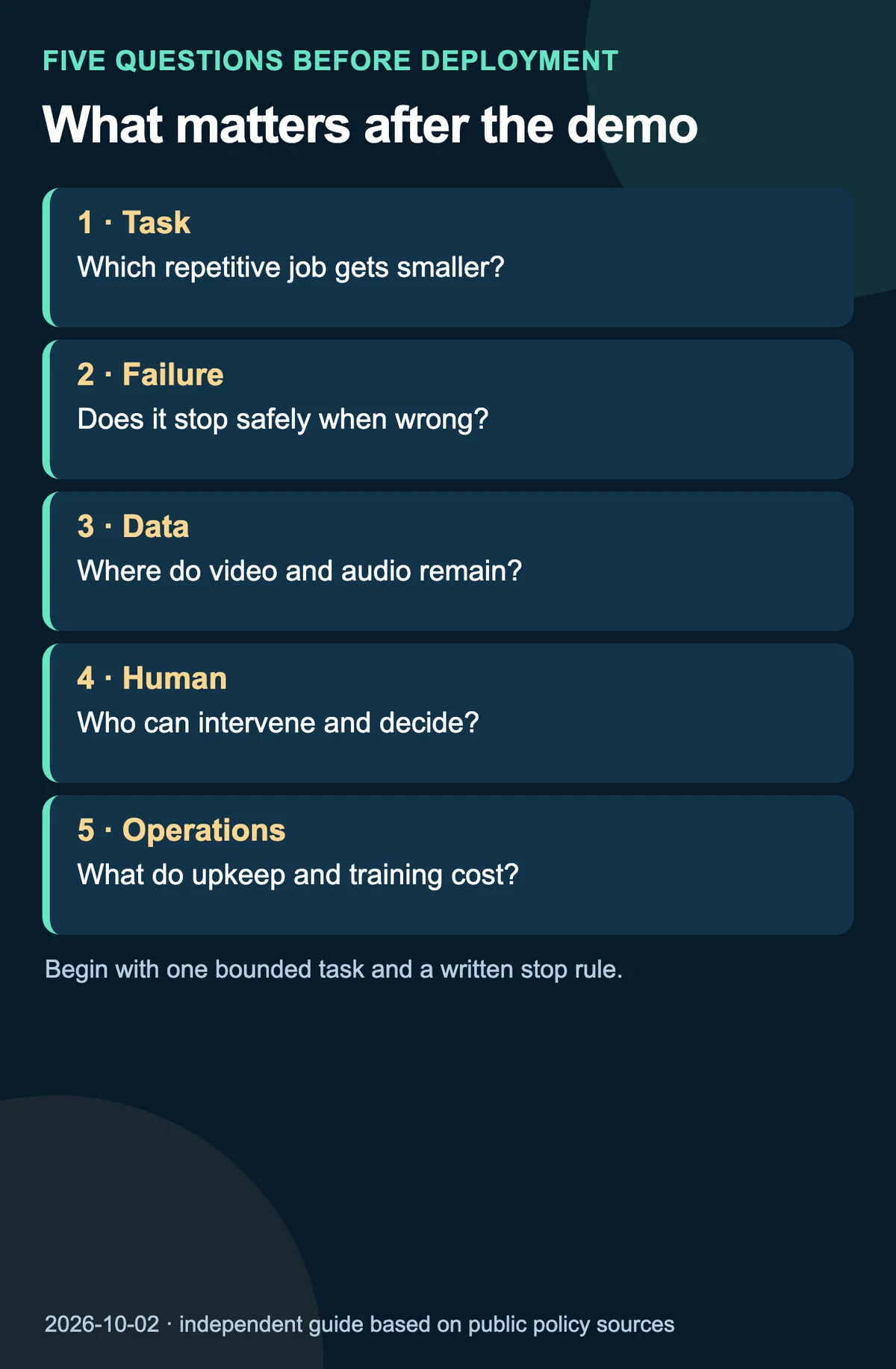
That setting can connect technology to the actual routes and users of a service: public-facility deliveries, accessible guidance, safety inspections and links between a robot and transportation. It also creates a risk of confusing an exhibition with operating evidence. Before treating a demonstration as a deployment candidate, ask:
- Was it tested on the same floors, doors and wireless network as the target site?
- Does it detect children, older adults and wheelchair users in realistic traffic?
- Will it stop safely when a sensor is covered or connectivity disappears?
- Is video processed on the device, at the site or in an outside cloud?
- How many units can one trained operator supervise during an exception?
Public service adds more than technical accuracy. Accessibility, complaint handling, privacy, nighttime noise and the place where a failed unit waits for recovery all belong in the operating design.
The United States emphasizes performance that can be measured
The US National Institute of Standards and Technology describes a physical-AI and robotics program intended to reduce the gap between academic research and real manufacturing. The page, updated April 24, 2026, highlights data generation, metrics and test methods for understanding safety and productivity in deployed systems.
This approach asks more than how many robots were installed. A picking system should be evaluated across object materials, lighting, position error, speed and the number of human rescues. A patrol system needs more than miles traveled: missed hazards, false alarms, charging interruptions and manual recovery time matter too.
The NIST program page is not a mandatory safety rule for every service robot in the United States, and it is not a certification for a particular product. It is evidence of a measurement and validation direction. Buyers still need product-specific testing and any rules that apply to their site and industry.
Japan connects labor gaps to sector roadmaps
Japan’s Cabinet Secretariat page for the interagency AI Robotics Strategy work describes structural labor shortages from demographic change as a reason to supplement labor supply and raise productivity. It lists a May 27, 2026 strategy and sector roadmaps, followed by an amended implementation roadmap dated August 28.
The useful idea is not to place one robot design everywhere. Food service, care, logistics, manufacturing and agriculture have different spaces, failure costs and supervision needs. A restaurant carrier has to deal with narrow aisles and unpredictable guests. A factory device emphasizes precision and controlled stops. An agricultural machine must handle terrain and weather.
A roadmap remains a policy plan, not a forecast that adoption will occur on schedule. The next evidence to watch is whether demonstration sites, standards, insurance, responsibility and support budgets connect to each other.
The common loop is data, action and correction
Despite different policy language, field robots operate through a similar loop. Sensors record a situation. A model interprets it. A controller acts. The result and any exception become input for the next test. A faster loop is not automatically a better loop. Bad labels or an exception treated as normal can scale risk just as quickly.
An operator should keep at least 3 distinct records: normal completions, human interventions, and near misses or mission aborts. Before storing failure video indefinitely, define its purpose, retention period, access list and de-identification method. The contract should separately state whether a supplier can view footage for remote support and whether the same material can be reused for model improvement.
Five practical tasks to evaluate first
The best first task is not necessarily the task people dislike most. It is a task with a clear boundary and a safe path back to human work.
- Carry supplies along a fixed hospital, hotel or office route.
- Check shelves and price labels before a store opens.
- Inspect temperature, leaks and door status during a closed shift.
- Sort or visually inspect standardized components in a controlled cell.
- Capture repeated images of crops, storage areas or equipment for change detection.
Emergency judgment, lifting a person’s body and unsupervised movement in dense traffic carry much higher failure costs. They require stronger evidence and oversight. Replace the broad goal of “replacing labor” with a measurable burden such as walking distance, waiting time or repeated scans.
A 12-week field pilot that produces evidence
Use the first 2 weeks to measure the existing job without a robot: task time, walking distance, errors, complaints and near misses. Run the robot beside a person for the next 4 weeks to collect exceptions. Limit real operation to selected areas and times for another 4 weeks. Use the final 2 weeks to evaluate costs and safety records.
Set success thresholds before the trial. More throughput is not a win if rescues and complaints rise with it. Track at least:
- human interventions per 100 tasks;
- safe stops, collisions avoided and false alarms;
- actual uptime after charging, faults and connection loss;
- minutes saved per job and new operator minutes added;
- average repair time and battery or wear-part costs; and
- retained recordings and confirmed deletions.
What a purchase contract often misses
The unit price is only one part of long-term cost. Ask whether remapping, elevator integration, wireless upgrades, after-hours support, scheduled safety checks, batteries, wheels and sensor replacement are included. Determine what happens to basic movement and safe stopping when a software subscription ends.
Make the data terms concrete. List which sensors operate in each mode, where originals are stored, whether the vendor may train on them, the deletion deadline after a contract ends, and the log format available for an incident investigation. If a subcontractor provides remote monitoring, add its location and access privileges.
Finally, assign stop and restart authority. On-site staff need a physical and software way to stop the machine immediately. A named role should review the cause before restart. If a model or control update changes safety behavior, the contract should define which tests must be repeated.
The practical conclusion for 2026
The AI-robot race is not explained by humanoid spectacle alone. Korea is highlighting city services that people can encounter, the United States is developing repeatable measurement and manufacturing validation, and Japan is organizing sector adoption around labor gaps. All 3 directions eventually depend on safe action, good field data and an operating system that keeps a human in control of exceptions.
If you are evaluating a deployment, ask for the least glamorous document first: the exception list. Run one bounded task for 12 weeks, record failures and rescues, and expand only when the evidence shows that human burden really fell. That is a more reliable path from a compelling demo to an everyday service.