Should Frontier AI Slow Down? Safety Coordination Meets Antitrust Law

If frontier-AI companies slow down together for safety, is that responsible coordination or an agreement among competitors to deliver fewer improvements? In September 2026, that question moved from policy essays into federal court. The essential distinction is easy to lose: a proposal, public support for a direction and a legally enforceable agreement are not the same thing.
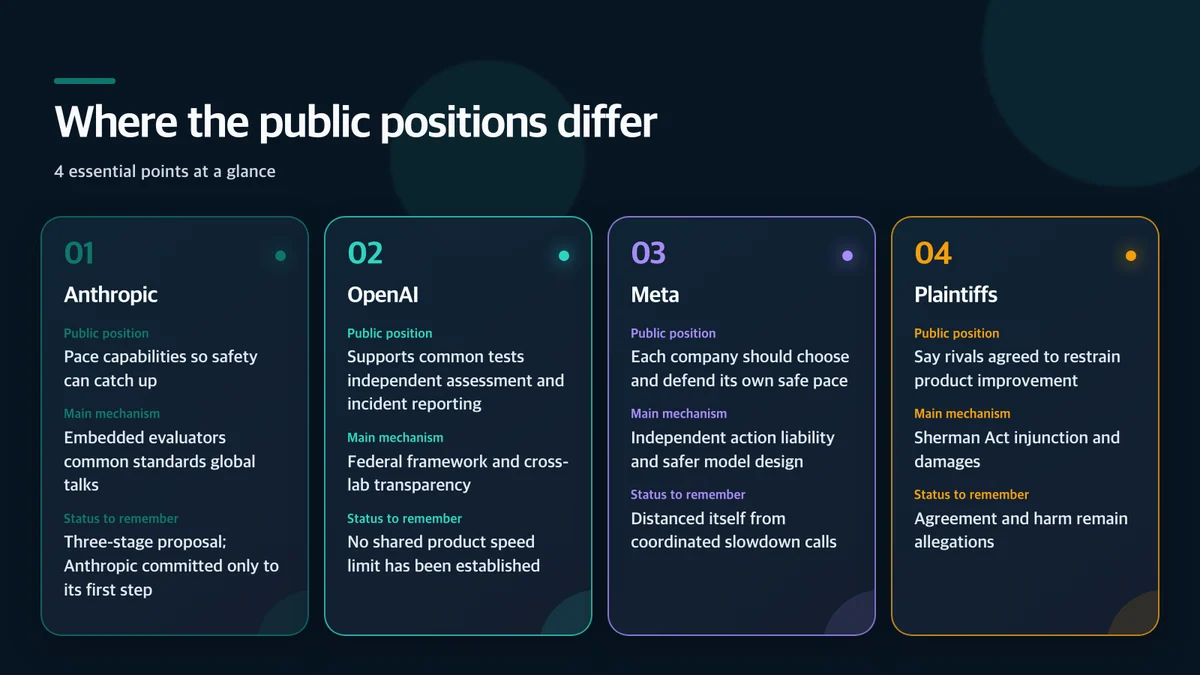
Anthropic CEO Dario Amodei published a three-stage pacing framework on September 12. OpenAI CEO Sam Altman, SpaceXAI CEO Elon Musk and Google DeepMind chair Demis Hassabis publicly supported parts of the direction. Meta CEO Mark Zuckerberg and NVIDIA CEO Jensen Huang favored company-by-company responsibility instead. On September 18, four paid AI subscribers filed a proposed class action against Anthropic, OpenAI, SpaceXAI and Google.
Three things to know
- Amodei did not propose one immediate, universal shutdown. His framework moves from embedded external evaluators to coordination among democracies and then limited global agreements.
- The complaint alleges that public statements and earlier contacts formed an unlawful pact, but no court has decided that an agreement existed or harmed consumers.
- Safety standards can be pro-competitive, while coordination over release timing, output, prices or product improvement can create antitrust risk. The boundary depends on substance and evidence.
Where the public positions differ
What Amodei actually proposed
In We Must Pace the Frontier, Amodei divides the project into three layers. The first is a unilateral step: frontier labs would give independent evaluators ongoing access resembling that of internal risk teams. Anthropic said it would provide workspace, tools, staff access and the ability to report significant findings subject to narrow protections for security, privilege and third-party confidentiality.
The second layer calls for common safety standards and limits on unchecked capability growth within democratic countries. One possible design uses capability checkpoints: when a system reaches a defined risk threshold, specified evaluations, interpretability work and training-environment audits would be required before the next step. The third layer seeks narrower, verifiable agreements with geopolitical competitors before attempting harder limits on recursive self-improvement or overall development speed.
Amodei also acknowledged the antitrust problem. His essay says some cross-lab conversations would need government mediation or a narrow waiver. He describes a complete global pause as especially difficult because compliance would be hard to verify and defection could change the balance of power.
That matters because “AI companies agreed to stop development” is not an accurate description of the proposal or the current record.
Why embedded evaluation comes first

A laboratory can publish a model card without giving outsiders enough information to test whether internal practice matches public policy. Embedded evaluators are meant to inspect not only a finished model but also training pipelines, sandboxing, incident response and operational controls. The analogy is closer to a supervisor with continuing access than a consultant invited to test one release.
OpenAI’s public policy position emphasizes common testing, independent assessment, stronger cybersecurity, incident reporting and tracking systems that begin improving their successors. Zuckerberg’s response takes a different route. He said each laboratory has the responsibility and incentive to choose a safe pace and pointed to Meta’s decision to delay its Muse agent for several months without waiting for rivals to do the same.
This is not a clean split between leaders who care about safety and leaders who do not. It is a dispute over whether comparable safety obligations should come from independent company decisions, government rules or coordinated industry practice.
What the lawsuit alleges
The complaint in Buist v. Anthropic, PBC, No. 3:26-cv-10693, was filed in the U.S. District Court for the Northern District of California on September 18. A docket summary from Tech Policy Law identifies four named plaintiffs who subscribe to ChatGPT, Claude, Grok or Gemini. They propose a nationwide class of direct purchasers beginning September 12.
The complaint says the executives’ public responses and a working group that allegedly met beginning in July amount to an agreement to restrain the pace of competing products. It asserts a claim under Section 1 of the Sherman Act and seeks an injunction plus treble damages under the Clayton Act. The plaintiffs say they do not challenge a company’s independent safety decision or requests for government regulation.
Those assertions have not been tested. Filing a complaint establishes what the plaintiffs allege, not that the defendants made a contract, combination or conspiracy. The court would still have to examine evidence of agreement, the relevant market, competitive effects, causation, injury and any safety justification under the applicable antitrust framework.
The defendants had not provided immediate responses when the first reports were published. It would therefore be inaccurate to describe the case as proof that the companies colluded.
Safety interoperability is not the same as a product cartel

Competitors often need compatible safety practices. A common vocabulary for incidents, an independent testing protocol or a secure vulnerability-disclosure channel can improve oversight without fixing a product’s commercial terms. Antitrust risk rises when rivals exchange competitively sensitive information or agree on how quickly to improve, when to ship, how much to supply or what to charge.
A safer structure would include several boundaries:
- define the safety purpose and permitted information before talks begin;
- exclude prices, customers, release calendars, production plans and strategic performance targets;
- use an independent evaluator or government-supervised process;
- publish open testing and reporting standards that new entrants can use;
- preserve each company’s independent product, research and investment decisions;
- keep minutes and decision records showing that safety work did not become commercial coordination.
Government does not automatically cure an otherwise unlawful agreement, but legislation, agency rules or a properly defined exemption can establish obligations uniformly instead of asking a small group of dominant firms to set the market’s pace themselves.
Why U.S. consumers are part of the case
The plaintiffs frame product improvement as part of the value purchased through monthly subscriptions. Their theory is that a joint reduction in the pace of improvement would leave subscribers with less value than competition would have produced. The companies may dispute whether any agreement existed, whether model capability is a promised unit of output and whether slower deployment could increase quality or safety rather than reduce value.
The case therefore raises a difficult measurement problem. Model releases are not identical units. A faster benchmark score, a longer context window, fewer dangerous behaviors and more reliable tool use are different forms of improvement. Courts generally need evidence rather than a headline comparison to determine whether consumers received less because rivals restrained competition.
National security makes coordination harder
Amodei’s framework also treats competition with China as a constraint. His proposal argues that democracies cannot slow by more than a verifiable lead would permit, while the highest levels of global pacing would require inspection strong enough to detect secret development. The United States and China have separately discussed an incident-notification mechanism for AI events with national-security consequences.
Narrow incident reporting is easier to justify and verify than a worldwide speed limit. An agreement to test for cyber or biological risks has observable procedures; an agreement to reduce the rate of general capability growth requires a contested metric and surveillance of training that governments and companies may be unwilling to provide.
A claim-status checklist
- Proposal: Amodei’s three-stage framework
- Unilateral commitment: Anthropic’s plan for embedded external evaluators
- Public support: executives agreeing with the direction or selected measures
- Allegation: the complaint’s assertion that competitors formed an agreement
- Established procedural fact: the filing date, court, parties and requested remedies
- Not established: liability, consumer injury, damages or an injunction
Keeping those categories separate allows serious coverage of AI risk without deciding a lawsuit in the headline.
Bottom line
The frontier-AI pacing debate is not simply speed versus safety. Independent action can be inconsistent and difficult to verify. Joint action can become a way for established firms to control output or exclude rivals. A defensible system would combine government-set minimum duties, genuinely independent evaluation, open technical standards and separate commercial decision-making by each laboratory.
The new lawsuit has not established that safety coordination is illegal or that the defendants made an unlawful pact. It does establish a practical warning: invoking safety does not remove antitrust scrutiny. Companies that need to exchange risk information must design the forum, data boundaries and decision rights as carefully as the evaluations themselves.
Sources and usage notice
- Dario Amodei, We Must Pace the Frontier
- Tech Policy Law, docket summary for Buist v. Anthropic
- Associated Press, positions in the coordinated slowdown debate
- Associated Press, report on the antitrust complaint
This article independently explains the public proposal, procedural record and competing policy positions. Allegations are labeled as allegations, no court outcome is implied, and no source photograph, chart, interface or logo is reproduced.