Anthropic’s Frontier Academy and the FDE role explained
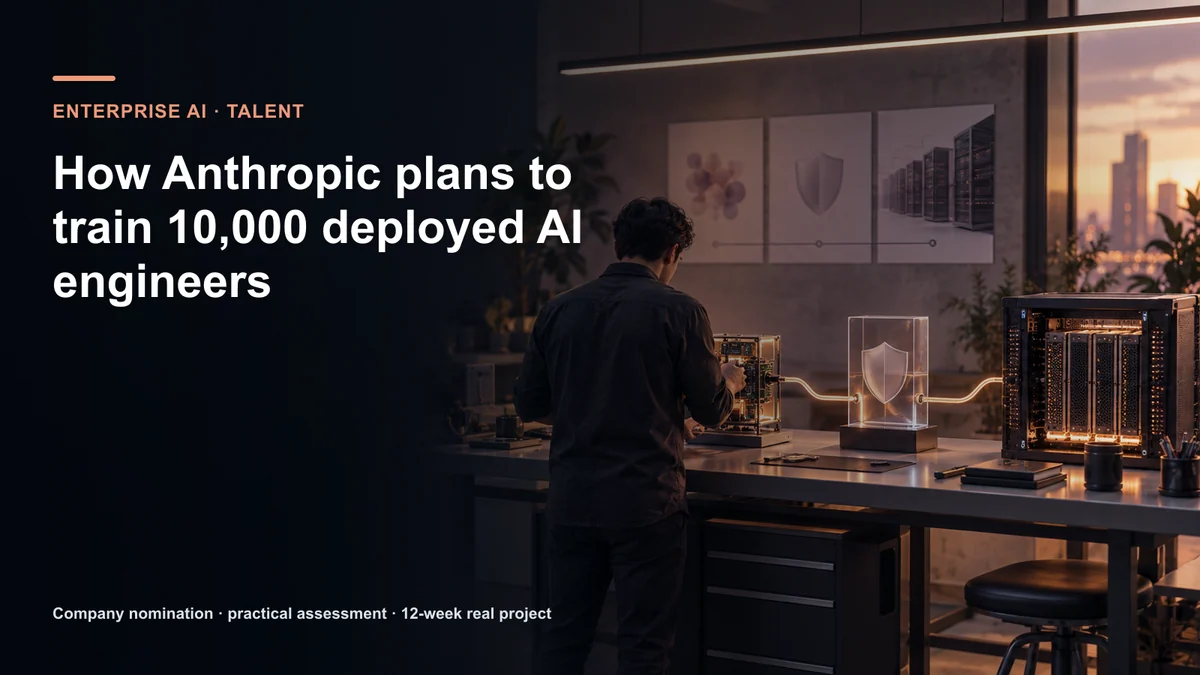
Anthropic committed 100 million dollars and aims to train 10000 Frontier Deployed Engineers by the end of 2027. The first program accepts engineers nominated by eligible organizations rather than open public enrollment. This guide separates confirmed events, attributed claims, technical limits, and the evidence still needed for a practical decision.
The short answer: this is deployment training, not a public prompt course
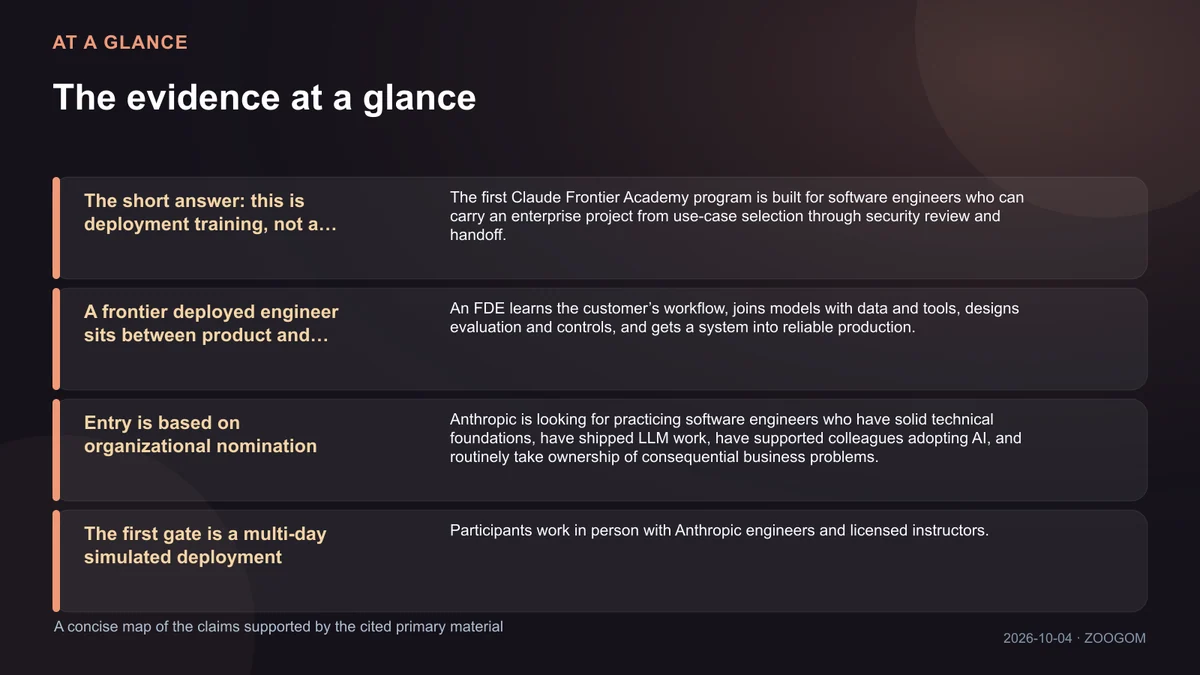
The first Claude Frontier Academy program is built for software engineers who can carry an enterprise project from use-case selection through security review and handoff. It is not a self-paced introductory class for anyone who wants a certificate.
Anthropic has committed $100 million and set a goal of training 10,000 FDEs by the end of 2027. A target is not a count of completed graduates.
A frontier deployed engineer sits between product and operations
An FDE learns the customer’s workflow, joins models with data and tools, designs evaluation and controls, and gets a system into reliable production. The role continues past a persuasive demo into adoption and operational ownership.
It therefore combines software engineering, domain discovery, security judgment, change management, and communication. Coding skill alone is not enough.
Entry is based on organizational nomination
Anthropic is looking for practicing software engineers who have solid technical foundations, have shipped LLM work, have supported colleagues adopting AI, and routinely take ownership of consequential business problems. Prior agent-building experience is not required.
An organization nominates its engineers, and each arrives with a named Claude project to lead after returning. This is not an open boot camp or an Anthropic job application.
The first gate is a multi-day simulated deployment
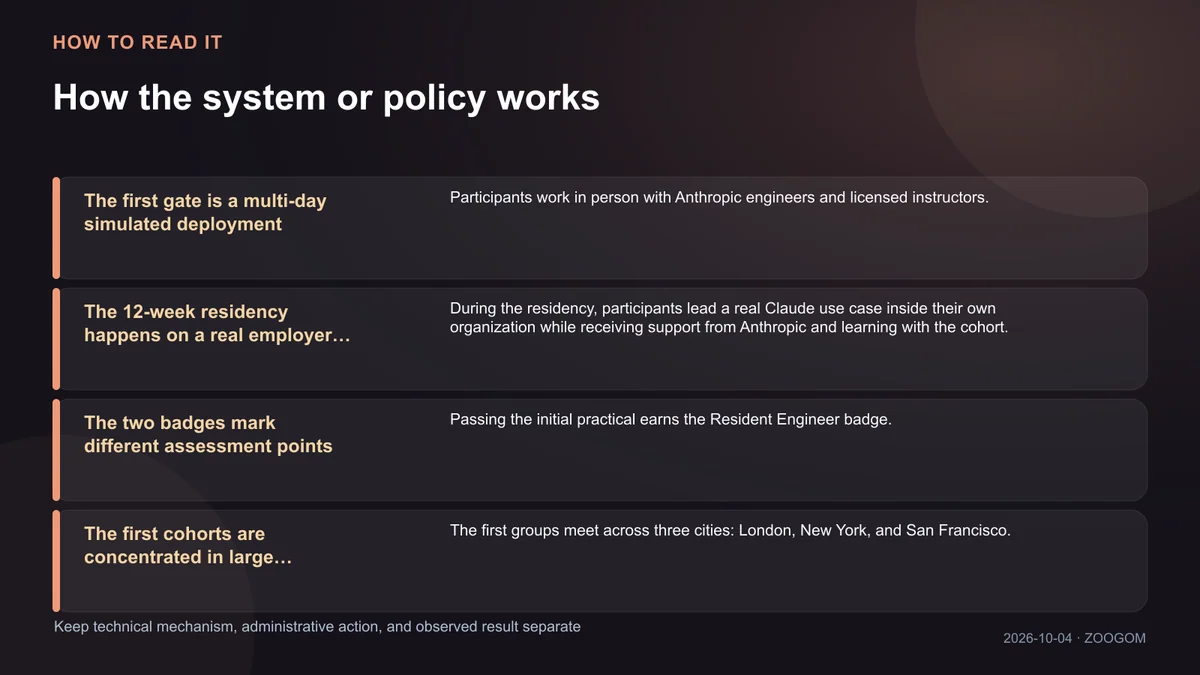
Participants work in person with Anthropic engineers and licensed instructors. The exercise runs from choosing the right use case through security review, implementation, and handoff.
A graded practical on a new scenario determines whether the engineer earns the Claude Resident Engineer badge and enters the next phase. Attendance alone does not produce the credential.
The 12-week residency happens on a real employer project
During the residency, participants lead a real Claude use case inside their own organization while receiving support from Anthropic and learning with the cohort.
That design connects training to actual constraints. It also means success depends on the employer providing data access, security participation, user time, and authority to change a workflow.
The two badges mark different assessment points
Passing the initial practical earns the Resident Engineer badge. A second successful assessment at the end of the 12-week project produces the FDE credential; Anthropic expects its earliest recipients near the start of 2027.
The badge records completion of a vendor program. It is not an occupational license, a model-neutral industry standard, or a guarantee of a job at Anthropic.
The first cohorts are concentrated in large organizations
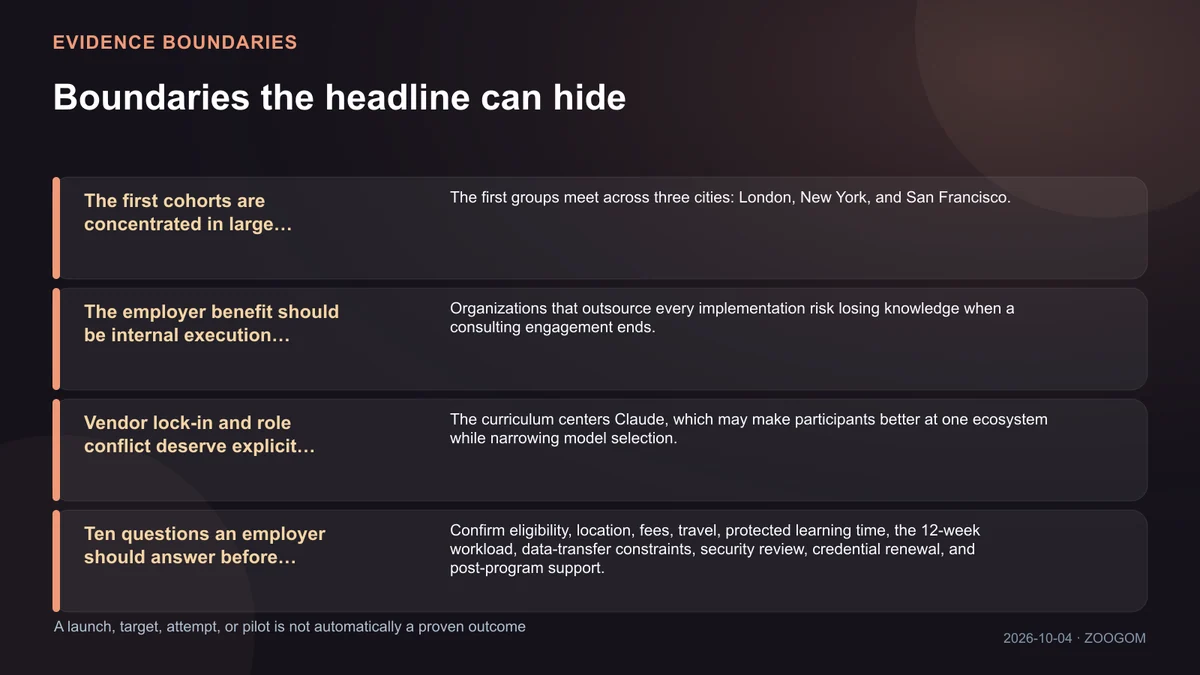
The first groups meet across three cities: London, New York, and San Francisco. Named participants span Novo Nordisk and Commonwealth Bank of Australia, investment bank Morgan Stanley, and the professional-services firms Deloitte, McKinsey, Capgemini, Bain, and Accenture.
That list signals an enterprise and professional-services strategy. The announcement does not establish equal access for small businesses, public agencies, or independent developers.
The employer benefit should be internal execution capacity
Organizations that outsource every implementation risk losing knowledge when a consulting engagement ends. An internal FDE can translate between business owners, engineers, risk teams, and users while spreading repeatable practices.
Measure production adoption, error reduction, time saved, control quality, and total operating cost—not badge counts. Ten thousand trained people do not automatically mean ten thousand successful deployments.
Vendor lock-in and role conflict deserve explicit controls
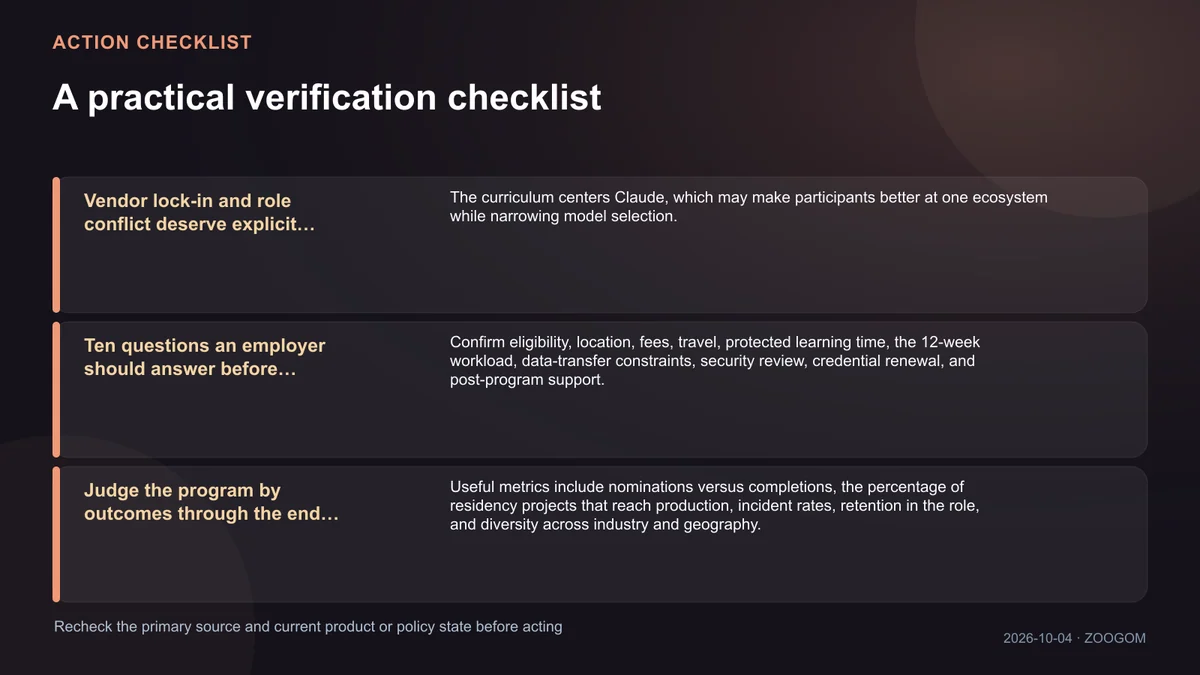
The curriculum centers Claude, which may make participants better at one ecosystem while narrowing model selection. An FDE who evaluates suitability and is also expected to expand a vendor can face a conflict.
Maintain independent model comparisons, portability requirements, exit plans, contract limits, and a separate purchasing authority. Education should not silently become procurement approval.
Ten questions an employer should answer before nomination
Confirm eligibility, location, fees, travel, protected learning time, the 12-week workload, data-transfer constraints, security review, credential renewal, and post-program support. The public announcement does not contain every commercial term.
Also define the project owner, success and stop criteria, privacy impact, maintenance budget, and who operates the system after the resident returns to normal duties.
Judge the program by outcomes through the end of 2027
Useful metrics include nominations versus completions, the percentage of residency projects that reach production, incident rates, retention in the role, and diversity across industry and geography. Selected testimonials cannot establish an average effect.
The launch makes a credible point: enterprise AI is constrained by deployment talent as well as model access. It should not be reframed as public enrollment, guaranteed employment, or a universal engineering license.
Copyright, trademark, and image notice
Company and product names may be trademarks of their respective owners. Unless otherwise credited, visuals are AI-generated conceptual backgrounds or original editorial designs and information graphics. Any quotations or third-party assets are identified with the applicable author, source, and usage information at the point of use or in the source list.
Sources and the next facts to verify
The links below are the primary and official materials used for fact-checking. Linking a source does not mean reproducing its prose, imagery, or page design.