AI Leaves the Screen: The Physical AI Race Across the U.S., South Korea and Japan
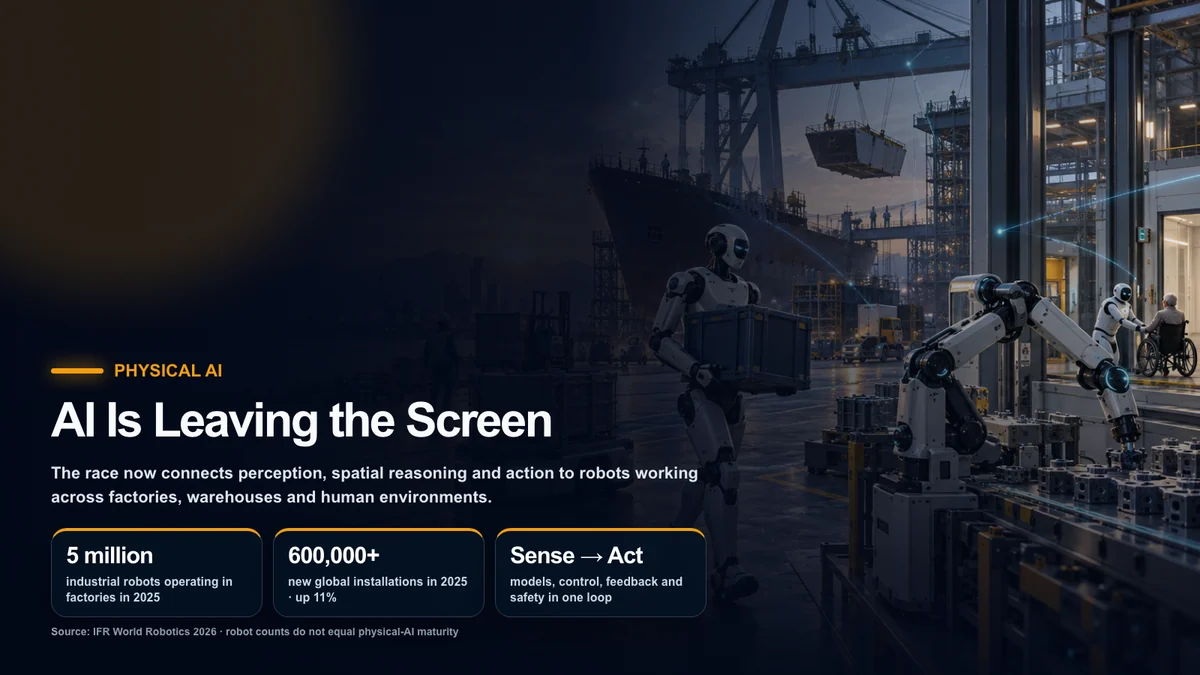
Generative AI first became visible inside a screen. It wrote, coded, analyzed and created media. Physical AI connects that intelligence to cameras, force sensors, motors and machines. A system has to perceive a changing environment, understand where people and objects are, plan an action, move a real body and verify the result.
The opportunity is larger than a new generation of humanoid demos. According to the International Federation of Robotics, the number of industrial robots operating in factories reached five million in 2025, up 9% in one year. Factories installed more than 600,000 new units, an 11% increase. IFR World Robotics 2026 release
The next competition is about upgrading narrow, preprogrammed motion into systems that can handle variation. The United States enters with frontier models, software platforms and robotics startups. South Korea has extraordinarily dense factory automation and valuable field data. Japan has a deep robot supply chain, precision manufacturing and a culture of reliability.
No single statistic identifies the winner. Annual installations, robot density, robot production, AI model quality and real-world reliability measure different things. Treating a large installed base as proof of general-purpose physical intelligence would be a category error.
What makes an AI system physical
A conventional industrial robot is exceptional at repeating a known trajectory in a controlled cell. Change the part orientation, add an unexpected obstacle or ask the machine to use a new tool, and it may need new programming or stop entirely.
Physical AI adds multimodal perception, spatial reasoning, planning and feedback. An instruction such as “place the blue container on the lower shelf” requires object recognition, collision-aware navigation, grasp selection, force control and a check that the container reached the right destination.
It is not limited to human-shaped robots. Robot arms, autonomous mobile robots, warehouse systems, drones, construction equipment and assistive machines can all use physical AI when they perceive and adapt rather than replaying a fixed script.
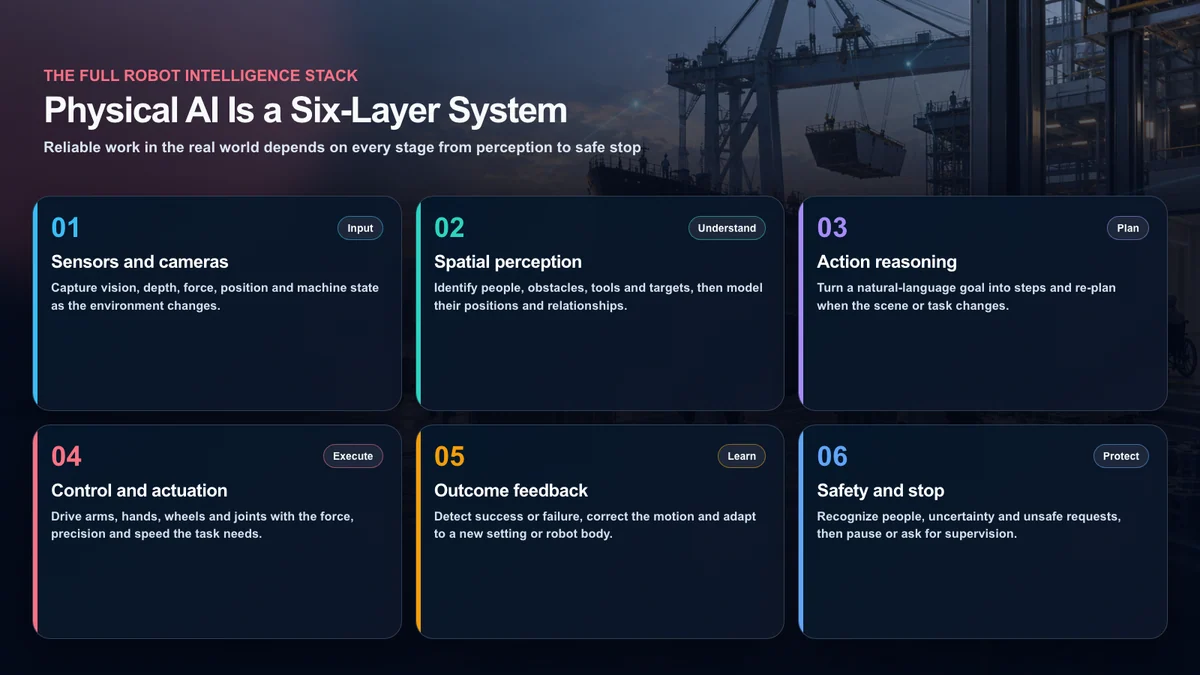
The six layers that have to work together
1. Sensors and cameras
The machine needs vision, depth, force, joint position, velocity and equipment-state data. Industrial lighting, dust, vibration and occlusion make this harder than a clean lab video. Late or unreliable sensing undermines every decision above it.
2. Spatial understanding
The model must distinguish people, obstacles, tools and task objects and represent their relationships. Classification is not enough. It must estimate whether an object is graspable, whether a route remains open and whether a planned motion could reach a person.
3. Action planning
A high-level goal becomes a sequence of steps. The system chooses tools, orders operations, monitors progress and replans when the environment changes. Longer jobs require a reliable definition of the current step and the condition that marks completion.
4. Control and actuation
Plans become commands for arms, hands, wheels and joints. Friction, payload, backlash and physical uncertainty can invalidate a motion that looked correct in simulation. The controller must deliver the required force, speed and precision without destabilizing the machine.
5. Feedback and adaptation
The robot checks whether it grasped the part, whether a box shifted or whether someone entered its route. It corrects the motion and learns how the same skill maps to a different body, sensor package or workplace.
6. Safety and human supervision
A bad sentence is inconvenient; a bad motion can injure someone or damage equipment. Physical AI needs uncertainty detection, safe stop behavior and escalation to a human, alongside conventional emergency stops, guarded zones and force and speed limits.
What changed technically in 2026
Google DeepMind’s July 30 announcement of Gemini Robotics 2 illustrates the direction. The company describes whole-body humanoid control, dexterous manipulation, multi-robot collaboration, multi-step tasks lasting several minutes and self-correction after a failed step. Gemini Robotics On-Device 2 is designed to run locally and adapt to a new two-arm embodiment with fewer than 200 examples and a few hours of data. Google DeepMind announcement
The same official material shows why commercialization should not be overstated. Several multifinger tasks still have modest success rates, and DeepMind says movement speed and human-level dexterity need more work. The ER model is available in Google AI Studio, but other access is through private preview, early-access partners or the Trusted Tester program. A research platform is not the same thing as a robot that a factory or household can buy and deploy without integration.
The global base is already enormous
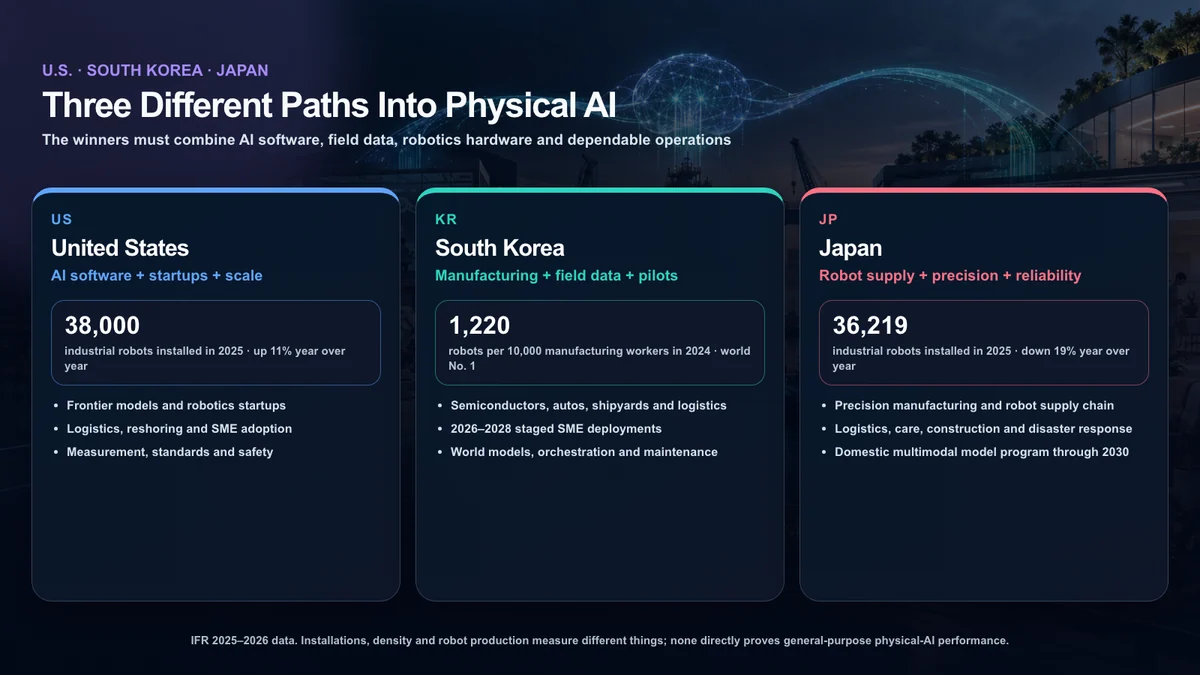
China installed 354,000 industrial robots in 2025, 59% of the global total. The United States installed about 38,000, up 11%. Japan installed 36,219, down 19%, and South Korea installed about 30,000, down 1%.
Those movements do not tell the whole story. Automotive and semiconductor capital cycles can move annual numbers sharply. Installed robots vary in age and capability, while AI functions added to existing equipment are not always visible in shipment data. The decisive layer is increasingly the integration of sensor data, heterogeneous equipment, operational software and human intervention.
United States: turning software leadership into factory adoption
The U.S. advantage begins with AI models, cloud platforms, chips, startup capital and a large logistics market. Its physical AI companies can aim to deploy one intelligence layer across multiple robot types, gather fleet data and update capabilities through software.
U.S. industrial robot installations rose 11% to approximately 38,000 in 2025. IFR attributes the recovery to strong growth in food and other non-manufacturing sectors, while automotive remained the largest adopter. IFR U.S. market release
The hard part is moving from a well-funded pilot to measurable productivity in small and midsize plants. In September 2026, the National Institute of Standards and Technology awarded more than $30 million to 12 Manufacturing Extension Partnership centers. The centers are intended to help manufacturers adopt advanced technologies including AI, robotics, automation and additive manufacturing and to share adoption metrics across the network. NIST announcement
NIST’s 2026 smart-manufacturing roadmap identifies industrial data complexity, heterogeneous sensing and control, explainability, reliability, maintainability and safety as continuing barriers. The American opportunity is to combine startup speed with the measurement and standards required for dependable industrial adoption.
South Korea: converting automation density into adaptable intelligence
South Korea’s manufacturing base is already intensely automated. IFR’s 2024 data placed robot density at 1,220 units per 10,000 manufacturing workers, the highest level in the world. Semiconductors, electronics, automobiles, shipbuilding and logistics generate difficult field problems and high-value operational data.
That density largely reflects success with conventional automation. Flexible physical AI still requires cross-vendor equipment integration, world models, usable field datasets, cybersecurity, maintenance and a path for smaller manufacturers that cannot build an AI team.
In September 2026, South Korea’s Ministry of SMEs and Startups and Ministry of Science and ICT described a staged expansion for smaller factories: individual AMR and AGV logistics segments in 2026, integrated heterogeneous equipment across logistics in 2027 and unified logistics and production operations from 2028. Korean government announcement
South Korea’s export opportunity is not just a robot body. It is a reproducible package that combines field data, process knowledge, orchestration, safety and maintenance for environments such as shipyards, mixed-model production and legacy factories.
Japan: moving from robot manufacturing to AI robot platforms
Japan has a deep industrial-robot supply chain and longstanding strengths in precision, motion components, sensors and lifecycle support. IFR’s 2024 density data put Japan at 446 robots per 10,000 manufacturing workers, fourth globally, and IFR has described Japanese suppliers as producing roughly 38% of the world’s robots.
Japan installed 36,219 industrial robots in 2025, down 19%. One weak year does not erase the installed base or supplier expertise, but it highlights the need to connect high-quality hardware to adaptable AI software and continuous data learning.
In June 2026, Japan’s Ministry of Economy, Trade and Industry and NEDO launched a domestic multimodal foundation-model program for physical AI covering fiscal years 2026 through 2030. The program emphasizes using field data while protecting it, reducing energy use and serving manufacturing, logistics, construction, retail, care and disaster response. METI announcement
Labor shortages and an aging population create real demand, but care and public environments are more variable and human-facing than fenced factory cells. Reliability, maintenance, social acceptance and clear responsibility will matter as much as dexterity.
Metrics that matter more than a demo video
- Success rate across hundreds of repeated attempts, not one curated run
- Performance with unseen objects, lighting, layouts and people
- Detection of failure and the rate of appropriate human escalation
- Time, examples and cost required to adapt to a new body or process
- Capability that continues locally during latency or network loss
- Safe-stop behavior, force limits and human-proximity testing
- Integration with PLC, MES, WMS, quality and maintenance systems
- Total cost including energy, support, consumables and downtime
- Traceability sufficient to reconstruct a failure or near miss
- Time required to reproduce one site’s result in a second plant
A practical adoption sequence
Start with variable work where people repeatedly compensate for exceptions. A task that is already perfectly deterministic may be served better by ordinary automation.
Capture outcomes, not just video. Sensor data should align with task success, quality, equipment state and human intervention on the same timeline. Ownership, privacy, trade-secret and supplier rights need to be settled before the dataset becomes a strategic asset.
Use a staged safety case. Begin in a constrained zone and define speed, force, stop and supervision rules. Expand only when repeated evidence supports the change. Human workers are not merely obstacles to model around; they are the experts who can explain why an exception matters.
Protect portability. Ask whether sensor data, action logs, model interfaces and operational history can be exported and whether the system can connect to existing equipment without locking the factory into one vendor.
Bottom line
The physical AI race will not be decided by the first company to publish a convincing humanoid video. The United States has software scale, South Korea has dense manufacturing and field data, and Japan has robot production, precision and reliability. Each is missing something the others possess.
The durable advantage will belong to systems that integrate perception and action in real facilities, measure failure honestly, collaborate safely with people and deliver economics that survive after the pilot. Five million industrial robots are the installed foundation. Physical AI becomes a market when those machines can handle variation and reproduce value across many sites.
Trademark and image notice
Google, Gemini, Microsoft and other company, institution and product names mentioned in this article belong to their respective owners. This is independent editorial coverage and is not sponsored or endorsed by those organizations. The article images were created for this feature and do not reproduce company logos, product screens, third-party photographs or other third-party artwork.
Sources
- IFR: Five Million Robots now Operate in Factories Globally
- IFR: US Robot Industry Returns to Double Digit Growth
- IFR: Robot Density Surges in Europe, Asia, and Americas
- Google DeepMind: Gemini Robotics 2 brings whole-body intelligence to robots
- Google DeepMind: Gemini Robotics On-Device 2 model card
- NIST: 2026 Roadmap on AI and Machine Learning for Smart Manufacturing
- NIST: More Than $30 Million for MEP Centers
- South Korea: Physical AI for small and midsize manufacturing
- South Korea: Strategy for core physical AI capabilities
- METI: Multimodal foundation-model program for physical AI
- Gartner Japan: 2026 Hype Cycle for Cloud and AI in Japan