Claude Optimized 30+ Biology Models: What the Reported 4× Speedup Really Means
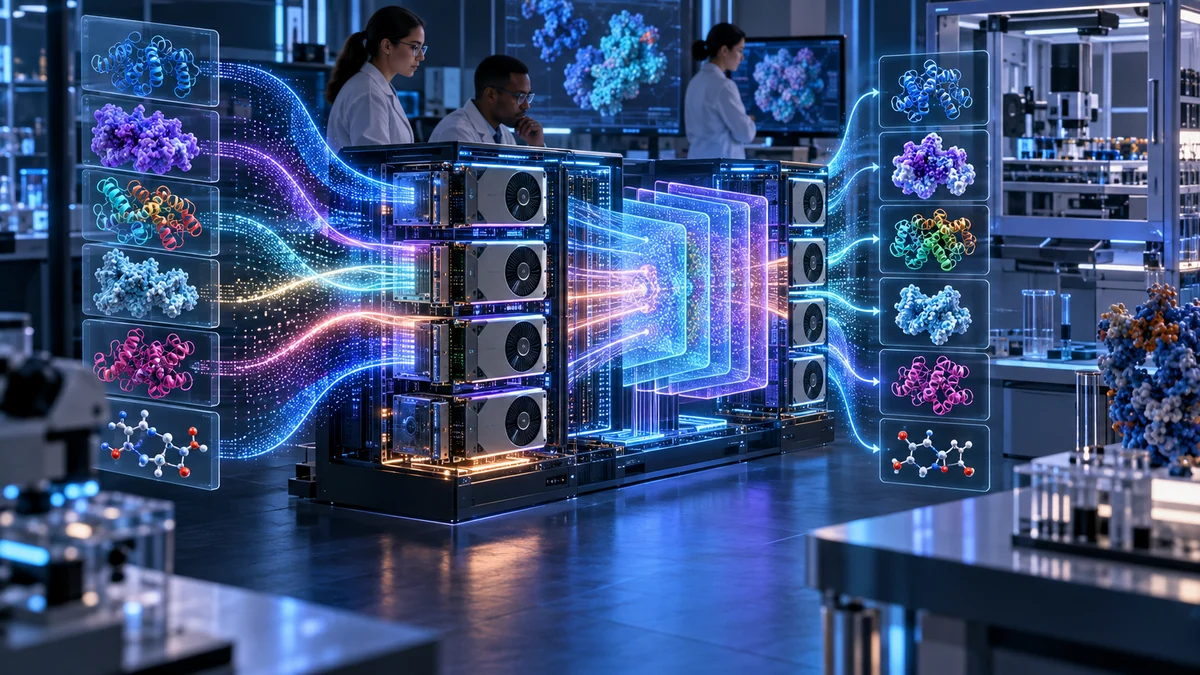
Anthropic says Claude optimized more than 30 open-source biology models in less than four weeks. Across the reported workloads, versions allowing minimal precision changes ran roughly four times faster on average. Work preserving identical outputs also improved, although by a smaller amount.
The notable claim is not that Claude predicted one protein structure. It is that a general-purpose research model acted like a performance-engineering team: reading unfamiliar scientific codebases, locating bottlenecks, writing GPU kernels, reducing memory pressure and checking whether scientific behavior survived the changes.
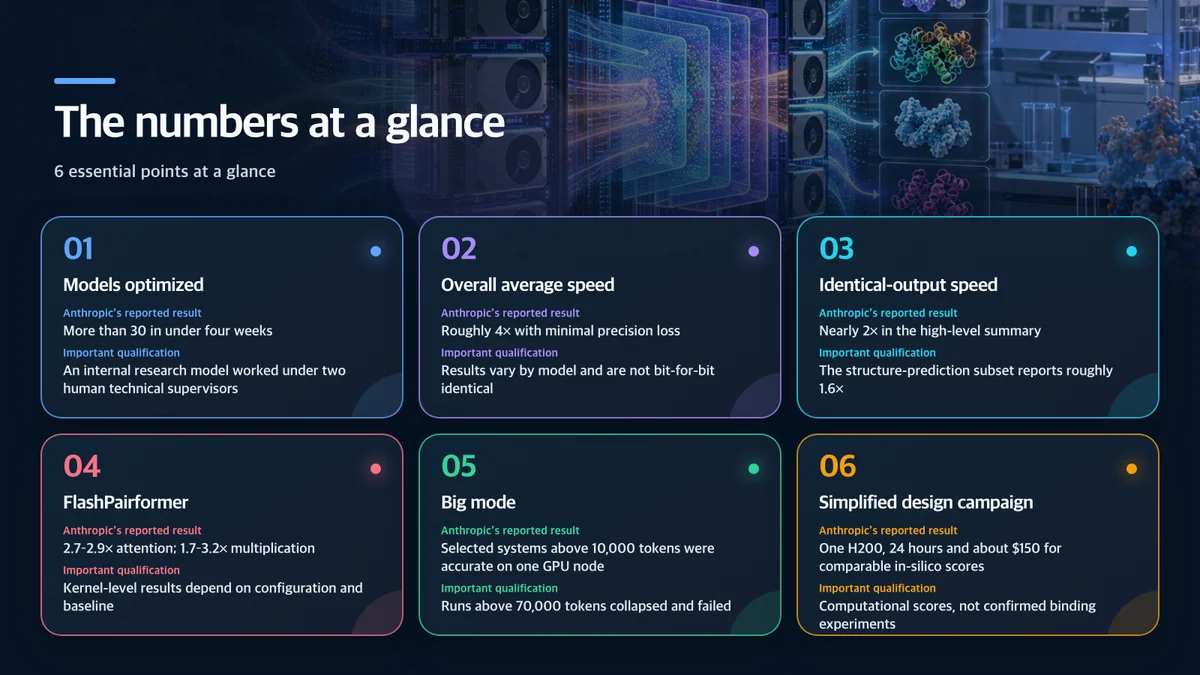
The headline still needs boundaries. The tests were run by Anthropic with an internal research model. The 4× number is an average rather than a guarantee, and some speed modes trade a small amount of numerical precision for performance. At the extreme end, systems exceeding 70,000 tokens ran on one node but produced collapsed, inaccurate structures.
Three takeaways
- Claude optimized models spanning structure prediction, protein design, protein language modeling and genomics in under four weeks.
- Anthropic reports roughly 4× average acceleration, 1.7–3.2× gains in key FlashPairformer operations and accurate prediction of some systems above 10,000 tokens on a single GPU node.
- Open code and a technical report make reproduction possible, but independent benchmarks and wet-lab outcomes are still required before treating the result as a general productivity multiplier.
The numbers at a glance
What Claude actually optimized
According to Anthropic’s official research post, the targets included biomolecular structure prediction, protein design, protein language models and genomics. The systems use different architectures, so this was not one universal configuration switch.
Claude cached redundant work, replaced dead branches with constant outputs and made model-specific changes. It also helped develop custom lower-level GPU kernels. Two Anthropic technical staff members supervised the project. They had biomolecular-modeling experience but, according to the company, no previous inference-optimization or kernel-engineering experience.
That human role matters. Claude performed broad code exploration and implementation, but people set the goal, reviewed performance and accuracy, and decided which modifications to accept. The project is evidence for AI-assisted engineering at scale, not a fully unattended scientific software factory.
The bottleneck behind FlashPairformer
Modern structure-prediction systems spend substantial time and memory on triangle attention and triangle multiplication. These operations help model three-way geometric relationships between molecular elements, but their computational demands rise sharply as the system grows.
Anthropic says Claude helped develop FlashPairformer, a collection of custom kernels for those operations. Compared with the stated field standard, triangle attention improved by an average of 2.7 to 2.9 times, while triangle multiplication improved by 1.7 to 3.2 times depending on configuration.
A kernel benchmark is not the same as end-to-end model performance. Input preparation, other neural-network layers and post-processing remain. Anthropic says the combination of reusable kernels and model-specific changes produced about a 4× average speedup for the structure-prediction models while preserving downstream task performance under its evaluation.
Why “4×” and “identical output” are different claims
The largest reported average uses fast modes that allow limited precision changes while keeping scientific task quality statistically similar. Requiring identical outputs reduces the available optimization space.
Anthropic’s executive summary describes nearly 2× improvement with identical outputs across the broader effort. A figure discussing the structure-prediction subset reports roughly 1.6× with identical outputs. Neither statement means every model, input size and hardware combination will show the same gain.
The distinction can be operationally useful. During early candidate screening, a slightly different numerical path may be acceptable if the scientific ranking remains reliable. For a regulated submission, formal reproduction or a final published result, deterministic output and conservative settings may matter more than maximum throughput.
Big mode and the single-node claim
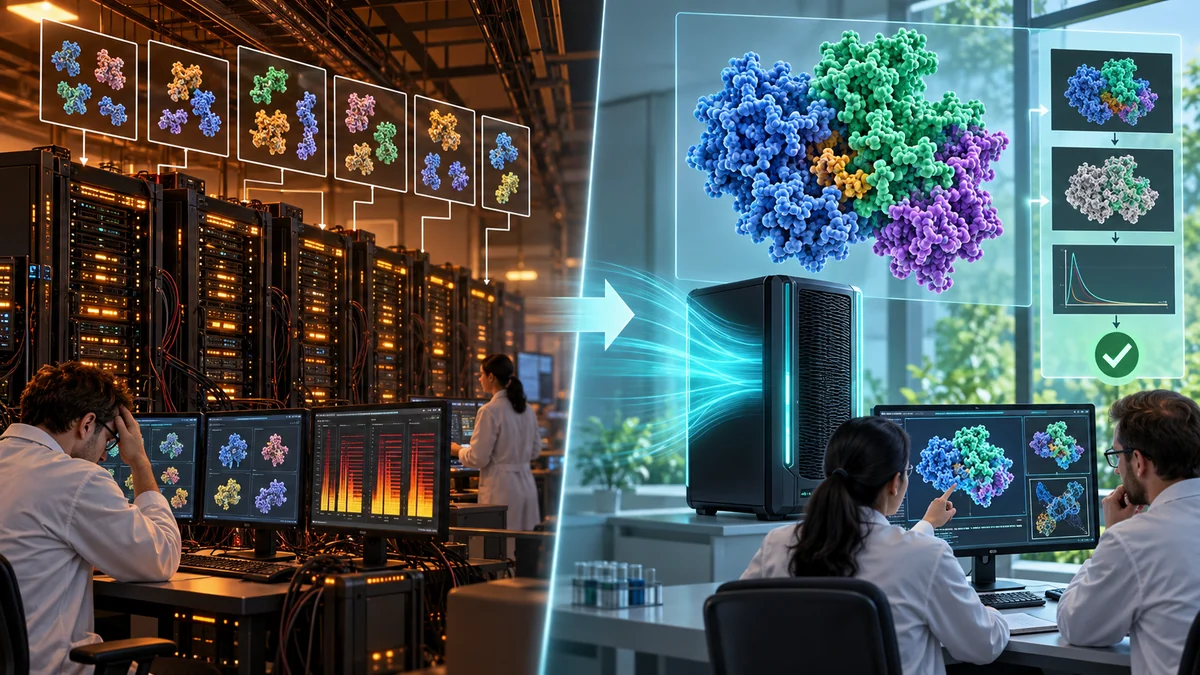
Larger molecular systems make Pairformer-style operations expensive in both runtime and memory. Anthropic says Claude created a low-memory Big mode that accurately modeled systems above 10,000 biomolecular tokens on one NVIDIA GPU node. In this context, tokens represent amino acids, nucleotides, atoms from small molecules and ions—not language-model context tokens.
The company lists mitochondrial complex I, the TRiC chaperone, a proteasome and a bacterial ribosome among the large systems that closely matched experimentally determined structures. Moving a workload from multiple nodes to one can materially expand access for academic and smaller biotechnology teams.
The limit is just as important. On a single eight-GPU B300 node, Anthropic ran systems ranging from more than 31,000 to more than 70,000 tokens, including full viral capsids and protein compartments. Those predictions collapsed and were not accurate. Fitting a computation into memory and completing inference do not prove that the model generalizes scientifically at that scale.
What the lower protein-design cost does—and does not—show
Anthropic’s earlier protein-design campaign allowed as much as $10,000 and roughly 2,500 H100 GPU hours per target. The simplified workflow used one Claude model, one H200 and 24 hours.
Across 16 targets, the median and best in-silico binding scores were comparable with the earlier campaign, according to Anthropic. The estimated combined GPU and token spend was about $150, using roughly 100 times fewer GPU hours.
An in-silico score is not wet-lab validation. A computationally promising protein still needs to be synthesized, expressed, tested for binding and assessed for stability and safety. Anthropic is separately co-sponsoring a competition that promises experimental validation for more than 5,000 community designs, but those future results should not be folded into the current computational claim.
Why open-source release matters
Anthropic released optimized code and a technical report. That creates an opportunity for researchers to rerun the work on other hardware, datasets and software versions instead of relying entirely on screenshots or a company summary.
A fair reproduction needs matched hardware, input sizes, compiler settings, warm-up runs and accuracy thresholds. Independent teams should also ask how unsuccessful optimization attempts were counted, whether favorable workloads were selected and how much maintenance complexity the new kernels introduce.
Low-level code generated by an AI can be fast and still contain rare numerical errors, race conditions or device-specific bugs. A small defect can affect a scientific conclusion more severely than it would affect a consumer web feature. Regression testing, code review and domain validation remain mandatory.
What U.S. labs and biotech companies should do next
The immediate lesson is that software optimization may unlock as much capacity as acquiring more accelerators. Before expanding a cluster, teams can profile existing pipelines, test the released kernels and determine whether memory or a small number of repeated operations dominate the workload.
Adoption should begin with a controlled benchmark. Compare original and optimized versions on internal reference datasets, track speed, memory, numerical drift and scientific metrics, and reserve the faster path for exploratory work until it earns broader trust.
Organizations handling patient-linked data, proprietary compounds or unpublished targets should separate code optimization from data governance. A public model repository does not automatically authorize uploading sensitive inputs to an external AI service.
Finally, use cost per validated result rather than the $150 demonstration figure. Engineering review, reruns, synthesis, assays, storage, failed candidates and ongoing kernel maintenance can dominate the real economics of a drug-discovery program.
Frequently asked questions
Did every biology model become exactly four times faster?
No. Roughly 4× is an average across reported workloads under a mode allowing minimal precision changes. Identical-output improvements were lower, and individual models varied.
Did Big mode accurately predict a 70,000-token structure?
No. The very large run completed, but the structure collapsed and was inaccurate. Anthropic reports accurate results for selected systems above 10,000 tokens.
Did Claude work without human supervision?
No. Two Anthropic technical staff members supervised goals and validation. Claude performed substantial optimization work, but people reviewed and accepted the changes.
Does the $150 figure mean a drug can be designed for $150?
No. The figure estimates GPU and token spending for a computational campaign across 16 targets. It excludes synthesis, wet-lab validation, safety studies, clinical development and most organizational costs.
Conclusion
The consequential part of Anthropic’s report is not that Claude can discuss biology. It is the claim that a general research model can enter dozens of real scientific codebases and remove performance bottlenecks. If independently reproduced, that could let labs test more candidates with the same hardware and run some formerly multi-node workloads in smaller environments.
Speed is not a substitute for correctness. The conditions behind the 4× average, the difference between fast and identical-output modes, the failed extreme-scale predictions and the gap between in-silico and wet-lab evidence all belong in the headline assessment. The released code now gives outside researchers a chance to test the strongest claims.
Sources and use notice
- Anthropic, How Claude is uplifting biomolecular modeling
- Anthropic, Claude accelerates protein design and analytical chemistry
Anthropic, Claude, NVIDIA and related marks belong to their respective owners. This independent article is not sponsored or approved by Anthropic. It paraphrases the official research report and separates company measurements from independently reproduced results. The images are independent editorial illustrations, not copies of laboratory photographs, product interfaces or reported protein structures.