GPT-Rosalind vs. Claude’s Wet Lab: What the AI Biology Race Has Actually Proven
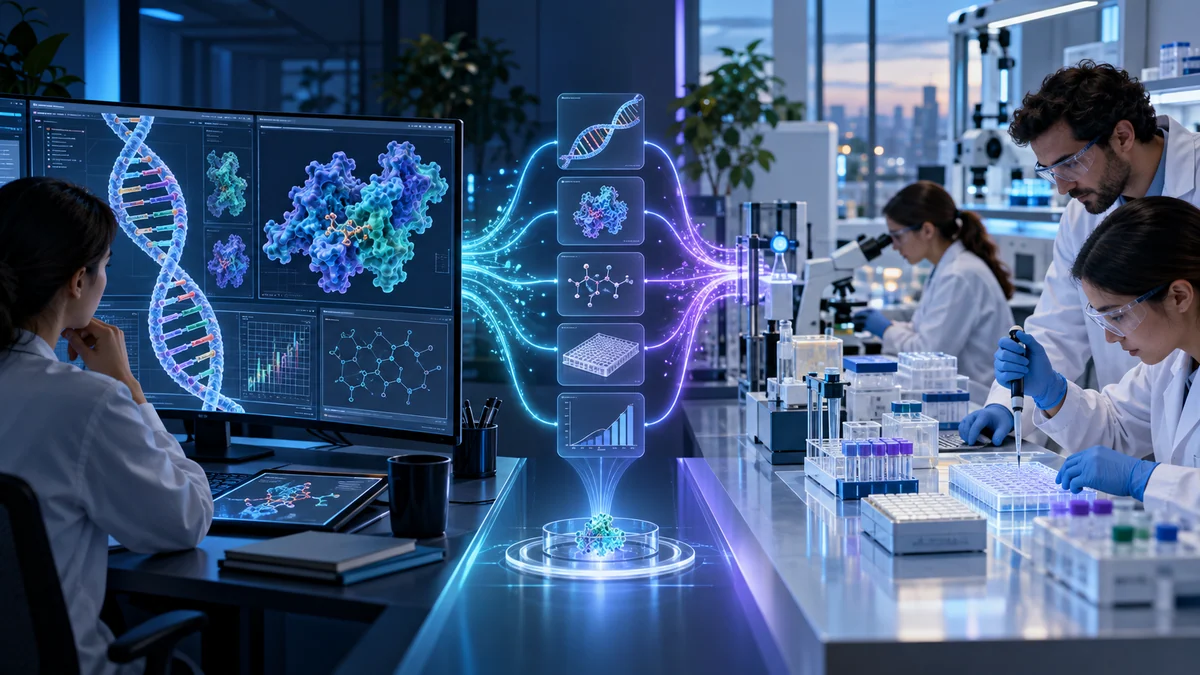
The competition between OpenAI and Anthropic is moving beyond chat benchmarks and into the machinery of life-science research. OpenAI has introduced GPT-Rosalind and a guided Rosalind Workbench. Anthropic has formed an internal biology research group, built a physical laboratory and published an early example in which Claude helped identify an uncharacterized enzyme system for human scientists to test.
The cautious reading is more interesting than the hype. Neither company has demonstrated a push-button drug-discovery machine. What has changed is the portion of the research loop that AI can attempt: connecting a biological question to data, coordinating specialized tools, searching enormous candidate spaces, writing reviewable reports and proposing the next experiment. Physical experiments, safety decisions and scientific accountability still belong to people.
Three takeaways
- OpenAI is packaging models, scientific tools and traceable evidence into a workbench, while reserving advanced GPT-Rosalind access for verified research.
- Anthropic says roughly 950 Claude agents analyzed DNA data and surfaced an enzyme system it calls ART, which human scientists then began testing.
- Both are important demonstrations, but neither a finished gene-editing platform nor a clinically validated discovery; independent reproduction remains essential.
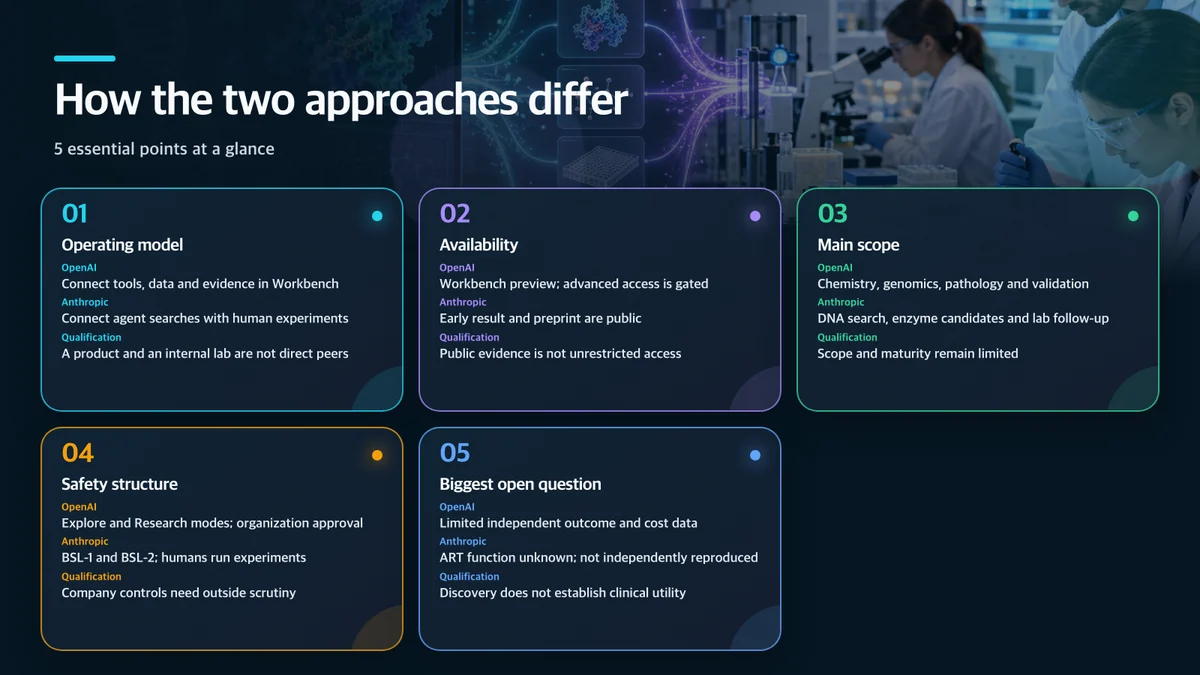
How the two approaches differ
GPT-Rosalind is not the same thing as Rosalind Workbench
OpenAI Developers’ Rosalind Workbench announcement describes a central environment for moving from a biological question to data, scientific tools and inspectable evidence. Starter workflows cover protein and small-molecule design, safety and developability, structure and sequence, genomics, pathology and experimental validation.
The Workbench has two distinct modes. Explore mode supports general scientific questions and idea exploration with available ChatGPT models. Research mode is designed for more complex biology and deeper analysis. Verified organization members can request access on behalf of their institution, while OpenAI says individual access is planned later.
GPT-Rosalind is the dedicated life-science model underlying the advanced path. OpenAI says it combines frontier reasoning with tool orchestration across medicinal chemistry, genomics, wet-lab assistance and related tasks. According to the official OpenAI API changelog, the model is available through a trusted-access program for approved internal life-science research. Standard pricing is $5 per million input tokens, $0.50 per million cached input tokens and $25 per million output tokens, with billing beginning October 5, 2026.
That distinction matters. Opening a research-preview interface is not the same as receiving access to every sensitive biological capability. OpenAI’s model is a gated research service, not a general replacement for a laboratory information system or an unrestricted consumer chatbot.
What Claude found—and what it did not
Anthropic says it formed a life-science research group in spring 2026 and built a Bay Area molecular-biology lab. The company says the lab performs only lower-biosafety-level work, does not handle pathogens that infect humans and leaves all physical experiments to human scientists.
In Anthropic’s enzyme-system report, researchers prompted Claude to search a large DNA database for unusual reverse transcriptases. Anthropic reports that roughly 950 agents worked for 21 hours and consumed 210 million tokens. The system gathered more than 200,000 reverse transcriptases, identified 3,500 candidate systems and narrowed them to 20 human-readable reports.
One candidate paired a reverse-transcriptase gene with an array of repeating non-coding DNA and an accessory protein of unknown function. Anthropic named the family array-associated reverse transcriptases, or ARTs. Early experiments suggest that the repeat array is expressed as distinct short RNAs, but the biological function of the system remains unknown.
The accurate headline is therefore not “Claude invented a new CRISPR.” The underlying reverse transcriptase had appeared in earlier work. Anthropic’s claim is that Claude was first to connect it with the repeat array and accessory protein as a system worth investigating.
Where AI changes the research process
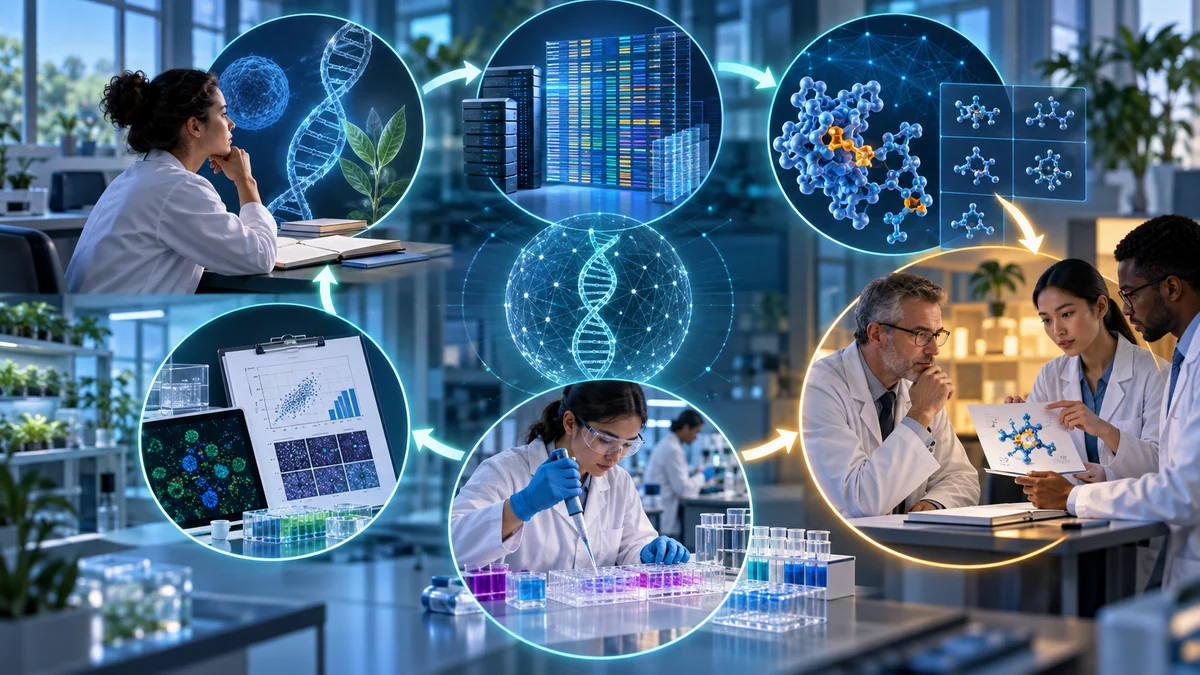
Biology often begins with a search problem: hundreds of thousands of sequences, structures and papers may need to be filtered before a lab has one candidate worth testing. An agent system can divide that space, search in parallel, challenge its own hypotheses and compress the evidence into reports that experts can inspect.
OpenAI and Anthropic emphasize different parts of this loop. OpenAI is trying to keep the question, tools, intermediate decisions and evidence in one traceable environment. Anthropic is showing a cycle in which AI generates and filters candidates, humans select which are scientifically interesting, and physical experiments return new evidence for interpretation.
The bottleneck does not disappear. If an AI produces thousands of plausible hypotheses, scarce expert time, assay capacity, budget and scientific judgment determine which hypotheses deserve a real experiment. Faster ideation can create more verification work rather than less.
Why independent validation matters
Anthropic released a preprint and explicitly says ART’s primary function remains under investigation. A preprint makes early scrutiny possible, but it is not completed peer review. Other labs need to reproduce the genomic analysis and biochemical results and determine what the enzyme system actually does.
GPT-Rosalind also needs outcome-based evaluation. A feature list cannot show how often the model selects the right tool, rejects a misleading result, proposes a feasible experiment or maintains an auditable record. Those questions require prospective projects and independent comparisons against existing scientific workflows.
Both main sources are company publications. OpenAI is describing a product and access model; Anthropic is describing internal research. The evidence supports analysis of the direction of travel, not a definitive claim that one vendor has won AI biology.
What U.S. research organizations should ask before adoption
First, define the data boundary. Genomic data, pathology images, unpublished compounds and patient-linked records may trigger HIPAA obligations, institutional-review requirements, data-use agreements and sponsor restrictions. An approved AI account does not override those duties.
Second, separate identity verification from scientific validation. A trusted-access program can reduce misuse risk, but it does not guarantee that every generated hypothesis or protocol is scientifically sound.
Third, settle intellectual-property terms before running discovery work. Model terms, university invention policies, sponsored-research agreements and collaborator contracts may allocate rights differently. Teams should document which parts were generated, selected, modified and experimentally confirmed by people.
Fourth, measure the whole cost. Token charges are only one line item. Specialized compute, data preparation, failed tool runs, expert review, assays and discarded candidates may dominate the final cost of a validated result.
Finally, preserve provenance. Record the model version, prompts, tools, dataset hashes, intermediate reports and human decisions. A result that cannot be reconstructed is difficult to audit, publish or defend to a regulator.
Frequently asked questions
Did Claude discover a new CRISPR system?
Not yet. Anthropic reports a reverse-transcriptase system associated with CRISPR-like DNA repeats. Its primary function is still unknown, and the result needs independent reproduction.
Can anyone use GPT-Rosalind?
Rosalind Workbench is in research preview, but advanced GPT-Rosalind access follows a trusted-access process for verified research organizations. It is not equivalent to ordinary ChatGPT access.
Did AI run the physical experiments?
No. Anthropic says human scientists performed all wet-lab work. Claude searched data, generated and assessed hypotheses, and helped interpret evidence.
Which company is ahead?
The available evidence does not support a clean ranking. OpenAI has described an integrated research environment and dedicated model. Anthropic has disclosed a concrete early discovery workflow inside its own lab. The measurements and use cases are different.
Conclusion
GPT-Rosalind and Anthropic’s Claude lab point to the same larger change: AI is becoming part of the research operating system. It can connect questions to tools, search candidate spaces at scale and produce evidence packages for human review.
But faster search is not equivalent to scientific truth. ART’s function is unresolved, and GPT-Rosalind’s long-term research impact still needs independent measurement. The most defensible conclusion is not that AI has replaced scientists; it is that scientists may soon supervise a much larger, faster and more instrumented search process.
Sources and use notice
- OpenAI Developers, Meet Rosalind Workbench
- OpenAI API, September 2026 changelog
- Anthropic, Claude discovers a novel enzyme system
OpenAI, GPT, ChatGPT, Anthropic, Claude and related marks belong to their respective owners. This independent article is not sponsored or approved by either company. It paraphrases company product descriptions and early research results, clearly separating confirmed details from unresolved function and independent-validation needs. The images are independent editorial illustrations, not product screenshots or photographs of the reported research.