Was Claude Opus 5.5 Nerfed? The October Data Check
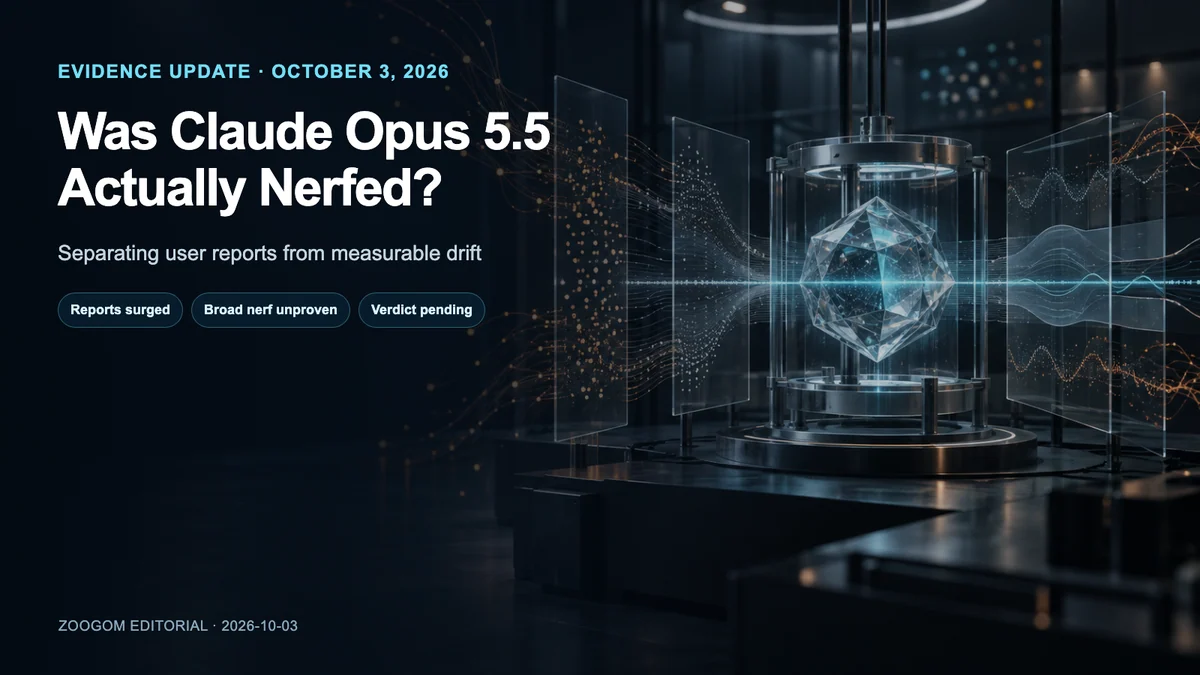
Reports that Claude Opus 5.5 had become shorter, less attentive and harder to steer accelerated across X and Reddit from September 30 through October 2. For a developer paying for Claude Code, a regression that adds two repair passes to every task is operationally real even before a benchmark captures it. The harder question is attribution: did the underlying model change, or did a product layer, conversation state, configuration or service path change what the user received?
The evidence available on October 3 supports a deliberately narrow answer. There is a signal worth investigating, but there is no public demonstration of a broad downgrade to Opus 5.5 weights, quantization or serving compute. BridgeBench moved down to 94.2% of its launch reference, yet that value remains inside the service’s own normal range. LiveNerf has completed a useful launch-period baseline, not a post-baseline decision. This is a new update rather than a rewrite of the September 27 fact-check, and it does not present a Zoogom-run head-to-head benchmark.
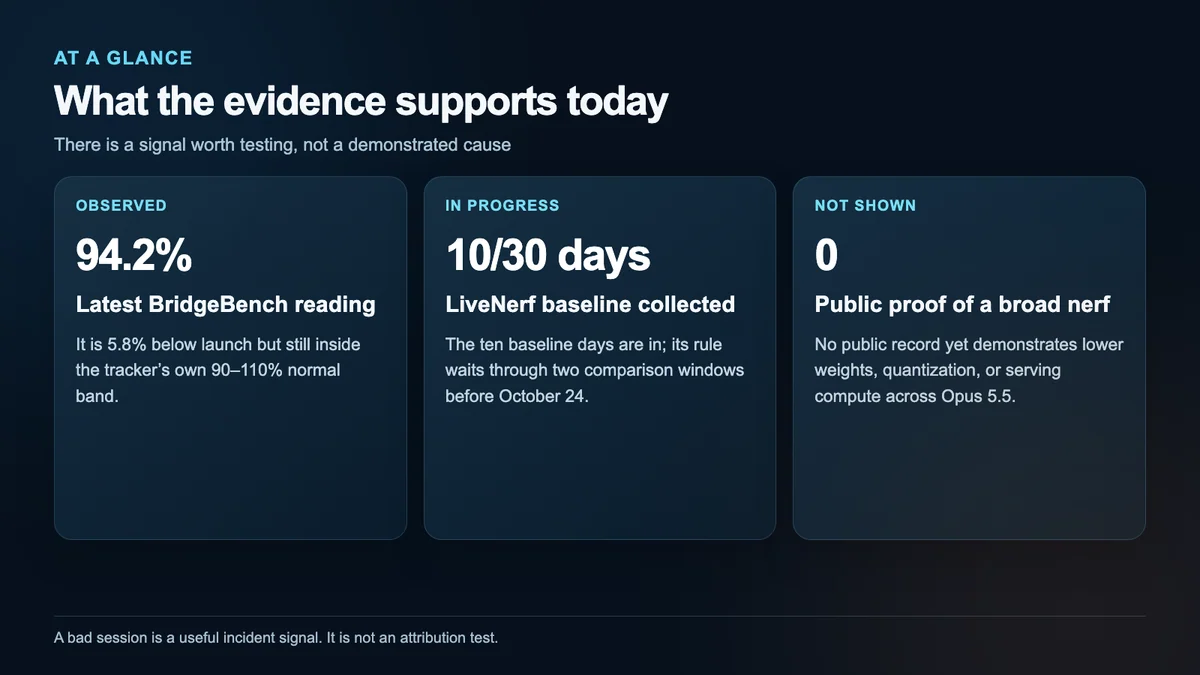
The verdict in one screen
- Observed: Complaints increased at the end of September, and BridgeBench recorded 94.2% of launch power on October 2.
- Still being measured: LiveNerf completed days 1–10. Its rule requires two subsequent ten-day windows before a formal determination.
- Not demonstrated: No public artifact shows that Anthropic replaced the underlying Opus 5.5 model, reduced its quantization quality or lowered compute for all users.
- Easy to conflate: A pinned model identity does not make the app router, safety fallback, Claude Code harness, tools, context state and infrastructure immutable.
For a U.S. API or enterprise team, this means incident response should begin now, but a vendor-level downgrade should not be entered as the root cause without matched logs. Preserve request IDs and environment data first. A weakly specified accusation is difficult for both an internal platform team and the provider to test.
Four different changes can feel like one nerf
The strongest version of the claim is a model substitution: different weights or lower-fidelity quantization behind the same identifier. A second possibility is a reasoning-budget change, such as a different effort default or output cap. A third is routing, including disclosed safety fallback. A fourth is everything around the model: CLI releases, tools, permissions, system instructions, context compaction, caching and service incidents.
All four can produce omissions, brief answers or more failed tool calls. Only the first is a silent underlying-model nerf. A good regression report therefore records selected and returned model, effort, output budget, conversation state, harness version, tools, region and timestamp. Without those fields, a painful production symptom may be valid while the proposed mechanism remains guesswork.
How the claim accelerated over eleven days
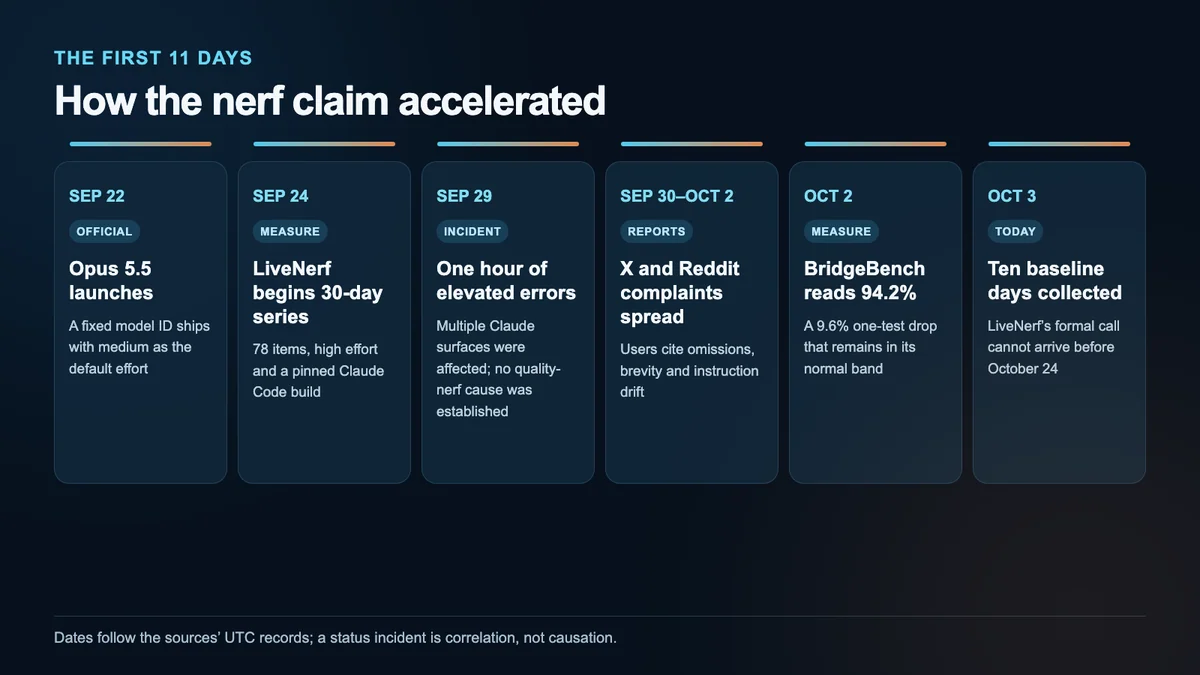
Anthropic’s official Opus 5.5 launch page establishes September 22 as the release date. LiveNerf began daily collection on September 24. Claude services then experienced about an hour of elevated errors on September 29. User reports became more visible over the next several days, BridgeBench posted 94.2% on October 2, and LiveNerf finished its first ten collection days on October 3.
That sequence gives investigators useful time boundaries; it does not establish causality. The official Claude Status history documents the September 29 incident across multiple surfaces, but it does not identify a persistent reasoning-quality downgrade as the cause. No new incident was posted for October 2 or 3. Conversely, a green status page is not a guarantee that every qualitative regression will be detected or listed.
What LiveNerf actually froze
The LiveNerf repository is the most structured public attempt to measure this launch. Its calibration screened 2,336 questions, drawing from MMLU-Pro and GPQA Diamond as well as competition math and the 2025–26 AIME sets. Because items that are always right or always wrong provide little sensitivity, the project retained 78 questions that Opus 5.5 answered inconsistently: 59 MMLU-Pro, 12 GPQA, four competition-math and three AIME items.
The primary arm runs each item once per day at explicit high effort. It pins Claude Code 2.1.280 and a harness hash, uses one turn in an empty working directory, and excludes tools, MCP servers, settings, hooks, project instructions and memory. Exact-match graders avoid a second language model that could drift. An Opus 5 control arm helps expose harness or platform movement shared by both models.
Ten days produced 780 primary-panel observations. The project’s 90 calls per day also include control-arm activity, so “780 primary samples” and “90 total daily samples” describe different scopes rather than conflicting counts. The value of this design is not that every variable is controllable—hosted sampling is not—but that the prompts, grader, client and comparison rule were fixed before the result window.
A baseline is not a finding
Days 1–10 define the launch reference. Days 11–20 form the first comparison window, and days 21–30 form the second. LiveNerf’s preregistered rule requires the 99% interval to exclude zero in both comparison windows, a change of at least three points, and no corresponding move in the control arm. The first possible formal call is therefore around October 24.
This distinction matters because launch week may itself be unusually strong or unusually weak. Capacity pressure, a new serving stack or launch bugs could make it an imperfect representation of the underlying model. The series is designed to report improvement as well as degradation. Treating baseline collection as evidence of a decline would assume the very effect the project is waiting to measure.
The 7.5-point sensitivity limit
The design predicts a minimum detectable accuracy shift of roughly 7.5 points per ten-day window. A real two- or four-point change could go undetected. During validation, substituting Opus 5 for Opus 5.5 was not distinguishable at the 99% level in the available sample, illustrating that the instrument cannot identify every same-family substitution.
There is also item uncertainty. A report-only audit found eight answer keys that appear wrong and 30 ambiguous questions among the 78 retained items plus two later exclusions. The project keeps the locked panel intact and uses a preregistered sensitivity analysis rather than silently cleaning it after seeing results. That protects the test from researcher choice, but it does not make questionable questions disappear from interpretation.
Finally, the target is specific: Opus 5.5 delivered through headless Claude Code on one Max subscription. It is not the raw Anthropic API, ordinary claude.ai chat, a million-token conversation, a tool-rich software agent or every geography. The scope overlaps many complaints, which makes it useful. It cannot establish that every customer surface moved together.
Why BridgeBench 94.2% is a signal, not a conviction
The BridgeBench Opus 5.5 history showed 103.8% on October 1 and 94.2% on October 2. That is a 9.6-point swing from one test to the next and a latest reading 5.8% below launch. It is reasonable to watch. It is not reasonable to omit that the same product labels 90–110% as normal variation.
Its methodology description explains that “power” is a proprietary composite of task performance, token use and cost rather than a simple accuracy rate. The displayed 0.6/0.2/0.2 weights are expressly illustrative; the production tasks, categories and weights remain private. With four published tests, an independent reviewer cannot rerun the exact panel, inspect component contributions or estimate stable model-specific variance.
The BridgeMind X update reported the October 2 drop while also retaining the normal-variance qualification. The responsible reading is that a private tracker emitted a watch signal. Saying it “confirmed a nerf” would contradict its own classification.
Three gauges that should never share a unit
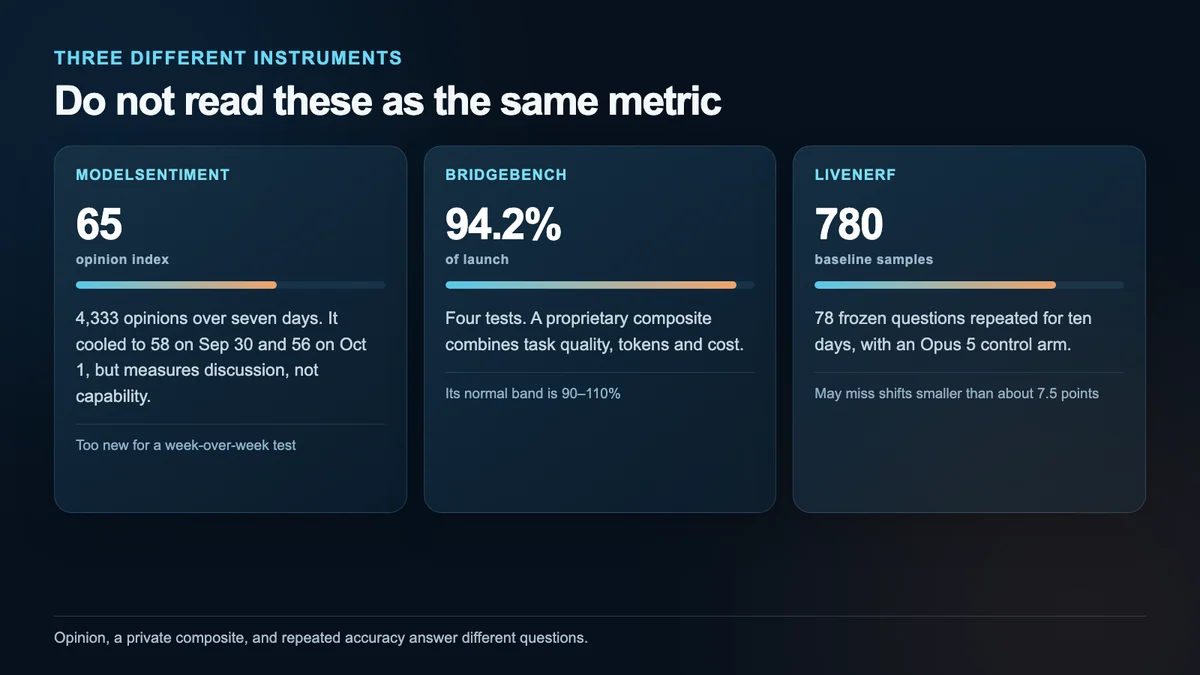
The ModelSentiment Opus 5.5 page displayed an index of 65 with a 62–68 confidence interval at 08:16 UTC on October 3. It summarized 4,333 opinions from 1,301 Reddit threads over seven days. Daily readings cooled to 58 on September 30 and 56 on October 1, while the partial October 3 value was 73. A week-over-week comparison is not yet available because the model has not completed two full weeks.
That index measures discussion, not capability. It can reveal when dissatisfaction concentrates and help researchers choose failure categories, but it is affected by community mix, attention and language. BridgeBench measures a private composite. LiveNerf will measure paired repeated accuracy and output-token behavior. Combining 65, 94.2% and 780 into a single trend line would mix opinion, a normalized score and a sample count.
What the community reports can and cannot establish
The Reddit LiveNerf Day 8 discussion is retained only as a reader route into the public discussion. Because its source text could not be retrieved reliably for this review, the thread is not used as evidence for a number, verdict, or expression comparison. The baseline status and decision timing come from the public LiveNerf repository; community reports remain symptoms to test, not proof of a model change.
Claude Code issue #96205 is more concrete than a generic post. It names Windows, Claude Code 2.1.280 and a feedback ID, and describes a sharp quality change. It still lacks a rerunnable prompt set, paired responses, serving-model records, effort values and repeated trials. It is a supportable incident lead rather than a service-wide A/B experiment.
An independent analysis of the frozen-panel method reaches the appropriately limited position: no drop had been demonstrated by October 2, and the project measures a particular subscription path with finite power. Anecdotes tell us where to probe. Controlled repetition tells us whether the distribution moved. Neither function should impersonate the other.
The pinned model ID changes the burden of proof
Anthropic’s model IDs and versions documentation says dateless IDs beginning with Claude 4.6 identify a pinned underlying model version for the lifetime of that ID. That differs from older convenience aliases that could point to newer snapshots. For an API request using claude-opus-5-5, a claim that Anthropic silently swapped the underlying model behind the unchanged ID now requires evidence against an explicit versioning guarantee.
The guarantee is strong but bounded. It does not hash the API gateway, safety classifier, load-balancing behavior, system prompt, caching, Claude Code client or a first-party app’s context handling. A team can therefore hold the model ID constant and still observe a changed product result. “The underlying ID is pinned” and “some user-facing path regressed” are compatible statements.
For enterprise observability, log both the requested identifier and the model returned with the response. Keep region, request ID, timestamps, token accounting, effort and product version next to application-level pass criteria. A human memory that the same prompt worked last week is valuable for discovery, but it is not enough to challenge version identity.
The default effort is not the old default
Anthropic’s Opus 5.5 change guide specifies medium as the default effort, while Opus 5 defaulted to high. Opus 5.5 also keeps adaptive thinking enabled. A migration test that omits effort for both model generations is not holding the reasoning setting constant.
Thinking and tool-call presentation changed as well. Progress material can appear in thinking blocks, and a client using an omitted display mode may look quiet between actions. A tight output budget can interact with reasoning and final-answer space. Regression suites should set effort and output limits explicitly, and should score task completion separately from visible verbosity.
This also explains why a one-prompt showcase is weak evidence. Hosted generation varies from run to run, and a configuration default can produce a systematic mismatch. The right comparison is a distribution of gradeable outcomes under a recorded configuration.
Disclosed fallback is not a hidden model downgrade
Anthropic’s model-switching help article documents safety-related fallback on first-party Claude surfaces and Claude Code. Certain requests can be handled by Opus 5 or Opus 4.8. The product is supposed to disclose the switch and identify the responding model. API fallback is opt-in rather than an automatic default.
That mechanism does not show that Opus 5.5 itself weakened. It can nevertheless create the same user impression if a notice is missed or if subsequent work continues on the fallback model. The classifier may consider files, memory and retrieved material in addition to the latest instruction, so an apparently harmless prompt may not reveal the triggering context.
Record the model shown on the actual response, not only the model selected at the beginning of a conversation. If policy permits, API teams can run a controlled arm without fallback and compare explicit refusal, routing and quality outcomes rather than folding them into one failure bucket.
Long context changes the effective prompt
The paid-plan context documentation describes supported windows up to one million tokens and automatic summarization as conversations approach limits. A long-running coding session accumulates abandoned requirements, failed tool output, stale paths and compressed decisions. Re-entering the same visible instruction does not reproduce the full input presented on launch day.
Preserve the failing conversation, then repeat the task in a clean thread against the same repository commit. If only the long thread fails, there is a real reliability issue, but context management becomes a more plausible cause than a global weights change. If both fail repeatedly under pinned settings, the case for a broader serving regression strengthens.
Enterprise teams should also distinguish conversational memory from request payloads, server-side prompt caching and their own retrieval layer. “Same prompt” is meaningful only after defining which of those layers is included.
A reproducible regression packet for API teams
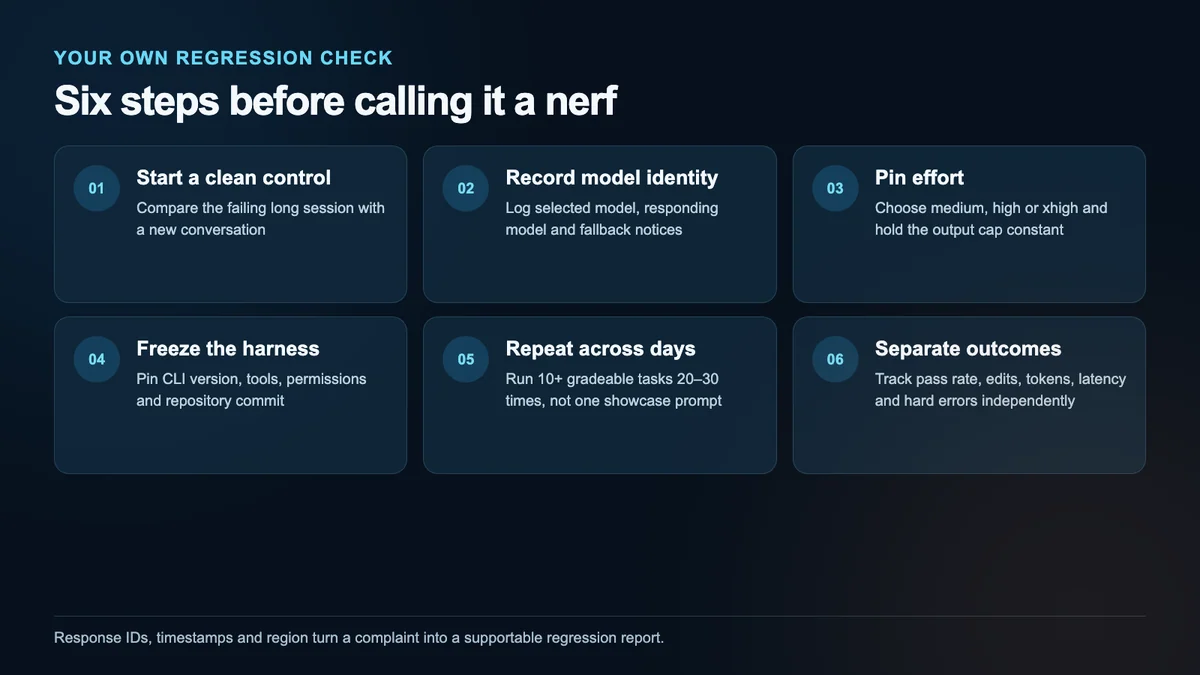
- Keep the failing trace and run a clean-conversation control.
- Record requested model, returned model and every fallback notice or response field.
- Pin one effort level and a constant output budget.
- Freeze client and SDK versions, tools, permissions, system prompt, repository commit and test data.
- Use at least ten tasks with deterministic checks, then collect 20–30 matched trials across multiple time windows.
- Report pass rate, human repair count, omissions, tokens, latency and hard errors as separate outcomes.
Attach request IDs, timestamps and region to a provider ticket. Redact customer data and proprietary prompts, but preserve a minimal structure that the recipient can reproduce. If an evaluation uses a judge model, version and validate that judge or provide deterministic tests. Do not average hard errors and semantic failures into a number that hides which layer moved.
What would change the current conclusion
A LiveNerf result after both comparison windows that crosses its preregistered interval in the same direction, exceeds the minimum effect and leaves the Opus 5 control stable would be strong evidence of a measurable shift on the subscription Claude Code path. Matched API runs that reproduce the change across regions under a pinned ID would broaden the claim. A provider incident report could then connect the observed movement to routing or infrastructure rather than the weights.
If the series remains near baseline and BridgeBench continues to oscillate within 90–110%, attention should narrow toward task mix, conversation state, product routing and harness changes. A null result would not prove that every user’s problem was imaginary; LiveNerf may miss small effects and does not cover agentic coding. It would constrain the size and scope of the broad claim.
Bottom line on October 3
The complaints are a legitimate reliability signal. The measurement program is real. The broad nerf conclusion is not yet earned. BridgeBench’s 94.2% is inside its own ordinary range, ModelSentiment’s 65 describes community opinion, and LiveNerf’s 780 primary baseline samples define the reference from which change will later be measured.
For now, call this an open regression investigation rather than a confirmed model downgrade. Pin the variables your team controls, capture the variables the provider exposes and revisit the preregistered series after roughly October 24. This verdict is a dated snapshot as of October 3, 2026 and should move when stronger evidence arrives.
Sources and editorial disclosure
- Launch: Anthropic, Claude Opus 5.5
- Version identity: Claude Platform, model IDs and versions
- Migration behavior: Claude Platform, what’s new in Opus 5.5
- Fallback: Anthropic Help Center, why Claude switched models
- Context: Anthropic Help Center, paid-plan context window
- Service history: Claude Status
- Repeated panel: LiveNerf
- Composite history: BridgeBench, Claude Opus 5.5
- Tracker method: BridgeBench, how Nerf Bench works
- Opinion index: ModelSentiment, Claude Opus 5.5
- Community context link (verdict-independent): Reddit, LiveNerf Day 8 update
- Product report: GitHub, Claude Code issue #96205
- Daily update: BridgeMind on X
- Independent method review: Stackness, the frozen eval panel and LiveNerf
Anthropic and Claude names and marks belong to their respective owner. Zoogom is not sponsored or endorsed by Anthropic, LiveNerf, BridgeBench or ModelSentiment. Links are provided for verification; no source post, screenshot, interface, avatar, table or chart is reproduced. The inaccessible Reddit link is classified only as non-dependent community context. The prose and infographics are an independent editorial synthesis of public material with explicit evidence boundaries.