Inside OpenAI’s adversarial model-distillation incident
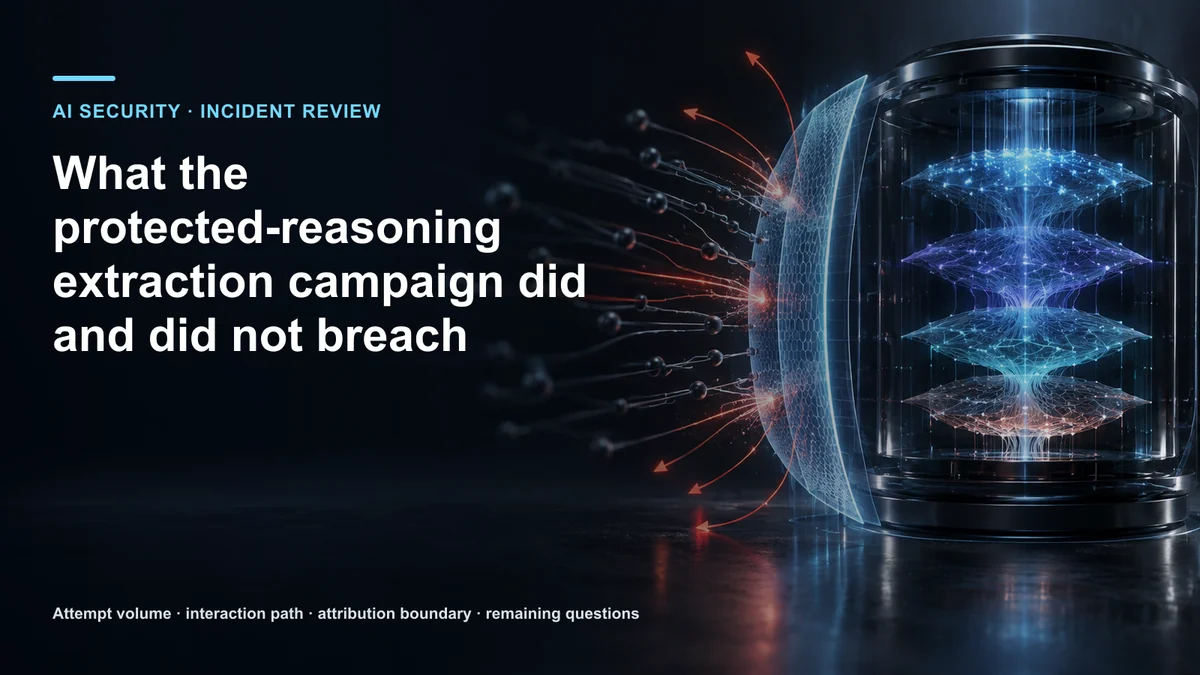
OpenAI reported about 16000 requests with a relevant extraction pattern from more than 4000 users on July 24 and 25. Investigators tied similar prompts to an account population above 15000 and said that group was disrupted by July 28. This guide separates confirmed events, attributed claims, technical limits, and the evidence still needed for a practical decision.
Start with the boundary: this was not reported as a database breach
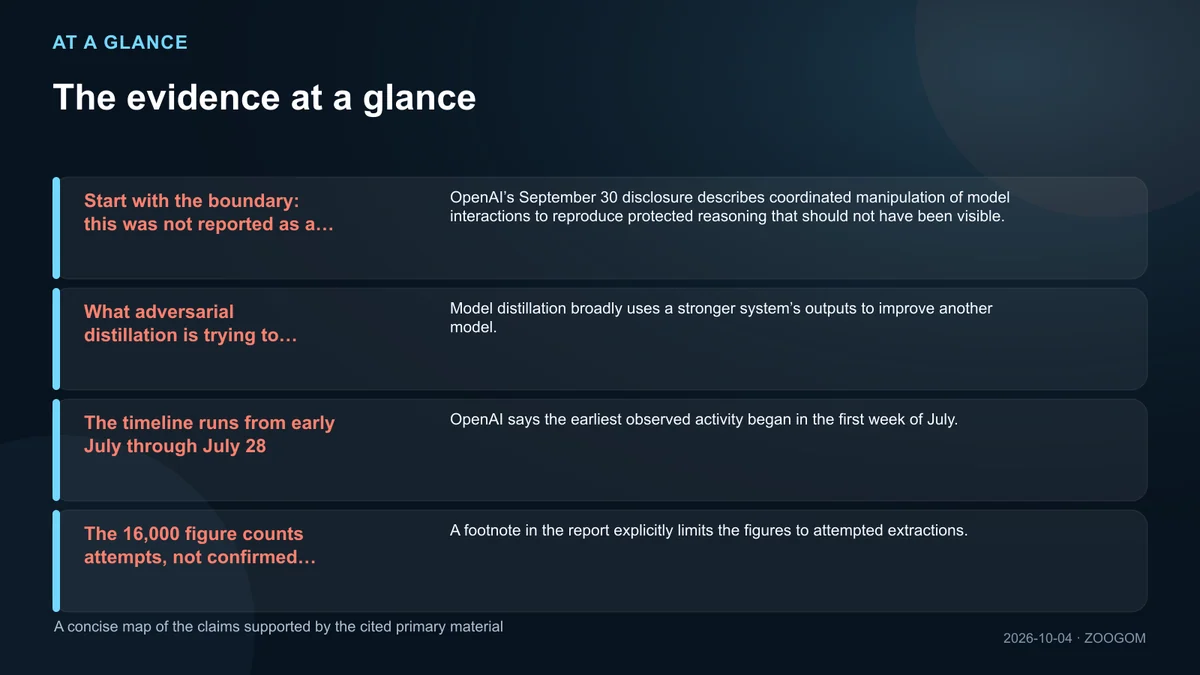
OpenAI’s September 30 disclosure describes coordinated manipulation of model interactions to reproduce protected reasoning that should not have been visible. It does not say attackers broke the company’s encryption, entered a conversation database, or directly downloaded stored customer chats.
The difference matters. An interaction-layer extraction campaign calls for protections around prompts, outputs, replayable artifacts, identities, and model boundaries. Traditional database controls alone would not address it.
What adversarial distillation is trying to obtain
Model distillation broadly uses a stronger system’s outputs to improve another model. It can be a permitted engineering technique. It becomes adversarial when operators systematically evade terms or safeguards to copy hidden behavior, reasoning patterns, or capabilities without authorization.
The objective is not one useful answer. A campaign can collect behavior across many tasks and use it as training material, reducing the cost of reproducing planning, tool use, or domain performance.
The timeline runs from early July through July 28
OpenAI says the earliest observed activity began in the first week of July. On July 24 and 25, it saw roughly 16,000 requests using a relevant extraction pattern from more than 4,000 users. Investigators then connected similar prompt behavior to an account population exceeding 15,000.
The company says it fully disrupted that cluster by July 28. Those dates and counts come from OpenAI’s investigation; a complete independent forensic record has not been published.
The 16,000 figure counts attempts, not confirmed successes
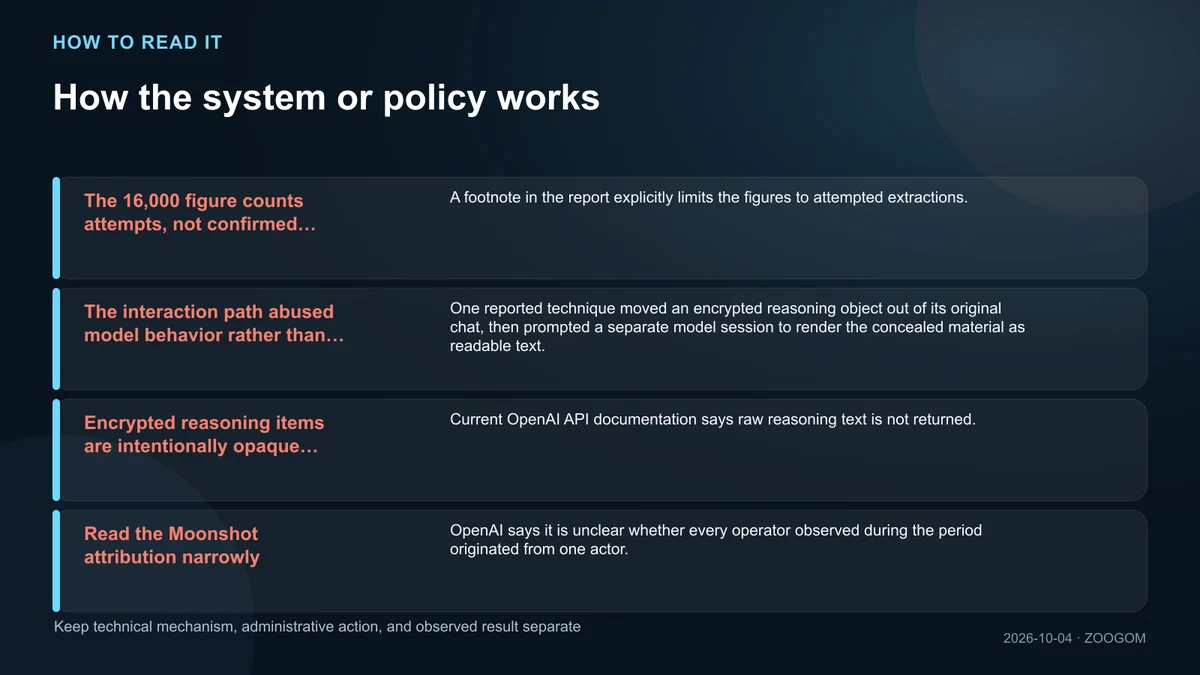
A footnote in the report explicitly limits the figures to attempted extractions. It would be inaccurate to describe 16,000 protected chains of thought as stolen or to treat 15,000 accounts as 15,000 proven human attackers.
One person can operate many accounts, and automated requests can fail. A useful incident metric separates attempted, blocked, partially exposed, and confirmed recovered content. OpenAI has not published that complete conversion funnel.
The interaction path abused model behavior rather than cracking ciphertext
One reported technique moved an encrypted reasoning object out of its original chat, then prompted a separate model session to render the concealed material as readable text. That is not the same as deriving an encryption key mathematically; it is an attempt to make a model transform a protected artifact into visible text.
OpenAI also says independent researchers responsibly disclosed related cross-model and conversation-compaction paths that it confirmed were real. Portable reasoning artifacts therefore need binding to the correct user, workspace, model, and purpose.
Encrypted reasoning items are intentionally opaque to applications
Current OpenAI API documentation says raw reasoning text is not returned. In stateless workflows, a reasoning item can contain encrypted_content that the client preserves and passes back without understanding it.
A visible encrypted blob is not a readable chain of thought. Yet any portable blob requires replay protection, tenant separation, expiration, and validation that it is being returned in the same authorized context.
Read the Moonshot attribution narrowly
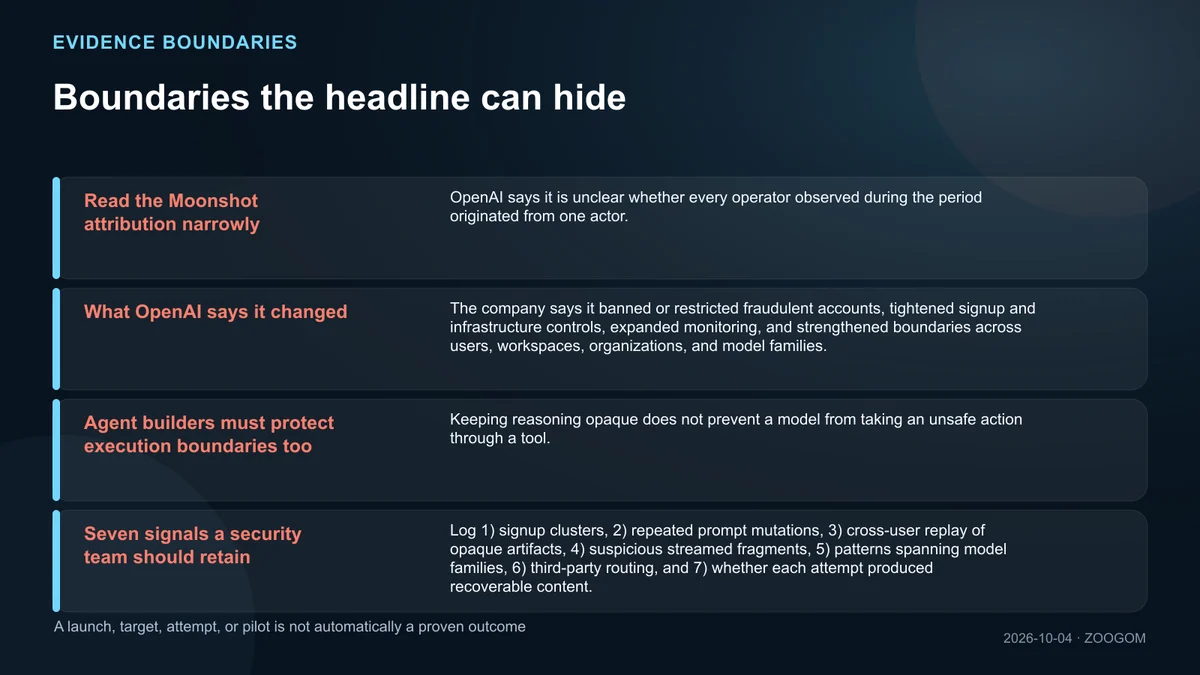
OpenAI says it is unclear whether every operator observed during the period originated from one actor. It attributes a core cluster to individuals associated with Moonshot AI, the company behind Kimi.
That wording is not a judicial finding about an entire company, every employee, or a government. Without the underlying indicators and a response from all affected parties, the accurate formulation remains “OpenAI’s attribution of a core cluster.”
What OpenAI says it changed
The company says it banned or restricted fraudulent accounts, tightened signup and infrastructure controls, expanded monitoring, and strengthened boundaries across users, workspaces, organizations, and model families. It also says it closed a replay path and added checks that can hold streamed output suspected of exposing reasoning.
It coordinated with third-party providers and shared indicators through the Frontier Model Forum and government channels. Detection rates, false positives, and the dates every partner deployment received equivalent protection remain undisclosed.
Agent builders must protect execution boundaries too
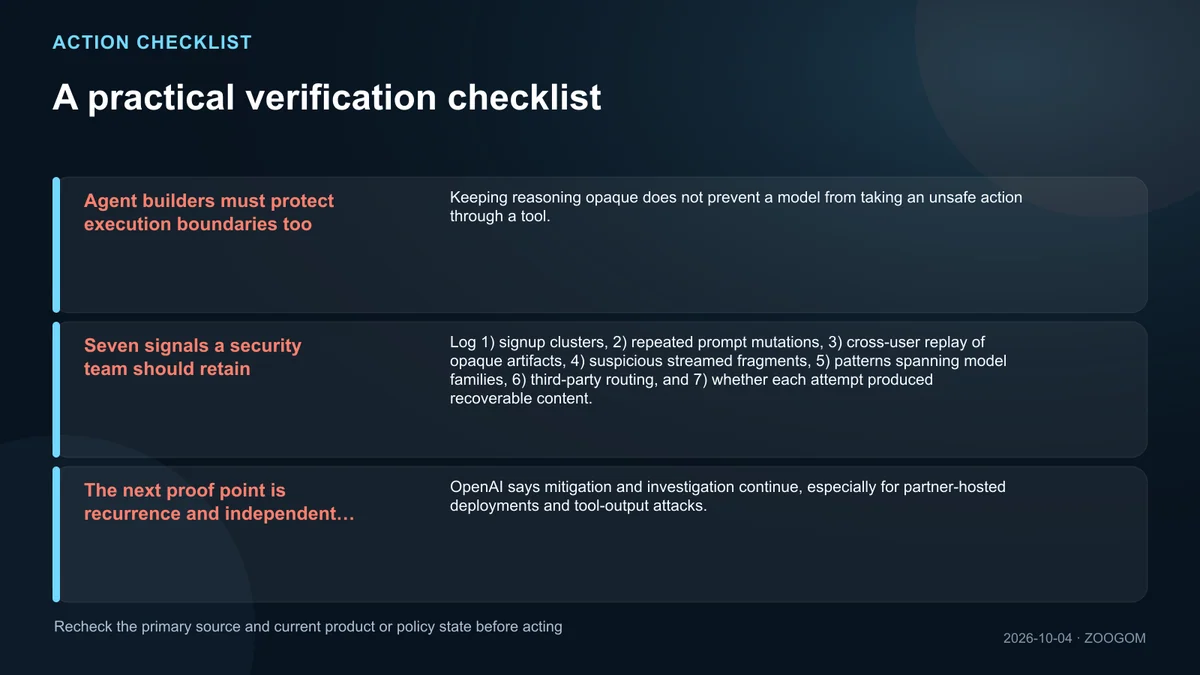
Keeping reasoning opaque does not prevent a model from taking an unsafe action through a tool. OpenAI’s current agent guidance distinguishes automatic guardrails from human approval: the former validates input, output, or tool behavior, while the latter pauses a sensitive side effect.
File deletion, credential use, external transfer, shell execution, and production changes should be checked at the tool boundary. An input filter attached to the first agent does not automatically govern every downstream tool call.
Seven signals a security team should retain
Log 1) signup clusters, 2) repeated prompt mutations, 3) cross-user replay of opaque artifacts, 4) suspicious streamed fragments, 5) patterns spanning model families, 6) third-party routing, and 7) whether each attempt produced recoverable content.
Raw request volume is not an impact assessment. Incident communications should distinguish confidence, exposure, remediation, and user action even when publishing exact detector thresholds would help attackers.
The next proof point is recurrence and independent validation
OpenAI says mitigation and investigation continue, especially for partner-hosted deployments and tool-output attacks. That is not a declaration that adversarial distillation has been solved.
Watch for recurrence of the same replay class, consistent controls across cloud partners, publication by the reporting researchers, and a quantitative account of successful versus attempted recovery. The evidence supports a large coordinated attempt and real attack paths—not a claim that a complete rival model was successfully copied.
Copyright, trademark, and image notice
Company and product names may be trademarks of their respective owners. Unless otherwise credited, visuals are AI-generated conceptual backgrounds or original editorial designs and information graphics. Any quotations or third-party assets are identified with the applicable author, source, and usage information at the point of use or in the source list.
Sources and the next facts to verify
The links below are the primary and official materials used for fact-checking. Linking a source does not mean reproducing its prose, imagery, or page design.