School AI Policy: New York Restricts It as South Korea Builds Guardrails

Should schools allow students to use generative AI? The most important policy choices in 2026 do not divide neatly into “yes” and “no.” New York City is pausing student-facing generative AI for younger students while preserving limited, vetted use and required literacy instruction in high school. South Korea is expanding AI education while adding rules intended to protect assessment integrity.
It would be misleading to summarize the contrast as “the United States bans AI while Korea embraces it.” New York City is one school system, not a federal American policy. Seoul’s assessment rule is a local education measure within a broader Korean national strategy. The useful comparison is how two large systems define age, purpose, teacher supervision and evidence of student learning.
What New York City is pausing
Under the New York City Public Schools guidance, student-facing generative AI software is not permitted in grades 2K through 8 during the 2026-27 school year. The city describes this as a one-year moratorium while it studies developmental effects and limited high-school pilots.
The restriction is specific to generative AI used directly by students. It is not a ban on every algorithm used by a school. Assistive technology required by an Individualized Education Program or 504 Plan remains available, and the policy identifies exceptions for assessments, remote instruction and centrally approved activities such as coding, robotics, simulations and e-books.
The city links the moratorium to concerns that early use could replace human interaction, hands-on learning and the productive struggle involved in solving difficult problems. Its policy also separates AI rules from individual screen-time recommendations, although the two were announced together.
High school use is limited rather than banned
Students in grades 9 through 12 may use approved and vetted programs for defined purposes, including career-readiness pathways and a limited set of pilots. Families are supposed to receive notice when a student participates in an approved program.
Every high school student must complete two 45-minute AI literacy modules. The required topics include how AI works, privacy, bias and appropriate school use. Some career and certification programs receive more extensive instruction.
South Korea is expanding use while tightening assessment rules
South Korea’s 2026 Ministry of Education plan supports schools in selecting and using AI learning materials and calls for a K-Education AI system for instruction and administration. It pairs that expansion with question-centered teaching, more written-response assessment and curriculum-linked AI ethics material.
The ministry plans to increase the number of AI-focused schools from 1,000 in 2026 to 2,000 in 2028. It also describes expanded AI-related instructional time at those schools: twice the general-school level in elementary grades and 1.5 times the general-school level in middle school.
Seoul is addressing the assessment problem more directly. An April 2026 amendment published by the Seoul Metropolitan Office of Education adds criteria for AI use in performance assessment to the city’s AI ethics guidance. The stated concerns include fairness between students, distortion of actual achievement and declining trust in teacher assessment.
That amendment is not a declaration that every AI use is allowed, nor does it ban generative AI from every assignment. It means that schools need clearer boundaries for what a student may delegate, what must be disclosed and how a teacher verifies the student’s own work.
How the approaches compare
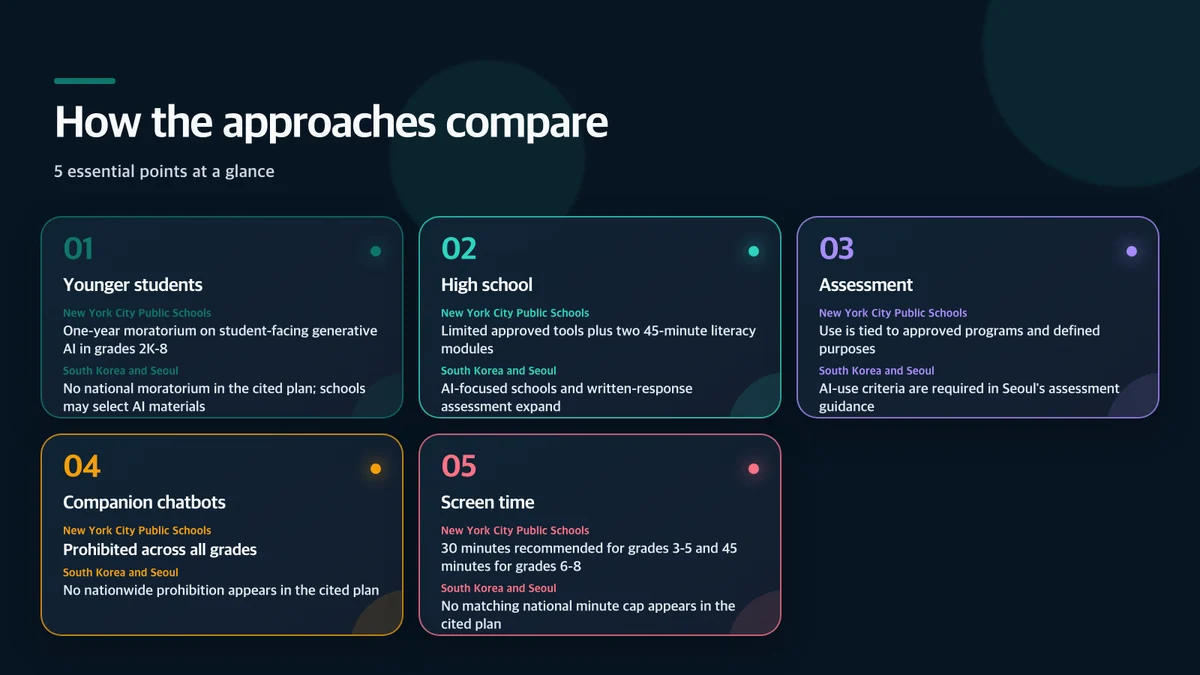
The systems begin from different risk tolerances. New York City is stopping direct access for younger students before deciding what to permit next. South Korea is building an AI-enabled school environment and trying to strengthen ethics and assessment around it.
Their goals are not complete opposites. Neither policy treats submitting an AI answer without thinking as meaningful learning. Both place weight on teacher judgment, critical thinking, privacy and age-appropriate use.
Five rules every AI-assisted assignment needs
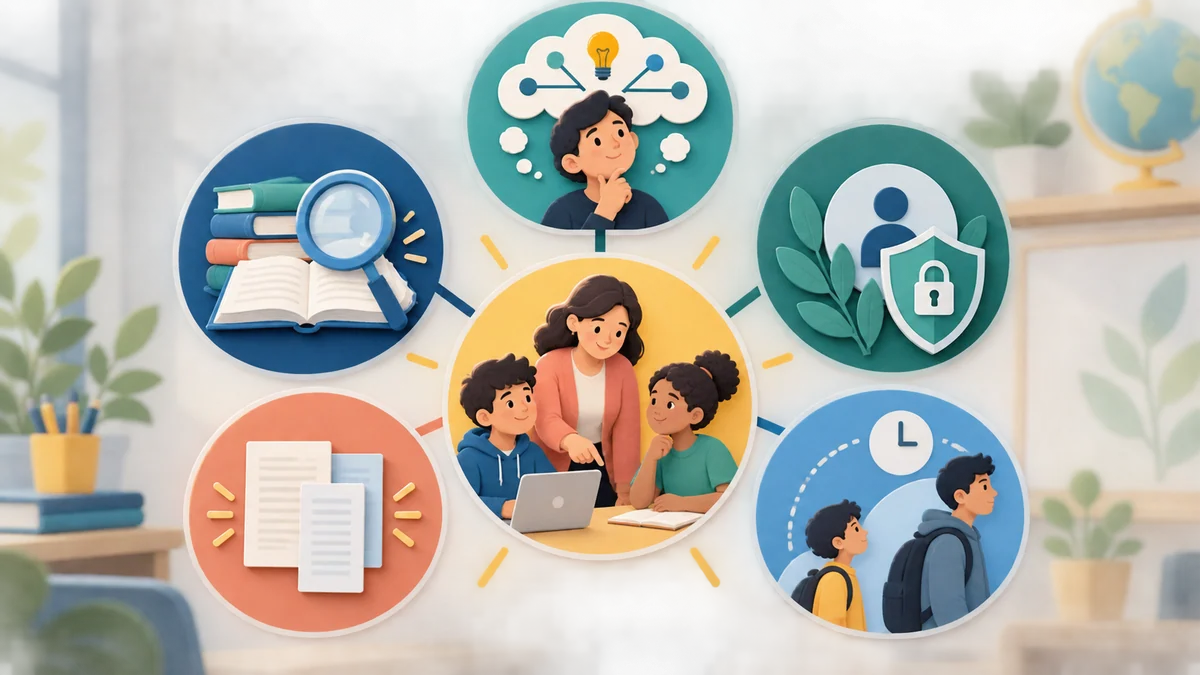
A single schoolwide sentence saying “AI is allowed” or “AI is banned” cannot resolve the differences between brainstorming, proofreading, research assistance and generating a finished answer. A workable assignment should define at least five things before students begin.
- Permitted functions: State whether students may brainstorm, search, outline, edit or generate prose.
- Disclosure: Decide whether students must submit the tool name, prompts, output and revision history.
- Verification: Require claims and citations to be checked against textbooks or primary sources.
- Privacy: Prohibit names, faces, grades, counseling information and internal school records from being entered into unapproved systems.
- Evidence of learning: Use oral explanation, in-class drafts or process notes to confirm the student understands the final work.
The principle is simple: the closer an AI function comes to producing the skill being assessed, the stronger the disclosure and independent evidence should be. Spell-checking during a history essay and generating the historical argument are not the same level of assistance.
Screen time and generative AI are related but different
New York City’s policy recommends no routine one-to-one screen time in grades 2K through 2, no more than 30 minutes a day in grades 3 through 5 and no more than 45 minutes in grades 6 through 8. High-school limits depend on the school and course.
Those recommendations do not mean that every minute on a screen creates the same risk. An accessible reading tool, a coding simulation and an open-ended generative AI service collect different data and replace different activities. The policy’s exceptions recognize that distinction.
The more transferable lesson is not the exact number of minutes. Schools need to classify technology by developmental purpose, the human interaction it may displace, the sensitivity of information it receives and the extent to which it performs the student’s intellectual work.
What families and students should ask
- Is this tool approved by the school for this specific assignment?
- Does “AI allowed” mean brainstorming, editing or generating a final response?
- Must prompts and AI-generated passages be disclosed?
- Will conversations be used for model training or product improvement?
- Should a student use a school-managed account or a personal account?
- Do the cited sources exist, and do they support the generated claim?
- What personal data does the product collect, retain or share?
AI literacy is not only the ability to write effective prompts. It includes knowing when not to use a system, recognizing what information should never be uploaded, finding evidence outside the model and separating personal judgment from machine suggestions.
Neither policy is the final answer
New York City’s moratorium is not described as permanent. A Technology in Schools Coalition representing students, educators, families, unions, officials and experts will study the policy and limited pilots during the 2026-27 school year. It is scheduled to issue recommendations in April 2027.
South Korea’s expansion is not unrestricted permission. If schools cannot preserve assessment fairness, protect student data and give teachers time to verify learning, a larger inventory of AI tools will not demonstrate better education.
Both systems ultimately face the same test: can a school distinguish between AI that extends a student’s thinking and AI that replaces the thinking being assessed? The answer depends less on the number of tools than on clear assignment design, transparent records and enough human contact for teachers to see how a student reached the result.