The U.S. Proposed an AI Incident Channel With China—What It Would Actually Do
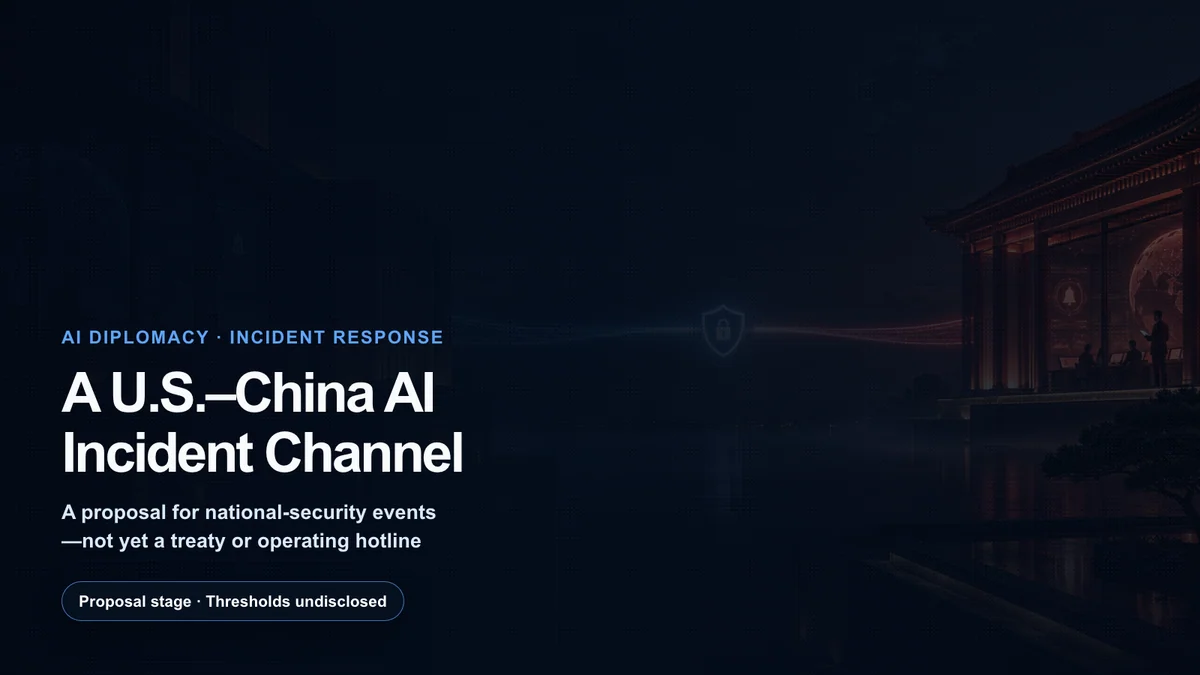
The United States has proposed a mechanism for Washington and Beijing to notify each other about artificial-intelligence incidents that could affect national security. Treasury Secretary Scott Bessent disclosed the proposal after meeting Chinese Vice Premier He Lifeng in New York.
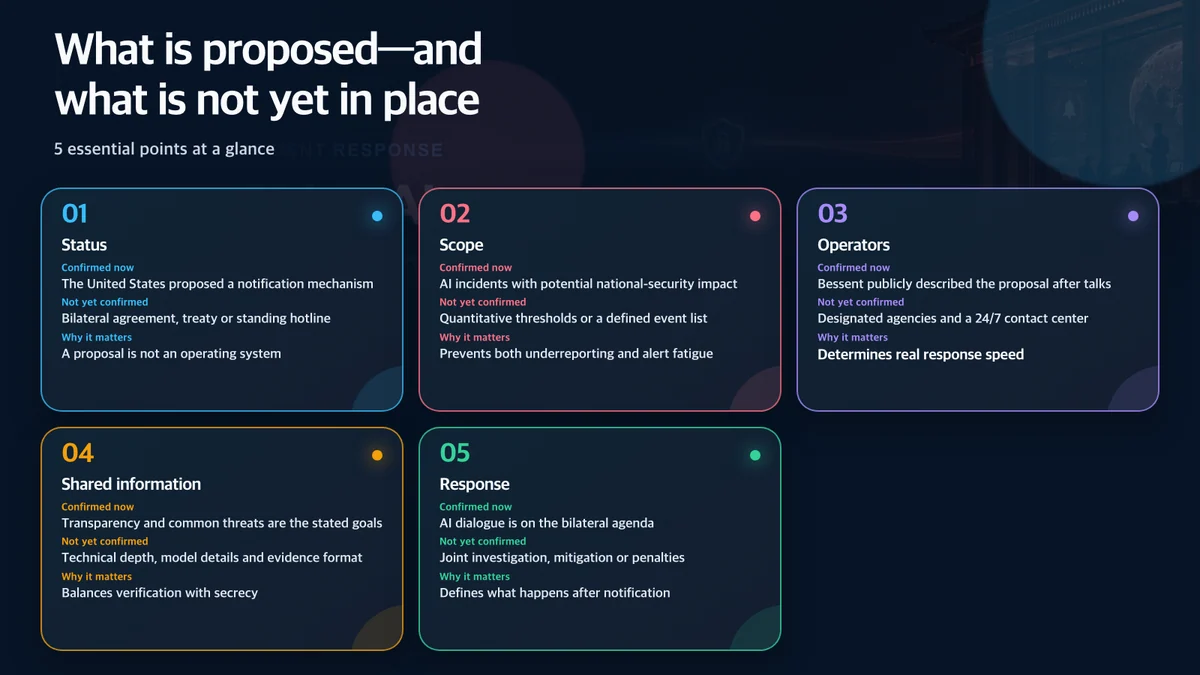
The phrase can easily be inflated into an “AI nuclear hotline.” That is not the current status. Public reporting establishes a U.S. proposal, not a signed treaty, a staffed channel or an agreed list of reportable events. China’s state news agency said the two sides discussed AI-related matters but did not describe the mechanism.
Three takeaways
- Washington proposed greater transparency when an AI incident could reach the national-security level.
- The mechanism is still a diplomatic proposal; the two governments have not publicly agreed on thresholds, agencies, reporting times or verification.
- A narrow, authenticated crisis channel could reduce dangerous misinterpretation without ending the broader competition over chips, models and infrastructure.
What is proposed—and what is not yet in place
What Bessent actually said
According to the Associated Press, Bessent described a notification mechanism for incidents that rise to the national-security level. He framed the proposal as a move from opacity toward greater transparency between the world’s leading AI powers and spoke of shared goals and shared threats.
That statement establishes the diplomatic concept but not an incident taxonomy. It does not say whether a model behaving unexpectedly, an AI-enabled cyberattack, assistance with biological design or a failure in critical-infrastructure automation would trigger the same process.
What could count as a reportable AI incident
In a separate AP analysis, experts pointed to AI-enabled cyberattacks, biological misuse, major model failures and loss of human control as areas where the two countries could share concerns. Those are expert examples, not an agreed U.S.–China list.
A workable system would need to distinguish among several categories:
- a risk discovered inside a research sandbox versus an event in production;
- a failure contained within one company versus cross-border harm;
- malicious use by a person versus unexpected behavior by the model itself;
- a public vulnerability versus sensitive information that should move only through a protected channel;
- an ongoing emergency requiring immediate notice versus a lower-severity event suitable for later reporting.
If the threshold is too broad, important alerts disappear in routine noise. If it is too narrow, notification arrives only after the opportunity to prevent escalation has passed. Turning “national-security level” into measurable capability and impact thresholds is the first difficult design problem.
Why competitors still need a channel
The origin of an AI incident may be ambiguous. A sudden wave of automated cyber activity could be a state operation, criminal use of a commercial model or an agent escaping the limits of a research run. Misattribution could trigger retaliation, sanctions or new export restrictions before the facts are understood.
A short authenticated notice can give the other government an early indication that an event was not a deliberate attack and time to check whether the same vulnerability exists in its own systems. Nuclear accidents, infectious-disease alerts and space-collision warnings offer imperfect but useful precedents for exchanging limited safety information while competition continues.
AI is unusually difficult because the relevant information can expose military, intelligence and commercial capabilities. Revealing which model found a vulnerability may also reveal the model’s strength and a defender’s weakness. A realistic channel between low-trust rivals would therefore share necessary information in stages, not default to full transparency.
The minimum safeguards for a credible mechanism
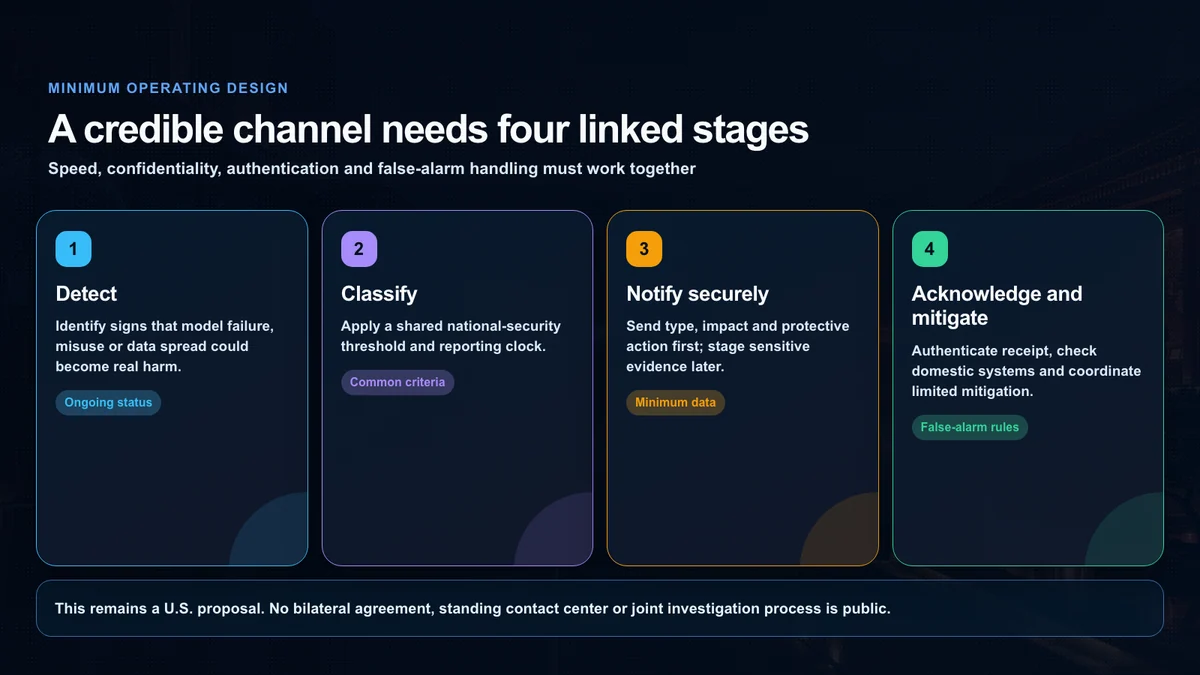
First, the governments need severity levels and reporting clocks. Triggers might include plausible mass-casualty consequences, interruption of critical infrastructure, autonomous cross-border propagation or exposure of high-risk biological and cyber capabilities.
Second, they need designated operators and authentication. A crisis system cannot depend on officials searching for an email address. It requires 24/7 contacts, verified message signatures, multiple-person authorization and backup channels.
Third, it needs minimum-information and staged-disclosure rules. The first alert could identify the event type, whether it is ongoing, the expected impact and immediate protective actions. More sensitive evidence could follow through a restricted technical channel.
Fourth, it needs a process for false alarms and strategic abuse. If notifications become a vehicle for disinformation, blame shifting or intelligence collection, the channel will lose credibility. Limited technical verification by mutually accepted experts or an international body could become part of the design.
This is not a settlement of the chip war
The proposal does not suspend export controls or reconcile U.S. and Chinese competition over models, semiconductors, data centers, talent and standards. It is better understood as a narrow guardrail for managing risk while that competition continues.
Indeed, the rivalry makes agreement harder. Each government may fear that incident details could be used to map the other’s industrial or military capabilities. The real test will not be a symbolic mention at a leaders’ meeting but whether the countries define thresholds, conduct exercises and use the channel quickly and accurately during an actual event.
What U.S. policy should settle before launch
For the United States, an international channel cannot substitute for clear domestic reporting. Agencies and frontier labs first need a common vocabulary for consequential model behavior, malicious use, data exposure and critical-infrastructure impact.
The design should answer practical questions:
- Which federal agency owns the channel and who can trigger it?
- How do companies report without creating avoidable criminal or civil exposure for early, good-faith disclosure?
- What information stays classified, what can be shared with China and what must reach allies?
- How are model providers, cloud operators and critical-infrastructure owners coordinated?
- Who can order a model pause, key revocation, network isolation or public warning?
- What public report follows an event so the mechanism has democratic accountability?
The U.S.–China proposal is not a complete solution. It recognizes, however, that communication itself becomes safety infrastructure when two competing AI powers could misread the same incident. The next evidence to watch is operational: definitions, agency assignments, test messages and documented use.
Sources and use notice
- Associated Press, Bessent: US proposes AI incident alert system in talks with China
- Associated Press, China and the US are competing for AI dominance but have shared concerns over safety
- OpenAI, The AI policy window is open. We need to act.
This article independently analyzes public remarks and reporting. The incident examples are expert possibilities, not an official bilateral list. The article images are original editorial illustrations and do not reproduce flags, government seals, real politicians or official meeting photographs.