Vibe Coding 2.0: From Pretty Screens to Working Services
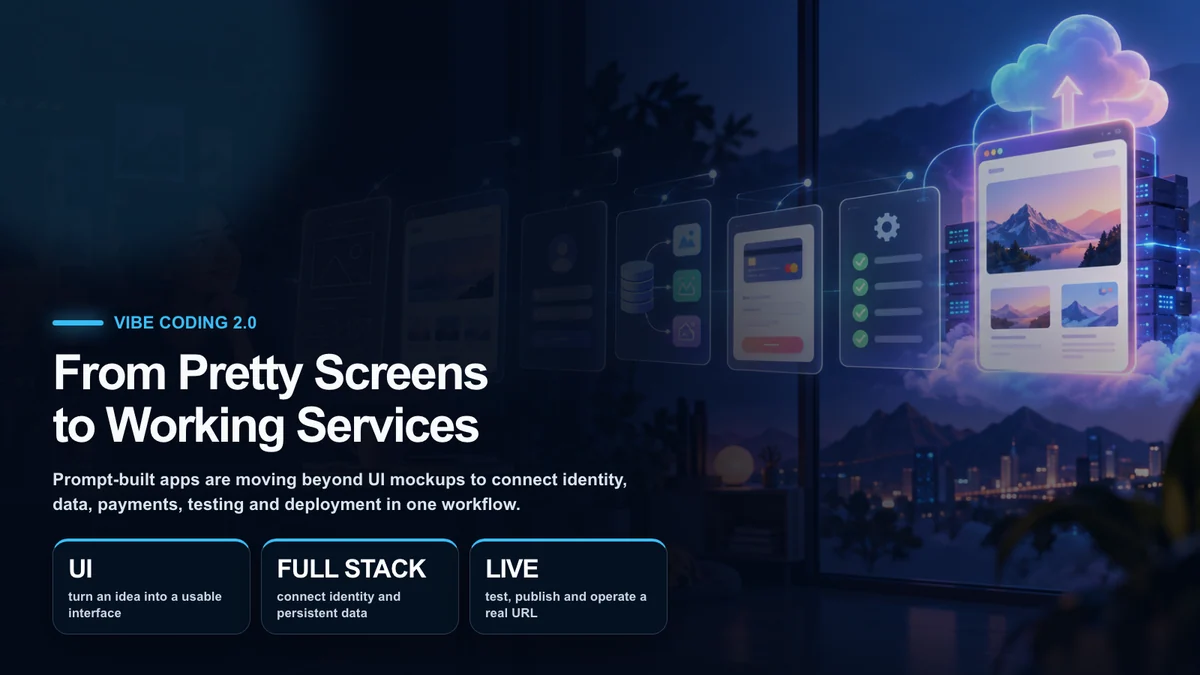
The first wave of vibe coding delivered an unforgettable demo: describe a product in plain English and watch a polished interface appear within minutes. It was excellent at making an idea visible. It was less reliable at everything that happened after the demo—keeping data after a refresh, separating one customer’s records from another’s, handling a failed payment or deploying an update without breaking existing accounts.
The important change in 2026 is not simply that generated interfaces look better. AI development environments increasingly connect the interface to authentication, a database, server logic, payments, source control, testing and cloud deployment. This article uses Vibe Coding 2.0 as an editorial name for that shift. It is not an official product name or an industry standard.
The promise is no longer “make me a screen.” It is help me assemble, test and operate a service. That can be transformative for a solo founder, a small business or an internal operations team—but only when the person building it treats generation as the beginning of the work rather than the end.
What changed from the first wave
Early prompt-to-app tools were strongest at front-end prototypes. A user could navigate between pages and click convincing buttons, but adding real accounts or persistent records often required leaving the tool and assembling several services manually.
Current platforms are designed around a broader workflow. Bolt describes itself as a builder for websites, web apps and mobile apps. Its cloud environment includes databases, user authentication, hosting and domains, with documented connections to GitHub, Stripe, Expo and other services. Bolt’s official introduction
Replit similarly documents an agent that can build applications from natural-language instructions, detect errors, connect databases and deploy to the cloud. Larger projects can be split into observable tasks such as authentication, profiles, dashboards and deployment instead of being attempted as one opaque generation. Replit AI documentation
That does not mean the agent autonomously proves that every feature is correct. The improvement is that the interface, code, infrastructure and deployment are close enough for a builder to inspect the result, describe a failure and iterate without rebuilding the entire environment.
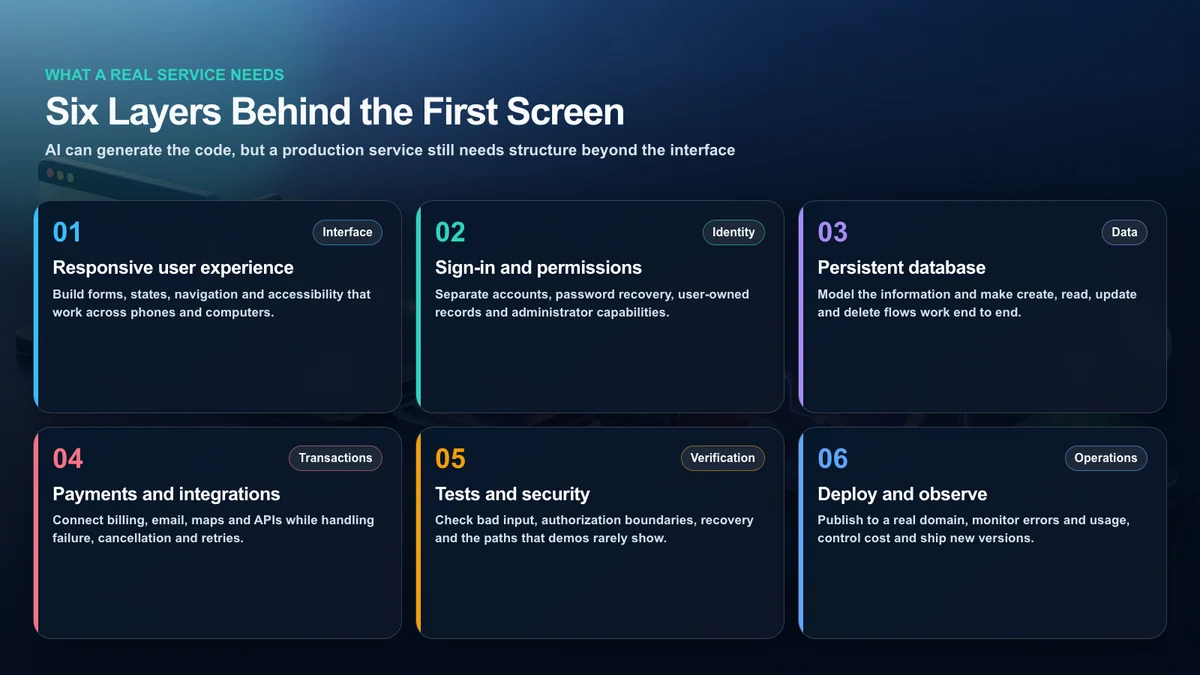
The six layers behind a working service
1. An interface that explains its state
A good landing screen is only one state of an application. A production interface also needs validation, loading indicators, useful empty states, success and error messages, keyboard navigation and layouts that remain usable on phones. When a save operation takes several seconds, the user must know whether to wait or try again. When it fails, the app should preserve the entered data and explain the next step.
2. Identity and authorization
Sign-in is not just an email form. A service may need account verification, password recovery, session expiration, deletion and separate roles for members, staff and administrators. Most importantly, every read and write must enforce ownership on the server. Hiding an edit button in the browser does not prevent someone from changing a URL or sending a direct request for another user’s record.
3. Persistent data
A database-backed feature has to survive refreshes, logouts and deployments. Create, read, update and delete operations should agree with one another, and concurrent edits need a predictable outcome. Development examples should be isolated from customer data. Backups are useful only after a restore has been tested.
4. Payments and external integrations
Stripe and other integrations can dramatically shorten setup, but a visible checkout button is not a complete billing system. Builders still need to handle success, failure, cancellation, retries, duplicate requests, refunds, webhooks and tax obligations. A network timeout must not silently charge a customer twice. Email, maps, analytics and third-party APIs need the same attention to errors and rate limits.
5. Tests and security boundaries
The happy path in a demo is the easiest path. Try blank fields, oversized text, unsupported files, a double-clicked payment button, a disconnected network and an expired session. Test with two accounts to prove that their data remains separate. Search the generated project for secrets embedded in browser code, and review dependencies before connecting real customer information.
6. Deployment and operations
Publishing creates a new set of responsibilities: HTTPS, a custom domain, logs, uptime, usage limits, backups, migrations and rollback. Bolt says projects can use its hosted subdomain and that paid plans can connect a custom domain; it also supports GitHub for version control and backup. Those conveniences are valuable, but a long-lived product should still have an exit plan for its code and data.
Why Vibe Coding 2.0 suddenly feels practical
The first reason is reduced setup. A founder can begin in a browser rather than first installing a runtime, package manager, database and deployment tool. The second is project-level context: agents increasingly change related files and data structures together instead of generating an isolated component.
The third is a better bridge between prompts and code. A non-developer can begin with a workflow description, while an experienced developer can inspect the implementation, connect a repository and take over the difficult parts. The fourth is reversibility. Checkpoints, task branches and source control make it possible to compare a change or recover from a prompt that damaged a working flow.
None of these improvements removes engineering. They move more of the engineering into an environment where the builder can see it and ask for help with it.
A useful U.S. path: prototype to indie SaaS
For a solo founder, the most promising projects are narrow services with a clear user and a short feedback loop:
- a client intake and approval portal for a small agency;
- a booking and reminder system for a local service business;
- a lightweight subscription research dashboard;
- an inventory or inspection tool for a small team;
- a paid calculator, report generator or niche directory;
- an internal operations app that replaces a spreadsheet and email chain.
The goal should not be to imitate a giant platform. A small service becomes valuable when it reliably solves one repeated task. Start with one complete journey—account creation, the core action, persistence and retrieval—before adding a long feature list.
Do not choose a platform only by its current feature list
AI development products change quickly. Google stopped the creation of new Firebase Studio workspaces on June 22, 2026 and says the product will shut down on March 22, 2027. Its migration guidance directs different workflows toward Google AI Studio or Antigravity. The change does not mean that core Firebase services such as Firestore, Firebase Authentication and App Hosting are shutting down. Google’s Firebase Studio migration guide
The lesson is portability. Before committing a business to a builder, ask:
- Can the full source be exported to a Git repository?
- Can the database be backed up in a standard format?
- Can identity, email and payments be replaced independently?
- Are development, preview and production environments separated?
- Are secrets stored on the server rather than in browser code?
- Can usage and spending limits be configured?
- Is there a tested rollback path?
- Can another developer understand and operate the project?
Prices and plan limits change too quickly to make a fixed comparison table useful for long. Portability, observability and recovery are more durable selection criteria.
A better prompt describes the business flow
“Build a beautiful booking app” tells the agent where to spend visual effort. A more useful starting request defines users, records, permission boundaries and failure conditions:
Build a mobile-friendly booking service. Customers must sign up by email and may view, reschedule or cancel only their own appointments. Staff can view the schedule but cannot access payment details. Prevent two bookings for the same slot, keep an audit record of changes, separate test accounts from production data, and create automated tests for the complete booking journey before deployment.
This prompt still will not guarantee a secure product. It gives the agent a much better map of what “finished” means.
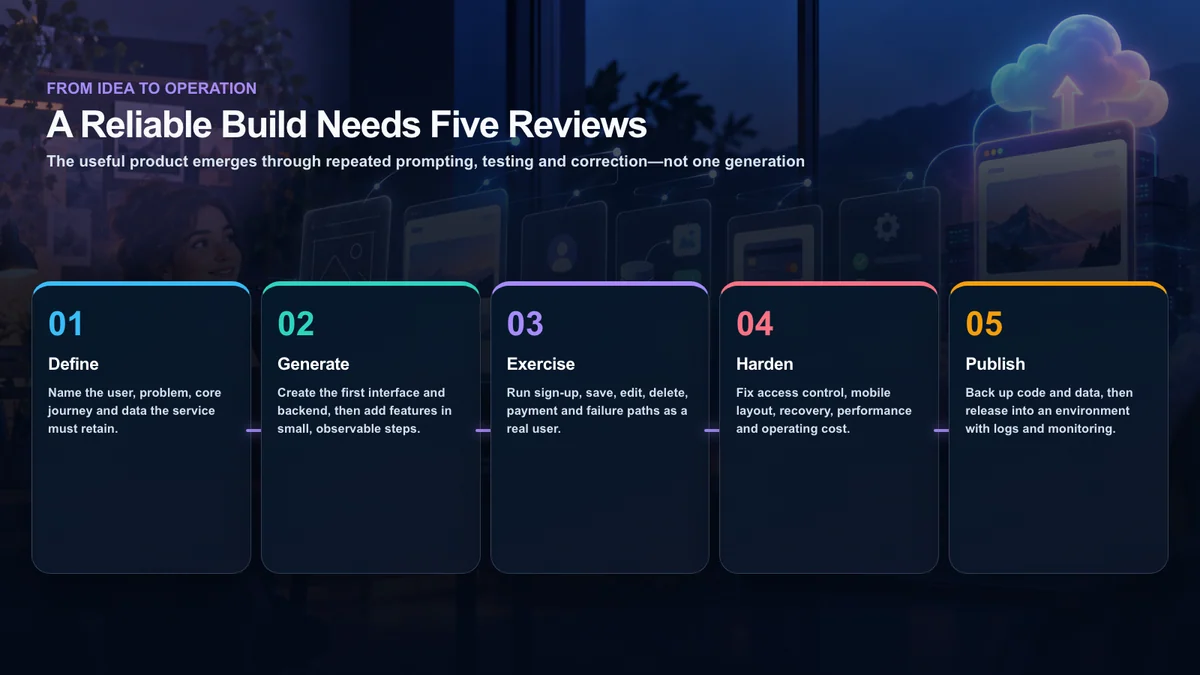
The production-readiness test
Before connecting a custom domain or accepting payment, run the service like a skeptical user:
- Create a new account, verify it and reset the password.
- Save a record, refresh the page, sign out and retrieve it after signing in again.
- Edit the record and confirm the change survives another refresh.
- Sign in with a second account and confirm it cannot read or change the first account’s data.
- Delete the record and confirm it disappears from lists, search and direct URLs.
- Test payment success, decline, cancellation, duplicate clicks and webhook retries in sandbox mode.
- Try the empty state, slow network, expired session and mobile layout.
- Back up the database and restore it into a test environment.
- Confirm that error and cost alerts reach a real person.
- Have a human or an independent analysis tool review the generated code.
If the app fails any of these checks, that is not evidence that vibe coding does not work. It is evidence that the product is still a prototype.
The bottom line
Vibe Coding 2.0 does not mean that one sentence now produces a trustworthy company. It means the distance between an idea and a testable full-stack product has become much shorter. Identity, data and deployment can remain in the same conversation as the interface, and builders can spend more time examining the real workflow.
The most successful builder will not necessarily write the longest prompt. It will be the person who can define a user journey, reproduce failures, verify access boundaries and keep a recoverable copy of the code and data. AI can accelerate implementation. The responsibility for deciding whether the service is safe and dependable still belongs to its operator.
Trademark and image notice
Bolt, Replit, Firebase, Google AI Studio, Antigravity, GitHub, Figma, Expo, Stripe and related marks belong to their respective owners. This independent editorial article is not sponsored or approved by those companies. Its illustrations were created for this article and do not reproduce a product interface, corporate logo, third-party photograph or third-party source code.
Sources
- Bolt Documentation: Intro to Bolt
- Bolt Documentation: QuickStart
- Bolt Documentation: Supported technologies
- Replit Documentation: AI Agent and Assistant
- Replit Documentation: Tutorials and app workflows
- Google: Migrate from Firebase Studio
- Google: Publish an app with Firebase Studio