Claude Sonnet 5.5 vs Opus 5.5: which model should you use?

Sonnet 5.5 costs 2 dollars per million input tokens 10 dollars per million output tokens and 0.20 dollars per million cache-read tokens. Opus 5.5 costs 4 dollars per million input tokens and 20 dollars per million output tokens. This guide separates confirmed events, attributed claims, technical limits, and the evidence still needed for a practical decision.
The short answer: Sonnet for bounded repetition, Opus for expensive ambiguity
Sonnet 5.5 is positioned for well-scoped coding, bug fixes, polished documents, slides, spreadsheets, and rapid iteration. Opus 5.5 earns its premium when requirements are ambiguous, the context is long, priorities shift, and sustained judgment matters.
Do not select on a single leaderboard row. Combine token spend, latency, tool time, human correction, retry rate, and the consequence of a wrong answer into a total cost per completed task.
The list price is a clean two-to-one difference
Sonnet 5.5 is $2 per million input tokens and $10 per million output tokens. Opus 5.5 is $4 and $20. Cache reads cost $0.20 for both, while cache writes are $2.50 for Sonnet and $5 for Opus.
For identical token use, Sonnet is the obvious cost choice. Real workloads are not identical: repeated corrections can erase the saving, while one correct Opus plan can be cheaper than several failed Sonnet passes.
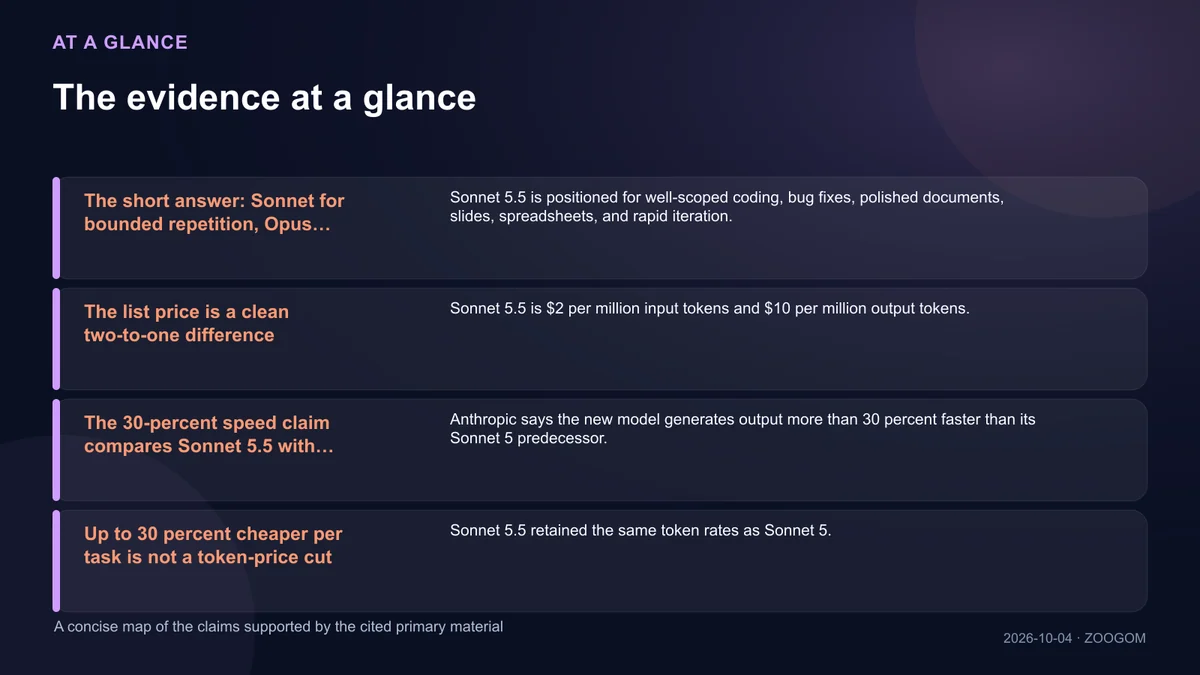
The 30-percent speed claim compares Sonnet 5.5 with Sonnet 5
Anthropic says the new model generates output more than 30 percent faster than its Sonnet 5 predecessor. It is not a blanket claim that every Sonnet request finishes 30 percent faster than Opus 5.5.
Measure time to first token, generation rate, tool waits, concurrency limits, and long-context processing separately. In an agent workflow, an external API or test suite can dominate end-to-end latency.
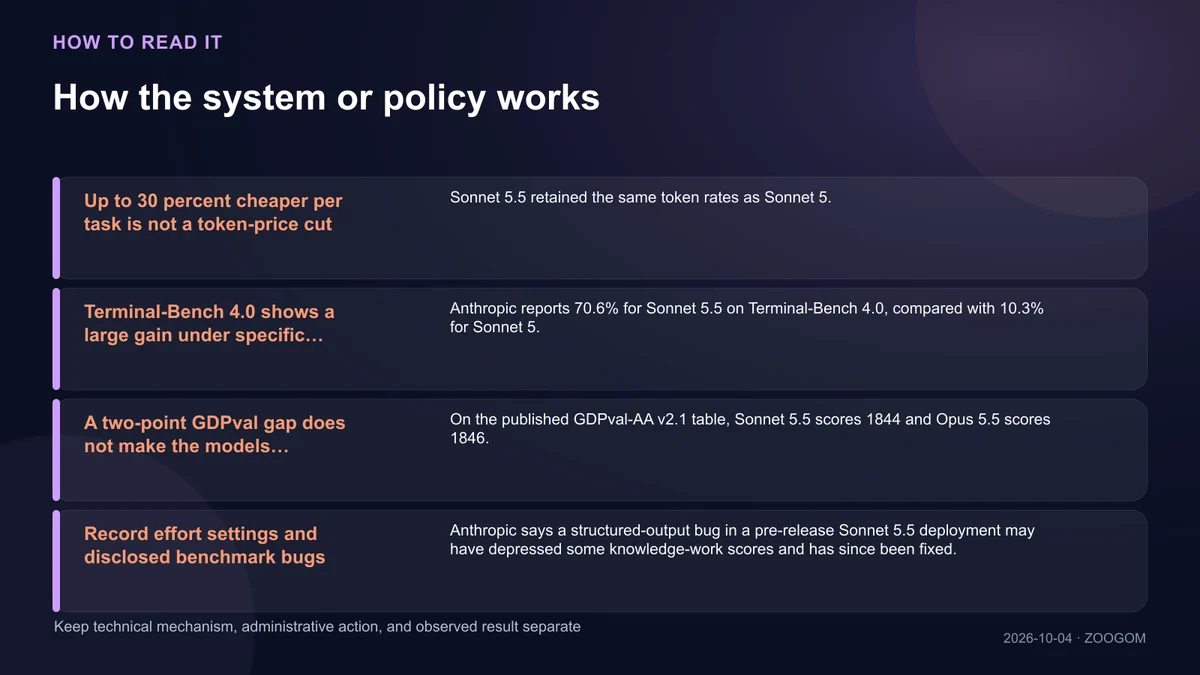
Up to 30 percent cheaper per task is not a token-price cut
Sonnet 5.5 retained the same token rates as Sonnet 5. Anthropic’s “up to 30% less” estimate comes from using fewer tokens to finish typical work in its testing.
Your prompt length, tool output, effort setting, and definition of completion can change the result. Budget from at least 50 representative tasks and include the upper tail rather than entering the vendor maximum as a guaranteed discount.
Terminal-Bench 4.0 shows a large gain under specific conditions
Anthropic reports 70.6% for Sonnet 5.5 on Terminal-Bench 4.0, compared with 10.3% for Sonnet 5. The benchmark covers complex, multi-step work in a command-line environment, so it is a meaningful signal for coding agents.
Settings still matter. The displayed Opus 5.5 result of 66.4% is its Xhigh-effort best score, and harness, budget, and timeouts affect all agent evaluations. The row is not a universal ranking for every coding task.
A two-point GDPval gap does not make the models interchangeable
On the published GDPval-AA v2.1 table, Sonnet 5.5 scores 1844 and Opus 5.5 scores 1846. Sonnet has clearly moved close on a broad knowledge-work evaluation.
Anthropic nevertheless says Opus remains clearly stronger in complex, open-ended work requiring sustained judgment based on internal and external testing. Average benchmark scores can miss rare but costly planning failures.
Record effort settings and disclosed benchmark bugs
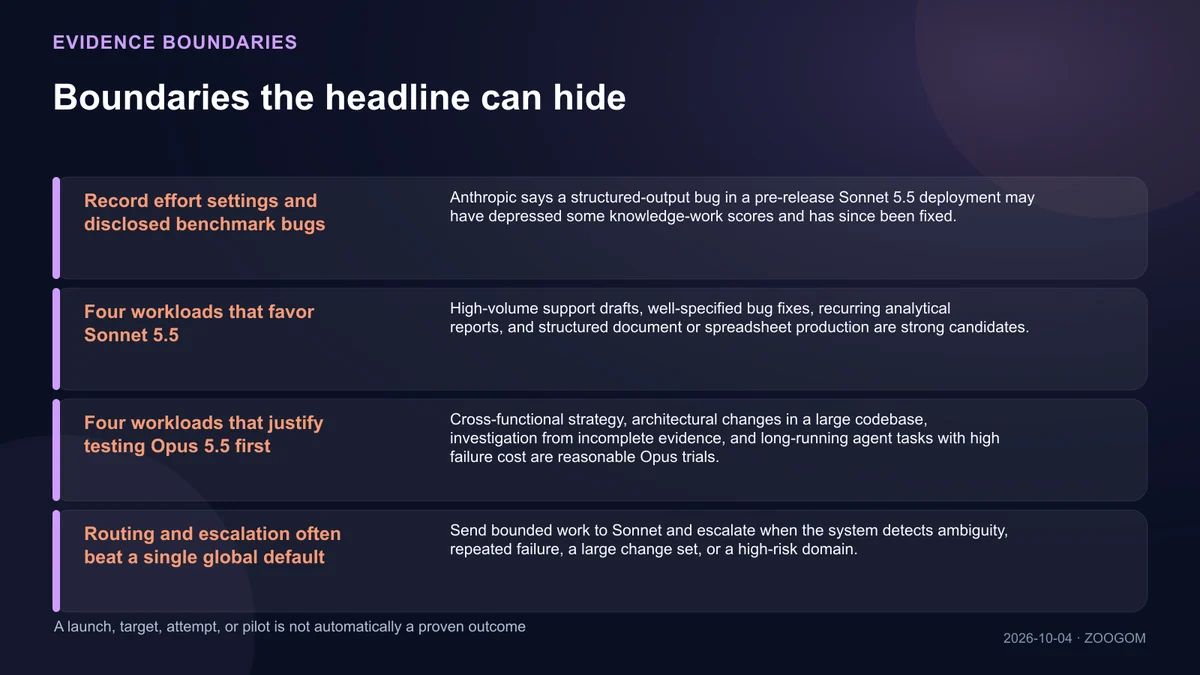
Anthropic says a structured-output bug in a pre-release Sonnet 5.5 deployment may have depressed some knowledge-work scores and has since been fixed. It also notes that Max effort underperformed Xhigh on FrontierCode when extra review behavior caused timeouts or out-of-scope edits.
More reasoning is not automatically better. Store model ID, date, effort, tool version, timeout, and token budget with every production evaluation so later results are comparable.
Four workloads that favor Sonnet 5.5
High-volume support drafts, well-specified bug fixes, recurring analytical reports, and structured document or spreadsheet production are strong candidates. User-facing products that depend on responsive iteration also benefit from lower latency.
The more clearly you can define input, expected output, allowed tools, and a machine-checkable finish condition, the easier it is to capture Sonnet’s price and speed advantage.
Four workloads that justify testing Opus 5.5 first
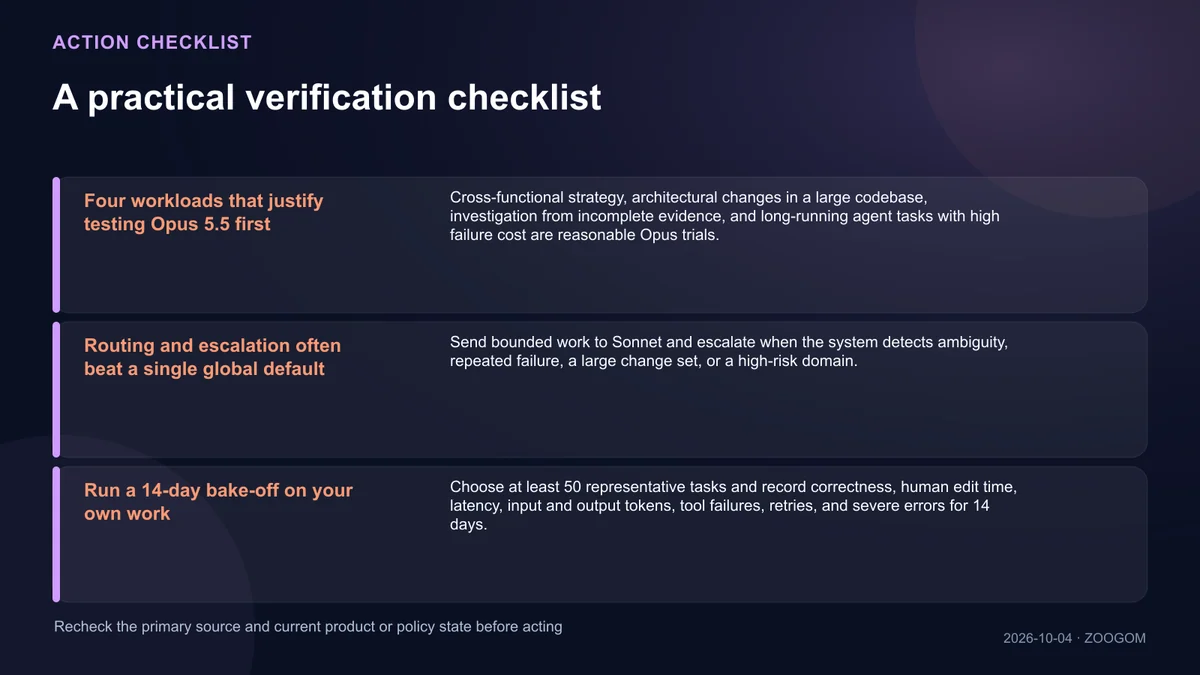
Cross-functional strategy, architectural changes in a large codebase, investigation from incomplete evidence, and long-running agent tasks with high failure cost are reasonable Opus trials.
The model name never replaces governance. Legal, medical, financial, and security decisions still need expert review, scoped tools, and an approval boundary before material side effects.
Routing and escalation often beat a single global default
Send bounded work to Sonnet and escalate when the system detects ambiguity, repeated failure, a large change set, or a high-risk domain. Another pattern is Sonnet for drafting and Opus for a final adversarial review.
The router can fail too. Log why escalation occurred, give users a manual review option, and enforce a budget ceiling so the premium path remains intentional.
Run a 14-day bake-off on your own work
Choose at least 50 representative tasks and record correctness, human edit time, latency, input and output tokens, tool failures, retries, and severe errors for 14 days. Alternate models on the same prompts and data.
Examine the worst 10% as well as the average. If Sonnet reliably clears the acceptance bar, make it the default. If Opus materially reduces the failures that matter, reserve it for that route rather than paying the premium everywhere.
Copyright, trademark, and image notice
Company and product names may be trademarks of their respective owners. Unless otherwise credited, visuals are AI-generated conceptual backgrounds or original editorial designs and information graphics. Any quotations or third-party assets are identified with the applicable author, source, and usage information at the point of use or in the source list.
Sources and the next facts to verify
The links below are the primary and official materials used for fact-checking. Linking a source does not mean reproducing its prose, imagery, or page design.