AI Shopping Agents: How Search, Comparison and Checkout Are Changing

Online shopping is moving from search boxes toward AI agents. Instead of opening ten tabs, a shopper can describe a budget, deadline and use case, then ask software to search, compare, monitor inventory, prepare a cart and sometimes move directly toward checkout.
That is more useful than a chatbot that merely summarizes products—and more consequential. An agent may connect search history, email, calendar, location, loyalty accounts, payment details and retailer systems. It can save time, but it can also hide sponsorship, misunderstand return terms or make personalized pricing harder to detect.
What makes an AI shopping agent different?
A conventional search engine returns links. Conversational search synthesizes information and accepts follow-up questions. An agent adds persistence and action: it can keep checking a condition, apply constraints across multiple sources, prepare a booking or cart and ask for approval at the last step.
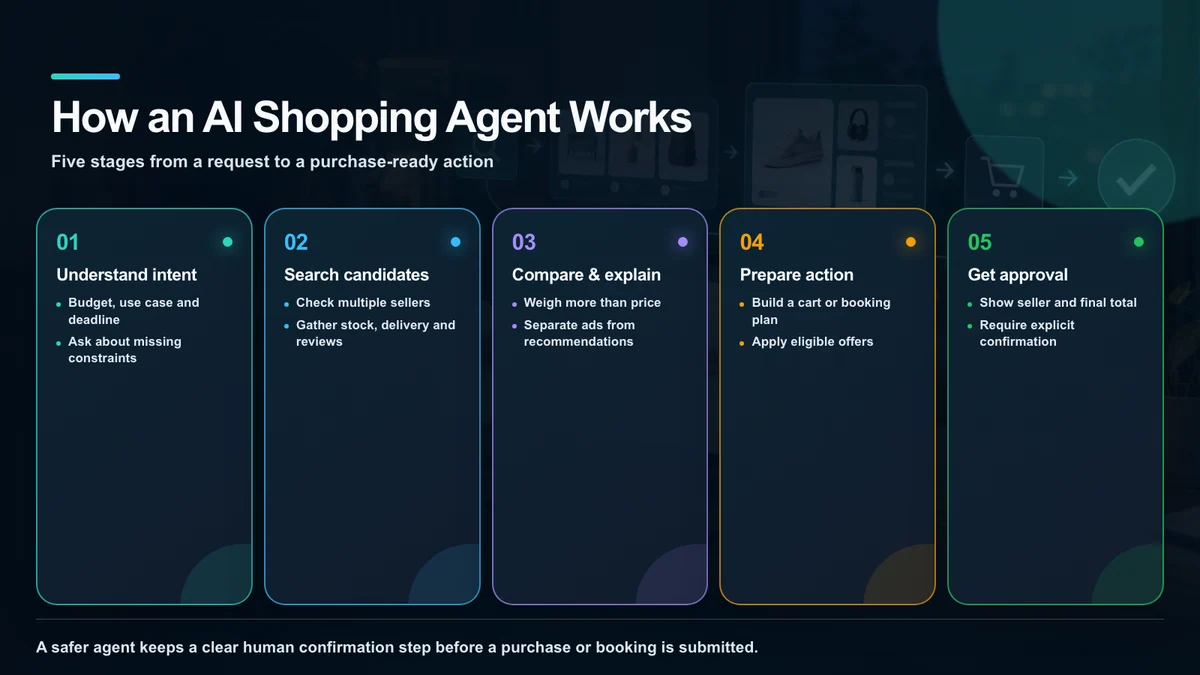
A responsible transaction flow has five visible stages: understand the request, search candidates, compare and explain, prepare an action, then obtain explicit confirmation. The user should be able to see what the agent did and stop before money or a reservation is committed.
What Google announced in 2026
Google says AI Mode has passed 1 billion monthly users and that queries have been growing by more than 2x each quarter. Its redesigned Search box accepts text, images, files, video and Chrome tabs while maintaining context across follow-up questions.
Information agents take a recurring task—such as watching apartment listings or waiting for a product drop—and monitor the web in the background. Google began with AI Pro and Ultra subscribers in the United States. Agentic booking is also expanding across local experiences and services, with selected U.S. categories able to ask Google to call a business on the user’s behalf.
Shopping is moving closer to the transaction. Google’s Universal Commerce Protocol, or UCP, is an open standard intended to let agents, merchants and payment providers exchange the information needed for discovery, checkout and post-purchase service. Eligible U.S. shoppers can already purchase products from participating Etsy and Wayfair sellers through experiences in Search and the Gemini app. Google is also introducing Business Agents that answer product questions inside eligible YouTube ads.
These features do not all appear for every account, retailer or product. Availability can depend on subscription, location, merchant participation and rollout stage.
The ideal workflow still keeps a human checkpoint
An agent can do the repetitive work before checkout:
- Translate a natural-language request into price, size, timing and quality constraints.
- Search participating retailers and gather inventory, delivery and return details.
- Explain the tradeoffs and disclose sponsored placement.
- Prepare a cart or booking with available loyalty benefits.
- Display the seller, option, quantity, address and final total for confirmation.
The final checkpoint matters. “Buy the best option” is not a precise instruction when a return fee, recurring membership or third-party seller can change the real cost.
Personalization can reach far beyond the prompt
A request may contain a budget, destination and deadline. Better personalization can add search and click history, purchases, abandoned carts, email, calendar, location, loyalty status and payment preferences.
Agents can also infer traits that were never directly entered: likelihood to buy, price sensitivity, household interests or travel habits. Those inferences may improve recommendations, but they can also shape which offers and prices a consumer sees.
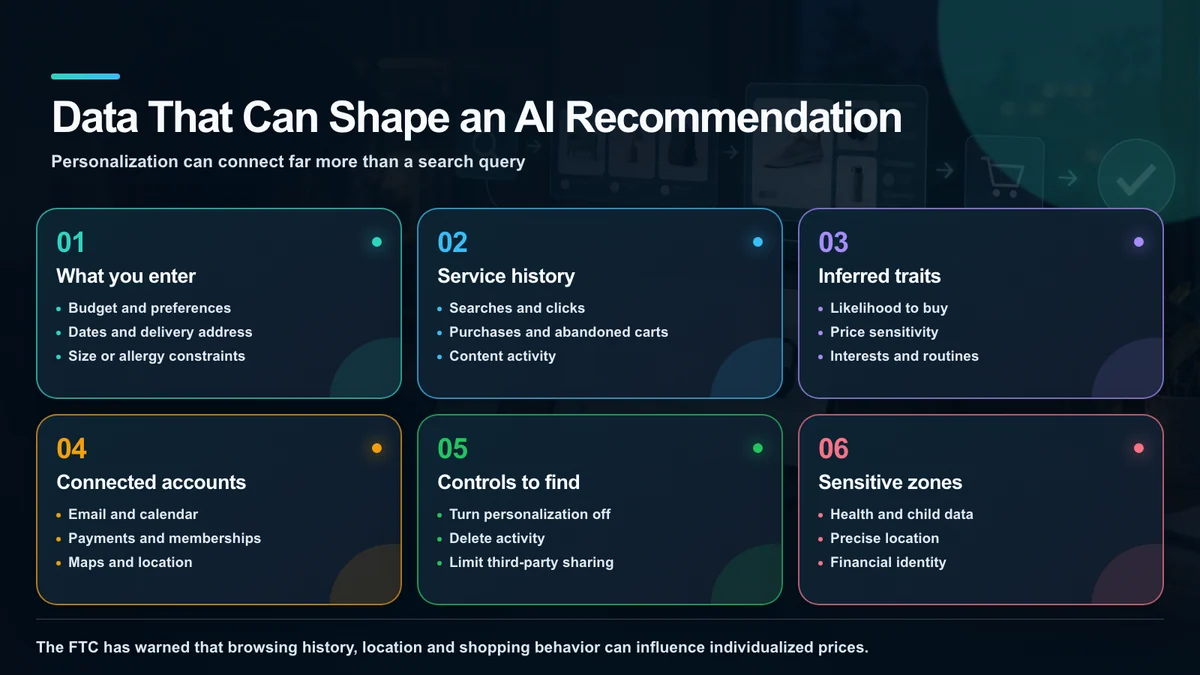
The FTC’s surveillance-pricing study found that intermediaries can use data such as precise location, browser history, mouse movement and abandoned-cart behavior to help retailers tailor offers or prices. In August 2026, the agency sought comment on a proposed personalized-pricing policy statement. The proposal emphasized that undisclosed use of personal data to set a price can create deception concerns even though personalized pricing is not prohibited in every circumstance.
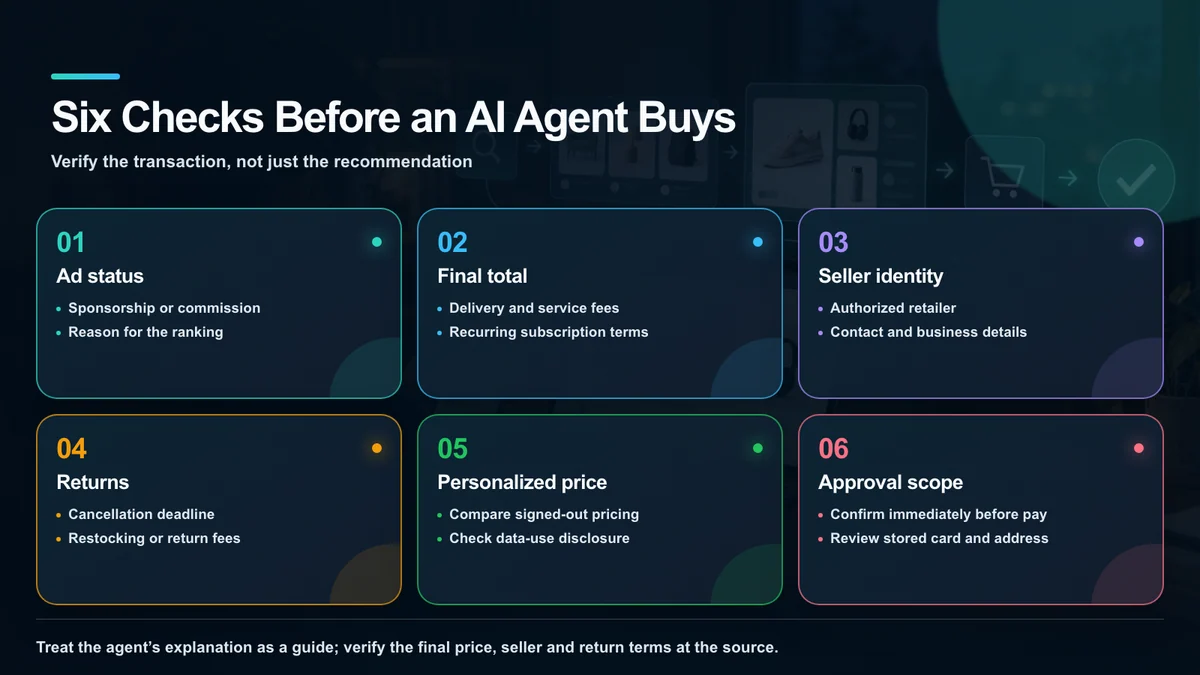
For a large purchase, compare the signed-in and signed-out price, check at least one other authorized seller and include delivery, membership and service fees in the total.
Recommendation is not the same as neutral ranking
An agent may have commercial relationships with merchants. A product can appear first because it fits the request, because the seller supplied structured data, because inventory is available—or because the placement is sponsored.
Google is testing ads and Direct Offers inside AI shopping experiences. Business Agents in YouTube advertising bring product questions even closer to sponsored content. A trustworthy interface should label ads clearly, explain why an item ranked highly and keep an independent comparison visible.
The FTC has long warned about deceptive patterns that disguise advertisements as editorial recommendations, reveal fees late or make cancellation difficult. An AI explanation does not remove those risks; it can make them less obvious if the answer feels personalized and authoritative.
Final price is more important than the suggested product
The lowest product price may not be the lowest transaction total. Delivery charges, service fees, restocking fees, mandatory accessories, extended warranties and trial memberships can reverse a ranking.
In 2026, the FTC also requested public input on hidden and inconsistent fees in online food and grocery delivery. The underlying principle applies to agents: compare the amount charged at checkout, not a partial number found earlier in the flow.
Ask the agent to separate these items:
- product price;
- shipping and service fees;
- taxes;
- recurring membership charges;
- discount conditions;
- return or cancellation fees.
Limit account and payment authority
An agent that only compares products does not need permanent payment authority. Start with read-only search and recommendation access. Allow cart creation separately. Require confirmation every time an order or reservation is submitted.
Useful controls should distinguish among five permissions:
- search products and prices;
- read account and loyalty information;
- create a cart or booking draft;
- retrieve an address or payment method;
- submit the transaction.
If a service bundles these into one broad consent, makes revocation difficult or keeps an indefinite purchase authorization, the convenience may not be worth the risk. Review connected accounts and delete stale access periodically.
What happens when the agent is wrong?
An agent can misread real-time inventory, describe a nonrefundable room as flexible, select the wrong size or apply a coupon whose conditions are not met. Fluent text is not a warranty that the merchant’s live terms were read correctly.
Save the final confirmation page, receipt and the conditions the agent presented. For travel, subscriptions and expensive goods, open the merchant’s cancellation or return page before approving. The seller’s final terms generally control the transaction, not the assistant’s summary.
A safer prompt for a shopping agent
A useful request controls both the recommendation and the action:
Find three wireless headphones under $250 that can arrive by Friday. Include only authorized U.S. retailers with a manufacturer warranty. Label sponsored results, rank by the final total including delivery and required memberships, and do not purchase—prepare a comparison and cart candidates only.
This prompt limits price, timing, seller, warranty, sponsorship, total-cost method and transaction authority. A travel request should also specify cancellation deadline, taxes, resort fees, room type and the exact traveler name before any booking is submitted.
Bottom line
AI shopping agents are valuable because they can coordinate work across search, comparison and merchant systems. The same coordination concentrates advertising, personal data, inferred preferences, individualized offers and payment authority in one place.
Use the agent to reduce repetitive research, but keep the final decision inspectable. Verify the seller, final total, return terms and recurring charges at the source, and require a clear confirmation immediately before checkout. The best agent is not the one that buys fastest; it is the one that makes every important assumption visible.
Trademarks and images
Google, Gemini, YouTube, Etsy, Wayfair and related marks belong to their respective owners. This independent article is not sponsored or endorsed by those companies. It does not reproduce Google product screens, company logos or third-party shopping photography.
Sources
- Google Blog: Google Search’s I/O 2026 updates
- Google Ads & Commerce Blog: What to expect in digital advertising and commerce in 2026
- Google Blog: Agentic commerce and holiday-shopping updates
- FTC: Surveillance pricing study and consumer-data findings
- FTC: Proposed personalized-pricing enforcement policy statement
- FTC: Dark patterns and online manipulation