OpenAI Teases “20+ Launches” for DevDay—What It Does and Does Not Confirm
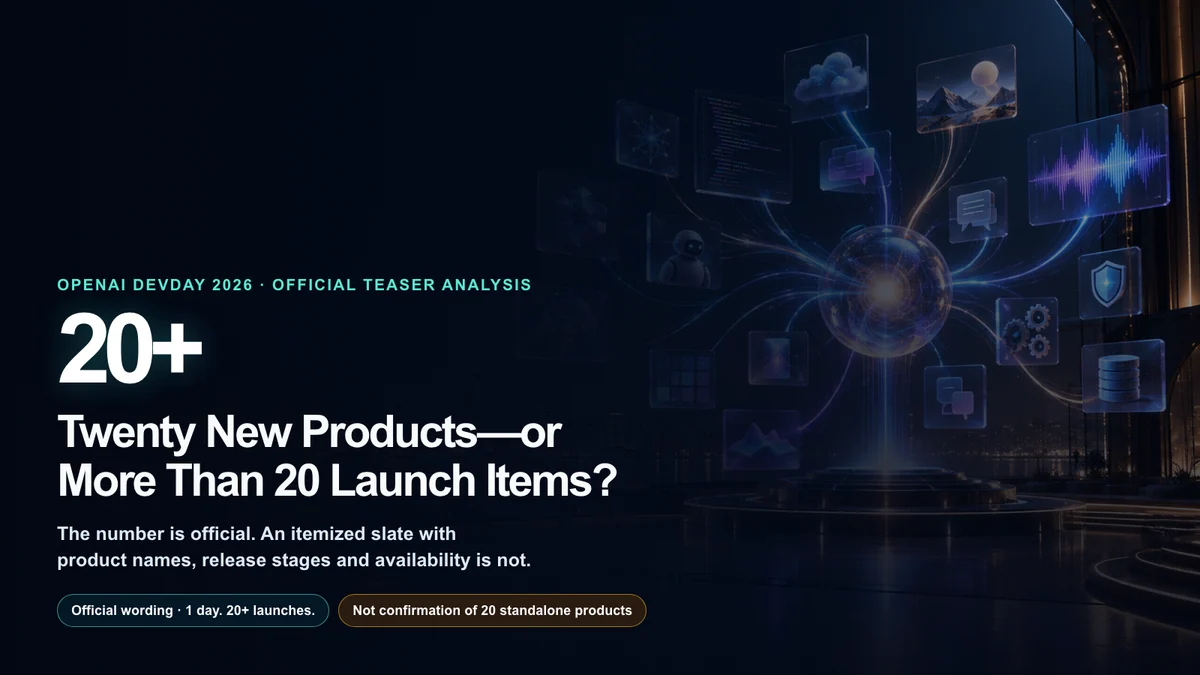
OpenAI has made the size of its DevDay rollout an official story. One day before the event, its X account posted an image reading “1 day. 20+ launches.” The idea that OpenAI plans a large launch slate is no longer based only on reporting or community prediction.
The phrase does not confirm 20 entirely new standalone products. OpenAI has not published an itemized list with names, model IDs, prices, release stages or availability. A model preview, an API feature, a move from preview to general availability, a pricing change and a regional rollout could each be counted as separate launches.
The responsible reading is narrower:
- Confirmed: OpenAI is teasing more than 20 launch items around DevDay.
- Not confirmed: that all 20 are new independent products or that every item becomes generally available on September 29.
- Decisive evidence: launch posts, model and API documentation, pricing and access terms after the keynote.
OpenAI’s original X post
X’s official embed data renders the post text as “Get ready.” while the attached media carries “1 day. 20+ launches.” The number therefore comes from OpenAI’s verified account, not a screenshot passed through rumor accounts. This article links to the original post rather than reproducing the X interface.
The key word is launches, not products. Technology companies use launch for a new product, a feature inside an existing product, an expanded preview, a new developer tool or a change in where and how something can be accessed. Until OpenAI defines the count, “20 new products” is an interpretation rather than a confirmed fact.
Sam Altman says OpenAI “found a new thing”
Sam Altman wrote that he was excited for DevDay and added, “We have found a new thing.” That phrasing raises the possibility that one central announcement sits above the long feature list. It does not identify the thing as a model, agent, research result, developer primitive or hardware product.
There is no primary evidence connecting that sentence specifically to Bel, GPT-7, the rumored always-on agent o or any other circulating name. A CEO teaser is primary evidence that OpenAI wants attention on an announcement. It is not a product specification.
Four different evidence levels sit under the 20+ headline
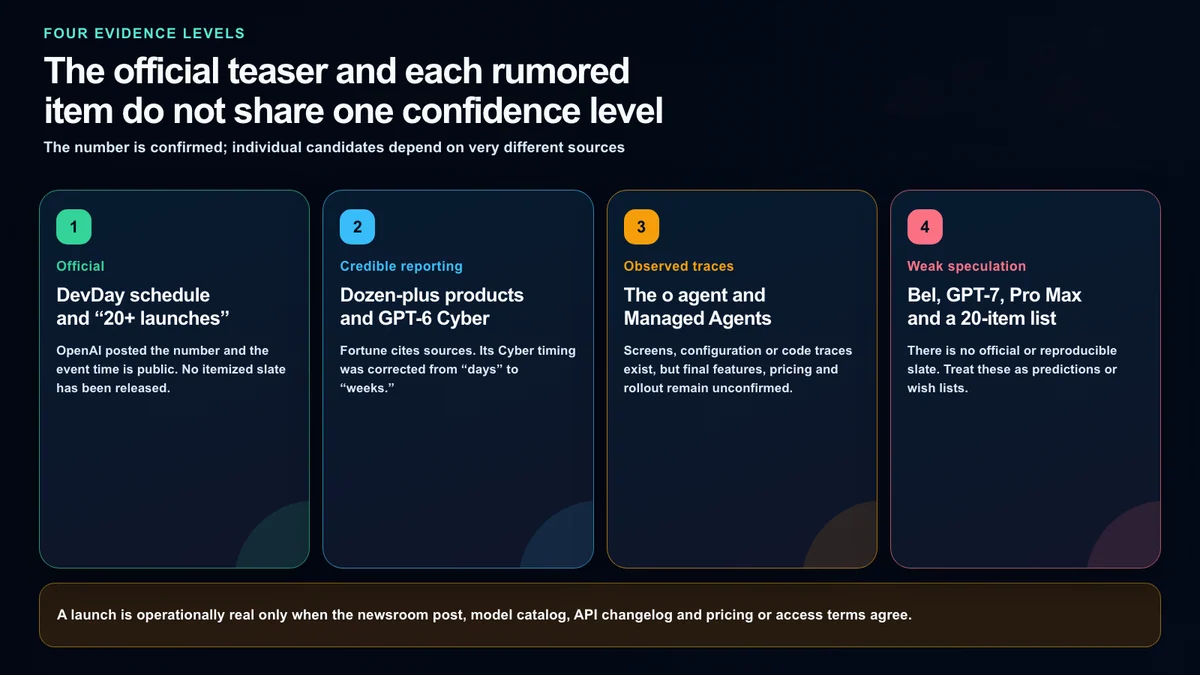
The first level is officially confirmed information: the event schedule, the 20+ teaser, the free keynote stream and products already documented by OpenAI. GPT-6 Sol and Luna belong to the existing-product column because they launched before DevDay; calling them surprise DevDay models would reset the timeline.
The second level is credible reporting. Fortune reported that OpenAI planned to ship a dozen or more other products at DevDay and was preparing GPT-6 Cyber plus an unnamed product for safer automated cyber deployment. The official 20+ tease is consistent with a larger slate, but Fortune did not publish the names of every item.
The third level is an observed interface, configuration or code trace. The rumored o always-on agent and Managed Agents fit here. These traces are more concrete than a wish list, but they may represent a limited experiment, unfinished code, renamed work or a launch that does not happen.
The final level is weak speculation: a full 20-item community slate, DevDay releases for Bel or GPT-7, a ChatGPT Pro Max launch and immediate general availability for every item. None has an official itemized source.
The earlier “dozen-plus” report and the new 20+ tease can both be true
Fortune reported on September 24 that OpenAI planned a dozen or more other DevDay products, most outside cybersecurity and spanning enterprise and consumer lines.
OpenAI’s own teaser now sets a broader 20+ number. That does not automatically invalidate the report. The source may have known about a dozen-plus major products, while OpenAI’s marketing count includes smaller features, release-stage changes or developer-program announcements.
Three units can be hiding inside the same number:
- Products with a distinct name, commercial offer or access path
- Features added to an existing product
- Release stages such as alpha, limited preview, public preview, GA or regional expansion
Comparing 12 and 20 as if they are the same unit would be false precision.
GPT-6 Cyber is the strongest individual rumor
Fortune says OpenAI is preparing to preview GPT-6 Cyber in the coming weeks, with a limited number of Daybreak Red customers already in alpha testing. It also describes an unnamed product intended to help customers deploy cyber models through safer automated workflows while giving OpenAI more visibility into usage.
That reporting is stronger than an anonymous launch list. The timing correction matters: Fortune changed “days” to “weeks.” OpenAI could name or demonstrate GPT-6 Cyber at DevDay without opening general API access that day. It could also announce the deployment product first and provide the model later.
A real cyber launch needs more than a name on a keynote slide:
- a documented model ID and endpoint
- eligibility or application rules
- boundaries for defensive and authorized research use
- network, production-system and credential controls
- human approval, audit logs, stop and recovery mechanisms
- pricing and U.S. availability
Our earlier GPT-6 Cyber and dozen-plus DevDay rumor analysis covers the reporting in detail. The new information here is that OpenAI itself has now raised the headline count to 20+.
Why o and Managed Agents belong in the middle, not the confirmed column
The rumored o product rests on two reported traces: an apparent ChatGPT Pro signup screen containing “o, your always-on assistant,” and separate client configuration fields using the same name. Two different trace types make it more plausible than a one-account claim.
OpenAI’s public event agenda and pricing documentation still do not name o. Its email behavior, Pro eligibility, final price, model, U.S. rollout and DevDay status remain unknown. Our separate o always-on agent fact check examines the traces and the permission model a persistent agent would require.
Managed Agents is similar. External analysts report platform-code traces that appear to describe a managed-agent layer, but OpenAI has not published a final product name or specification. It could become an Agents API operations product at DevDay, or it could remain internal or change before release.
How a 20+ count can be assembled without 20 standalone apps
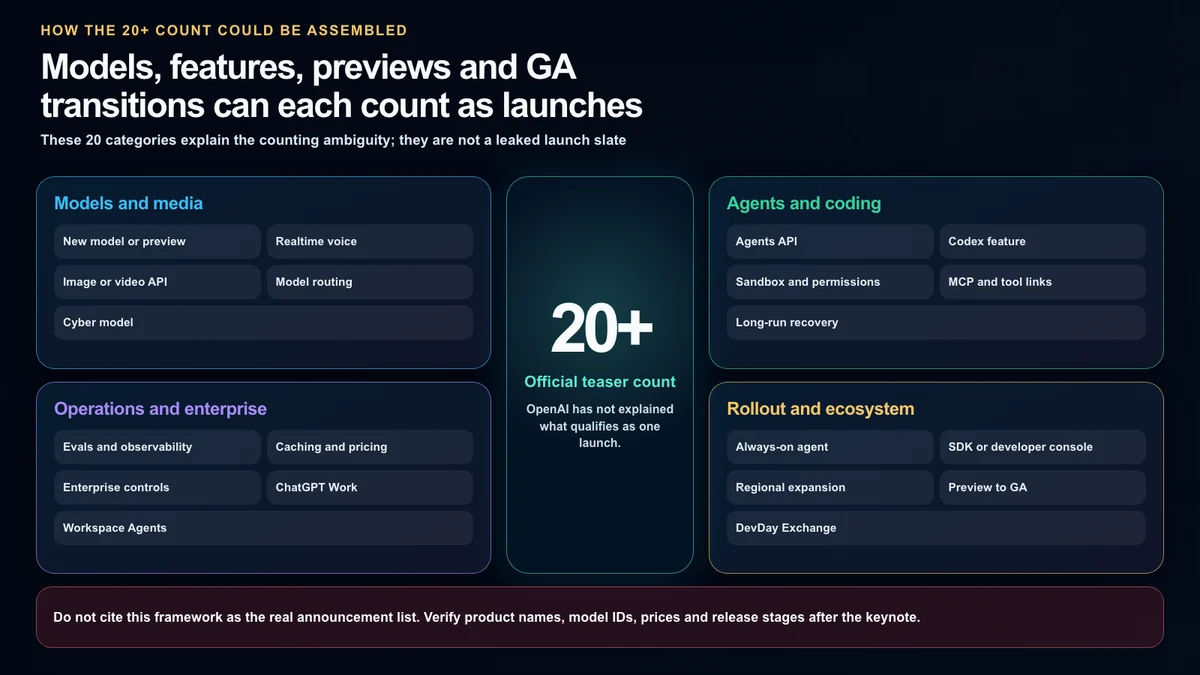
The visual above is not a leaked list. It is an editorial framework showing the range of items that can qualify as a launch.
The model and media bucket could include a model preview, Realtime voice, an image or video API, model routing and a cyber model. Agents and coding could split into Agents API, a Codex feature, sandbox or permission controls, MCP and tool connections, and long-running recovery.
Operations and enterprise could produce separate announcements for evals, observability, caching, pricing, enterprise controls, ChatGPT Work and Workspace Agents. Rollout and ecosystem items could include an always-on agent, SDK or developer-console changes, regional expansion, a preview-to-GA transition and DevDay Exchange programs.
The point is not to fill 20 blanks with guesses. It is to show why a 20+ launch count does not automatically mean 20 new models or 20 independent subscriptions.
What U.S. developers actually need from the slate
Community reaction is split between anticipation and launch-count fatigue. Some developers want more Codex usage, lower cost, reliable recovery and better long-running execution more than another model name. Others suspect the 20 count may divide small changes into separate launches. Comparisons with Anthropic’s latest coding models have also raised the bar for price and usable output.
Those reactions do not establish product facts. They do identify the criteria that will determine whether the announcements matter:
- completion cost rather than token price alone
- state and artifact recovery after a long run fails
- sandbox network policy and secret handling
- human approval before consequential external actions
- transparent per-model usage and rate limits
- continuity across the desktop app, CLI and cloud tasks
- stable latency and availability under launch-day demand
Twenty names have less production value than one improvement that cuts retries, review time and operational risk.
The U.S. event time and what to check live
OpenAI’s official DevDay site lists the opening keynote for 10 a.m. Pacific / 1 p.m. Eastern on September 29 at Fort Mason in San Francisco. The keynote will stream free, and OpenAI says other sessions will be recorded and posted after the event.
U.S. developers and buyers should separate seven questions during the stream:
- Is this a product, a feature, a research preview or a developer program?
- Is it GA, public preview, limited beta or application-only alpha?
- Is there a real model ID, endpoint, SDK or user-facing access path?
- What are the token rates, task limits, cache terms and subscription eligibility?
- Which actions require explicit approval and which run automatically?
- Where are task state, memory, credentials and audit logs stored?
- Can a customer stop work immediately, revoke access and recover changes?
A polished demo does not answer these on its own.
How to verify a launch after the keynote
Use a fixed order instead of relying on clips and reposts:
- Keynote: capture the exact name and target customer.
- Newsroom: identify the release stage and rollout language.
- Model catalog: find the model ID, context limits and tool support.
- API changelog: verify that endpoints and SDK support are active.
- Pricing and limits: check rates, caching, quotas and approval gates.
- Plan and region: confirm which U.S. plans and organization types qualify.
- Safety and administration: review permissions, retention, audit and recovery.
If the documentation chain is incomplete, describe the item as announced or previewed—not generally available.
The bottom line
OpenAI’s 20+ launches teaser is a strong official signal. It upgrades the story from “a source says a dozen-plus products” to “OpenAI itself is marketing more than 20 launch items.” Sam Altman’s line about finding a new thing also suggests that the event may have one centerpiece beyond the rapid-fire slate.
It still does not provide a confirmed list of 20 new products. GPT-6 Cyber has credible reporting. The o agent and Managed Agents have reported traces. Bel, GPT-7, Pro Max and complete 20-item lists remain weakly supported.
After the event, model IDs, access stages, prices, regions, permission boundaries and documentation should outrank the launch count. That is how developers can distinguish a headline from a product they can actually build on.
Sources
- OpenAI official X post: DevDay 20+ launches teaser
- Sam Altman official X post: “We have found a new thing”
- OpenAI DevDay 2026 official site and schedule
- OpenAI’s DevDay 2026 announcement
- Fortune: GPT-6 Cyber and a dozen-plus DevDay products
- OpenAI Agents API official overview
- TestingCatalog: reported o always-on agent traces
- AI Insiders: reported Managed Agents code traces
OpenAI, ChatGPT, Codex, GPT and related names and marks belong to their respective owners. Zoogom.com is an independent editorial site and is not sponsored, endorsed or operated by OpenAI. This article distinguishes official material, source-based reporting, reported interface or code traces and editorial inference. It does not reproduce third-party news photography, product interfaces, company logos or X screenshots; X posts are connected through original URLs and the platform’s official embed method.