AI data centers unite chips, the grid and communities
An AI data center is easy to picture as a building full of servers. That picture leaves out the system that makes the servers useful. Accelerators depend on memory, substrates and advanced packaging. The package creates power-delivery and heat problems. The facility needs grid capacity, cooling, land, communications and permits. The surrounding community experiences the construction, noise, water use, taxes, employment and electricity debate.
Policy developments in Korea, the United States and Japan reveal different links in that chain. Korea is placing large data centers and a domestic AI-semiconductor stack in one industrial plan. A U.S. program is treating packaging power, heat, test and reliability as manufacturing problems. Japan is linking data-center decarbonization with regional coexistence. The useful unit of analysis is no longer the server building alone.
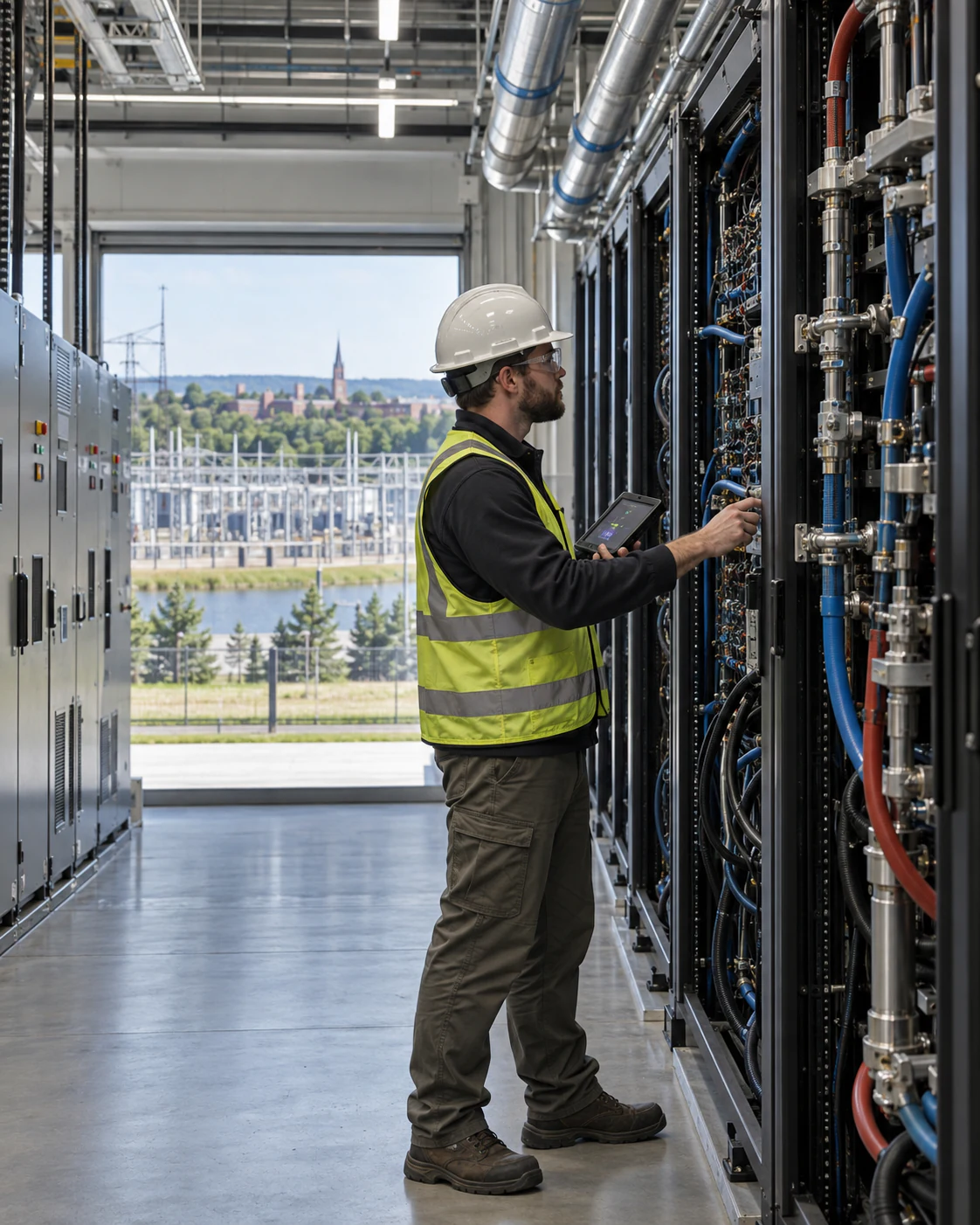
This is an original conceptual image for the article. It is not a photograph of a named data center, utility, community or investment project.
Korea put data centers and an AI chip stack in one plan
The Korea Ministry of Science and ICT described AI data centers as a national strategic industry in its work plan for the second half of 2026. The ministry said it would support electricity and land acquisition and accelerate permitting for gigawatt-scale projects associated with 550 trillion won in stated private investment by companies including SK, GS and Naver.
The 550 trillion won figure is an announced private-investment plan. It is not the value of operating equipment, a confirmed disbursement total or a measure of power already delivered. “Gigawatt-scale” does not establish that every project has connected to the grid. Groundbreaking, interconnection, phased energization and utilization must be checked project by project.
The same plan links data centers with domestic IT, power and cooling equipment and a “full package” ecosystem spanning AI chips, infrastructure, networks, software and services. It also refers to preliminary planning for 1-nanometer-class devices and next-generation stacked HBM. These are government policy and development goals, not proof of production yield or customer qualification.
The combined framing is nevertheless important. A data-center plan can fail because a building lacks accelerators, because chips lack qualified packages, or because complete racks lack power. Tracking one layer in isolation produces false confidence.
Advanced packaging is where compute, power and heat meet
AI accelerators are not useful by themselves. Compute dies, high-bandwidth memory, interconnects, substrates and power delivery have to work at extremely short distances. The resulting package has limits in signal integrity, heat density, assembly yield, test access and repair.
The NIST National Advanced Packaging Manufacturing Program says $300 million in first-notice awards for advanced substrates and materials was finalized for Absolics, Applied Materials and Arizona State University. That number applies to the program’s first funding opportunity and three recipients; it is not total U.S. investment in advanced packaging.
NIST’s technical questions connect directly with facility engineering: how to make multiple tightly assembled chips behave like one larger chip, how to supply power and remove heat, how to test and repair complex assemblies, and how to assure reliability when visual inspection is difficult. Data-center cooling is downstream of a thermal problem that begins inside the package.
This is why a chip team and a facilities team cannot optimize independently. A denser package may improve compute per rack while requiring new liquid loops, pumps, power shelves and maintenance procedures. The right metric is service delivered per constrained resource, not one component’s efficiency in a laboratory.
Japan tied zero emissions to regional coexistence
On September 17, Japan’s Ministry of the Environment opened the second call under a fiscal 2026 program for data-center zero-emission development and accelerated regional coexistence. The official deadline is noon on October 16. As of October 3, it was an open funding call—not a selection announcement and not a report of achieved emissions reductions.
The ministry’s background combines renewable-energy use, flexible supply and demand, distributed power systems and locally compatible energy development. That framing treats a data center as an energy participant whose location, timing and flexibility matter, rather than merely a large annual electricity customer.
Japan’s July 14 Integrated Innovation Strategy 2026 lists 17 strategic technology fields. Resource and energy security and green transformation, AI and advanced robotics, and semiconductors and communications appear as distinct fields. The list does not approve a data-center project or award funding, but it shows why compute infrastructure sits across several national priorities at once.
Capacity has four states
Headlines often compare capacity figures that describe different things. Separate at least four states:
- Announced: A developer or government publishes a target investment and candidate capacity.
- Reserved: Land, equipment slots or some form of interconnection position has been secured.
- Energized: Construction and grid work allow the facility to receive power.
- Utilized: Installed systems are processing customer workloads and drawing power.
An announced gigawatt and a utilized gigawatt do not have the same capital at risk, delivery certainty or grid impact. A project dashboard should show the megawatts and target date at each state, the evidence supporting that state, and the conditions that can move or cancel it.
Power contracts need the same precision. Record the service date, maximum demand, ramp schedule, expected average load, emergency generation, demand-response obligation and responsibility for stranded grid upgrades. A promise of flexible demand should be tested against customer-service commitments rather than treated as a marketing adjective.
A site is a coordinate where four networks intersect
Low land cost does not make a good data-center site. The parcel must intersect the electric grid, diverse fiber routes, an appropriate cooling resource and a workable permitting path. Flood, wildfire, earthquake and extreme-temperature risk affect design and insurance. Roads must carry transformers and cooling equipment, and workers must be able to reach the facility.
Schedules need to connect land control, utility studies, grid construction, environmental review, equipment orders and customer demand. A building permit cannot compensate for a multi-year interconnection delay. Conversely, reserving grid capacity for a project that does not proceed can block other users and leave an argument over cost recovery.
Water claims should be site specific. Cooling design, climate, water quality and reuse determine consumption. Ask for maximum-day and annual projections, source, drought operating rules, reuse, discharge temperature and treatment. An industry average cannot answer a local watershed question.
Fiber resilience also deserves physical evidence. Two contracts are not redundant if the cables share a conduit, bridge or central office. Map diverse paths and restoration expectations before assuming that a second provider eliminates communications risk.
Community benefits need units, dates and owners
Construction can employ many people for a limited period, while long-term operations use a different number and skill mix. A jobs claim should separate construction and permanent roles, duration, wage bands, local hiring, apprenticeships and training funds. A tax estimate should disclose abatements and the possibility that equipment values change.
A community record should track at least:
- power capacity by project phase and who pays for grid upgrades;
- normal and drought water use, reuse and discharge conditions;
- cooling, transformer and backup-generator noise and emissions tests;
- construction traffic, road repair and public-safety plans;
- operating jobs, local procurement and training outcomes;
- renewable contracts by location and time, not annual volume alone;
- conditions for heat reuse or other local energy support;
- release of land and reserved capacity if the project shrinks or is canceled.
If a developer offers a community fund or bill support, document the amount, recipients, duration, inflation adjustment and termination conditions. Benefits can begin before full operation and increase with delivered capacity so residents are not asked to accept all construction impact in exchange for a distant promise.
Cooling and power decisions outlive the first servers
Server generations turn over faster than buildings, switchgear and cooling plants. A facility tailored to one accelerator generation may face expensive changes when rack density or coolant requirements rise. Design envelopes should cover supply and return temperature, flow, pressure, leak detection, service clearance and a realistic expansion limit.
Air cooling, direct-to-chip liquid cooling and immersion each move cost and risk to different places. The selection should account for part-load performance, maintenance skill, water and energy use, equipment availability and the consequences of a leak or pump failure. “Liquid ready” needs an engineering definition, not a brochure label.
Power usage effectiveness is useful but incomplete. Track performance at partial load, water use, hourly carbon exposure, backup-generator tests, power quality and any actual heat-reuse output. A new efficient facility may still increase local peak demand or run during higher-emission hours.
Chip supply needs an end-to-end yield view
Counting accelerators ignores the HBM, substrate, packaging, network, power-supply and rack integration needed to deploy them. Manufacturing yield, packaging yield, server acceptance and field reliability compound. The number of useful systems can be materially smaller than the number of nominal chips ordered.
Procurement should therefore include acceptance criteria, tolerated degradation, spare parts, repair time, cooling and power dependencies, firmware support and migration cost. A highly optimized software and facility stack can make changing an accelerator vendor difficult even when another chip is available.
Public funding, industrial strategy and a large customer order are evidence of activity, not a promise of a company’s profit, security price or final market share. Procurement and investment decisions require current contracts, delivery, qualification and operating evidence beyond the policy sources discussed here.
One project ledger should connect every constraint
Separate chip, power, construction and community teams often report different versions of the same project. A shared ledger should connect:
- announced, reserved, energized and utilized capacity with evidence dates;
- accelerator, HBM, package, network and rack delivery and acceptance;
- rack power, cooling design and upgrade limits;
- utility, building and environmental permit dependencies;
- measured water, noise, emissions and community commitments;
- customer-contracted capacity and cancellation terms;
- the owner, next decision date and stop criterion for each risk.
Monthly reporting should emphasize the slowest dependency rather than an average completion percentage. Servers waiting for power do not produce service. Grid work completed for canceled demand can leave costs behind. An integrated schedule makes those mismatches visible before they become a public dispute.
The industry is the whole chain
Korea’s plan groups large AI data centers with power, land, permitting and a domestic semiconductor stack. NIST’s packaging program shows that power, heat, test and reliability are already coupled at the chip assembly. Japan’s funding call places zero-emission design and regional coexistence in the same program.
The largest announcement will not necessarily produce the strongest infrastructure. The system becomes real when packages become qualified servers, servers receive power and cooling, customers use them, and communities can verify both costs and benefits. In 2026, the most informative boundary for the AI data-center industry runs from the semiconductor package through the grid to the place that hosts it.