Who Should Pay for AI’s Power Boom? The Data Center Grid-Cost Fight
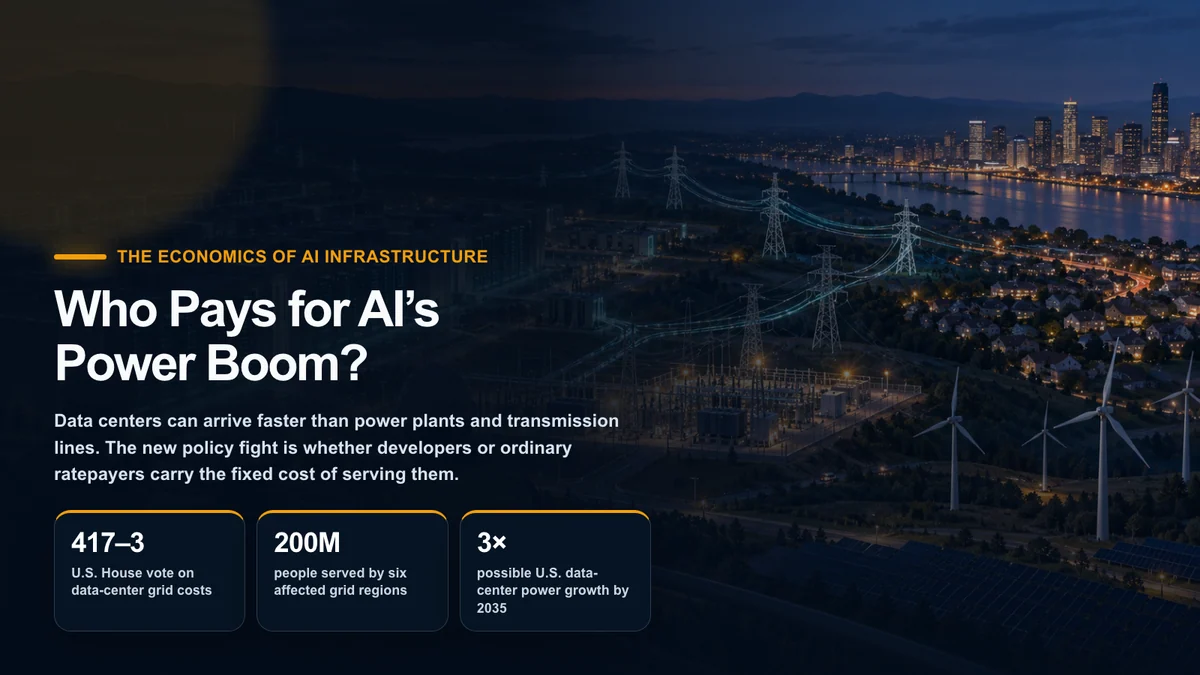
The politics of artificial intelligence has reached the electric bill. Training and serving larger models requires data centers that can arrive far faster than power plants, transmission lines and utility regulators can adapt. When a new campus triggers billions of dollars in infrastructure, the central question is no longer simply whether the grid can connect it. It is who pays if the project changes, shrinks or disappears.
In September 2026, the U.S. House voted 417–3 for legislation asking state utility regulators to consider charging data centers the full cost of new power generation and transmission upgrades needed to serve them. The overwhelming margin reflects a new political reality: voters may support AI investment while opposing a rate structure that shifts its fixed costs to households and small businesses.
What the 417–3 bill would—and would not—do
The Associated Press report on the House vote describes a federal recommendation, not a national retail rate. States would retain authority over electricity markets and decide how to translate the standard into tariffs and contracts.
The principle is straightforward. If one very large customer requires a new plant, substation or transmission project, that customer should not automatically socialize the bill across everyone connected to the utility. The difficult part is assigning causation. A regional transmission line may be accelerated by a data center but later benefit many communities. A power plant may serve both an AI campus and general growth. Some projects request far more capacity than they ultimately use.
The bill therefore begins a cost-allocation process rather than completing it. It does not build generation, eliminate interconnection queues or settle whether a data center brings enough taxes and jobs to justify public support.
A data center pays for more than electricity consumed
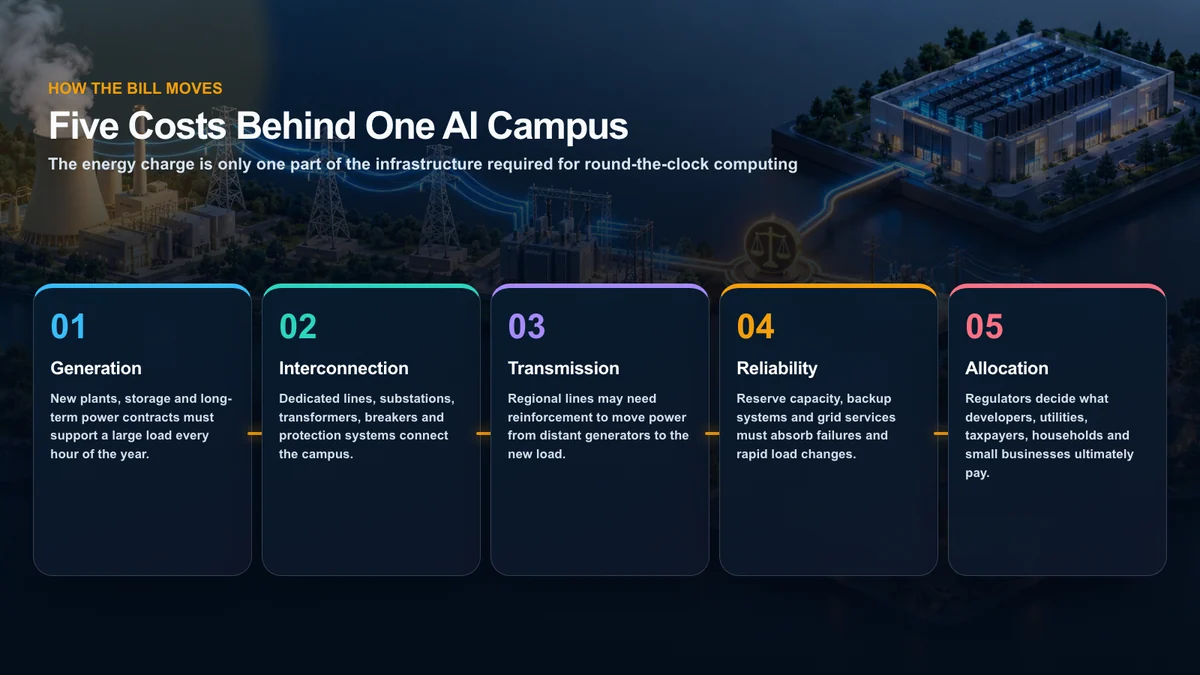
The monthly energy charge is only the visible edge of a much larger capital stack.
- Generation: new gas, nuclear, renewable, storage or contracted capacity capable of serving a large round-the-clock load
- Direct interconnection: dedicated lines, substations, transformers, breakers and protection systems
- Regional transmission: reinforcements that move power from generators to the new demand center
- Reliability: reserve capacity, balancing services and emergency systems for failures or rapid load changes
- Stranded-cost risk: debt and equipment left behind if a project is delayed, downsized or canceled
A policy can require developers to pay direct interconnection costs while leaving generation adequacy and regional transmission charges in broader rate bases. That is why “the data center pays for its connection” does not necessarily mean ordinary customers are fully protected.
FERC accelerated connections but cannot create power overnight
In June, the Federal Energy Regulatory Commission directed six regional grid operators to create a timely and orderly path for large loads. Those systems serve about 200 million people, roughly two-thirds of FERC’s jurisdiction. Under the order, data centers would pay the full cost of upgrades required for their connection. Associated Press coverage of the FERC action
Faster paperwork does not solve a physical shortage. New turbines, transformers and high-voltage lines have long lead times. States remain responsible for retail rates and much of the siting process. A developer may receive a clearer place in line while still waiting years for adequate generation.
The scale explains the urgency. Data centers now account for about 5% of U.S. electricity demand, according to an Electric Power Research Institute estimate cited by AP, and that share could triple by 2035. More than 4,000 facilities operate in the country, with about 3,000 planned or under construction. The exact load depends on which projects are completed, but the queue itself forces utilities to plan.
The cost-shift problem
Utilities recover long-lived investments over many years. If a data center signs a short or flexible commitment while the utility finances a 30-year asset, other customers may become the backstop. The risk appears in several forms.
- A project reserves capacity at multiple sites and builds only one.
- A customer announces a very large load but ramps servers more slowly than forecast.
- Efficiency gains or a business downturn reduce usage after the grid is expanded.
- The campus builds behind-the-meter generation and leaves shared infrastructure underused.
- A company relocates while the utility continues repaying the original upgrades.
Ratepayer protection therefore depends less on a slogan and more on contract details: minimum billing demand, long terms, collateral, exit payments, phased capacity releases and rules for reusable assets.
Korea and Japan show the same bottleneck from different angles
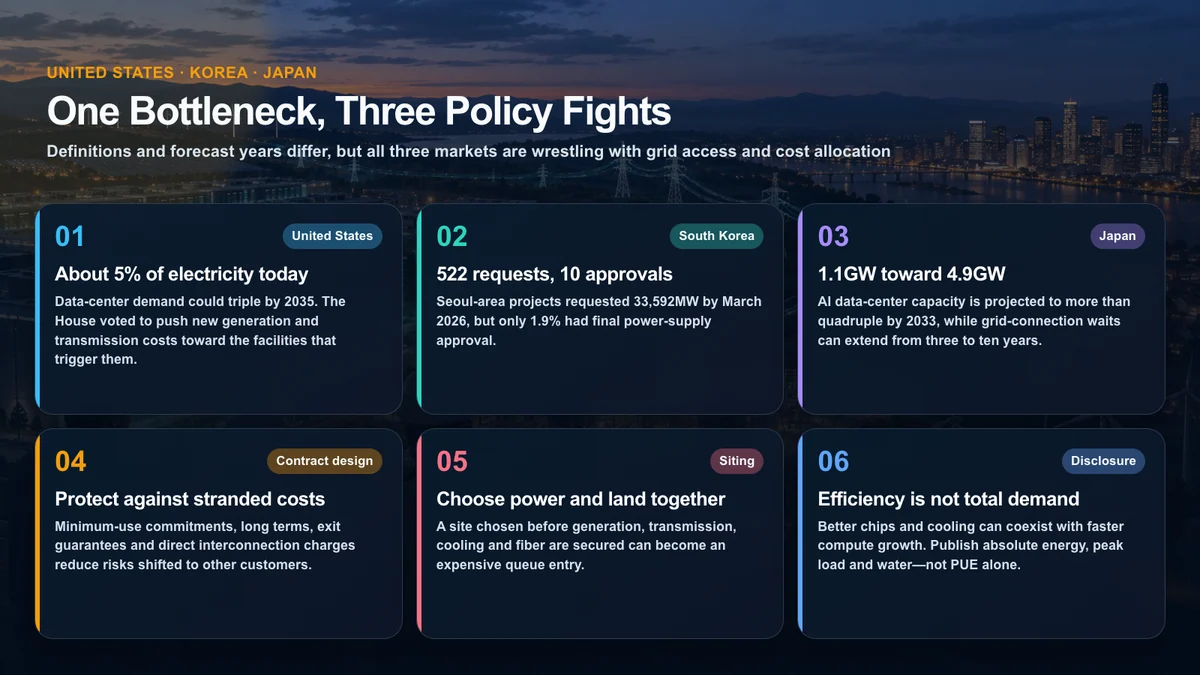
South Korea demonstrates how a queue can grow much faster than deliverable power. CBRE Korea reported that Seoul-area projects had submitted 522 first-stage grid-impact requests totaling 33,592MW by March 2026. Only 10 had final supply approval, a 1.9% approval rate by application count. The headline total should not be read as simultaneous construction—projects and sites can overlap—but it reveals how scarce credible power commitments have become.
Japan is entering what market analysts describe as its largest data-center investment cycle. A survey of 26 operators projected AI data-center capacity to increase from 1.1GW at the end of 2025 to more than 4.9GW by 2033, with about ¥10 trillion in construction investment. Grid-connection waits can range from three to ten years. Japan Data Center Index briefing
The three markets have different utility structures, but the shared lesson is that capital alone cannot compress transmission construction. Projects increasingly follow available power rather than assuming power will follow the project.
Contract terms that can protect ratepayers
A durable large-load tariff should answer six questions.
- How much capacity is firm? Require deposits or collateral before a speculative request occupies the queue.
- How long is the commitment? Match the customer term to the life of assets built primarily for that customer.
- What happens after cancellation? Predefine exit payments and ownership of reusable equipment.
- When does capacity ramp? Release power in phases tied to construction and verified server deployment.
- Who benefits from shared upgrades? Allocate regional transmission according to documented causation and broad public value.
- Can demand become flexible? Reward campuses that can delay workloads or reduce load during system emergencies.
Public reporting also matters. Power usage effectiveness, or PUE, measures overhead relative to computing equipment. It does not reveal absolute energy, peak demand, water use or whether a campus actually runs at the capacity it reserved. Regulators need the full set.
Jobs and tax revenue belong in the same ledger
Data centers can expand local tax bases and finance public services. Supporters of the House bill cited communities where new revenue produced large teacher bonuses. That benefit is real, but it should be compared with the number and duration of permanent jobs, abatements granted, water use, backup-generator pollution, transmission corridors and the portion of infrastructure paid by other customers.
The comparison should be project-specific. A campus that finances its interconnection, signs a long power commitment, locates near underused generation and provides substantial tax revenue is different from a speculative project that requests scarce urban capacity and leaves the utility to finance upgrades.
Bottom line
The United States does not face a single national shortage so much as a mismatch of location, timing and financial responsibility. Compute can be installed quickly. Power plants and transmission cannot. If contracts treat a data center like an ordinary customer, its exceptional size and cancellation risk can spill into everyone else’s bill.
The strongest principle is cost causation: the customer triggering dedicated infrastructure and stranded-cost risk should carry those costs first. Shared projects with broad long-term benefits can be allocated more widely, but only through transparent analysis. Protecting ratepayers is not anti-AI. It is how utilities preserve public support for the grid expansion AI actually requires.
Sources and use notice
- Associated Press, House data-center grid-cost bill
- Associated Press, FERC large-load interconnection order
- CBRE Korea, Seoul-area data-center power approvals
- Japan Data Center Index, 2026 investment, capacity and power briefing
Facts, numbers and policy positions are independently paraphrased. This article does not reproduce press photographs, company promotional media, maps or source charts. Organization and company names are used only for factual identification. The original illustrations were created for this analysis.