AI Saves Scientists Nearly Seven Hours a Week—Then Verification Takes Over
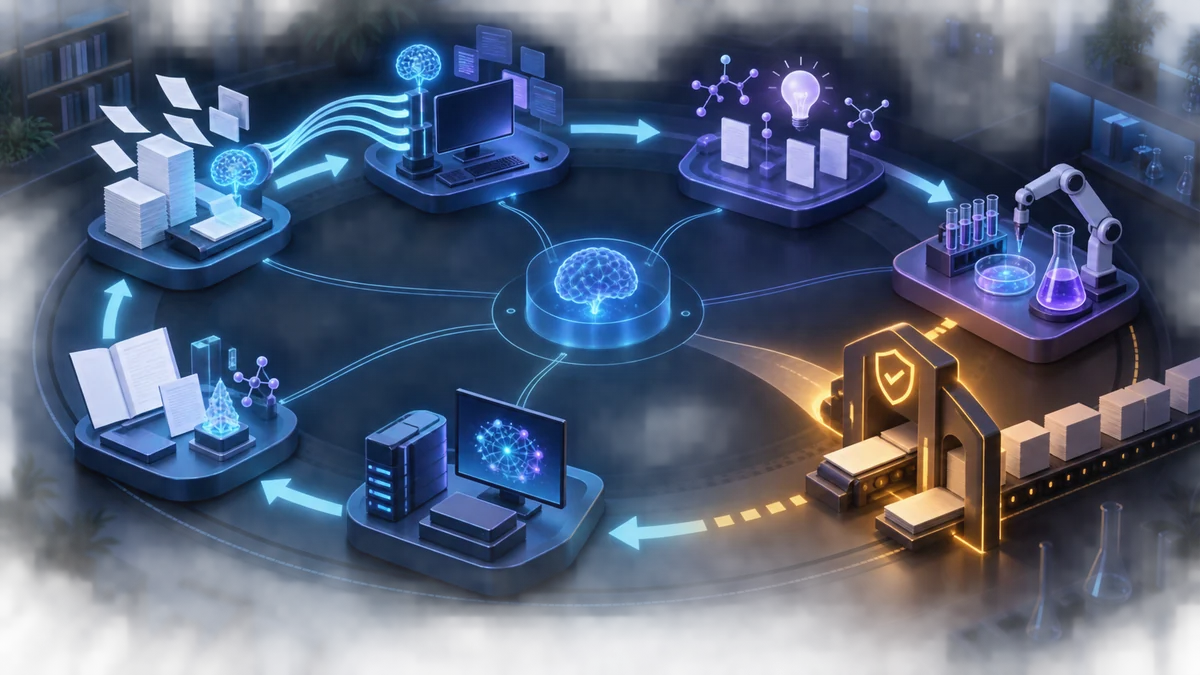
Scientists using AI reported saving nearly seven hours in an average week. The same study found that faster analysis and hypothesis generation can push work into slower stages: physical experiments, clinical validation, field collection and human review. The result is not the disappearance of a bottleneck but its movement downstream.
The new AI in Science: Early Insights report combines roughly 15 million Gemini interactions, an inventory of 2,690 specialized science models and a survey of 637 active scientists in the United States and United Kingdom. It maps all three sources to a task taxonomy developed with MIT FutureTech.
The headline needs an important qualifier. The seven hours are self-reported average time savings, not a measured seven-hour increase in scientific output. The survey is also a screened nonprobability sample that the authors say should not be treated as representative of every scientist.
Three things to know
- General-purpose LLMs and specialized science models appear complementary: one handles broad coding, writing and analysis, while the other performs domain-specific prediction, classification and simulation.
- About three quarters of surveyed scientists reported saving time, yet 41% saw a larger backlog of untested hypotheses and 46% of time savers spent more than one quarter of those savings checking AI output.
- Real gains require investment beyond model access—in experiment capacity, clinical and field validation, reproducibility, data quality and independent review.
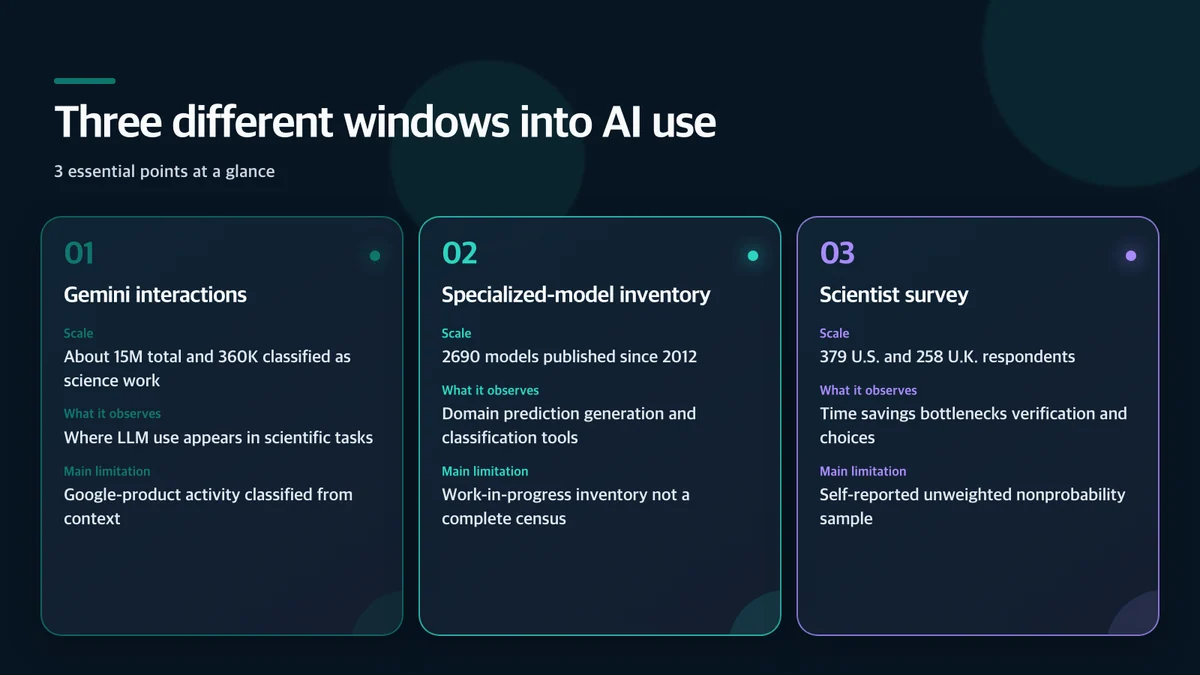
Three different windows into AI use
General LLMs and specialized models do different work
The research paper does not treat every AI system as interchangeable. General LLMs such as Gemini appear across troubleshooting research code, statistical analysis, literature review and drafting. Specialized systems are more common in health and life sciences and in tasks such as disease prediction, molecular design and simulation.
The survey attributes about 41% of scientists’ AI working time to general chat and document LLMs and about 30% to specialized models. Those categories depend on how respondents understood the question, but they challenge the idea that one general model has already absorbed the scientific software stack.
The specialized-model inventory includes 2,690 systems published since 2012 with an OpenAlex-linked paper and official code repository. The researchers assembled it from publications, repositories, agentic search and the Epoch AI model database. They explicitly describe it as a work in progress, not a ground-truth registry of every scientific AI model.
Where the seven-hour number comes from
An independent provider surveyed 379 U.S. and 258 U.K. scientists online from July 27 through August 11, 2026. Respondents included principal investigators, professors, laboratory directors, industry R&D managers, mid-career researchers and a smaller group of early-career scientists. Physical and engineering sciences, life sciences, health and clinical sciences, and social sciences were represented.
About three quarters reported saving time through AI, averaging just under seven hours per week. Respondents said that much of the recovered time went back into research. Sixty-eight percent reported greater access to insights from other disciplines, and 89% expected additional growth in output.
This was not a randomized trial comparing otherwise identical AI and non-AI laboratories. It records scientists’ estimates of their own workflow. There is no reliable population frame covering every type of scientist in both countries, so the authors report unweighted results without a margin of error. Selection, recall and differences in the meaning of “AI tool” can all affect the estimates.
The bottleneck moves to the physical world
Scientific tasks are connected. If an AI system helps produce ten plausible hypotheses, the laboratory does not automatically gain ten times as many instruments, samples, clinical participants, field seasons or ethics reviewers. Faster upstream work can lengthen the downstream queue.
About 44% of respondents said their primary constraint had moved downstream during the previous two years, toward physical laboratory work, manuscript preparation or other later stages. Forty-one percent reported a growing backlog of untested hypotheses, compared with roughly 25% who reported a decline.
Verification also claims part of the dividend. Among respondents who saved time, 89% spent at least one tenth of those savings checking AI output. Forty-six percent spent more than one quarter of the recovered time on auditing and verification. The paper reports that this verification cost was especially high in life sciences.
These figures do not prove that AI caused every bottleneck. They show reported associations in a sample where more intensive use, workflow change and verification demands appear together.
More papers are not automatically bigger discoveries

Forty-nine percent of respondents said AI pushed their work toward safer, more incremental questions with established benchmarks and reliable results. Twenty-eight percent said it enabled more high-risk work. The paper describes a possible “streetlight effect”: AI lowers the cost of problems with abundant data and clear evaluation before it helps with less structured questions that are expensive to test.
That distinction matters for universities, funding agencies and corporate R&D. More drafts, analyses or candidate molecules can raise measured activity without producing a proportional increase in replicated discoveries. If review capacity stays fixed, low-cost generation may transfer labor from creation to screening.
Useful productivity measures should therefore include more than output volume:
- time from hypothesis to validated result;
- replication rate and correction rate;
- experiment and instrument queues;
- provenance of data, code, model versions and prompts;
- time spent auditing generated results;
- negative findings preserved rather than discarded;
- access to AI and validation resources across institutions.
What U.S. research organizations should change
The United States is a major center for both scientific AI use and specialized-model development. But adding subscriptions or compute credits without expanding downstream capacity can intensify the queue the study identifies.
Research leaders can respond at the workflow level:
- Budget explicitly for verification instead of treating it as invisible overhead.
- Separate model-assisted generation from independent confirmation.
- Record source data, software and model versions, prompts and human edits needed to reproduce a result.
- Expand shared instruments, automated laboratories, clinical-validation support and field-data infrastructure alongside compute.
- Reward replication, negative results and corrected findings rather than only publication volume.
- Test whether time saved reaches junior and resource-constrained teams, not only well-funded laboratories.
The policy question is not merely how many scientists have access to a frontier model. It is whether a laboratory can test the additional ideas that cheap generation produces.
Do not merge the ATLAS logs with the survey
Google’s ATLAS methodology describes 14,653,926 de-identified interactions sampled from the Gemini app, Google AI Mode and Gemini API between April 6 and April 19, 2026. Its automated pipeline removes clusters representing fewer than ten users and applies differential privacy to public aggregates.
Those logs provide behavior at scale, but they do not contain verified employment records for each user. The science subset is inferred from occupational and conversational context. The seven-hour estimate, by contrast, comes from a separate July–August survey. Saying that Google directly measured seven hours in product telemetry would be wrong.
The logs are also centered on Google products and exclude some paid Gemini API use under enterprise contracts. They do not measure every use of ChatGPT, Claude, local models, internal pharmaceutical systems or offline research software. ATLAS is a large observational window, not a global census of scientific AI.
The Korea connection
The paper identifies specialized-model development as concentrated in the United States, China, the United Kingdom, the European Union, Korea and Canada. It also finds that a country’s share of the global researcher workforce is strongly associated with its share of scientific LLM interactions. That makes the downstream-bottleneck question relevant to U.S. partnerships with Korean universities, chipmakers, biotechnology companies and public research institutes.
It does not make the 637-person U.S.–U.K. survey a measurement of Korean scientists. Cross-border programs should collect local workflow and validation data rather than importing the seven-hour figure as a universal productivity assumption.
Bottom line
AI is becoming a practical layer of scientific work. It can reduce time spent on coding, literature review, analysis and routine preparation while connecting researchers to unfamiliar fields. Science, however, ends in evidence rather than generated possibilities. Physical experiments, clinical confirmation, field collection, replication and peer review remain slower and more expensive.
The nearly seven-hour estimate is best read as a clue about where work is changing, not as a guaranteed productivity multiplier. The institutions that convert that time into reliable discoveries will be the ones that expand validation capacity and reward quality at the same pace that they expand model access.
Sources and usage notice
- Google, Google DeepMind and MIT FutureTech, AI in Science: Early Insights
- MIT FutureTech, AI in Science research page
- Google AI, AI & Economy ATLAS methodology
- Google, September 2026 AI & Economy ATLAS update
This article independently explains the study’s reported figures and methods. It separates observational logs from survey estimates, does not treat self-reported time savings as causal proof, and does not reproduce source charts, tables, photographs or interfaces.