ChatGPT Pro Max Rumor: The $500 Codex Plan Claim, Fact-Checked

A ChatGPT Pro Max rumor began spreading on September 24, 2026, with claims of a higher subscription tier built for faster, longer ChatGPT Work and Codex tasks. One report puts the price at $500 per month. At that rate, the annual bill would be $6,000 before any applicable tax.
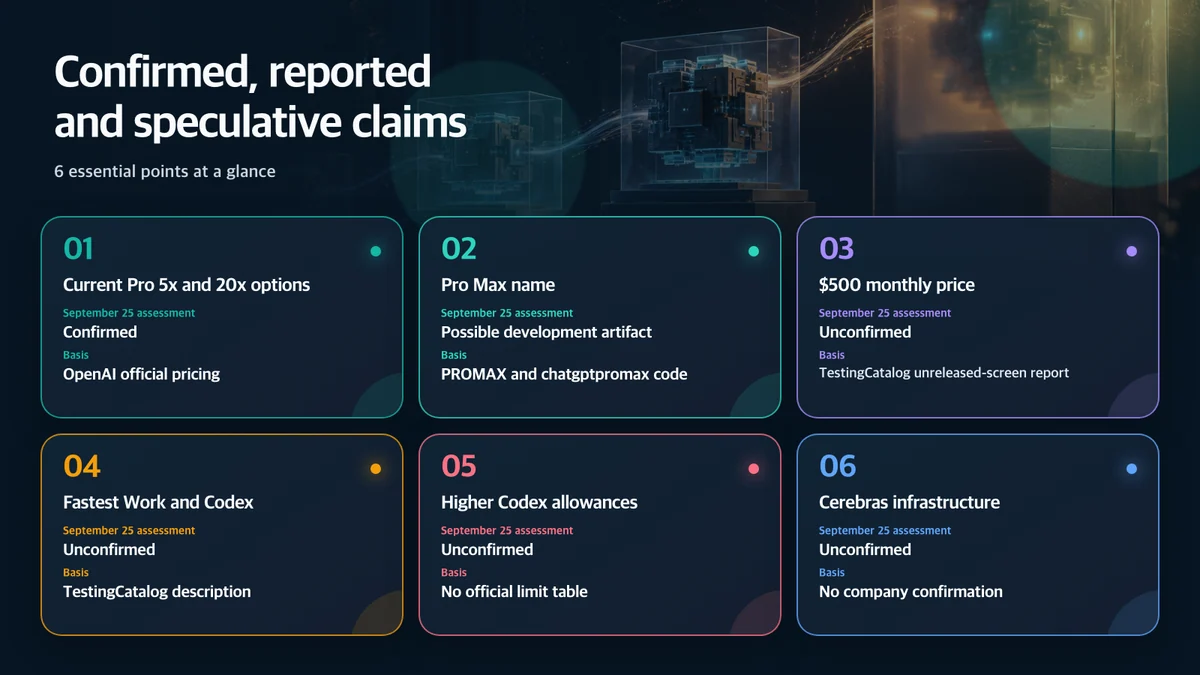
There is evidence that OpenAI has tested code or an unreleased interface associated with a higher Pro tier. There is no OpenAI announcement confirming ChatGPT Pro Max, Codex Pro Max, a $500 price, its limits, its launch date or availability in the United States or elsewhere.
This article examines the original X posts, OpenAI’s published pricing, the alleged unreleased screen, secondary reporting and the community requests that are being mixed into the story. The status is current through September 25 and may change if OpenAI publishes product terms later.
Three takeaways
PROMAXandchatgptpromaxstrings are a meaningful development signal, but code labels do not prove a public launch.- The $500 price and
Fastest Work and Codexwording come from TestingCatalog’s account of an unreleased subscription screen, not an OpenAI pricing announcement. - The official baseline remains Pro starting at $100 per month, with a choice of 5x or 20x more Codex usage than Plus.
Confirmed, reported and speculative claims

What the first X post actually showed
View Tibor Blaho’s original higher-tier ChatGPT Pro post on X
Tibor Blaho wrote on September 24 that OpenAI was preparing a higher-tier ChatGPT Pro plan. Analysis of the shared code-search screen identified repeated PROMAX, chatgptpromax and promax labels near plan-related strings such as PRO and PRO_FREE.
The narrow conclusion is that ChatGPT-related code displayed identifiers that appear connected to a Pro Max tier. The image does not establish whether those values are active, server-supported, part of an A/B test, reserved for an internal experiment or left over from work that will never ship.
PromptBlueprints’ conservative examination reaches the same boundary. The screenshot can support the existence of the strings. It cannot establish the final product name, price, features, eligible countries or launch status. A development signal and a confirmed subscription are different claims.
Where the $500 and Fastest Work and Codex claims came from
TestingCatalog posted later that day that a ChatGPT Pro Max plan had been spotted in development. Its companion report describes a $500 base price and says a $600 figure visible in the video reflected tax. It identifies Fastest Work and Codex as the main wording added to the existing Pro description.
That is more specific than the first code screenshot, but it is still reporting about an unreleased interface. OpenAI has not published the price or description, and there is no independently documented completed purchase. Even an authentic pre-release screen can change before launch or represent a limited experiment that never reaches the public.
RuntimeWire’s follow-up correctly treats Pro Max as a reported development rather than an available product. It notes the $500 and possible Cerebras claims while confirming that OpenAI’s public pricing and DevDay announcement do not list Pro Max.
The two X posts should not be counted as two independent confirmations. They may be two views of the same product experiment and rumor chain. More posts repeating the same artifact increase reach, not evidentiary strength.
The official pricing baseline
OpenAI’s official Codex pricing currently lists the following individual options:
- Free at $0 per month and Go at $8 per month.
- Plus at $20 per month, with Codex across supported surfaces and access to GPT-6 Sol and Luna.
- Pro starting at $100 per month, with a choice of 5x or 20x more Codex usage than Plus.
- Optional ChatGPT credits when Plus or Pro users exhaust included usage.
- Separate usage-based API-key billing for eligible local and scripted Codex workflows.
The page has no Pro Max listing. It would therefore be inaccurate to rename the current 20x option Pro Max or tell readers that a $500 plan can already be purchased.
Why the rumor is plausible now
Codex has moved beyond short code completions into multi-hour and multi-day agent work. Repository analysis, tests, browsers, computer use and multiple subagents can consume substantially more compute than a conventional chat session. A fixed subscription designed for interactive use may leave a gap for professionals who want sustained autonomous work without switching to an open-ended personal credit bill.
A GitHub feature request proposed fixed tiers ranging from $300 to $500, with illustrative allowances from roughly 35x to 80x Plus. A separate OpenAI Developer Community proposal asked for a $400 plan with about 50x usage to support continuous agentic research.
Those figures are customer proposals, not leaked OpenAI terms. They are evidence of demand for a larger predictable allowance, not evidence that Pro Max will use those exact multipliers.

Who would pay $500 per month?
If the reported price ships, the target customer would probably not be someone using ChatGPT for occasional questions. Likely candidates include:
- independent developers running several long Codex tasks across repositories;
- researchers combining agents, browsers, tests and tool calls for days;
- professionals who prefer a predictable software subscription to variable personal API spending; and
- small operators for whom lower latency and additional concurrency directly affect revenue.
An expensive plan would not automatically mean unlimited use. Five-hour and weekly windows, concurrency, per-model multipliers, speed modes, long-context surcharges and fair-use controls could matter more than the headline price. A plan that is faster but burns its allowance faster may not deliver the expected value.
Is the Cerebras connection real?
TestingCatalog and later reports connect the word Fastest with OpenAI’s work on faster inference and suggest that Cerebras could provide capacity. That is a plausible inference because OpenAI has used Cerebras in other latency-focused work.
There is no official evidence that a Pro Max subscription would route through Cerebras. One product can use multiple infrastructure paths depending on model, region, demand and selected speed. A short plan description cannot prove the hardware provider, latency multiplier or guaranteed throughput.
Will OpenAI announce it at DevDay?
OpenAI DevDay 2026 is officially scheduled for September 29 in San Francisco. The rumor appeared five days earlier, prompting speculation that Pro Max could be announced during the event.
OpenAI’s DevDay announcement does not mention Pro Max. Timing is a useful signal, not a promise. OpenAI could announce developer APIs and tools without changing consumer subscriptions, unveil the plan on another date or continue testing without a public release.
What U.S. buyers should verify if it launches
The final decision requires more than a name and monthly price. Check:
- The exact five-hour and weekly allowances relative to Pro 20x.
- Whether GPT-6 Astra, Sol and Luna consume the same allowance or have different multipliers.
- Whether ChatGPT Work, local Codex, cloud tasks, image generation and other agentic features share one budget.
- Included concurrency, queue priority and Fast or Ultrafast processing.
- What happens after the included allowance is exhausted: credit purchase, slower processing or a hard stop.
- Tax, cancellation, refund and mid-cycle upgrade rules.
- Whether business use, automation and account sharing are allowed under the plan terms.
A $500 subscription can still be poor value if a weekly cap interrupts core work. It can be economical for a narrow group if throughput is predictable, the models needed for the job are included and the completed-task cost compares favorably with API billing and human time.
Frequently asked questions
Has ChatGPT Pro Max launched?
No. OpenAI’s official pricing page did not list Pro Max as of September 25. The current evidence consists of code references and reporting about an unreleased interface.
Is Codex Pro Max a separate subscription?
There is no evidence of a standalone Codex-only product. The reported name is ChatGPT Pro Max, with Work and Codex included in the alleged description.
Is the price definitely $500?
No. TestingCatalog reported that price from an unreleased screen. OpenAI has not confirmed it.
Will it provide 50x Codex usage?
No allowance has been confirmed. The 50x figure comes from a community request for a hypothetical $400 plan. Official Pro currently offers 5x or 20x relative to Plus.
Will GPT-6 Astra be unlimited?
There is no official support for that claim. Model availability, multipliers and fair-use limits remain unknown.
Is a DevDay announcement confirmed?
No. DevDay is confirmed for September 29; a Pro Max announcement is not.
Bottom line
The ChatGPT Pro Max rumor has a real signal behind it: PROMAX and chatgptpromax code strings, a higher-tier interface claim, reported Fastest Work and Codex wording and a $500 display all point in a similar direction. Heavy Codex users also have a documented reason to want a larger fixed-price allowance.
None of that makes the product official. The strongest public artifacts are still pre-release code and screens. OpenAI’s pricing page, product documentation and event announcement do not list Pro Max. The $500 price, larger usage limits, Cerebras routing and DevDay launch are separate unconfirmed claims.
The most accurate description today is that OpenAI may be testing a higher ChatGPT Pro tier that emphasizes Work and Codex. It becomes a product only when OpenAI publishes the final name, price, U.S. availability, per-model limits and subscription terms.
Sources and use notice
- OpenAI official Codex pricing
- OpenAI DevDay 2026 announcement
- Tibor Blaho’s higher-tier ChatGPT Pro post on X
- TestingCatalog’s ChatGPT Pro Max post on X
- TestingCatalog’s $500 Pro Max report
- PromptBlueprints’ review of the code evidence
- RuntimeWire follow-up analysis
- GitHub request for $300 to $500 higher Codex tiers
- OpenAI Developer Community proposal for a $400, 50x tier
OpenAI, ChatGPT, GPT, Codex and related marks belong to their respective owners. This independent article is not sponsored or endorsed by OpenAI. X posts are shown through original embeds or links; the leaked code and unreleased product screens are not reproduced as separate images. The article’s illustrations are original editorial images that do not use OpenAI logos, product interfaces or third-party screenshots.