GPT-6 Sol Rumors Ahead of September 22: What Is Confirmed and What Is Not

Claims that GPT-6 Sol will launch on September 22, 2026 are moving quickly through AI communities. A screenshot presented as a model configuration, reports of OpenAI API and Codex OAuth preparation, and predictions of a simultaneous GPT-6 Luna release have combined into a confident-sounding “tomorrow” narrative.
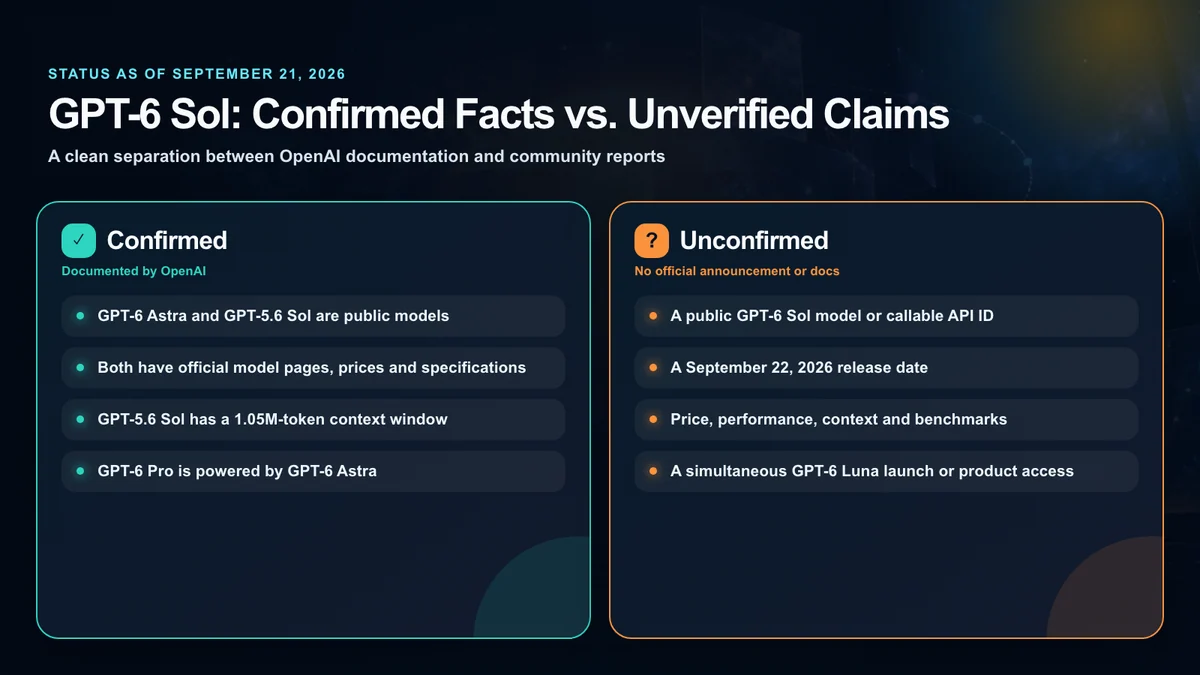
OpenAI had not announced a GPT-6 Sol product, release date, price, API identifier or benchmark as of September 21. The company’s public model catalog lists GPT-6 Astra and GPT-5.6 Sol. It does not list GPT-6 Sol.
That distinction does not prove the rumor is false. It means the evidence is not strong enough to describe September 22 as a confirmed launch. This guide separates documented facts, claims attached to an alleged configuration screenshot and inferences based on OpenAI’s existing model names. The status date is September 21, 2026; any official release could change the record after publication.
The short version: plausible preparation is not a confirmed launch
The current situation can be reduced to three points.
- The name GPT-6 Sol has appeared in community discussions and material described as a configuration screenshot, but OpenAI has not authenticated that material.
- September 22 comes from leak-oriented accounts and posts citing them, not from an OpenAI release calendar.
- Pricing, context length, reasoning levels, GPT-6 Luna, and availability across ChatGPT, Codex and the API remain unconfirmed.
Where did the September 22 rumor come from?
The most specific date points back to a post from the X account @LuminaBench, an account associated with model-leak reporting. Posts citing it say that GPT-6 Sol preparation appeared in provider configurations for the OpenAI API and Codex OAuth.
Descriptions of the alleged screenshot mention image input, multiple reasoning levels, a long-context-related value of 272,001, and a display-only price tier. A secondary report summarizing the claim explicitly notes that the screenshot does not establish public access, pricing or a release date.
There is another reason to treat the calendar claim cautiously. An earlier September 17 prediction did not produce a GPT-6 Sol announcement. Expectations then shifted to September 22. A moving date can be a sign that launch preparation is real but timing is uncertain; it can also be rumor momentum. It cannot support the phrase “confirmed for Tuesday.”
An OpenAI Developer Community thread about GPT-6 Sol, Terra and Luna shows genuine user interest, but the forum is a user-discussion space. A post on an OpenAI-hosted community domain is not automatically a product announcement or employee confirmation.
What a configuration screenshot can—and cannot—prove
Model names and feature flags sometimes appear in configuration files, provider catalogs or client code before a public release. The same name appearing through more than one path can therefore be more interesting than a name invented in a social post.
Configuration is not final product documentation, however. An entry can be a reserved label, an internal test alias, a nonfunctional flag or something added by a third-party router. A screenshot does not establish who produced the configuration, whether OpenAI’s servers accept the model ID, or whether ordinary accounts will receive access.
The number 272,001 deserves particular caution. It does not prove that GPT-6 Sol has a 272,000-token context window. GPT-5.6 Sol’s current official documentation applies long-context pricing when input exceeds 272K tokens: 2x input and 1.5x output pricing for the full request. The screenshot value might refer to a threshold related to that behavior, but that is an inference. It is not a documented GPT-6 Sol limit.
Reasoning labels can also be misleading. A client display label such as “Ultra” does not necessarily map one-to-one to the API’s reasoning.effort parameter. The official GPT-5.6 Sol API page currently documents none, low, medium, high, xhigh and max. An unverified UI label should not be copied into a final API specification.
A dollar-sign tier is no substitute for a rate card. A usable price comparison needs input, cached-input, output, cache-write, long-context and processing-tier rates.
The documented baseline: GPT-6 Astra
OpenAI released GPT-6 Astra in early September 2026. The public model catalog describes it as the company’s most capable model for the hardest end-to-end work.
Its Standard API rates are $10 per million input tokens, $1 per million cached input tokens and $50 per million output tokens. The model page lists a 1.05-million-token context window, a 128,000-token maximum output and an April 30, 2026 knowledge cutoff. A separate Fast mode offers higher speed at a higher rate.
In ChatGPT, GPT-6 Pro is powered by GPT-6 Astra. OpenAI’s ChatGPT availability guide separates access by plan and by product. That matters because a model announcement does not guarantee the same name, timing or allowance in ChatGPT, Work, Codex and the API.
The other baseline: GPT-5.6 Sol
Sol is already an official OpenAI model-tier name. The current GPT-5.6 Sol model page calls it the flagship model in the GPT-5.6 family for complex professional work.
Its documented rates are $4 per million input tokens, $0.40 per million cached input tokens and $20 per million output tokens. It has a 1.05-million-token context window, a 128,000-token maximum output and a February 16, 2026 knowledge cutoff. Above 272K input tokens, the full request is billed at 2x input and 1.5x output rates.
Those numbers do not transfer to an unannounced GPT-6 Sol. They do explain the product expectation behind the rumor. Many users assume that a new Sol would become a faster, less expensive everyday GPT-6 tier below Astra. The naming logic is plausible; the performance and price are still guesses.
How credible is each major claim?
A GPT-6 Sol model is in preparation
The repeated name and the configuration material described by several communities make the claim more specific than a pure invention. Yet there is no official model page, callable ID or reproducible public response. The accurate label is possible but unverified.
It will launch on September 22
Confidence should be low. The date does not come from an official schedule, and an earlier September 17 prediction failed. No announcement on September 22 would not prove that the model can never exist; a different OpenAI announcement that day would not confirm Sol either.
It will be faster and cheaper than Astra
The idea fits a reasonable product strategy, not published evidence. Astra targets the highest-capability tier at a premium rate, so a smaller everyday GPT-6 could be faster and less expensive. Actual cost and quality require an official rate card and repeatable tests.
It will have a one-million-token context window
Both GPT-6 Astra and GPT-5.6 Sol currently have 1.05-million-token windows, which makes the prediction understandable. Existing models do not guarantee a new model’s specification. The reported 272,001 configuration value does not establish a one-million-token window either.
GPT-6 Luna will launch at the same time
This is among the least-supported claims. Communities are extending the GPT-5.6 Sol, Terra and Luna naming pattern into the GPT-6 generation. OpenAI has not announced a GPT-6 Luna name, release schedule or specification.
GPT-5.6 Sol requests are already routing to GPT-6 Sol
Users cannot reliably identify a backend model from tone, speed or response quality. System prompts, tools, traffic routing and server load can change behavior. Without a clear OpenAI notice or reproducible model-identity record, automatic-replacement claims remain speculation.
Seven checks for an actual release
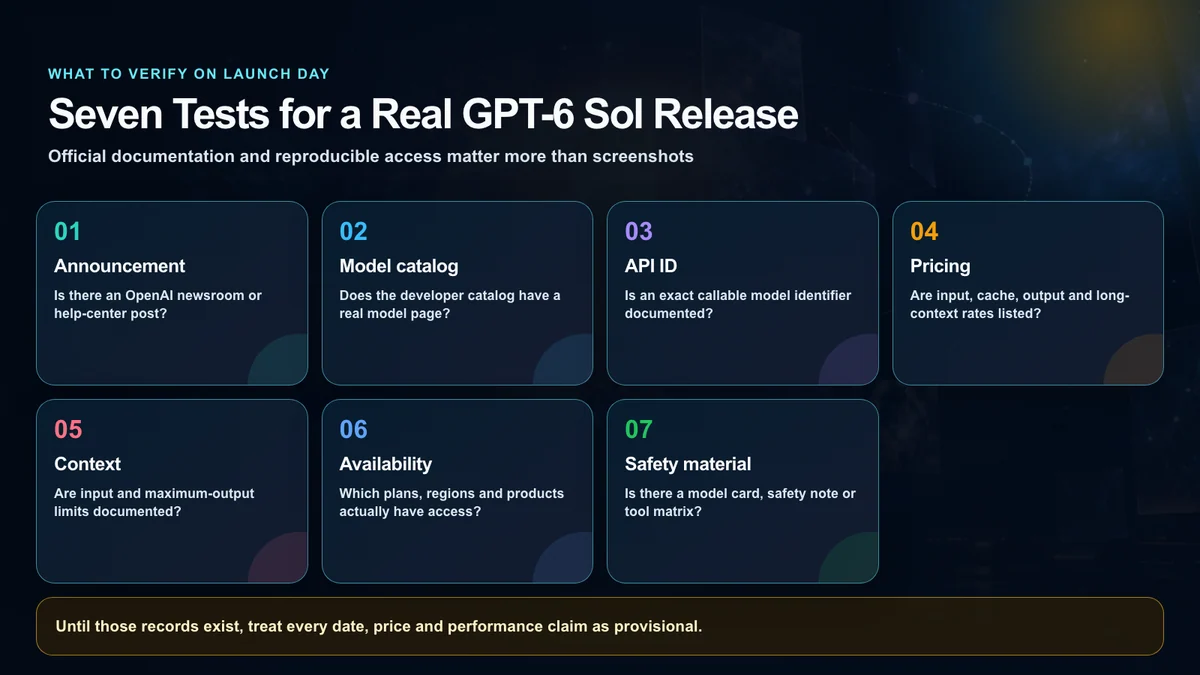
First, look for an OpenAI newsroom, help-center or developer-documentation announcement. Second, confirm that the developer model catalog contains a dedicated page. Third, find the exact callable API identifier.
Fourth, read the entire rate card—not only an approximate price tier—including cached input and long-context rules. Fifth, separate context window, maximum input and maximum output. Sixth, check product, plan and regional availability across ChatGPT, Work, Codex and the API. Finally, look for a model card, safety note, supported-tool matrix and known limitations.
A name in a model picker is not enough by itself. Account-level rollout flags, client catalogs and server permissions can differ. For API access, the strongest evidence is official documentation plus a successful authorized request that returns the expected model identity.
What U.S. users should verify
U.S. availability does not mean every account receives a model at the same moment. ChatGPT subscription, staged rollout, workspace policy, Codex app or CLI version, and API usage tier can each affect access.
A practical launch-day sequence is:
- Read the official announcement and model documentation.
- Recheck the model picker and Codex model list on the intended account.
- For API use, send a small test request with the documented model ID.
- Inspect the pricing and usage dashboard rather than estimating cost from another model.
- Compare quality, latency and tool behavior with the current model before moving production work.
Adding gpt-6-sol to a configuration file before OpenAI documents the ID can produce an unsupported-model error or route through an unrelated third-party provider. A familiar model name does not prove that the endpoint is OpenAI’s.
Frequently asked questions
Is GPT-6 Sol confirmed?
No. As of September 21, 2026, OpenAI’s public catalog does not list GPT-6 Sol. GPT-6 Astra and GPT-5.6 Sol are official models.
Is it really launching on September 22?
There is no official release date. September 22 is a prediction from community and leak-oriented sources.
How much will it cost?
No price has been published. Claims that it will undercut Astra or replace GPT-5.6 Sol are speculative.
Will it support a one-million-token context window?
Unknown. GPT-6 Astra and GPT-5.6 Sol each support 1.05 million tokens, but that specification cannot be copied to an unannounced model.
Should I postpone work and wait for it?
There is no need to pause current work for an unconfirmed model. If a release occurs, compare documented price, limits, tool support and real task performance before switching.
Bottom line
The GPT-6 Sol rumor is more concrete than a random name. Repeated configuration claims and the existing Sol tier create a credible reason to watch. What the public record currently shows, however, is only that material presented as preparation is circulating.
OpenAI has not confirmed September 22, pricing, a one-million-token context window, Astra-relative speed or a simultaneous Luna release. The decisive evidence will be a real model page, a callable ID, an official rate card and product-by-product availability. Until those records exist, GPT-6 Sol is a rumor worth monitoring—not a confirmed launch.
Trademarks and images
OpenAI, ChatGPT, GPT, Codex and related marks belong to their respective owners. This independent article is not sponsored or endorsed by OpenAI. The article images do not reproduce OpenAI logos, product screens, alleged leak screenshots or third-party photography.
Official sources
- OpenAI API: Compare models
- OpenAI API: GPT-5.6 Sol model documentation
- OpenAI: GPT-6 Astra announcement
- OpenAI Help Center: GPT-5.6 and GPT-6 Pro in ChatGPT
Rumor trail and community material
- @LuminaBench: X post associated with the September 22 claim
- OpenAI Developer Community: User discussion of GPT-6 Sol, Terra and Luna
- Prompt Blueprints: Secondary summary of the configuration claim and its limits