OpenAI Bel Rumor: The 10-Trillion-Parameter, GPT-7 and AGI Claims Fact-Checked
An alleged OpenAI model called Bel is moving through X, Reddit and AI rumor sites. The most dramatic versions say OpenAI has completed pretraining on a system with more than 10 trillion total parameters, that it follows an internal model called Doug, and that it could become GPT-7 or cross an AGI threshold.
As of September 25, 2026, OpenAI has not announced Bel. The name does not appear in the official OpenAI model catalog, a product release, a system card or the company’s published research about its latest internal mathematics model. The central claim can be traced to one pseudonymous X account; many subsequent posts repeat or intensify that claim rather than verify it independently.
This article follows the evidence chain from the original X post to later amplification, then compares it with OpenAI’s official Astra, mathematics and DevDay materials. A rumor can be plausible without being verified. The model’s existence, size, lineage and release timing each require separate evidence.
Three takeaways
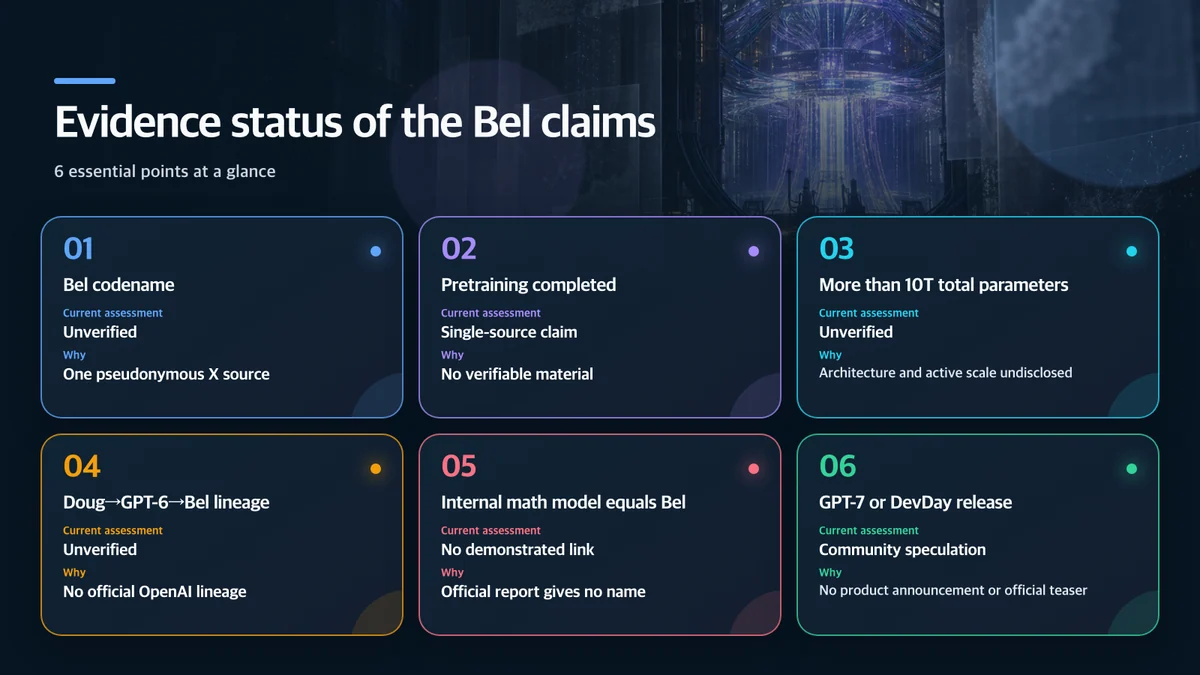
- Bel’s existence, completed pretraining and a 10-trillion-plus total parameter count currently trace back to one pseudonymous X post, not an OpenAI announcement.
- OpenAI has confirmed using an internal mathematics model substantially more capable than Astra, but the company did not call that model Bel.
- The original Bel post did not say GPT-7 or promise a DevDay release; those labels were added during community amplification.
Evidence status of the Bel claims

What the earliest traceable X post actually claimed
On August 25, the X account @synthwavedd said OpenAI had finished the next pretraining run under the codename Bel. The post described Bel as a successor to Doug, which it said would receive more reinforcement learning and underpin Astra and GPT-6. It also claimed Bel had more than 10 trillion total parameters, was similar in size to GPT-4.5, and might underpin a post-GPT-6 or AGI-threshold system.
The specificity of the names and numbers makes the account sound informed, but the post did not provide evidence that readers can authenticate. It included no document, model card, training log, code artifact, data-center record, explanation of the source’s access, or confirmation from a second reporter. A history of discussing model rumors would not independently verify this claim.
The narrow fact established by the post is that an account publicly made the Bel and 10-trillion-parameter claim. It does not establish that OpenAI trained Bel or completed the run.
Several posts do not necessarily mean several sources
The following day, @Adidotdev reframed the story as OpenAI already having finished the model after Astra. A separate source attribution post, however, points back to @synthwavedd. This is amplification of the first claim, not evidence of a second independently obtained leak.
The @kimmonismus post also attributes the information to the original account while repeating the Bel, parameter-scale and rival-compute claims. It is another branch of the same source chain. A yumeacademy post pushes the story toward far more dramatic language and introduces additional size estimates without linking to OpenAI documentation that supports them.
Search results can create an illusion of corroboration: a claim appears in X posts, Reddit discussions and articles, so it seems to have multiple witnesses. Source tracing matters more than the number of pages. If those pages all point back to one account, the story still has one underlying source.
The original post did not call Bel GPT-7
Headlines and discussion threads increasingly equate Bel with GPT-7. The first post did not. It speculated that Bel might become a foundation for a model after GPT-6; it did not identify a shipping product called GPT-7.
A research codename, pretrained checkpoint and commercial product need not map one-to-one. A base model can branch into several products. Reinforcement learning, safety work and serving constraints can change its purpose or name, and an internal run may never ship. Even if Bel exists, that fact alone would not prove that Bel is GPT-7 or that it is close to release in ChatGPT or the API.
What would 10 trillion total parameters mean?
The original wording was 10T+ total parameters. That is a claim about the total number of model parameters, not the number of training tokens. Yet a total parameter count does not reveal how much computation is used for each generated token.
In a mixture-of-experts architecture, only a fraction of the total weights may be active for a given token. A dense model could activate far more of its weights on every pass. Without active parameter count, expert routing, numerical precision, training compute, data mix, context length and serving architecture, the 10-trillion figure cannot be converted into speed, inference cost or capability.
OpenAI has not published an exact official parameter count for GPT-4.5, so the post’s comparison with GPT-4.5 also lacks a public reference value. Scale may expand capacity, but data quality, post-training, inference strategy, tool use and evaluation design all shape useful performance.
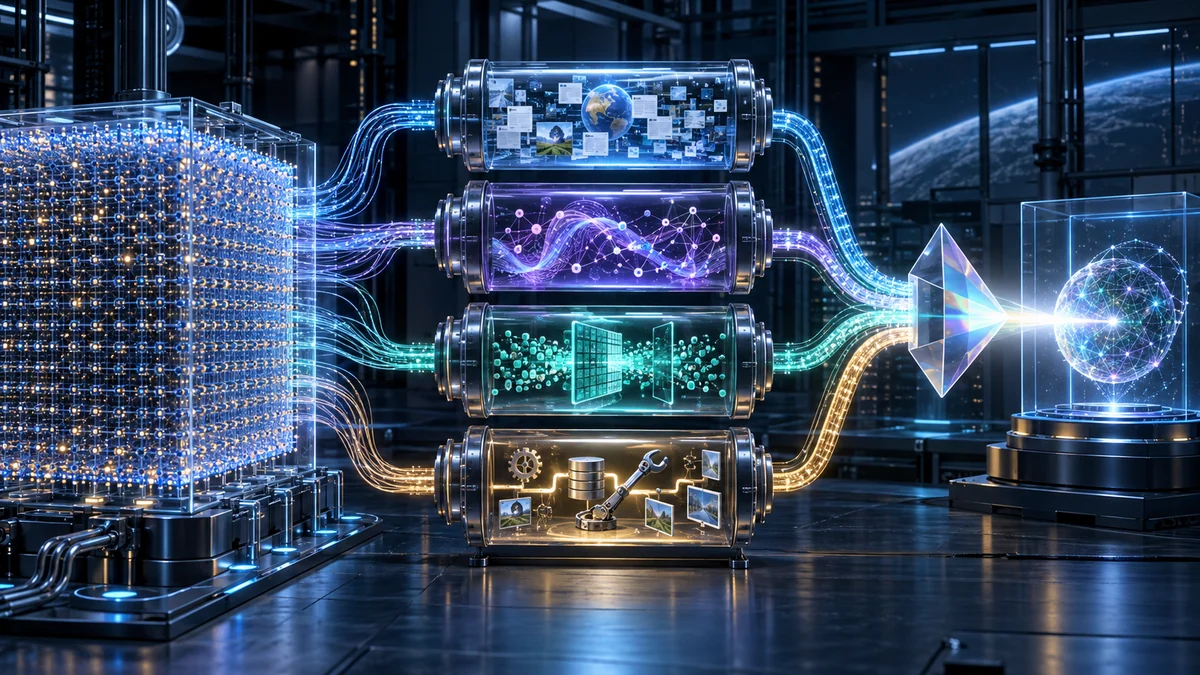
Why parameter count does not establish AGI
AGI threshold is not a single standardized measurement. Strong results on several benchmarks would still leave long-horizon planning, generalization to unfamiliar tasks, factual reliability, autonomous recovery, safety and real-world cost to be tested separately.
A total parameter count does not tell us:
- how many parameters are active during a request or how long it takes;
- the quality, coverage, duplication and contamination of training data;
- how much capability remains after reinforcement learning and safety tuning;
- success rates when browsers, code execution, tools and multiple agents are involved;
- the complete cost of errors, retries, abstentions and human review.
Even if the 10-trillion claim were later confirmed, it would not automatically establish AGI, the GPT-7 name, an imminent release or superiority on every evaluation.
What OpenAI officially lists today
The OpenAI model catalog lists public models such as GPT-6 Astra, GPT-6 Sol and GPT-6 Luna but not Bel. Absence from the catalog cannot disprove the existence of a private research checkpoint. It does show that Bel is not a documented model that U.S. customers can currently select or purchase through the API.
OpenAI’s official GPT-6 Astra announcement describes Astra as the product of pretraining, reinforcement learning and alignment research. It does not publish a Doug-to-Astra-to-Bel lineage. No official document currently bridges the anonymous account’s internal narrative and the products OpenAI has named.
That distinction changes the accuracy of a headline. OpenAI has an unconfirmed model rumor called Bel matches the evidence. OpenAI's leaked GPT-7 Bel is complete presents disputed assumptions as established facts.
Is OpenAI’s stronger internal math model Bel?
OpenAI said in its September 8 Navier–Stokes solution report that it used an internal model substantially more capable than GPT-6 Astra. The report says large-scale reinforcement learning began on August 28 using a previously pretrained model and approximately 10,000 concurrent agents. The effort used about 2.7 million messages and 130 billion output tokens, reached the solution after 88 hours, then spent another 17 hours using Astra for Lean verification.
This is official evidence that OpenAI operates internal systems more capable than its public frontier model for at least some research workloads. The August 28 reinforcement-learning start also came three days after the first traceable Bel post, which makes the timeline attractive to rumor watchers.
Timing is not a model identifier. The official report says only previously pretrained model; it does not use Bel, Doug, 10 trillion parameters or GPT-7. OpenAI could have multiple internal checkpoints. Claiming that Bel solved Navier–Stokes would therefore go beyond the published evidence.
OpenAI’s August 1 report on ten advances in mathematics and theoretical computer science explicitly identified the system in that work as an internal version of Astra. That example shows why the unnamed model in the newer report should not be assigned a community codename without confirmation.
roon’s post did not mention Bel
OpenAI researcher roon argued that laboratories should not hold important solutions back for too long because other groups could reach similar capabilities within a month or two. Some Reddit titles and replies interpreted the statement as a clue about Bel-level capabilities or an upcoming frontier release.
The original post contains no reference to Bel, GPT-7, parameter count or a launch date. Readers may interpret its tone as a broader signal about research progress, but it is not evidence that an OpenAI employee confirmed Bel. Reporting it as a Bel launch teaser would alter the source’s meaning.
Could Bel appear at DevDay?
OpenAI DevDay 2026 is officially scheduled for September 29. A major developer event naturally attracts predictions about new models and APIs, especially when a rumor arrives shortly beforehand.
OpenAI’s event page does not mention Bel. A confirmed event and an unconfirmed model reveal are separate claims. Even if a new pretraining run had finished, reinforcement learning, safety evaluations, serving optimization, product packaging and pricing could take additional time.
What would actually confirm Bel?
The following evidence would materially change the assessment:
- An OpenAI announcement, system card, model catalog entry or research paper naming Bel.
- API documentation with a model identifier, access method, regions and pricing.
- A technical explanation separating total and active parameters and describing the architecture.
- Authenticated internal material confirmed by multiple reporters who are not relying on one another.
- Preregistered evaluations or reproducible independent benchmarks.
- OpenAI clarification of how the research checkpoint relates to a shipping product.
A code string or provider configuration could strengthen the case for an internal codename, but it still would not settle the final product name or launch plan. An official document would require this article’s assessment to be updated immediately.
What U.S. users should check after any announcement
If Bel becomes a real product, parameter count should not be the first purchasing criterion. U.S. users should verify whether it is included with a ChatGPT subscription, available in Codex or sold only through the API; the applicable five-hour and weekly limits; long-context multipliers; processing tiers; and data retention controls.
Enterprise buyers would also need to confirm data residency, zero-data-retention eligibility, security documentation, service-level commitments and whether the research system described in a paper matches the production endpoint. A 10-trillion total parameter count would not guarantee that every customer receives the same route, latency or quality.
Teams should evaluate completed-task cost rather than token price alone. Retries, tool failures, review time and the cost of a confident error can outweigh a model’s nominal capability advantage.
Frequently asked questions
Has OpenAI announced Bel?
No. As of September 25, Bel does not appear in OpenAI’s official model catalog or product announcements. It is an alleged codename from a pseudonymous X post.
Is Bel GPT-7?
That is unverified. The earliest traceable post did not use the name GPT-7; it speculated that Bel could underpin a post-GPT-6 model.
Does 10 trillion mean 10 trillion training tokens?
No. The post claimed more than 10 trillion total parameters, a different concept. The claim itself remains unconfirmed.
Is the Navier–Stokes research model Bel?
Unknown. OpenAI confirmed using a model substantially more capable than Astra, but the report did not name it Bel.
Did roon tease a Bel release?
No. The original post discussed rapid diffusion of research capabilities and did not mention Bel or a release schedule.
Will OpenAI reveal Bel at DevDay on September 29?
DevDay is confirmed. A Bel announcement is not. The event connection is community speculation.
Conclusion
The Bel rumor combines an internal-sounding lineage, a 10-trillion total parameter claim and AGI language. It also arrives while OpenAI is publicly describing internal systems that can exceed Astra on advanced mathematics, which makes the story sound plausible.
Plausibility is not verification. The core Bel claims trace to one pseudonymous X post. Later posts are amplification rather than independent corroboration, and neither OpenAI’s mathematics report nor roon’s statement uses the Bel name. GPT-7 and a DevDay reveal were added by community interpretation.
The most accurate description today is that there is an unconfirmed claim that OpenAI calls a next-generation pretrained model Bel. Its existence, parameter count, product lineage and launch timing should remain labeled unverified until OpenAI publishes technical documentation or multiple independent sources authenticate the same information.
Sources and use notice
- OpenAI official model catalog
- OpenAI, GPT-6 Astra announcement
- OpenAI, Navier–Stokes solution report
- OpenAI, ten advances in mathematics and theoretical computer science
- OpenAI DevDay 2026
- @synthwavedd’s Bel claim on X
- Adit_Yah’s amplification post on X
- Adit_Yah’s source attribution
- kimmonismus’s source-attributed X post
- yumeacademy’s amplification example
- roon’s capability-diffusion post on X
- Mukhtada’s analysis of the Bel evidence chain
- Traictory’s review of the 10-trillion-parameter rumor
- Skala Blog’s Bel rumor fact-check
OpenAI, ChatGPT, GPT and related marks belong to their respective owners. This is independent editorial coverage and is not sponsored, endorsed or approved by OpenAI. X posts are presented through original embeds or links; their interfaces were not copied into images. Editorial images do not use logos, product interfaces, real people or third-party photography. Unverified claims, secondary amplification and official OpenAI material are labeled separately and summarized in original language.