Meta Connect 2026 Recap: Muse AI Glasses, 100g VR and Ray-Ban Meta Audio

Meta Connect 2026 has moved from preview to product roadmap. Meta says it will bring Muse to AI glasses in the coming months, allowing the agent to act on objects, flyers, and lists in the wearer’s field of view. The company also introduced Meta VR Glasses at about 100 grams, Ray-Ban Meta Audio, and Ray-Ban Meta Gen 3 while promising more than 100 AI-glasses options across Ray-Ban, Oakley, and Meta Glasses by year end.
This revision replaces our pre-keynote preview with the confirmed post-event announcements. Rumored specifications have been removed. Company claims remain labeled as claims, and unresolved questions—price, launch timing, model compatibility, privacy behavior, and regional availability—remain unresolved rather than being filled with predictions.
Three things to know
- Muse is moving from an app to an ambient agent that can use what the wearer sees and continue work during a long voice conversation.
- Meta is building a family of display, audio, camera, and VR glasses rather than one universal frame.
- A polished stage demo does not establish everyday reliability. Approval, cancellation, data flow, battery, comfort, accessibility, repair, and service availability still need real-world testing.
The confirmed Connect 2026 announcements
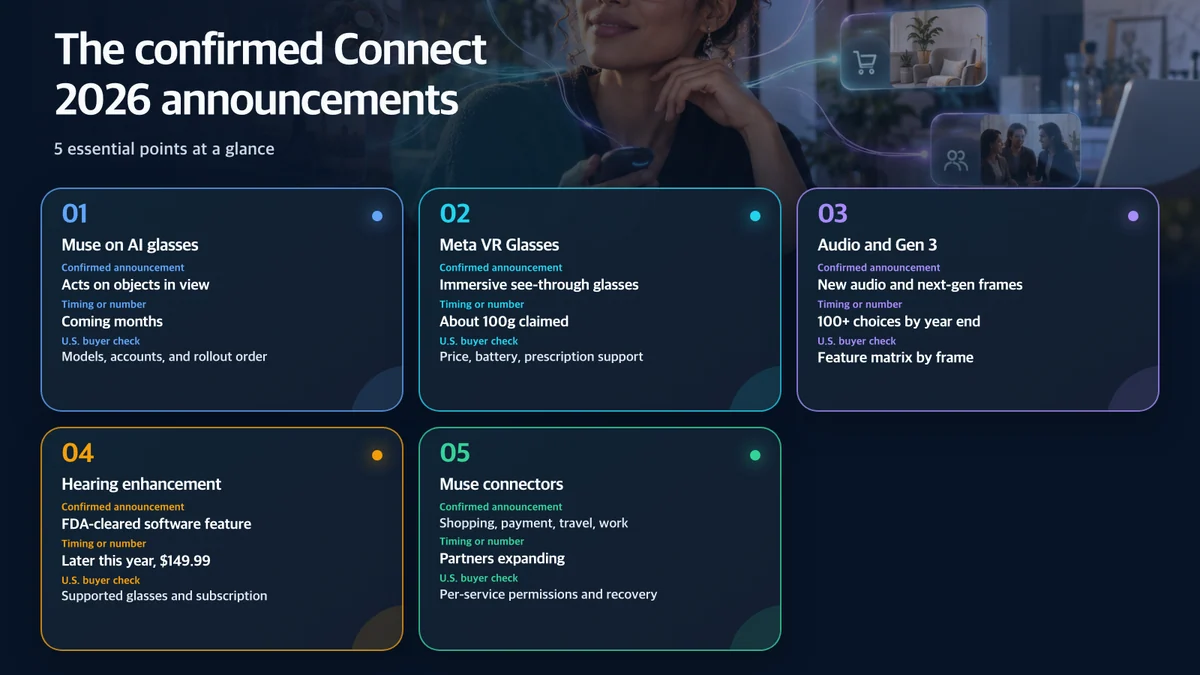
The official Meta Connect 2026 recap makes Muse the connective layer. Instead of requiring the user to describe an object, Meta says the glasses can use the camera view: ask about a product on a shelf, a flyer on a wall, or a long school-supply list, then have Muse take action.
Muse is moving from answers to actions
Meta positions Muse voice mode as more than speech input for a chatbot. A user can hold a long conversation while the agent performs work in the background and returns results. Calling the agent by name through glasses could make search, list processing, communication, and connected services available without reaching for a phone.
The announced commerce additions include Walmart, Best Buy, American Eagle Outfitters, DICK’S Sporting Goods, Fanatics, Gap, Michael Kors, Sephora, Ulta, and Wayfair. Shop Pay and PayPal cover payments, Expedia is coming for travel, and Instacart supports grocery tasks. Work connectors include Notion, Granola, GitHub, and Box. Meta also plans a dedicated email address for Muse.
The partner list is not a promise that every integration has identical permissions, availability, or recovery. Users should know whether Muse is reading a catalog, adding an item, placing an order, sending a message, or changing a repository—and should receive a separate confirmation when an action becomes consequential.

An ambient agent needs action-level consent
Reading a product label, adding to a cart, paying, sending email, and modifying a work file should not share one authorization. A responsible wearable agent needs different scopes for read-only information, communication, location, purchases, account changes, and deletion.
The practical safeguards to test include:
- visible and audible cues when cameras or microphones contribute to a request
- a specific preview of the recipient, item, date, and price before action
- one place to inspect and cancel background work during a voice conversation
- individual expiration and revocation for each third-party connector
- protection of the Muse email address from spam, phishing, and malicious attachments
- receipts that distinguish attempted, failed, pending, and completed actions
- a clear explanation of which visual frames, transcripts, and account data leave the device
Meta has used capture indicators and camera-disable protections on supported glasses. Those measures address visible photo or video capture, but an AI data flow is broader. Saved media, transient visual frames used for inference, wake-word audio, long conversations, phone connectivity, and third-party tools require separate explanations.
Meta VR Glasses: a claimed 100g personal display
Meta describes Meta VR Glasses as a personal cinema, sports seat, workspace, and game system in a frame weighing about 100 grams. The design is intended to preserve awareness of the surrounding environment without a conventional head strap.
The company says the product is the first IMAX Enhanced-certified VR device and will support selected films in IMAX’s expanded aspect ratio. Named media partners include Prime Video, YouTube, DIRECTV, AMC+, Crunchyroll, Plex, ESPN, and Tubi, with 3D content from Disney+, Peacock, HBO Max, and Paramount+. Meta also says work with ESPN, MLB, NBC Sports, TNT Sports, UFC, and others will enable more than 100 immersive live sports events a year.
One hundred grams is light relative to many headsets but heavy relative to ordinary glasses. Comfort depends on weight distribution, heat, nose pressure, optics, prescription support, and battery duration. Content rights can also vary by service and region. These claims need independent, long-session testing before the device can be evaluated as a daily monitor or theater.
Ray-Ban Meta Audio, Gen 3, and hearing enhancement
Ray-Ban Meta Audio combines open-ear listening, calls, and AI access in what Meta calls its lightest and slimmest AI-glasses design. Ray-Ban Meta Gen 3 is presented as thinner and more comfortable, with longer battery life and a customizable action button for Meta AI.
Meta expects more than 100 frame and style options by the end of 2026. A large catalog can hide meaningful hardware differences. Camera, display, battery, audio, hearing enhancement, prescription-lens support, and compatible AI features should be checked for the exact generation and frame.
In the United States, Meta says an FDA-cleared hearing-enhancement software feature for adults with perceived mild to moderate hearing loss will arrive on supported glasses later this year. It will cost $149.99, be HSA/FSA eligible subject to the user’s plan, or be included with a Meta One subscription. Buyers should confirm the supported device list and understand that software support is not a substitute for clinical care when symptoms require evaluation.
Muse Charm and the details Meta has not released
Muse Charm is a pocket-size real-time voice device for interacting with Muse. Meta says more information will arrive later this year. Price, battery life, sales date, and complete compatibility are not yet established in the announcement, so it should not be treated as a shipping product.
Muse on glasses has a “coming months” window rather than one universal release date. Meta VR Glasses pricing and broad availability also require a final product page. Users should separate a feature demonstration, a formal announcement, a preorder, and general availability.
A U.S. buyer checklist
Before buying or subscribing, verify:
- exact frame, generation, sensors, display, and supported AI features
- list price, prescription-lens cost, taxes, accessories, and subscription requirements
- battery behavior under continuous audio, camera, translation, and agent use
- return, accidental-damage, repair, and battery-service terms
- which connectors can read, write, purchase, publish, or delete
- capture disclosure and rules in workplaces, schools, clinics, and private venues
- state-specific recording, biometric, and consumer privacy requirements
- which hearing features are supported and whether professional care is appropriate
Connect 2026 is less about one pair of glasses than an always-available agent with eyes, ears, accounts, and permission to act. The quality of that future will be determined by predictable controls and support—not the number of services in a keynote demo.
Sources and use notice
This article independently analyzes Meta’s post-event announcement. Weight, performance, availability, and roadmap statements are company claims that require independent testing. It does not reproduce official photography, video, interfaces, or logos.