Why AI Data Centers Run So Hot: Power, Cooling and Water Explained
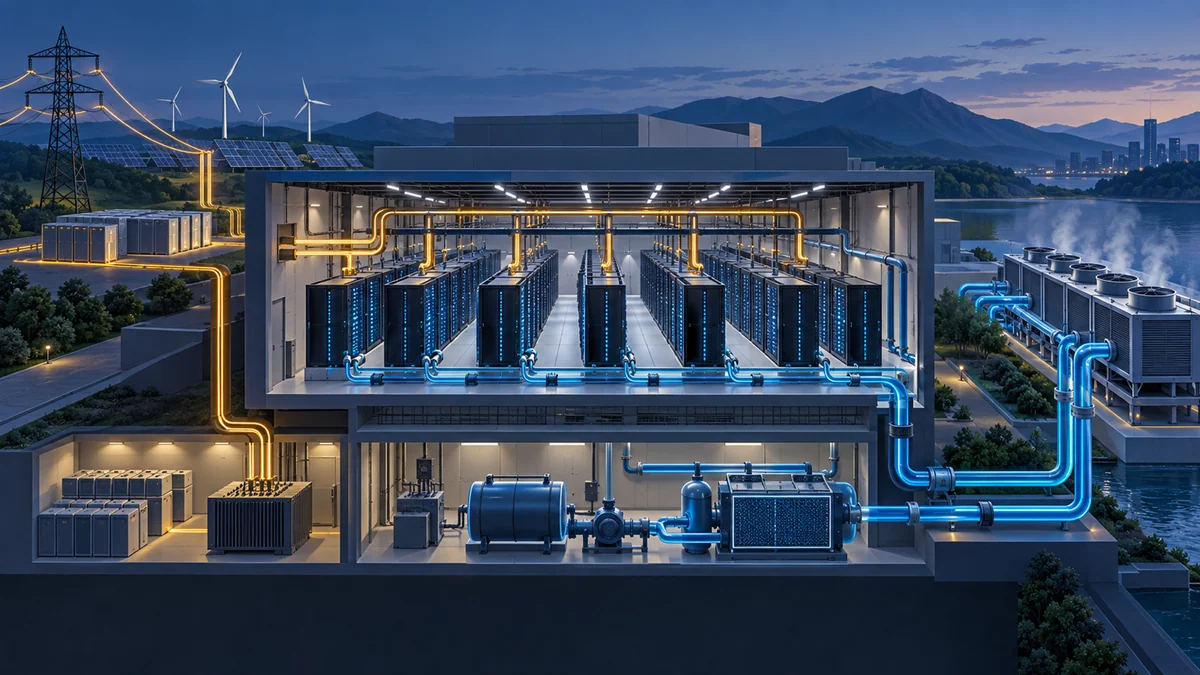
AI may appear to live inside a browser, but every answer is produced in a physical facility that has to receive electricity and remove heat. As models become larger and reasoning runs longer, accelerators stay busy for more time, racks become denser and cooling equipment moves closer to the chips. Understanding AI infrastructure therefore requires more than counting GPUs. The grid connection, substation, cooling loop, water conditions and local siting constraints all matter.
This is a shared U.S.–Korea story. The United States is building large clusters and confronting new grid demand. South Korea is expanding national compute capacity while supplying memory, power equipment and thermal-management technology to global operators.
The central conclusion is that the bottleneck is not simply how many megawatts a site can buy. Operators must deliver power at the right time, remove heat reliably and manage the tradeoff between electricity and water for the climate in which the facility actually operates.
Three things to know
- Global data center electricity use is on course to roughly double by 2030, while AI-focused facilities grow faster.
- High-density accelerator racks are pushing operators from room-level air cooling toward direct liquid cooling and other chip-adjacent systems.
- “Zero water for cooling” often means no water is evaporated during normal operation, not that the entire property has no water footprint.
What makes an AI data center different
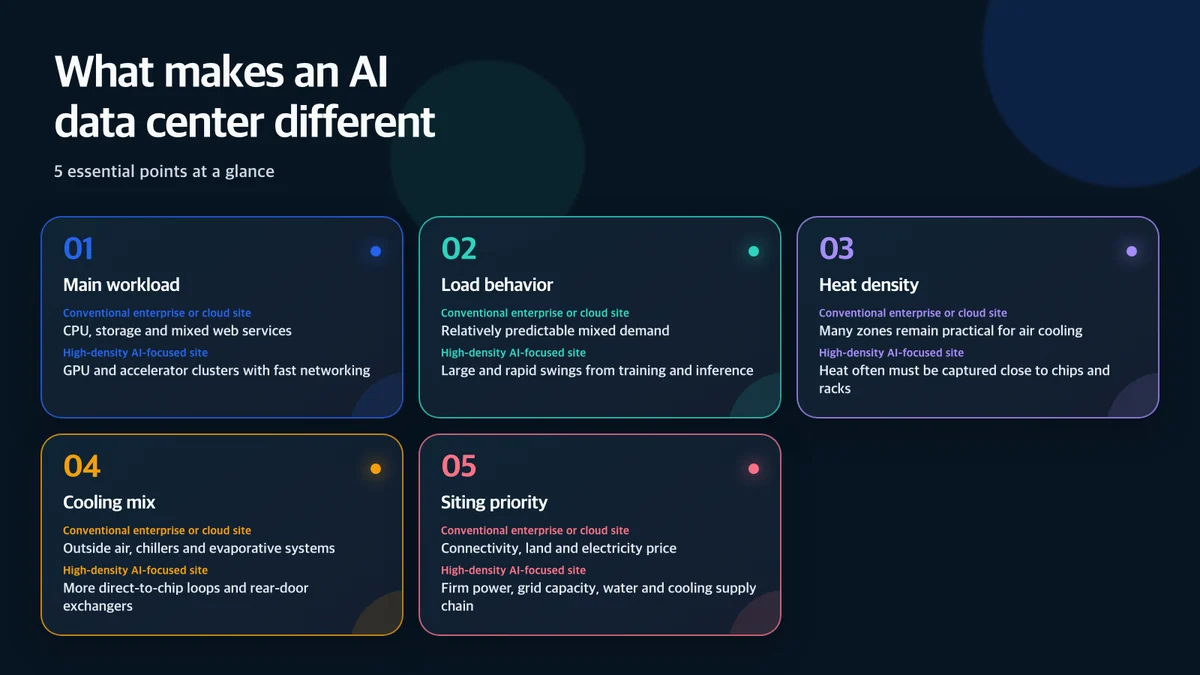
Not every kilowatt entering a data center reaches a processor. The International Energy Agency’s updated analysis and its Energy and AI report estimate that servers account for roughly 60% of electricity demand in a modern data center on average. Storage, networking, power conversion, uninterruptible supplies and cooling consume the rest.
AI accelerators process data in parallel and are linked in large clusters so that many devices behave like one system. Packing more compute into the same floor area raises rack density and makes short-term load changes more important. A region can have enough annual generation on paper and still lack a substation, transmission line or interconnection slot capable of serving a new campus on schedule.
How large is the electricity increase
The IEA’s central outlook puts global data center electricity consumption at about 485 TWh in 2025 and about 950 TWh in 2030. That is close to a doubling, while electricity use by AI-focused facilities roughly triples. The 2030 total would be around 3% of global electricity demand, but the local impact can be far larger because campuses cluster in a small number of grid regions.
The U.S. numbers show that concentration more clearly. A Department of Energy summary of the Lawrence Berkeley National Laboratory study estimated that U.S. data centers used 176 TWh in 2023, or about 4.4% of national electricity. The study projected a broad range of 325 to 580 TWh in 2028, equal to 6.7% to 12% of U.S. electricity.
That does not mean AI alone is guaranteed to use 12% of U.S. power. The study covers the entire data center sector, including conventional cloud, storage and networking. Its range is deliberately wide because investment, chip efficiency, utilization and grid constraints are uncertain. The reverse mistake is also common: a modest national share does not prevent severe congestion in an individual utility territory.
Cooling moves heat rather than making it disappear
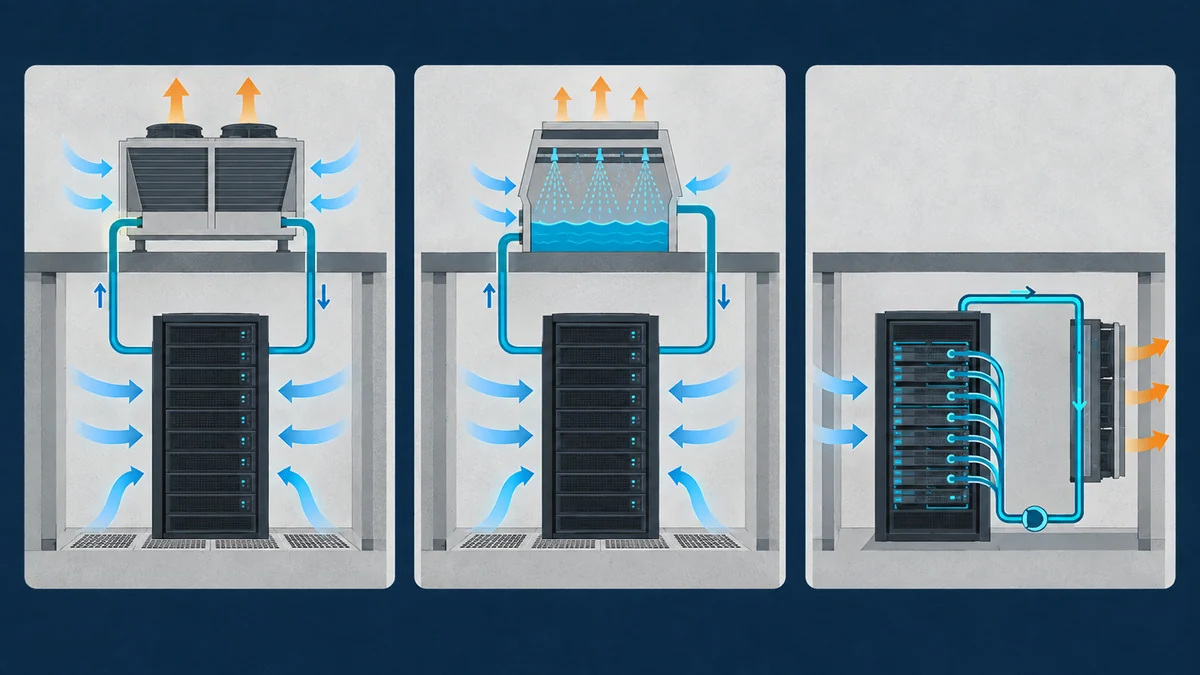
Cooling transfers heat from silicon to air or liquid and then rejects or reuses it outside the data hall. The main approaches involve different tradeoffs.
- Outside air and air cooling: Fans and favorable weather can remove heat with a comparatively simple system, but the result depends on climate and rack density.
- Mechanical chillers: Refrigeration equipment removes heat from a closed loop. It can reduce evaporative water use while increasing electricity consumption.
- Evaporative cooling: Water absorbs heat as it evaporates. It can be electricity-efficient but places pressure on water supplies in dry regions.
- Direct-to-chip liquid cooling: Cold plates collect heat near processors and memory. The method supports dense racks but requires pumps, leak detection, plumbing and specialized maintenance.
- Rear-door heat exchangers: A liquid loop captures hot exhaust at the back of a rack and can help retrofit an air-cooled site for denser equipment.
There is no universally green option. A water-saving chiller may use more electricity, while an evaporative system can reduce electrical load at the cost of water. The local temperature, humidity, grid mix and water stress determine which combination has the lowest overall impact.
What “zero-water cooling” actually means
In a June 2026 explanation of its water strategy, Microsoft said about 90% of its owned 2025 fleet operated with low-to-zero-water cooling. Its newer direct-to-chip design circulates coolant in a closed loop and eliminates water evaporation during normal cooling operation.
In its earlier next-generation cooling announcement, Microsoft estimated that each site could cut annual cooling-water demand by over 125 million liters relative to its fleet average. Pilot projects in Phoenix, Arizona, and Mount Pleasant, Wisconsin, were scheduled for 2026, with those facilities expected to begin coming online in late 2027.
The label does not mean the entire property uses no water. Offices, sanitation, landscaping and fire protection can still require it, and manufacturing the equipment has a separate footprint. Closed-loop systems can also shift part of the burden from water to pumps and mechanical refrigeration. A credible disclosure should state both water usage effectiveness and power usage effectiveness rather than promoting only one number.
Electricity does not stop at the server
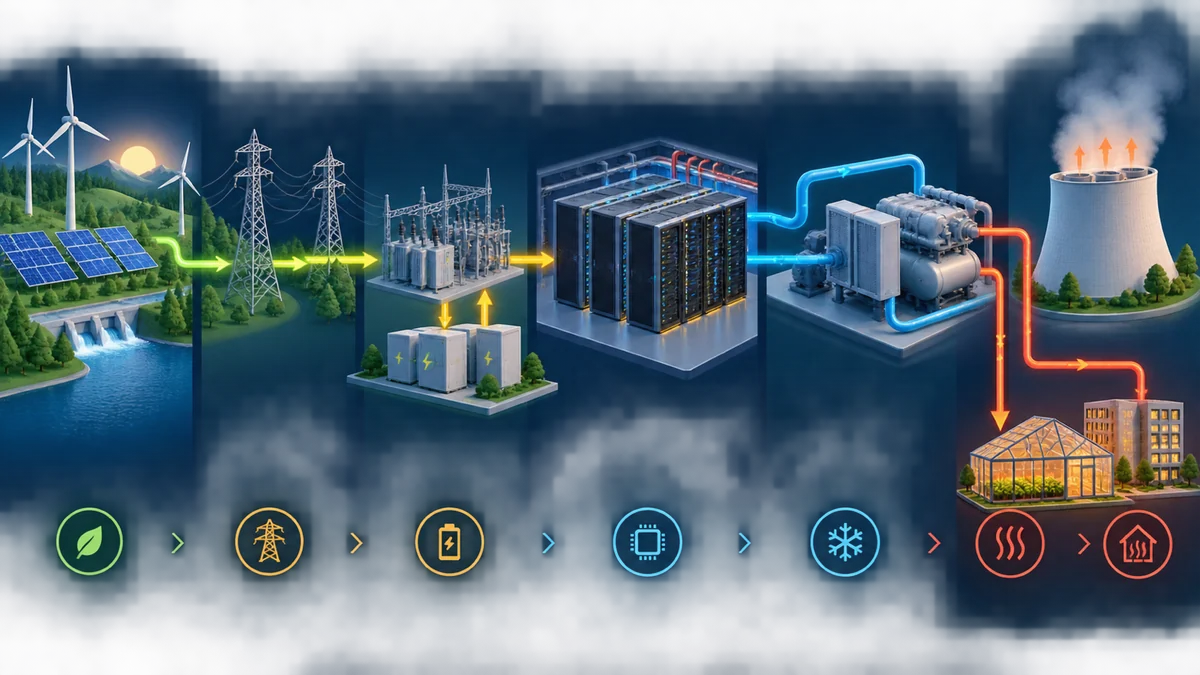
A data center’s impact begins with the regional generation mix. A renewable power contract does not mean every electron reaching the site is renewable at every hour. Batteries and uninterruptible power supplies can smooth short events and maintain operation during an outage, but they do not replace a long-duration source of firm power.
Waste heat can sometimes serve a nearby district-heating network, greenhouse or industrial user. It is not automatically useful. The temperature must be high enough, the customer must be close, demand must coincide with the data center’s output and the additional pumps and pipes must be economically justified. Announcing “heat-reuse potential” is different from operating a measured reuse project.
One AI query is the wrong unit for most policy questions
There is no single permanent energy number for an AI prompt. Model size, input and output length, batching, hardware, utilization, cooling and the grid all change the result. The IEA says the energy used by a simple text task has fallen rapidly, but video generation, extended reasoning and agentic work can consume hundreds or thousands of times more energy per request than basic text generation.
Efficiency gains also do not guarantee a reduction in total demand. A cheaper request can encourage far more use and new applications. At the same time, treating every AI interaction as if it consumed the energy of a long video or autonomous agent is misleading. Operators need measurements for energy per completed task, accelerator utilization, latency and facility overhead.
Why Korea matters to the U.S. buildout
South Korea’s 2026 Ministry of Science and ICT plan calls for securing a cumulative 37,000 GPUs through government procurement, a national supercomputer and other programs. That expansion has the same physical requirements as U.S. projects: substations, transmission, cooling and an operating workforce.
Korea also matters as a supplier. Its companies produce high-bandwidth memory, chillers, heat exchangers, pumps, cables, power-conversion equipment and batteries. This breadth shows why data center competition now extends beyond accelerators into thermal management and power infrastructure. Technical capability and a possible supply role should still be separated from a confirmed contract or completed delivery.
For U.S. communities, the supply-chain connection is useful because it shows where accountability belongs. A cloud operator may buy efficient servers and cooling systems from global partners, but the local utility and public agencies still have to evaluate the interconnection, rate design, water plan, backup generation and construction schedule.
Questions operators and communities should ask
- What are the peak load, hourly load profile and realistic grid-connection date?
- Are power usage effectiveness and water usage effectiveness reported together?
- Does “zero water” mean zero evaporation for cooling or zero site-wide withdrawal?
- What fuel powers backup generators, and how often will they be tested?
- Does a heat-reuse proposal identify a real customer and the cost of connecting it?
- Do efficiency improvements reduce total consumption, or are they absorbed by rapid capacity growth?
- How will regulators prevent grid-upgrade costs from being shifted unfairly to households and small businesses?
Bottom line
The fastest accelerator does not create a viable AI data center by itself. The grid must serve the load, the cooling system must move heat safely, and the operator must disclose how water and electricity tradeoffs affect the surrounding region. The United States has scale and investment; South Korea contributes critical memory and thermal-management capabilities. Both still face the same physical limits.
A well-designed AI facility is not the one with the largest announced compute number. It is the one that produces useful work with less electricity and water, connects without undermining reliability and pays the costs it creates. When evaluating the next project, look past GPU counts and capital spending to firm power, cooling design, water metrics and the date the infrastructure can actually operate.
Sources and licensing
- IEA (2026), Key Questions on Energy and AI, Licence: CC BY 4.0
- IEA (2025), Energy and AI, Licence: CC BY 4.0
- U.S. Department of Energy, data center electricity-demand report summary
- Microsoft, 2026 data center water-management update
- Microsoft, next-generation zero-water cooling design
- South Korean Ministry of Science and ICT, 2026 work plan
This article independently reorganizes facts and figures from the sources above. It does not reproduce their photographs, charts or diagrams.
This is a work derived by Zoogom Live from IEA material and Zoogom Live is solely liable and responsible for this derived work. The derived work is not endorsed by the IEA or its Member countries in any manner.