Next.js September 30 Security Release: What Teams Should Prepare Now

Next.js plans to publish a scheduled security release on September 30, 2026. The official advance notice names versions 16.3.7 and 15.5.27 and says the release will address nine vulnerabilities: one critical, two high, five medium, and one low. As of September 26, the affected versions, impact conditions, CVE details, and complete upgrade instructions are not public.
That last point matters. An advance notice is a reason to prepare a controlled patch window, not an invitation to guess at an exploit. Teams can inventory versions, establish a clean test baseline, and rehearse deployment and recovery now. They should wait for the published advisory before deciding which applications are affected or whether any mitigation beyond an upgrade is required.
The September 30 release is also separate from the out-of-band update that shipped on September 22 as 16.3.6 and 15.5.26. Applying that emergency update does not remove the need to review the next advisory. Conversely, a team that has not applied the September 22 update should not assume it is safe to wait simply because another release is scheduled.
Three things to know
- The date, target patch versions, vulnerability count, and severity distribution are confirmed; the technical impact is not yet disclosed.
- The most useful work before release day is operational: know what you run, prove the current build passes, and define staged rollout and rollback criteria.
- “Critical” does not mean every Next.js site is exploitable in the same way. Exposure depends on the affected feature and deployment architecture, which the final advisory must establish.
Confirmed facts versus open questions
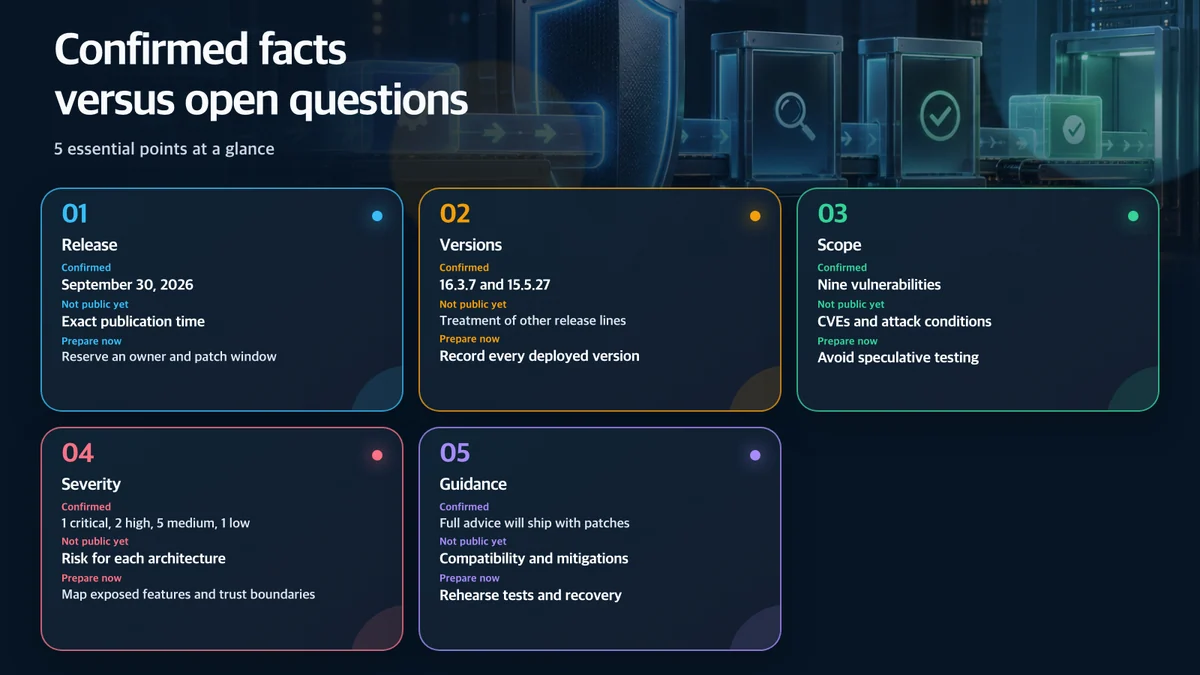
Severity is a prioritization signal, not an organization-specific risk calculation. Whether an application is reachable through the vulnerable path can depend on server features, request routing, authentication boundaries, hosting, and runtime configuration. The September 30 advisory should be mapped to the application rather than reduced to the headline score.
A five-part readiness checklist
First, inventory all deployed copies of Next.js. Include monorepos, internal admin tools, preview environments, abandoned marketing sites, and containers that may not match the main branch. Check lockfiles and build artifacts, not only the version range in package.json.
Second, establish a passing baseline before the patch. If tests already fail, release-day failures will be hard to attribute. Prioritize authentication, authorization, Server Actions, uploads, cache invalidation, payments, messaging, and other flows where a mistake has a high cost.
Third, isolate the security change. Avoid combining the patch with a broad dependency refresh or framework migration. A small, reviewable diff makes compatibility problems and rollback decisions easier to understand.
Fourth, define recovery criteria in advance. Select measurable thresholds for error rate, latency, login failures, server exceptions, build duration, and critical conversions. A rollback could reintroduce a vulnerable build, so prepare alternatives such as routing restrictions, maintenance mode, or feature flags rather than treating rollback as the only response.
Fifth, protect secrets while debugging. Emergency work often produces verbose build logs and copied environment output. Keep tokens, cookies, personal data, and internal URLs out of tickets, screenshots, and shared logs.

What to do when the patch appears
Read the complete Next.js advance notice and linked advisory, not only a social post. Confirm affected versions, fixed versions, feature conditions, and any hosting-specific instructions. If the advisory changes after publication, use its latest revision as the source of truth.
Update the framework and lockfile on a dedicated branch, install from a clean environment, and build with the same runtime and configuration used in production. Unit tests are necessary but not sufficient. Exercise server rendering, routing, middleware, image handling, caching, API routes, and Server Actions. Run end-to-end tests in a preview environment that cannot write to production data.
Use a canary or phased rollout when the platform supports it. Compare new and old builds using the predefined signals, then expand traffic only after the canary remains healthy. Create fresh user and administrator sessions after deployment so old cookies and cached assets do not hide a regression. Verify that long-lived containers, edge regions, and CDN assets all moved to the patched build.
U.S. operational and compliance considerations
Companies handling health, financial, education, or government data may have incident-response and change-control obligations beyond installing a patch. The advisory may require a retrospective review of logs once impact conditions are known. Preserve relevant security telemetry according to policy, but do not collect extra personal data merely because a security release was announced.
Third-party integrations deserve explicit testing. Authentication providers, payment systems, identity verification, analytics, and edge middleware can expose differences in cookies, redirects, headers, or rendering even when the patch does not directly target the integration. Use vendor sandboxes and test accounts where available.
Managed hosting can simplify deployment but does not remove application ownership. Confirm whether the platform upgrades the framework automatically, rebuilds the application, or requires a source change. A runtime mitigation from a host and a fixed application dependency are not necessarily equivalent.
Responses to avoid
- Do not invent or circulate exploit details before the advisory is public.
- Do not submit production URLs, sessions, or source code to unverified scanners.
- Do not interpret one critical vulnerability as proof that a specific site was compromised.
- Do not mix the patch with a large refactor unless no safer option exists.
- Do not leave production on an old build after a failed rollout without compensating controls and a documented decision.
The purpose of the early notice is operational readiness. On September 30, the newly published advisory will supersede pre-release summaries, including this one. The correct final action should follow the actual affected-version matrix and upgrade instructions—not speculation about what the nine issues might be.
Sources and use notice
- Next.js: Upcoming September Security Release
- Next.js blog, including the September 22 out-of-band update
This article independently summarizes the disclosed schedule, versions, and severity counts. It does not infer undisclosed vulnerability mechanics or reproduce official graphics, product interfaces, or third-party copyrighted images.