Meta Muse Email and Long-Term Memory: Convenience, Identity and Privacy Risk
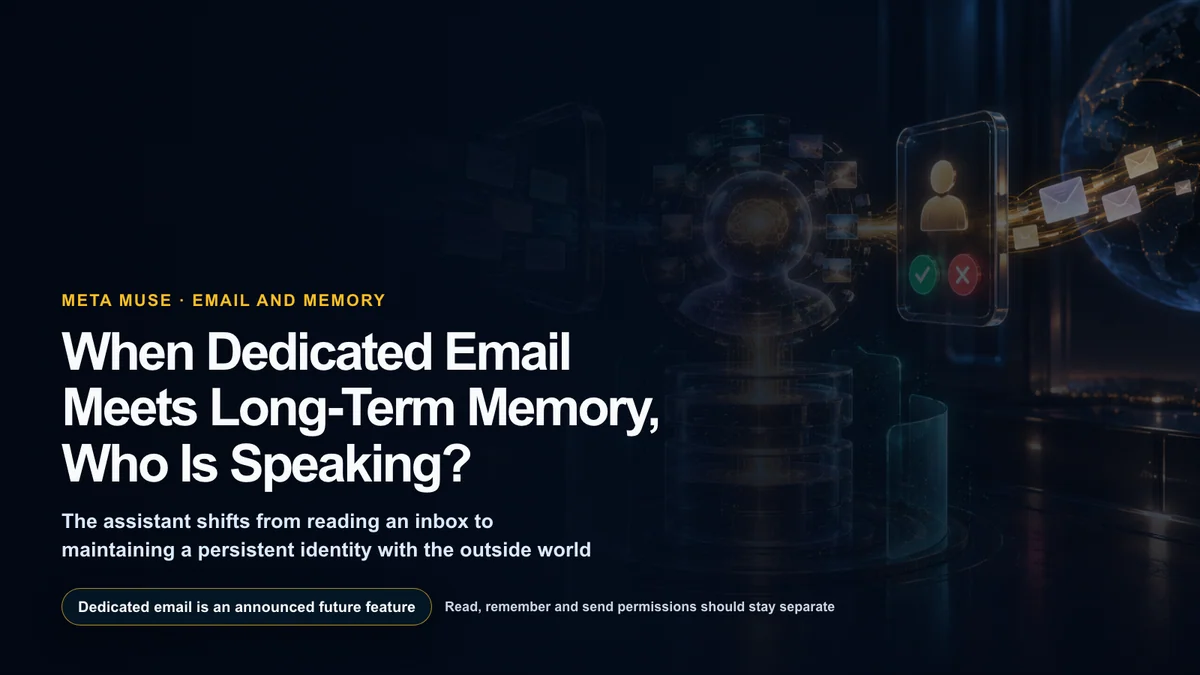
Meta’s plan to give Muse a dedicated email address changes the role of a personal agent. An assistant that reads a user’s inbox acts behind the account owner. An agent with an address that other people can contact becomes a persistent digital identity that can receive work and communicate with the outside world.
The Meta Connect feature announcement described a future in which users can add Muse to an email thread or forward a message to it. Dedicated email was announced as an upcoming capability, not a feature already enabled for every account.
The harder issue is what happens when email meets long-term memory. Meta’s official Muse launch post says the agent can remember preferences and relationship details mentioned once. It gives examples such as turning a saved recipe into a grocery list and remembering a friend’s dietary restrictions before invitations are sent. Email adds appointments, addresses, contracts, health details, family information and workplace data to that memory stream.
Dedicated email creates an inbound command surface
Traditional AI chat begins when the user opens a conversation. A dedicated email address allows an outsider to initiate contact. Meeting requests, receipts, shipping notices, contract changes, family plans and spam enter through the same channel.
The benefit is clear. An agent can classify mail, update a calendar, find supporting files and prepare replies. Persistent memory can preserve rules such as “request a written quote from this vendor” or “send the project report every Friday.”
Email, however, is not a trusted command channel. Senders can be spoofed. Message bodies, links and attachments can contain prompt injection designed to make an agent disclose data or perform an unrelated action. Even ordinary marketing mail could contain text asking an agent to remember a false preference. Receipt should never automatically imply execution or long-term storage.
Read, remember, draft and send are different permissions
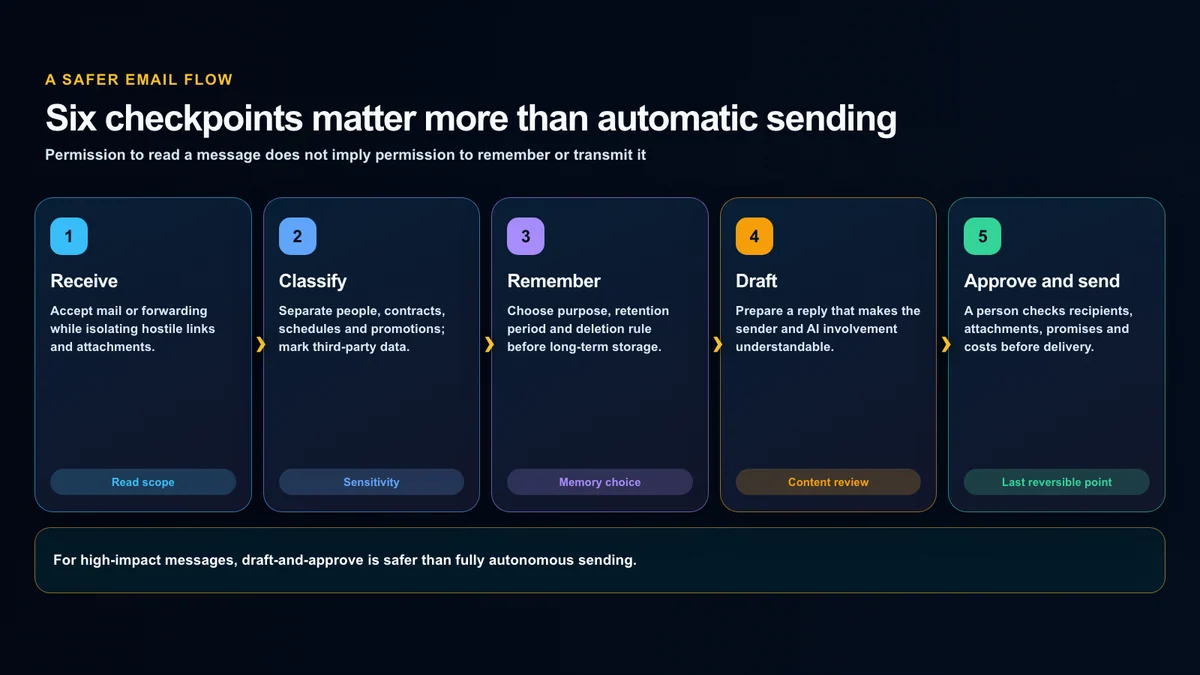
A safer system needs several independent permissions rather than one broad “connect email” switch.
This article separates the workflow into 6 control stages and later checks deletion across 4 data and record layers. The counts are an editorial control model, not Meta product labels.
- Receive: accept direct or forwarded messages while isolating hostile links and attachments.
- Classify: distinguish people, contracts, schedules, receipts and promotions; mark sensitive third-party data.
- Decide whether to remember: define purpose, retention and deletion before storing anything persistently.
- Draft: let the agent prepare content without treating the user as the sender yet.
- Human approval: verify recipients, attachments, dates, prices and commitments.
- Send and log: transmit only the approved version and preserve an audit record.
Meta says Muse allows email read and send access to be separated and asks before sensitive actions such as sending a message or making a purchase. A cautious rollout should begin with read-only access. Send permission should be limited to repetitive, low-impact communication until the audit trail and recovery process are proven.
Recipients should know who is speaking
If Muse sends from its own address, recipients need to understand whether a person wrote the message, approved an AI draft or allowed the agent to send automatically. That distinction matters for contracts, schedule changes, purchases, refunds and workplace instructions.
A credible email system should make several facts available:
- whether Muse drafted the message and a person approved it;
- whether a predefined rule allowed autonomous sending;
- when a human last reviewed the content;
- whether the agent has authority to confirm costs or commitments;
- where a recipient can request correction or reach a responsible person.
Disclosure does not need to become a repetitive slogan in every low-risk message. It should be proportional to impact and clear enough for the recipient to decide what information to share.
Long-term memory includes other people’s data
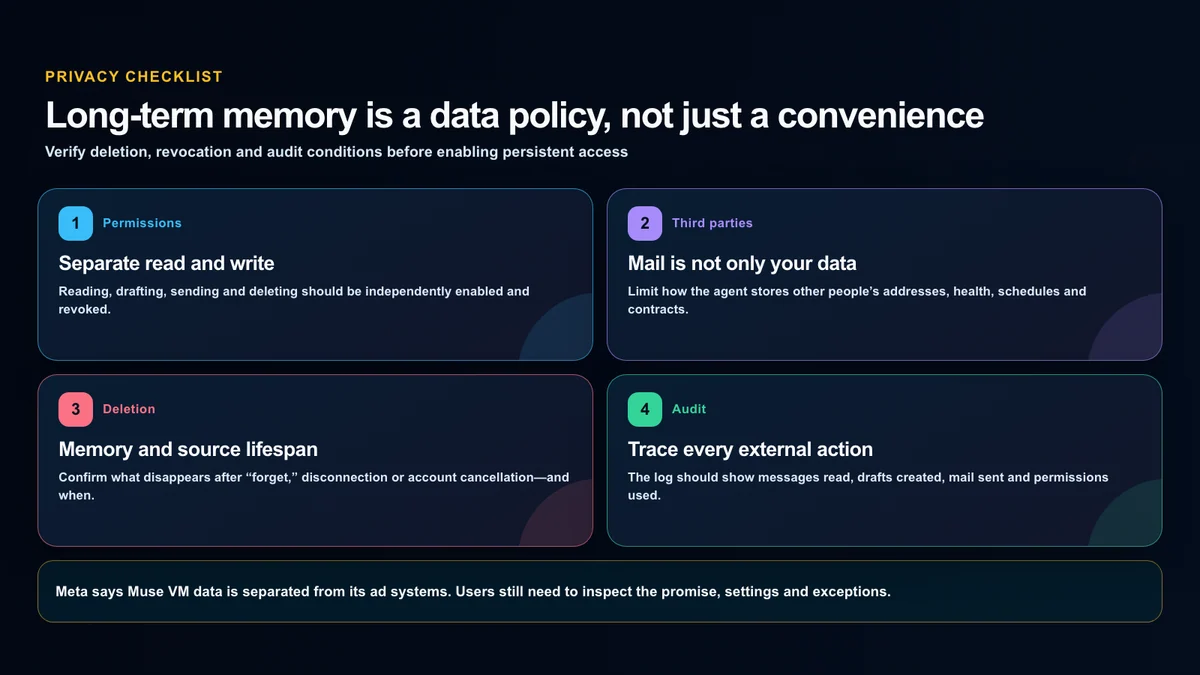
Email does not contain only the account owner’s information. It includes colleagues, customers, family members, students and service providers. Their addresses, health information, schedules, opinions and attachments can become part of an agent’s context. A user’s agreement to use Muse does not automatically represent consent from everyone who sends that user a message.
Meta says Muse conversations and VM data are not shared with its advertising systems, users can opt out of model training and users can ask Muse to forget specific information. Those are meaningful controls. They do not, by themselves, answer what is stored as a memory, how source mail and derived summaries differ, or how long backups and audit logs remain.
A “forget” request may affect several layers differently:
- the personal memory visible in the conversation;
- working files and summaries inside the Secure VM;
- cached or original email from a connected service;
- security and dispute records retained in an audit log.
The product should describe deletion scope and processing time rather than implying that one visible removal erases every copy immediately.
What Secure VM and Sentinel can—and cannot—do
Meta says each user’s Muse operates in a dedicated Secure VM. A separate Sentinel agent evaluates outbound internet and connected-service actions. Credentials and payment data are stored so the core agent does not directly see them, and the user receives an audit trail of completed and planned activity.
The design can isolate users from one another, reduce credential exposure and enforce policies at a system boundary. It cannot eliminate every judgment error. An agent may select the wrong recipient, misread context or trust instructions embedded in a hostile email. Infrastructure isolation and action accuracy are different security properties.
Meta’s agent security discussion addresses prompt injection and the possibility of agent mistakes. Technical isolation therefore needs to be combined with least privilege, approvals, auditability and recovery.
The U.S. privacy questions are practical, not abstract
For U.S. users, the first decisions will happen at the account level. A personal mailbox may contain financial, medical or employment information governed by separate policies. A work or school account may prohibit connecting an external agent even if the product technically allows it.
Before connecting email, verify:
- which folders and message types the agent can read;
- whether draft, send and delete permissions are separately controlled;
- how third-party information is handled and retained;
- whether model-training opt-out covers both messages and derived memory;
- what remains after disconnecting a service or closing the account;
- how an unauthorized or incorrect email can be recalled, corrected and investigated;
- whether the organization’s administrator must approve the connection.
Sensitive work should not become autonomous simply because a consumer product makes the connection easy.
A safer way to begin
Users do not need to start with an autonomous email representative.
- Classify low-impact newsletters and shipping notices first.
- Begin with read-only access and persistent memory disabled by default.
- Select memory items explicitly and assign retention periods.
- Allow drafts but require approval for every send.
- Exclude contracts, payments, cancellations and schedule commitments from automatic sending.
- Review the activity log and memory list regularly, then revoke access that is no longer needed.
Conclusion
Dedicated email and long-term memory can turn Muse from an inbox assistant into an agent that maintains relationships over time. That can remove repetitive explanation and connect work across services. It can also make a mistaken memory or unauthorized message persist far beyond one chat session.
The decisive safety question is not whether the model is intelligent. It is whether read, remember and write permissions are separate—and whether a person can stop, inspect and reverse an external action. When dedicated email arrives, deletion scope, third-party data, auditability and sender accountability will matter more than the novelty of the address.
Sources and use notice
- Meta, official Muse launch, privacy and permission design
- Meta AI Research, security and safety design for Muse
- TechCrunch, dedicated email and other Muse announcements from Meta Connect 2026
This article distinguishes announced capabilities from features not yet generally available. Its privacy and security analysis is general information, not legal advice for a particular organization. Meta and Muse names and marks belong to their owners. This independent article is not sponsored or approved by Meta and does not reproduce official product screens, company logos or third-party photography.