Will Meta Muse Stay Free? Meta One and the Business Model for Personal Agents
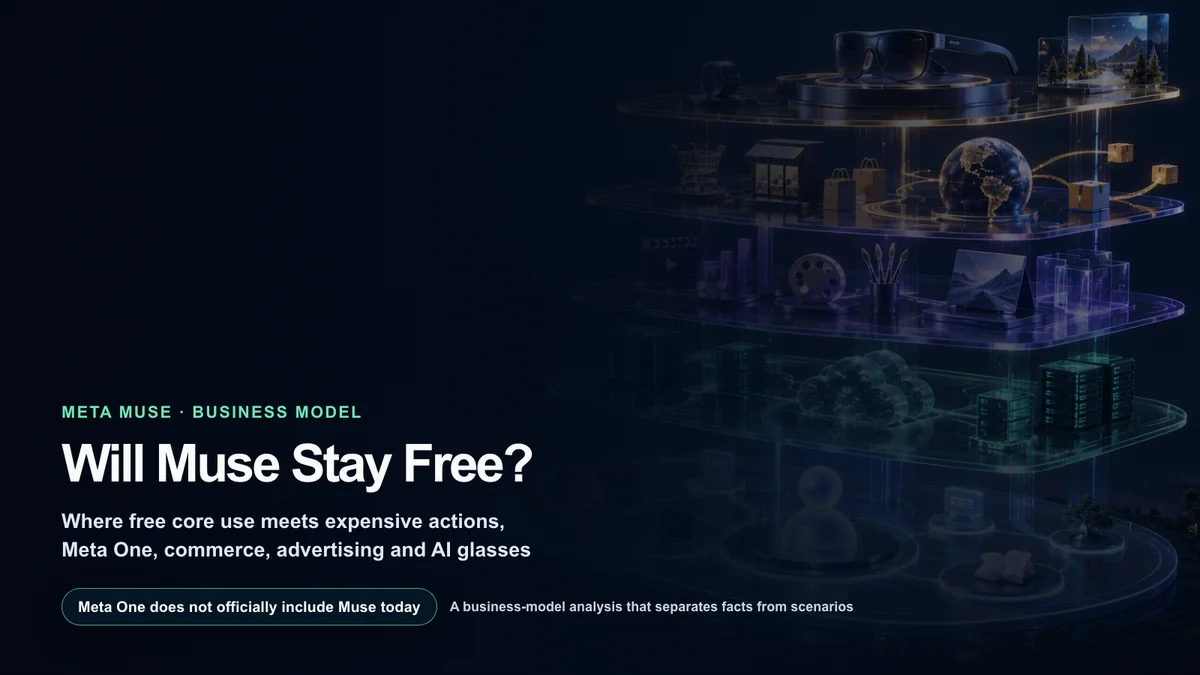
When Meta launched Muse, it set a broad commercial direction: most everyday use would be free, with subscriptions for people who wanted to do more. That strategy makes it easy for a personal agent to acquire users. It leaves a harder question for later: where does Meta place the paid boundary after users connect email, calendars, shopping and long-term memory?
Meta One is an obvious candidate because it organizes paid features across Instagram, Facebook, WhatsApp and Meta AI. Yet the official Meta One announcement does not say that the personal Muse agent is included in Core or Premium. A future combination is plausible, but it is not a confirmed product today.
Rather than repeating the full Meta One plan table, this article examines the economics of a personal agent: which activities are expensive, which revenue paths fit Meta’s ecosystem and which claims remain scenarios rather than announced plans.
What Meta has actually said about free and paid use
In the official Muse launch post, Meta says Muse is free for most of what people need and offers subscriptions for people who want to do more. It does not publish a universal free task count, monthly compute allowance or complete price ladder.
Meta One is a separate, confirmed subscription system. Meta says the core experience of its apps and everyday Meta AI use will remain free. U.S. announced prices are $2.99 per month for WhatsApp Plus, $3.99 each for Instagram Plus and Facebook Plus, $7.99 for Core and $19.99 for Premium. Creator and business plans begin at $14.99 and reach a Max tier starting at $499.
Core and Premium primarily expand use of compute-intensive AI creation such as images, video and Restyle. That structure offers a clue for Muse. A short conversation is cheaper than an agent that maintains a Secure VM, browses for an hour, calls several connected services and stores a long-running project. The paid boundary may center on execution time, tool use and concurrent tasks rather than access to a particular model name.
Revenue path 1: usage and execution time
An agent can create costs long after its user closes the app. Muse maintains a cloud environment, browses pages, revises a plan, invokes connectors and waits for approvals. Persistent goals also require storage and background scheduling.
A plausible structure would give free accounts fewer concurrent tasks, lower priority and shorter retention, while paid accounts receive longer runs, more parallel work, broader connectors and faster execution. Meta has not announced that exact structure, so it should be treated as analysis rather than a plan.
The important pricing questions are:
- monthly task count and maximum time per task;
- separate allowances for browsing, Mac computer use and connector calls;
- memory and file storage capacity and retention;
- whether exceeding a limit causes a wait, slower service or an added charge;
- whether failed or rejected tasks consume the allowance;
- which purchase-protection and support benefits are included.
Revenue path 2: a Meta One bundle
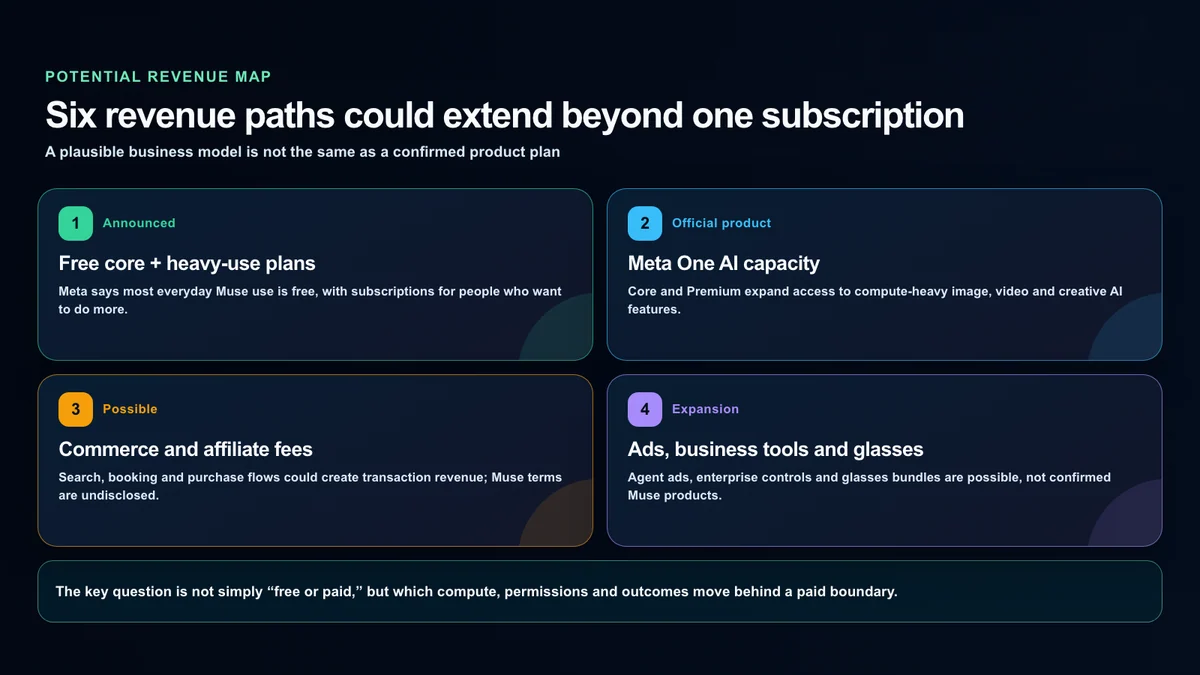
Meta One Core and Premium already expand image, video and creative-AI usage. If Muse becomes the layer connecting Meta AI, saved Instagram content and WhatsApp, including a certain amount of agent work in Meta One would be a logical bundle strategy.
The current announcement does not promise it. Meta AI benefits shown in Meta One should not automatically be treated as access to the personal agent Muse. Before paying, a user would need to see whether the checkout page explicitly lists agent tasks, dedicated email, Mac use and persistent memory.
Bundling can simplify several subscriptions. It can also make users pay for Instagram or Facebook benefits they do not need and increase switching costs across multiple services.
Revenue path 3: commerce and affiliate economics
Muse can compare products, build a cart, plan travel and move toward checkout. An agent that influences a transaction could support merchant ads, affiliate commissions, preferred placement or payment-service revenue.
Meta has not announced that Muse recommendations are ranked by advertising or affiliate compensation. Commerce should therefore be described as a potential path, not a current revenue stream. If it appears, the product will need to disclose:
- whether ranking is based on price, quality, personal preference or compensation;
- which results are sponsored or affiliated;
- whether lower-priced non-affiliated options receive equal comparison;
- how merchant payments influence the final recommendation;
- which party is responsible for returns, refunds and price protection.
A conflict of interest matters more when an agent acts than when a user merely sees an ad in search results. Explainable ranking and human approval should remain part of a purchase flow.
Revenue path 4: advertising without breaking the privacy promise
Meta says Muse conversations and Secure VM data are not shared with its advertising systems. That promise is important because the agent may process private email, calendars and shopping intent.
It does not prove Muse will never contain advertising. Contextual placements, sponsored recommendations or another ad-supported free tier are possible. If Meta introduces them, users will need to know which signals power the ad, how advertising data is separated from agent memory and whether a subscription reduces advertising.
At this stage, neither “Muse is ad-funded” nor “Muse will always be ad-free” is supported by public evidence.
Revenue path 5: creator and business controls
Meta One’s Essential and higher plans sell scheduling, analytics, team access and Meta Business Agent capacity. They are separate from consumer Muse, but they show that Meta can charge more for operational control than for raw AI output.
Organizations pay for roles, audit retention, policy enforcement, human escalation and predictable support—not simply more messages. If Muse technology expands into work accounts, administrator controls and compliance features may become the highest-value paid layer.
Revenue path 6: AI glasses and device bundles
Meta announced plans to connect Muse with AI glasses. An agent that can use what a person sees as context could continue into search, memory, shopping and scheduling. That creates possible revenue through hardware sales, Meta One bundles, higher AI usage and partner services.
It also increases privacy stakes. Cameras, microphones and persistent memory can capture third parties and documents. A device bundle will need clear recording indicators, memory controls and an explanation of what remains functional after a subscription ends.
Country and account differences still matter
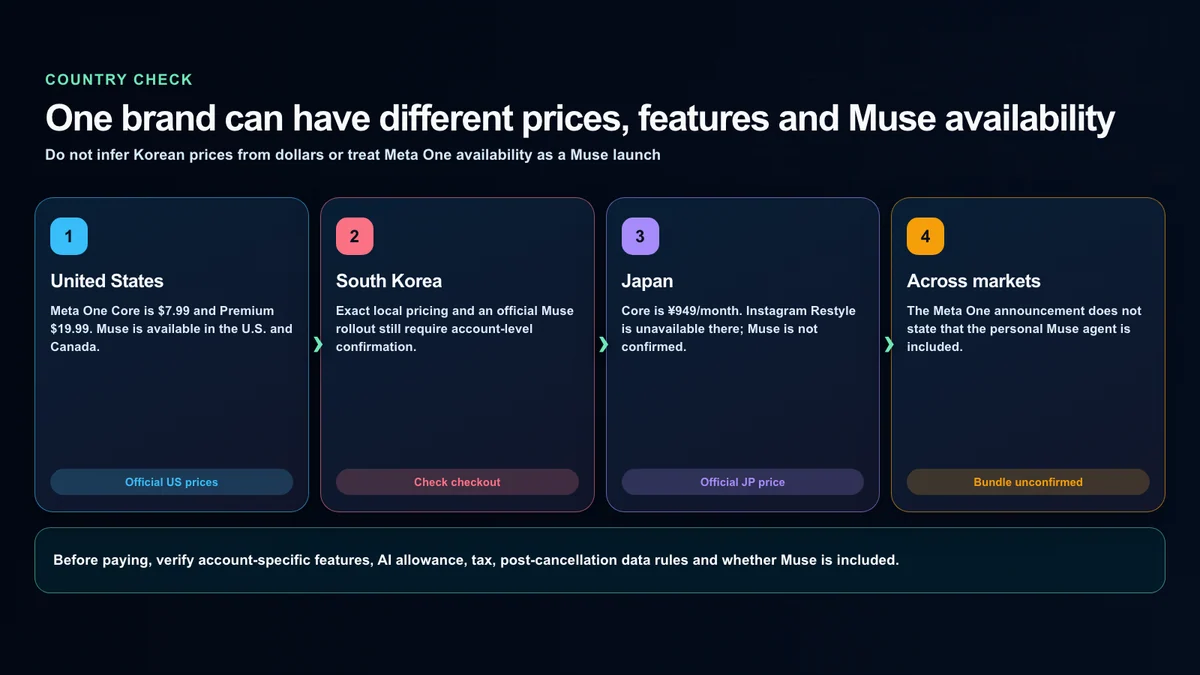
In the United States, announced Meta One prices are $7.99 per month for Core and $19.99 for Premium. Muse is available in the United States and Canada. Those two facts do not mean Muse is included in U.S. Premium.
Meta’s Japanese announcement lists WhatsApp Plus at ¥239, Instagram Plus and Facebook Plus at ¥319 each, and Core at ¥949 per month. It also says Instagram Restyle is not currently available in Japan. Meta One availability there does not establish that the personal Muse agent has launched in Japan.
South Korean users need to check the actual local checkout screen for pricing and features. Converting U.S. dollars into won does not account for tax, app-store price tiers or regional policy. A separate official announcement is also required for a Korean Muse launch.
Seven questions before subscribing
- Does the plan explicitly include the personal Muse agent?
- What are the task, execution-time and concurrency limits?
- How long do memory and project files remain after cancellation?
- Are email, Mac use, payments and connectors available on the account?
- Are sponsored and affiliate recommendations labeled?
- Do failed or user-rejected tasks count against the allowance?
- What support covers an incorrect purchase or other agent failure?
Conclusion
Free access helped Muse become a fast-growing consumer app, but persistent browsing, Secure VMs, connected services and long-term memory cost more than a simple chat response. Heavy-use subscriptions, Meta One bundling, commerce, business controls and AI glasses are all plausible revenue paths.
The confirmed facts are narrower: Meta intends a free Muse baseline with subscriptions for more use, and Meta One sells expanded features and AI capacity across its apps. Meta has not announced that Meta One includes personal Muse. Users should evaluate the task allowance, permissions, data terms and price shown for their own account—not infer them from a shared brand name.
Sources and use notice
- Meta, official Meta One announcement and U.S. plan prices
- Meta, official Muse launch and free-plus-subscription direction
- Meta Japan, Japanese Meta One prices and regional feature notes
Affiliate fees, Muse advertising and a Meta One–Muse bundle are potential business models, not announced products. Prices, benefits and availability can vary by region, app and account. Meta, Muse and Meta One names and marks belong to their owners. This independent article is not sponsored or approved by Meta and does not reproduce official screens, company logos or third-party photography.