How Meta Muse Reached 3.4 Million Downloads in Two Weeks
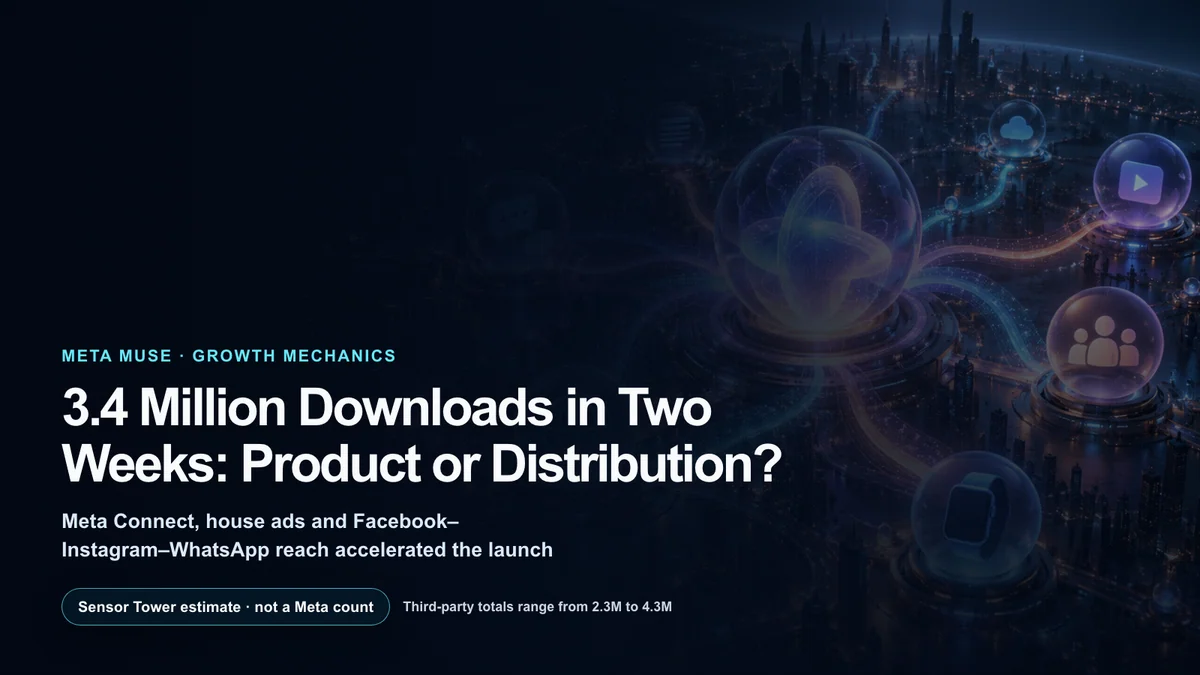
Meta’s personal AI agent Muse has produced one of the fastest consumer-AI launches of 2026. Sensor Tower data reported by TechCrunch estimated more than 3.4 million downloads by September 25, up from 2.5 million at the beginning of that week.
The number is not an official Meta total. Apptopia estimated roughly 4.3 million downloads at the same point, while Appfigures saw about 2.3 million. A two-million-download spread among reputable measurement firms is a warning against presenting 3.4 million as a settled fact. Each company models store data differently and updates on a different schedule; Meta has not published its internal download or active-user count.
The more useful question is how Muse generated such a steep acquisition curve. Its launch combined a product story that is easy to demonstrate, a major conference, paid promotion and a distribution network few startups can match.
The three estimates are measuring an evolving target
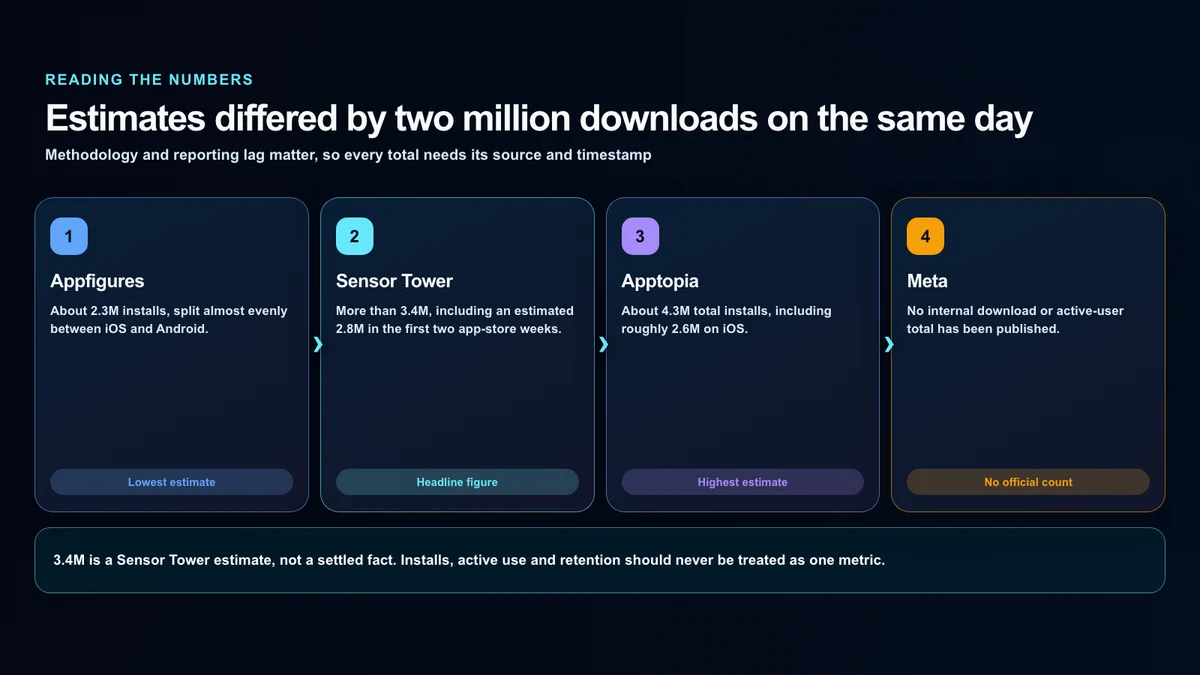
Sensor Tower estimated about 2.8 million app-store downloads during Muse’s first two weeks. From September 8 through September 17, it saw average day-over-day download growth of 55%. For context, the firm calculated 24% average daily growth for the first 10 days of ChatGPT’s mobile launch. It also estimated that Muse daily active users rose 27% immediately after Meta Connect.
Those comparisons do not establish that Muse is a stronger long-term product than ChatGPT. The launches occurred in different years and market conditions. Muse started on iOS and Android at once and arrived after generative AI had become mainstream. Most important, its parent company owns Facebook, Instagram and WhatsApp.
Four metrics should remain separate:
- Downloads show acquisition, not whether someone returned.
- Active users show app openings during a period, not successful task completion.
- Retention shows how many users remain after 30 or 90 days.
- Paid conversion shows whether attention becomes recurring revenue.
Muse has clearly acquired users quickly. Its durable value will depend on retention, successful actions, error rates and willingness to pay.
Growth force 1: a product benefit people can see
Many chatbots compete on answer quality, which is hard to explain in a short ad. Muse is positioned around completed outcomes: organizing email, comparing products, making plans and moving a reservation or purchase toward completion.
Meta’s launch announcement says Muse can browse websites, fill forms and continue long-running work after the app closes. It returns when a task changes or reaches a sensitive action such as sending email or making a purchase. That creates a simple demonstration: the value is time or effort removed from a task.
It does not mean every workflow succeeds. Bot defenses, logins, regional restrictions and changing websites can interrupt an agent. Meta has not disclosed how many new users reach a successful first task or how many leave after a failed attempt.
Growth force 2: Meta Connect created a second wave
At Meta Connect 2026, the company previewed video chat, Mac computer use, a dedicated Muse email address, more connectors and AI-glasses integration. Sensor Tower’s estimated 27% daily-active-user increase after the event suggests that the announcements materially renewed interest.
The Connect feature roundup also illustrates an important caveat: a roadmap announcement is not the same as general availability. Dedicated email and some glasses features were presented as upcoming capabilities. They should not be counted as finished features for every account.
Growth force 3: Meta already owns the audience
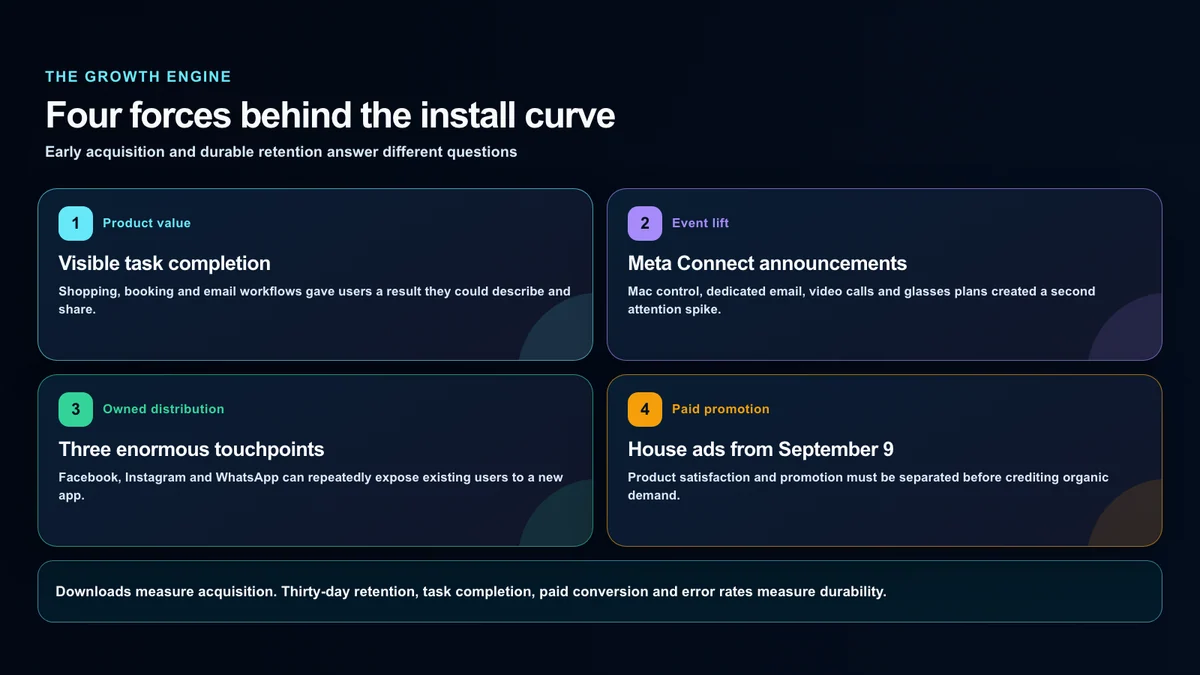
Muse does not begin with an empty audience. Facebook, Instagram and WhatsApp give Meta billions of existing relationships, notifications and usage habits through which it can explain or expose a new product.
An earlier Apptopia analysis estimated that more than 95% of Muse users also used Facebook and 63% used Instagram. The overlap supports a distribution advantage, but it does not prove cause. Users may install Muse because they already trust Meta’s products, because they were repeatedly shown the app or because independent reviews persuaded them.
WhatsApp lowers another barrier by letting people interact with an agent in a familiar messaging environment. If saved Instagram content, calendars, shopping services and travel connectors become deeply linked, users may move less often between apps. That convenience can also increase ecosystem lock-in and the amount of personal context entrusted to one company.
Growth force 4: house ads amplify store rankings
Sensor Tower observed Meta house ads promoting Muse beginning September 9, one day after launch. A company with enormous owned ad inventory can reach likely users without depending entirely on outside media.
Paid exposure can lead to more installs, which can raise app-store rankings. High rankings then produce organic discovery and news coverage, which creates more installs. The loop can be summarized as promotion → installs → rankings → coverage → more installs.
This does not invalidate product demand. It means downloads should not be attributed to product satisfaction alone. A useful growth analysis must separate paid acquisition, owned distribution, event publicity and organic recommendations.
What U.S. users should watch next
Muse is available in the United States and Canada, so the U.S. market is where the next evidence will appear first. The important questions are no longer whether people are curious enough to install it.
Watch for:
- 30-day and 90-day retention after the conference spike;
- the percentage of assigned tasks completed without handoff;
- how often users reject an action at the approval screen;
- failure and recovery rates for booking, email and purchase workflows;
- conversion from free use to paid tiers;
- whether paid acquisition declines while new users continue arriving.
A high download count can coexist with weak retention. Conversely, a smaller but highly active group that delegates recurring tasks may support a durable service.
What the launch does—and does not—prove
Muse’s launch demonstrates that a consumer agent can become a mainstream app-store event. It also shows the strategic value of pairing an agent with a company’s existing messaging and social graph.
It does not yet prove that users will keep delegating personal work, trust the permission model or accept recurring fees. The 3.4 million figure is one firm’s estimate inside a much wider range. The next stage will be measured by completed work and retained relationships, not installation momentum.
Sources and use notice
- TechCrunch, Sensor Tower, Apptopia and Appfigures Muse estimates
- Meta, official Muse launch announcement
- TechCrunch, Muse early installs and active-user estimates
- TechCrunch, Muse features announced at Meta Connect 2026
Download and active-user figures are third-party estimates, not audited Meta statistics. Meta, Muse, Facebook, Instagram and WhatsApp names and marks belong to their respective owners. This independent editorial article is not sponsored or approved by Meta and does not reproduce official product screens, event photography or company logos.