GPT-6o Rumor Fact Check: Did Tibo Actually Tease a New Model?
The claim that OpenAI is preparing a model called GPT-6o has returned to social media. The newest supposed clue is an extremely short X post from Codex leader Tibo Sottiaux: o no :(. Some readers treated the letter o as a hint at an unreleased product name.
As of September 26, 2026, GPT-6o does not appear in OpenAI’s official model catalog. The announced GPT-6 family consists of Astra, Sol and Luna. There is no verified GPT-6o system card, API model ID, price sheet or release announcement. The X clue also changes meaning when the next post is included: it was part of a Codex outage-and-recovery sequence.
Three takeaways
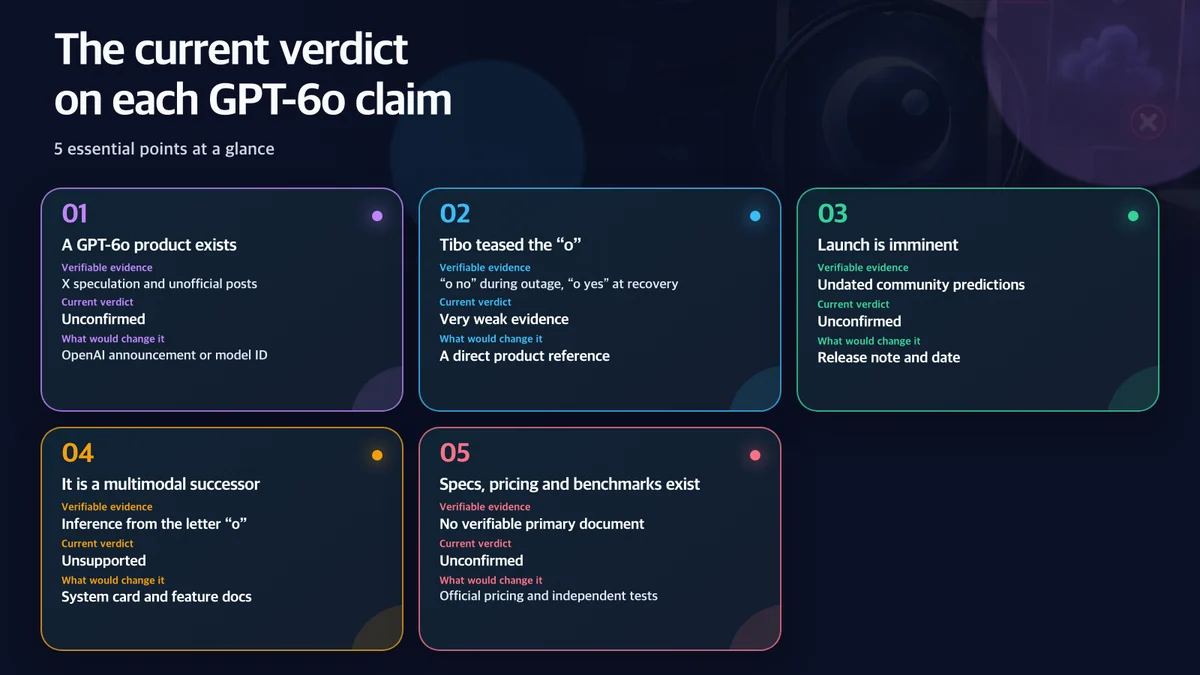
- The name GPT-6o appears in X speculation, blogs and prediction-market rules, but OpenAI has not announced it as a product.
- Tibo posted
o noduring a Codex outage, then followed roughly an hour later with ano yesrecovery notice and paid-user usage reset. - A future launch cannot be ruled out, but there is no credible public evidence for specifications, pricing, benchmarks or a DevDay release.
The current verdict on each GPT-6o claim
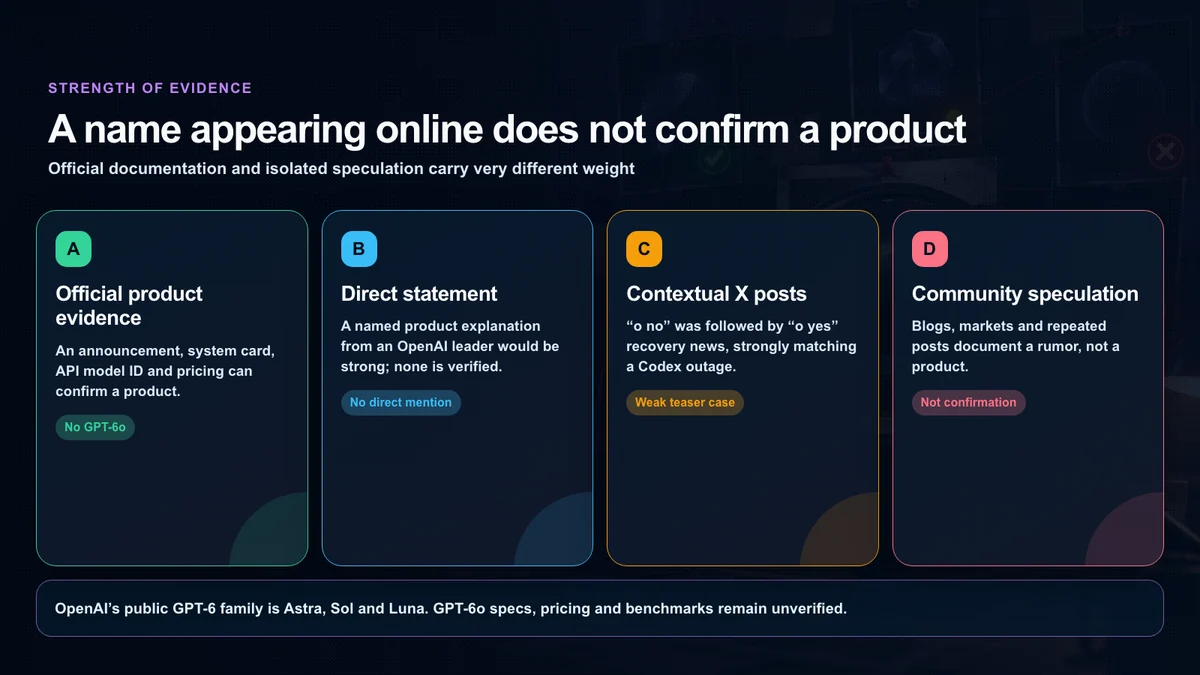
What is actually in the GPT-6 catalog
OpenAI’s official model catalog and product announcements list GPT-6 Astra, GPT-6 Sol and GPT-6 Luna. Astra is positioned for the most demanding work, while Sol and Luna offer different tradeoffs among capability, speed and cost.
GPT-6o is absent. An absent public listing cannot prove that no internal experiment exists. It does mean that claims about a selectable ChatGPT model or callable API product are unverified until OpenAI publishes a model ID, documentation and access terms.
The letter o also does not establish a feature set. Reusing a past naming pattern to infer native audio, video or real-time multimodality is speculation. OpenAI has not explained this name because it has not publicly introduced the product.
The recent X “clue” in context
Tibo posted the short phrase on the evening of September 25 in the U.S. while Codex was experiencing an outage. Read alone, a single letter can absorb almost any interpretation. A fact check has to include the timestamp and the next post.
Roughly an hour later, Tibo began a post with o yes, said Codex was back in action and announced usage-limit resets for paid users across Codex and ChatGPT Work. He apologized for the brief disruption and mentioned a special spare Codex used to help during outages.
The sequence strongly supports a simple reading: o no marked the outage and o yes marked the recovery. Neither post identifies a new model or describes a capability. Extracting the letter and labeling it an official GPT-6o teaser goes beyond the source.
Why the GPT-6o name was already circulating
The name predates these two posts. It appeared in speculative blogs, videos and prediction-market rules that combined the GPT-4o naming pattern with expectations for GPT-6. Those items generally assumed a future product rather than citing an OpenAI document.
A Futuur GPT-6 prediction market included a rule saying a product named ChatGPT-6o could count toward resolving the market. That is a market operator defining possible outcomes, not evidence that OpenAI supplied the name or planned the product.
Some secondary articles described GPT-6o as transformative and assigned capabilities or timing without a system card or independent test. Such material can document that a rumor existed. It cannot substantiate the rumored specifications.
What about a DevDay announcement
Unannounced names routinely become attached to developer events as the date approaches. The existence of an official DevDay does not establish that GPT-6o is on the agenda. Direct evidence would include a session title, an official teaser, a documentation change or an API model identifier.
The defensible statement is that a future announcement is possible. There is no public basis for saying GPT-6o will launch at DevDay, is already in private testing or will replace GPT-4o.
Evidence that would change the verdict
The assessment should change if any of the following appears:
- an OpenAI blog post, release note or system card that names GPT-6o;
- a callable model ID in developer documentation or an authenticated API response;
- official pricing, context limits, input-output formats and regional availability;
- a direct product explanation and release date from an identified OpenAI leader;
- reproducible tests from multiple independent evaluators using the same model ID.
By contrast, a composited model-picker screenshot, a name in an unattributed code fragment, a date from an anonymous account or many posts tracing back to one claim are not independent confirmation.
What users should do now
There is no reason to pause current work while waiting for an unverified model. Choose among Astra, Sol and Luna based on task difficulty, latency and cost. If OpenAI announces another model, compare it on the same workload and include retries and human review in the result.
For U.S. businesses and schools, procurement should focus on operational facts rather than the product name:
- accuracy on representative documents and workflows;
- data retention and training controls;
- tool, file and external-send permissions;
- task success and retry cost, not context length alone;
- regression tests and human approval when switching models;
- fallback rules when availability, rate limits or pricing changes.
The most accurate conclusion is straightforward. GPT-6o exists as an online name, not as a confirmed product. Tibo’s paired X posts describe a Codex outage and recovery more convincingly than a model launch. Until OpenAI publishes direct evidence, a single o should not carry specifications and a release date.
Sources and use notice
- OpenAI official model catalog
- OpenAI, GPT-6 Astra
- OpenAI, Introducing GPT-6 Sol and Luna
- Tibo Sottiaux’s “o no” post on X
- Tibo Sottiaux’s Codex recovery post on X
- Futuur’s GPT-6 prediction-market rules
The X posts are displayed through original embeds rather than copied screenshots. Apart from the short phrases necessary to explain the claim, the article uses independent wording. GPT-6o is an unconfirmed name. The article images are original editorial illustrations that do not reproduce official logos, product interfaces or X screens.