What Is OpenAI Launching This Week? Tibo’s Tuesday Hint and the GPT-6 Sol Question

Recent X posts from Tibo Sottiaux, who leads product work across Codex and ChatGPT at OpenAI, repeatedly point toward a release window this week. References to a week comparable to an earlier DevDay, something still arriving Tuesday, and part of the DevDay story shipping early have triggered predictions about GPT-6 Sol, a major Codex feature, ChatGPT changes and usage resets.
The best-supported conclusion is narrower: OpenAI has signaled meaningful activity this week, but the public record does not yet identify the product or a verified launch hour. In particular, the online leap from 3am on a Tuesday to a scheduled GPT-6 Sol release adds a product, a future date and a time zone that the original reply did not provide.
This article was checked on September 22, 2026. At that point, OpenAI’s official model catalog listed GPT-6 Astra and GPT-5.6 Sol, but not GPT-6 Sol. Posts from Tibo Sottiaux on X are valuable primary signals. They are not substitutes for a model page, rate card, product announcement or rollout notice.
The short version: strong launch signal, open product question
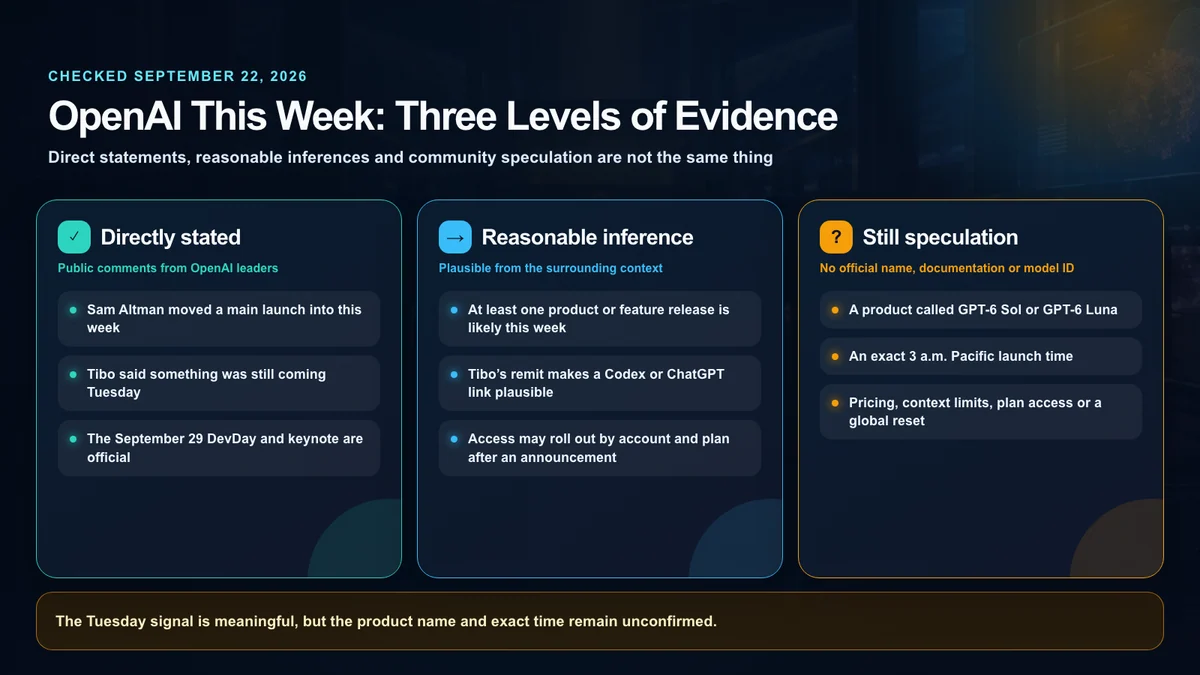
The evidence is easiest to understand in three layers.
- Directly documented: Tibo and Sam Altman discussed a major release, Tuesday timing and material shipping before DevDay.
- Reasonable inference: A Codex or ChatGPT feature, or a usage-policy change, fits Tibo’s role and the context of the replies.
- Still speculative: GPT-6 Sol, a precise 3 a.m. launch, pricing and simultaneous access for every account remain unconfirmed.
That separation matters because a product executive’s teaser can be a real launch signal without naming what is coming. A short pronoun such as it may refer to the request in the immediate conversation, a related feature, or one item in a broader release week. The thread does not collapse those possibilities into one answer.
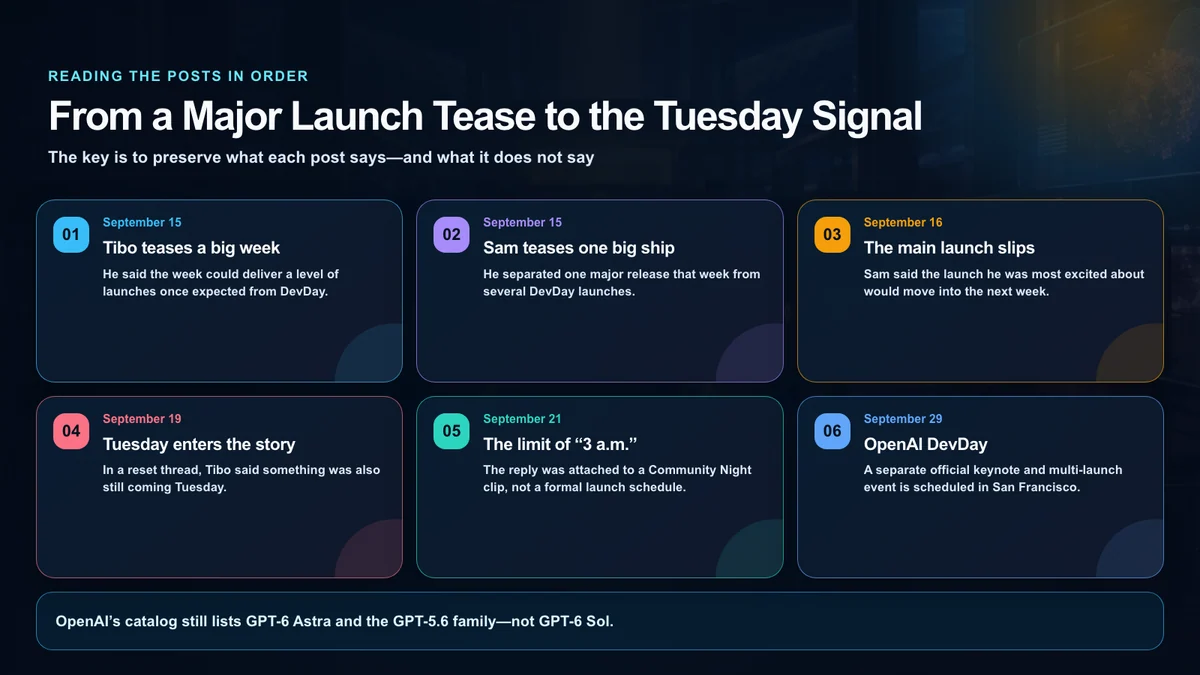
September 15: one big release was distinct from DevDay
Interpretation: The first strong signal arrived on September 15. Tibo suggested that the week could rival a previous DevDay in the amount shipped. The wording pointed to a release week with multiple pieces rather than proof of one particular model.
That same day, Sam Altman distinguished one major release that week from several things planned for DevDay. This makes it difficult to explain every teaser as a reference to the September 29 event. It also does not establish that the separate release was a frontier model. The post characterized scale and timing, not a product name.
September 16: the most anticipated item moved
Interpretation: The schedule changed a day later. Altman said the release he was most excited about had slipped to the following week. Any prediction that froze the September 15 timeline without accounting for this update became incomplete.
Two details are important. He described a delay, not a cancellation. He also referred to the item he was most excited about, which does not necessarily mean every other release planned for the original week was delayed. Tibo’s later posts support the idea that the high-profile item, or at least part of the DevDay story, moved into the week beginning September 21.
September 19: part of the DevDay story would ship early
Interpretation: Tibo said he was preparing the DevDay keynote with Sam Altman and Romain Huet and that part of it would ship early the following week. This is the clearest direct support for a release during the current week.
The limiting word is part. The post did not say that the full keynote would be revealed early. It could refer to a developer tool, a Codex workflow, a ChatGPT feature, an API capability or a model. The source does not choose one of those categories.
Why the Tuesday reply is meaningful
Interpretation: A user had asked for a usage reset when Tibo replied that it was still coming Tuesday. A named weekday from an OpenAI product leader is materially stronger than a date invented by community speculation, but the reply does not identify a product.
The object of the sentence is still ambiguous. Because the reply appeared in a usage-reset conversation, several interpretations remain possible:
- a change to usage limits or reset behavior;
- extra usage or a credit for eligible accounts;
- a Codex or ChatGPT feature arriving alongside a usage change;
- more than one update in the same release window.
Rewriting the reply as GPT-6 Sol launches Tuesday inserts a product name that Tibo did not use. Ignoring the Tuesday signal entirely would also understate the evidence. The accurate description is that Tuesday is supported, while the object of the release is not settled.
Why “3am on a Tuesday” is not a verified launch time
Interpretation: The phrase reads like a precise clue when separated from the conversation. In context, however, it was a response attached to a GPT-6 Community Night video. The text does not establish whether it describes a future schedule, jokes about the scene in the video or assumes a particular time zone.
No time zone was included. Treating it as 3 a.m. Pacific, Eastern or UTC would produce three different launch times. Without an event page, countdown or product document, converting it into a calendar appointment creates false precision.
Additional interpretation: The nearby Codex reply makes a Codex connection more plausible. A short emoji reply still does not name a feature, provide a launch time or define who will receive it.
Leading candidate 1: a Codex or ChatGPT capability
The most conservative leading candidate is a Codex or ChatGPT capability. That fits Tibo’s role, the explicit Codex reference and the developer focus of DevDay. Agent workflows, tool connections, collaboration, long-running work and integration between app and API surfaces all fit the surrounding product story.
OpenAI also announced the Agents API in public beta on September 10. That confirms that developer-facing agent infrastructure is an active launch area. It does not prove that the current Tuesday hint is another API announcement. The release could extend an existing announcement into Codex or ChatGPT, broaden access, or concern an unrelated feature.
If the release is a product capability, availability may not be simultaneous. Server-side rollout flags, app version, ChatGPT plan, workspace policy, region and API usage tier can create different access windows.
Leading candidate 2: a usage reset or limit change
The immediate context of the Tuesday reply makes a usage-related change impossible to dismiss. Possibilities include a one-time reset, banked reset credits, temporary limit expansion or compensation targeted at certain accounts.
The reply does not disclose eligible plans, regions, amounts, frequency or whether the change would be automatic. Even if a reset is announced, U.S. Plus, Pro, Business and Enterprise accounts may not receive identical treatment. The help article, in-product usage screen and account notice will be more reliable than a generalized social post.
Candidate 3: GPT-6 Sol
GPT-6 Sol is the most discussed model theory, but its evidence is weaker than the general release signal. OpenAI’s public model catalog currently includes GPT-6 Astra and GPT-5.6 Sol. As of the article’s check time, it did not provide a standalone GPT-6 Sol page, API identifier, rate card, system card or product-availability notice.
The theory is understandable. Sol is already an official name in the GPT-5.6 family, and users expect a more everyday GPT-6 tier below Astra. The overlap between model rumors and Tibo’s Tuesday signal has increased confidence in the community. A plausible naming pattern is not employee confirmation, however.
A real model launch should produce at least six records:
- an announcement in OpenAI’s newsroom, help center or developer documentation;
- an exact callable model ID;
- input, cached-input and output prices, including long-context rules;
- context-window and maximum-output specifications;
- plan and regional availability across ChatGPT, Codex and the API;
- safety documentation, supported tools and known limitations.
A name appearing in a client model picker is not sufficient by itself. Client catalogs can update before server permission, and experimental flags can expose an entry to only a subset of accounts.
This week’s release is not the full September 29 DevDay
The official OpenAI DevDay 2026 page schedules the event for September 29 in San Francisco. The opening keynote with Sam Altman starts at 10 a.m. Pacific, or 1 p.m. Eastern.
An early release this week would not replace the full event. One coherent scenario is that OpenAI enables a subset of the product, gathers early use cases and then explains the broader developer strategy during the September 29 keynote. That reading fits Tibo’s reference to shipping part of the story early, but it remains an inference about launch structure.
How U.S. users can verify the announcement
When the announcement appears, a short verification sequence will prevent most false conclusions.
- Check the OpenAI newsroom, official model catalog and help center for a new primary document.
- Update ChatGPT or Codex, then reopen the model and feature list on the intended account.
- For a usage change, read the eligibility language in the usage screen and account notice.
- For an API model, send a small request using only the documented model ID and inspect the returned identity and billing record.
- If access is missing, check staged rollout, plan, workspace policy and API tier before concluding that the release did not happen.
Names exposed by unofficial routers or user-edited model catalogs need separate verification. They do not prove that OpenAI’s servers accept the model or that ChatGPT subscription usage covers it.
Frequently asked questions
Is OpenAI definitely launching something this week?
The repeated statements from Tibo and Sam make a release likely. Timing can still change until OpenAI posts the product documentation or the feature becomes available.
Is GPT-6 Sol launching Tuesday?
That has not been confirmed. The Tuesday reply exists, but it was made in a usage-reset conversation and did not name GPT-6 Sol.
What time zone does “3am” refer to?
None was stated, and the reply was not clearly presented as a future schedule. There is no reliable conversion to Pacific, Eastern or another local time.
Why is Codex a leading candidate?
Tibo explicitly referenced Codex in a nearby reply, his product role covers the area, and DevDay is developer-focused. No specific Codex feature or rollout scope was named.
Could usage limits reset too?
Yes, because that was the context of the Tuesday exchange. Whether this means a full reset, banked credit or limit increase—and which plans qualify—remains unknown.
When is DevDay?
OpenAI DevDay 2026 is September 29 in San Francisco. The keynote begins at 10 a.m. Pacific and 1 p.m. Eastern.
Bottom line
Read chronologically, Tibo Sottiaux’s posts form a stronger signal than a single cryptic joke. The September 15 release-week teaser, September 16 delay, September 19 DevDay preview and Tuesday reply establish a coherent sequence.
They do not establish a GPT-6 Sol launch at 3 a.m. Tuesday. The best current conclusion is that OpenAI may release something involving Codex, ChatGPT, usage policy or a model this week, with Tuesday specifically signaled, while the product and exact time remain unverified.
When a real announcement arrives, the decisive details will be the official model or feature name, exact ID, price, account eligibility, app version and usage terms. This week’s early release should also be evaluated separately from the full DevDay program on September 29.
Trademarks and images
OpenAI, ChatGPT, GPT, Codex and related marks belong to their respective owners. This independent article is not sponsored or endorsed by OpenAI. The article images do not reproduce product screens, company logos, X screenshots or third-party photography.
Official sources
- OpenAI API: official model catalog
- OpenAI: Introducing the Agents API
- OpenAI DevDay 2026 schedule and keynote
Primary social posts
- Tibo Sottiaux: September 15 release-week teaser
- Sam Altman: September 15 distinction between the weekly release and DevDay
- Sam Altman: September 16 delay to the following week
- Tibo Sottiaux: September 19 DevDay preparation and early release
- Tibo Sottiaux: September 19 Tuesday reply
- Tibo Sottiaux: September 21 3am on a Tuesday reply
- Tibo Sottiaux: September 21 Codex reply