Inside OpenAI’s 10,000-Agent Navier–Stokes Research System

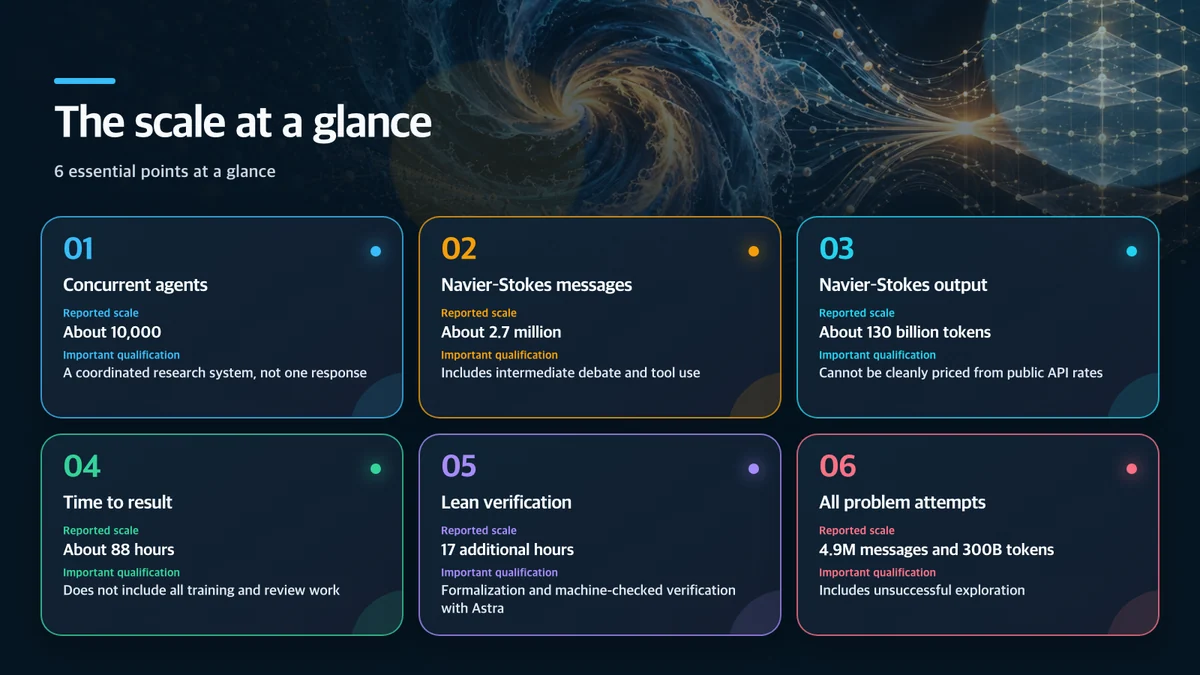
OpenAI’s September 8, 2026 Navier–Stokes announcement is less a story about one chatbot answer than a preview of computation-scaled research. According to the company, roughly 10,000 concurrent AI agents explored different approaches, exchanged useful intermediate findings and converged on an analytical proof plus a Lean formalization.
The headline-grabbing detail is that OpenAI used an internal model “significantly more capable” than GPT-6 Astra. That does not mean an unreleased chat model solved a century-old problem in one prompt. The result came from a system: a model undergoing large-scale reinforcement learning, coordinated agent groups, cached-web and code tools, human allocation decisions, Codex synthesis of intermediate ideas and a final Astra-assisted formal-verification phase.
Three takeaways
- OpenAI says its system showed that smooth three-dimensional incompressible fluid motion can develop a finite-time singularity under a smooth forcing construction.
- The Navier–Stokes run alone consumed about 2.7 million messages, 130 billion output tokens and 88 hours, followed by 17 hours of Lean work.
- A public paper and formalization create a reviewable starting point; independent mathematical acceptance and any Clay Mathematics Institute process remain separate.
The scale at a glance
What OpenAI says the system proved
The Navier–Stokes equations describe fluid motion in settings ranging from aircraft design and weather prediction to blood-flow research. The long-running question asks whether a smooth three-dimensional incompressible flow must remain smooth, or whether velocity can become unbounded in finite time.
OpenAI says its system produced an analytical proof and Lean formalization in which a fluid initially at rest, subject to a smooth force, develops a finite-time singularity while retaining finite energy. The construction centers on a vortex that spirals inward and stretches. Large acceleration, pressure, transport and viscosity terms allegedly cancel with enough precision to leave a smooth applied force even as velocity diverges.
The company says this establishes statements C and D in the Clay Mathematics Institute formulation. Publication is not the same as final acceptance. Mathematicians still need to inspect the argument, reproduce key steps, audit the formalization and resolve any errors. OpenAI explicitly says it does not intend to claim the Millennium Prize for the result.

How a 10,000-agent research lab operated
OpenAI says it began large-scale reinforcement learning on a previously pretrained model on August 28 and launched tests across the open Millennium Prize Problems and other high-impact questions on September 1. Different groups received variations of each problem statement. Agents could read a cached copy of the internet, run code and communicate within their groups.
The team did not commit every resource to Navier–Stokes immediately. Nearly 100 agents spent about 50 hours finding an unforced Euler regularity counterexample. Human researchers treated that result as a promising lead, moved agents away from other problems and supplied the Euler finding to Navier–Stokes groups. As a more trained checkpoint of the internal model became available, the system updated agents during the project.
OpenAI encouraged groups to pursue diverse approaches. Later, Codex consolidated useful intermediate insights so other groups could build on them. Humans remained responsible for choosing problems, reallocating compute, designing prompts, judging promising directions and deciding what could be published.
What 130 billion output tokens means
The 130-billion-token figure is not equivalent to one extremely long conversation. It represents parallel hypothesis generation, computation, criticism, dead ends and cross-group communication. Across all attempted problems, the system generated roughly 300 billion output tokens—showing that a large share of the research budget went to exploration that did not become the final result.
Multiplying those tokens by a public API price would produce a misleading cost estimate. OpenAI did not disclose internal accounting for reasoning tokens, cache use, hardware utilization, training expense or failed reruns. The figure is evidence of computational scale, not a reliable invoice.
It also raises an access question. Ten thousand agents running for 88 hours are not a method most universities can immediately reproduce. Scientific evaluation should therefore ask not only whether the proof is correct, but which parts can be independently checked with much smaller compute budgets.
Why Lean verification matters
Natural-language proofs can hide unstated assumptions, sign mistakes or gaps in boundary conditions. Lean requires definitions and inference steps in a formal language that a small trusted kernel checks. OpenAI says GPT-6 Astra spent another 17 hours formalizing and verifying the result after the agent system reached its solution.

Formal verification is powerful, but it is not a universal authenticity stamp. Researchers must still check that formal definitions match the original mathematical question, imported assumptions are appropriate and the prose interpretation does not exceed what the theorem states. The advantage is auditability: a public Lean artifact lets researchers rerun the same kernel checks instead of trusting a narrative alone.
Why the internal model should not be called Bel
Online speculation has used Bel as a name for a possible future OpenAI model. The Navier–Stokes post does not use that name. It says only that a new internal model is significantly more capable than GPT-6 Astra and still in training.
The accurate label is therefore “OpenAI’s internal model.” Connecting it to Bel, GPT-7 or a rumored parameter count requires evidence that OpenAI has not provided. Model capability and system capability must also remain separate. Access to the same weights in a normal chat interface would not automatically reproduce a 10,000-agent workflow with tools, coordination and formal verification.
Research acceleration and its risks
In its inside look at AI-accelerated research, OpenAI describes systems that speed literature search, hypothesis generation, coding and verification. This project turns that general claim into an operational example. Parallel exploration can cover more ideas, connect distant intermediate results and compress a successful path into a formal proof.
Scale can also amplify shared errors. Thousands of agents built from related models may inherit the same blind spot, reward-hacking strategy or false premise. OpenAI’s separate model-misalignment reporting framework and monitoring guidance underscore the need for behavior monitoring, isolation and incident reporting as agent systems grow.
What U.S. labs and companies should learn
Most organizations should not begin by copying the 10,000-agent number. The transferable design is role separation: one process generates hypotheses, another searches for counterexamples, another checks sources, another runs code and an independent stage verifies the final claim. Smaller systems can gain reliability from explicit stop conditions and automated checks before they gain anything from raw agent count.
Research contracts and IP policies also need updating. Organizations should define which papers and proprietary datasets agents may access, how intermediate artifacts are retained, what confidential data can reach an outside model provider and who bears authorship and error responsibility. Public mathematics and regulated medical or corporate research cannot share one default policy.
For U.S. research funding, the reproducibility gap matters. A result created with enormous private compute may be scientifically useful if the proof is compact and independently checkable. It is less useful if validating the core claim requires the original company’s inaccessible system. Public papers, formal artifacts, logs and smaller verification paths are therefore part of the scientific contribution, not optional documentation.
Frequently asked questions
Is the Millennium Prize Problem officially solved?
OpenAI says the proof establishes statements C and D in the official formulation. Independent review and the Clay Mathematics Institute’s process are separate. “Prize confirmed” would be premature.
Did GPT-6 Astra solve it?
The main search used an internal model described as more capable than Astra and a roughly 10,000-agent system. Astra was used later for Lean formalization and verification.
Can customers use the internal model?
No public catalog listing exists. OpenAI has not confirmed its name, release date, price or context window.
Are 10,000 agents equivalent to 10,000 researchers?
No. They are many model instances, often sharing training and blind spots. They do not provide the independent life experience, accountability or disciplinary diversity of 10,000 human scientists.
Bottom line
The most consequential part of OpenAI’s announcement is not simply a stronger model. It is a computational research organization combining a frontier internal model, thousands of coordinated agents, millions of messages, human steering and formal verification.
If the proof survives independent review, the project will be an important example of AI-accelerated science. The 130-billion-token scale is not itself evidence that the conclusion is true, however. The public proof and Lean artifact begin the verification process; they do not replace it.
Sources and rights notice
- OpenAI, On the Navier–Stokes Millennium Prize Problem
- OpenAI, A view inside AI-accelerated research
- OpenAI, Model misalignment reporting framework
- OpenAI Developers, Misalignment monitoring
- Clay Mathematics Institute, Navier–Stokes equation
OpenAI, GPT, Codex and Lean names and marks belong to their respective owners. This independent editorial article is not sponsored, endorsed or approved by any company or institution. It distinguishes disclosed facts, company claims and analysis. Its images are editorial concepts, not official research scenes or product interfaces.