How SynthID Bio watermarks AI-generated protein sequences and structures
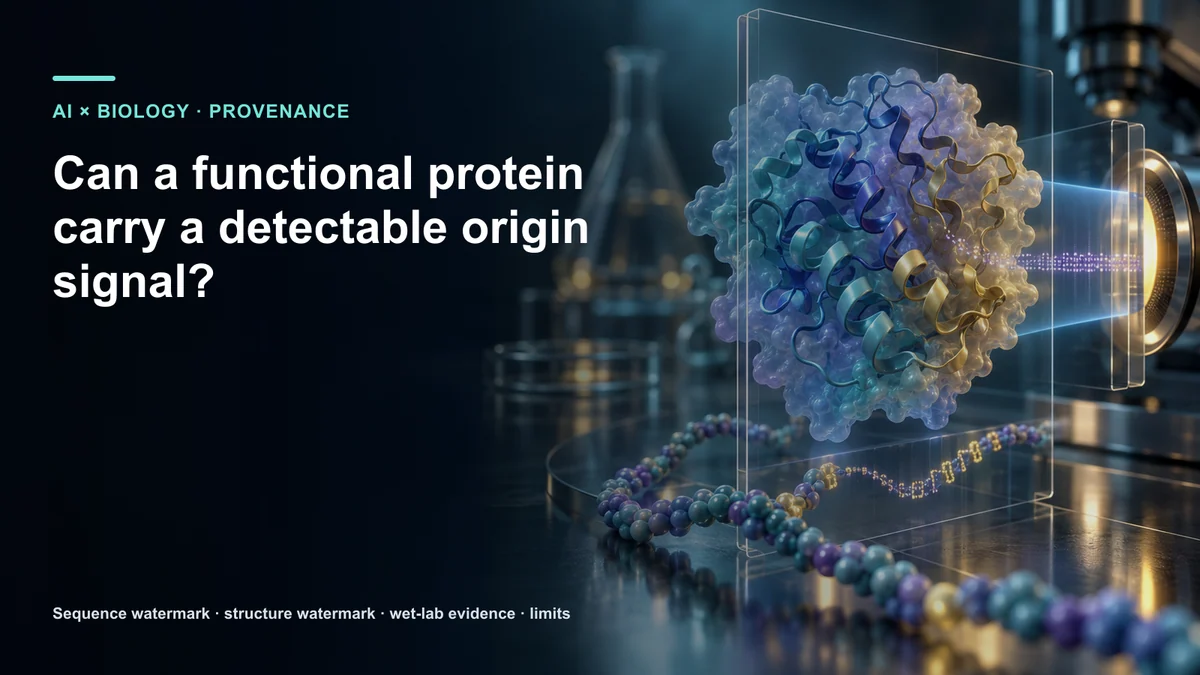
SynthID Bio is a proof of concept for detectable provenance signals in AI-generated protein sequences and predicted three-dimensional structures. The sequence study tested binders for three targets VEGF-A SARS-CoV-2 spike RBD and PD-L1 in the laboratory. This guide separates confirmed events, attributed claims, technical limits, and the evidence still needed for a practical decision.
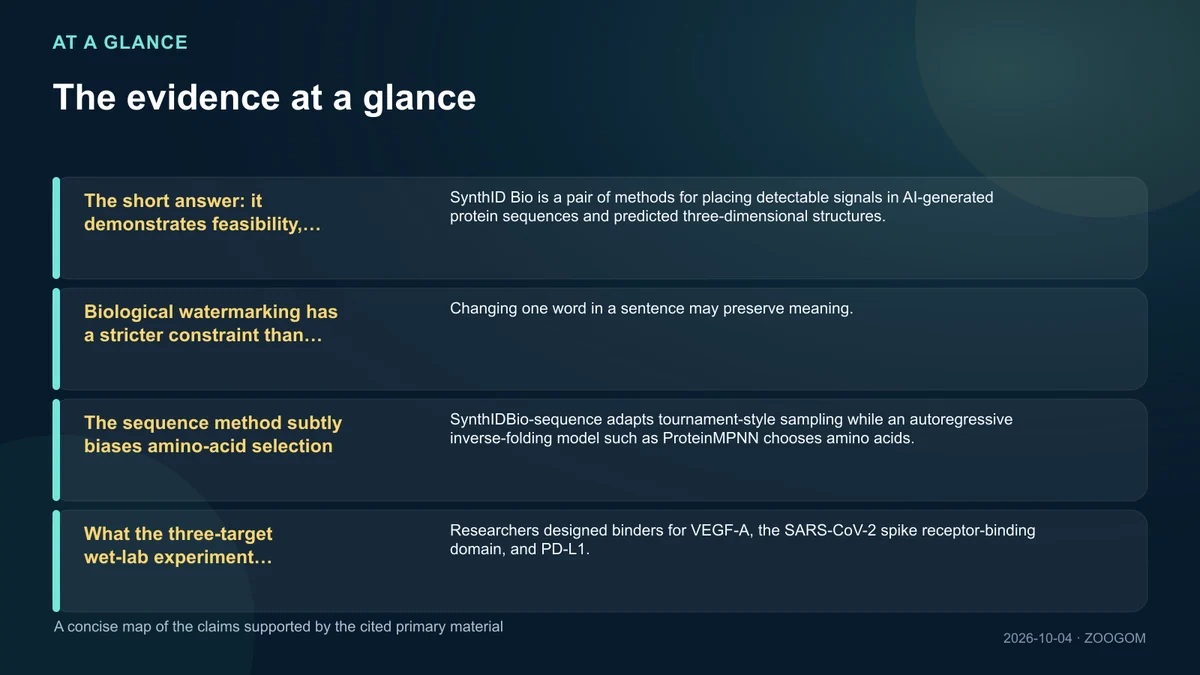
The short answer: it demonstrates feasibility, not a universal standard
SynthID Bio is a pair of methods for placing detectable signals in AI-generated protein sequences and predicted three-dimensional structures. The team reports that watermarked binders retained function after physical synthesis and laboratory testing.
The work does not cover every protein family, model, mutation, laboratory, or adversary. It is best understood as evidence that provenance and function can coexist under studied conditions.
Biological watermarking has a stricter constraint than text
Changing one word in a sentence may preserve meaning. Changing one amino acid can alter folding, stability, expression, binding, immunogenicity, or toxicity.
A useful biological watermark therefore needs more than detection accuracy. It must preserve intended function, produce plausible diversity, survive synthesis and measurement, and avoid quietly narrowing the design space.
The sequence method subtly biases amino-acid selection
SynthIDBio-sequence adapts tournament-style sampling while an autoregressive inverse-folding model such as ProteinMPNN chooses amino acids. A key-dependent statistical preference is distributed across positions and accumulated by a detector.
It is not a visible tag appended to the protein. That makes the sequence look natural, but extensive mutation, truncation, or redesign can potentially weaken the signal and needs adversarial testing.
What the three-target wet-lab experiment establishes
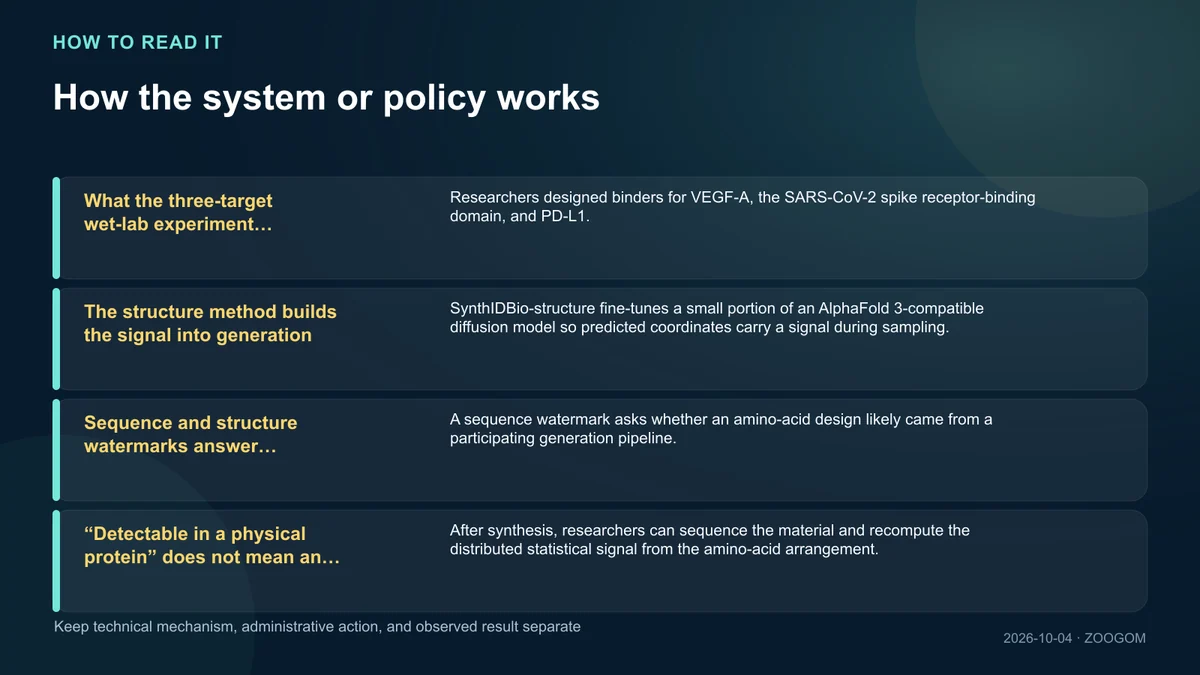
Researchers designed binders for VEGF-A, the SARS-CoV-2 spike receptor-binding domain, and PD-L1. They report that watermarked and unwatermarked candidates had comparable hit rates, binding affinities, and natural sequence diversity.
That is meaningful physical validation for three targets in a particular design pipeline. It is not evidence about every enzyme, membrane protein, antibody, therapeutic toxicity profile, or long-term stability question.
The structure method builds the signal into generation
SynthIDBio-structure fine-tunes a small portion of an AlphaFold 3-compatible diffusion model so predicted coordinates carry a signal during sampling. A PointNet-inspired detector examines the resulting structure.
The researchers report preserved prediction accuracy, key structural distributions, robustness to small coordinate changes, and near-perfect detection in their evaluations. Those claims remain bounded by the published test conditions.
Sequence and structure watermarks answer different provenance questions
A sequence watermark asks whether an amino-acid design likely came from a participating generation pipeline. A structure watermark asks whether a coordinate file was produced by a participating prediction model.
One does not automatically authenticate the other. A workflow can retain the sequence while replacing the structure, or redesign the sequence while keeping a related fold, so each data type requires its own verification.
“Detectable in a physical protein” does not mean an embedded transmitter
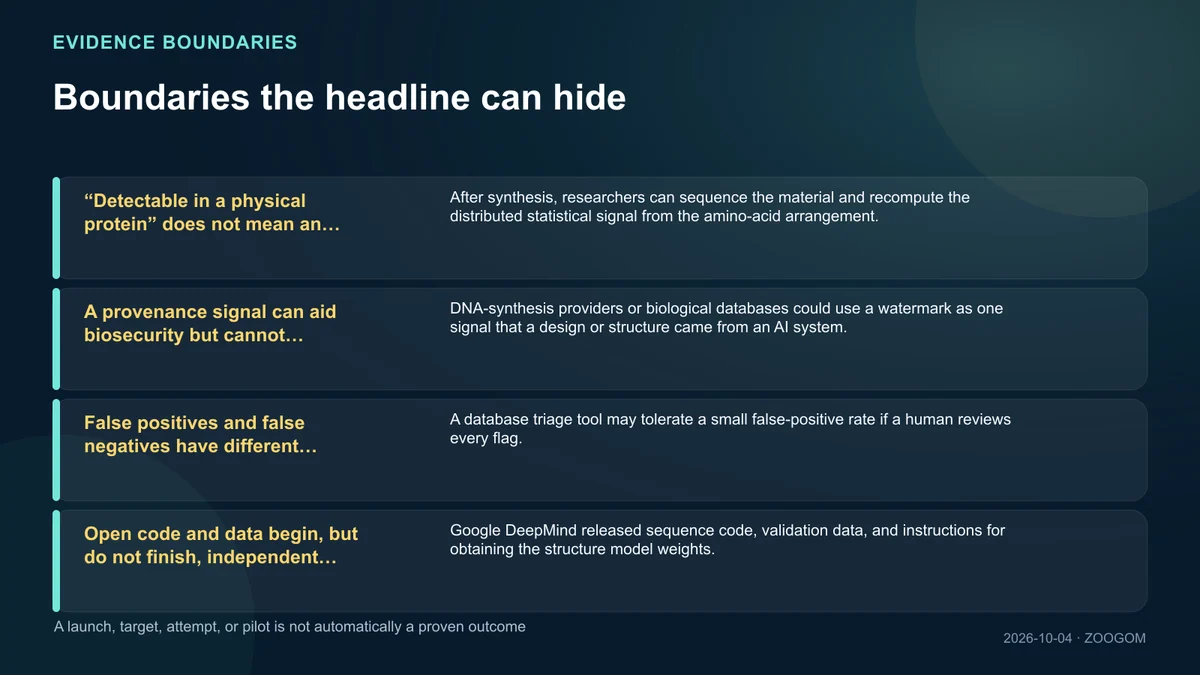
After synthesis, researchers can sequence the material and recompute the distributed statistical signal from the amino-acid arrangement. The protein does not contain a radio beacon or a visually readable mark.
Detection supports a provenance claim; it does not independently prove who synthesized the sample, when it was made, or why. Chain-of-custody and measurement quality still matter.
A provenance signal can aid biosecurity but cannot replace screening
DNA-synthesis providers or biological databases could use a watermark as one signal that a design or structure came from an AI system. It may also help distinguish predicted structures from experimental records and reduce provenance confusion.
An adversary can use a model without watermarking or try to remove the signal. Sequence-risk screening, customer verification, laboratory controls, and functional assessment remain necessary. Absence of a watermark is not proof of safety.
False positives and false negatives have different costs
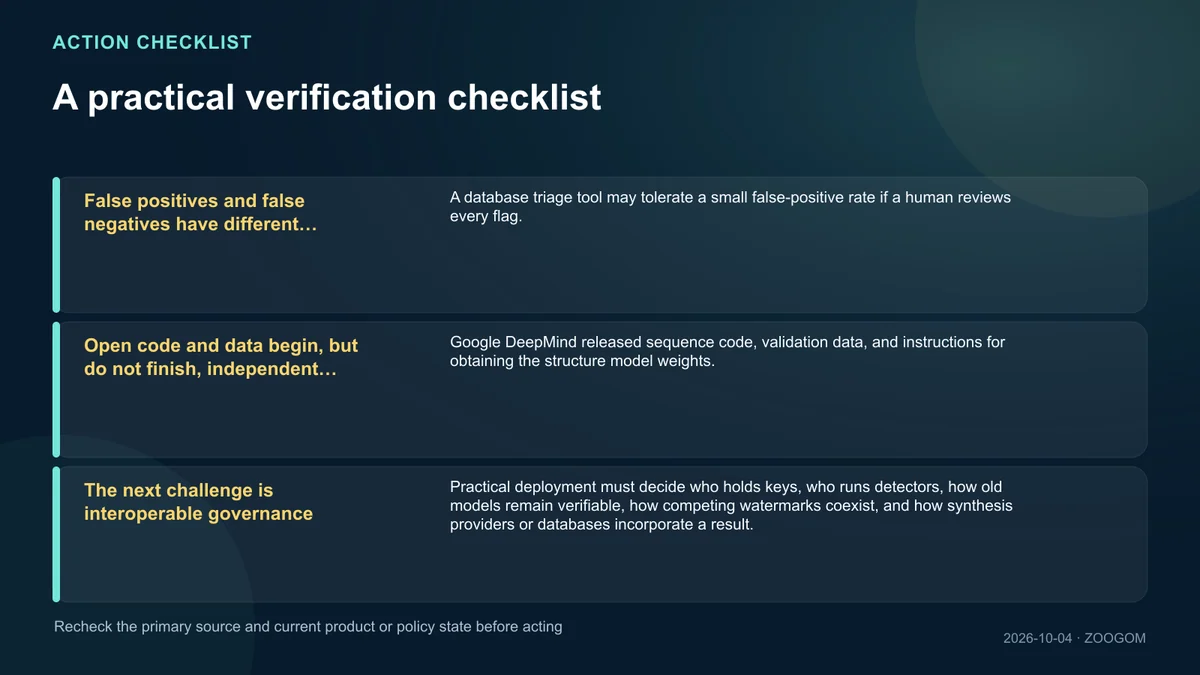
A database triage tool may tolerate a small false-positive rate if a human reviews every flag. An automated decision that rejects an order or sanctions a researcher requires stronger corroboration, transparent appeal, and calibrated thresholds.
Operators need detector version, confidence, key governance, and uncertainty—not the phrase “near-perfect” alone—before acting on an individual sample.
Open code and data begin, but do not finish, independent validation
Google DeepMind released sequence code, validation data, and instructions for obtaining the structure model weights. The Nature paper also identifies public datasets and discloses Alphabet funding.
Independent teams still need to reproduce the findings across protein classes, aggressive transformations, sequence edits, and different laboratories. Repository availability and completed replication are not the same milestone.
The next challenge is interoperable governance
Practical deployment must decide who holds keys, who runs detectors, how old models remain verifiable, how competing watermarks coexist, and how synthesis providers or databases incorporate a result.
SynthID Bio is a substantial proof that a functional design can carry provenance. It is not a reason to label every watermarked protein dangerous or every unwatermarked protein natural and safe.
Copyright, trademark, and image notice
Company and product names may be trademarks of their respective owners. Unless otherwise credited, visuals are AI-generated conceptual backgrounds or original editorial designs and information graphics. Any quotations or third-party assets are identified with the applicable author, source, and usage information at the point of use or in the source list.
Sources and the next facts to verify
The links below are the primary and official materials used for fact-checking. Linking a source does not mean reproducing its prose, imagery, or page design.