Google’s Project Suncatcher satellite is a test, not an orbital AI data center
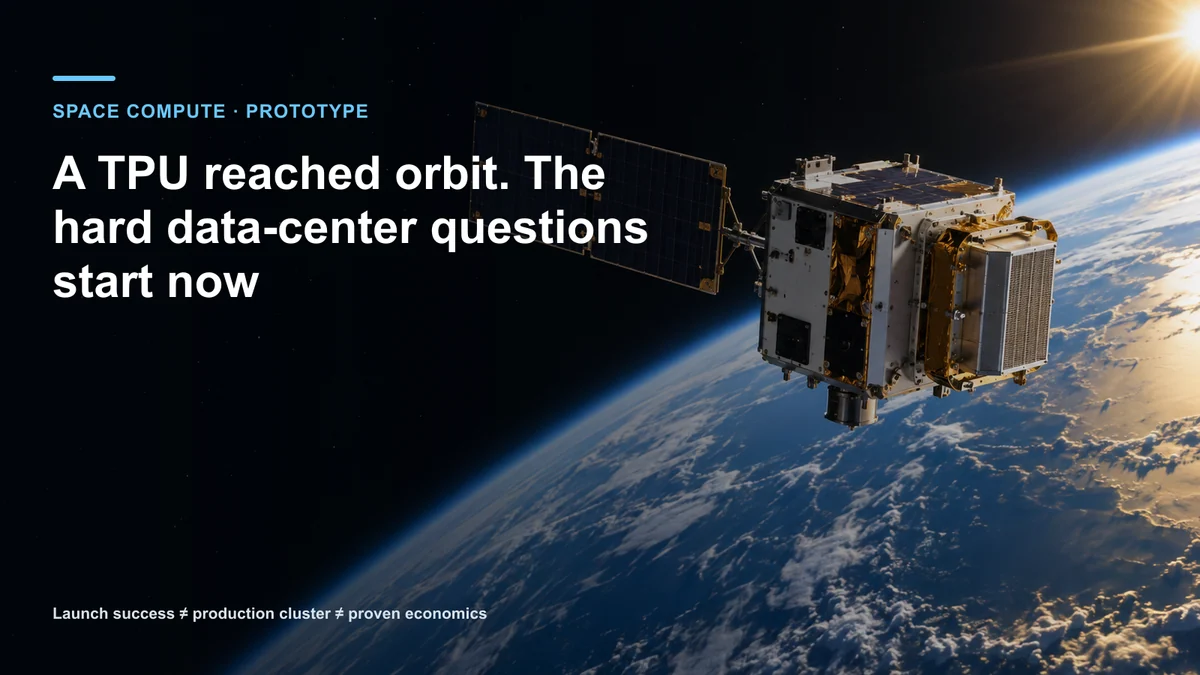
Google says a Project Suncatcher prototype built with Planet launched on SpaceX Transporter-18 on October 1 2026. The team confirmed contact and reported that the spacecraft was operating as expected. This guide separates confirmed events, attributed claims, technical limits, and the evidence still needed for a practical decision.
The short answer: this is a hardware-survival mission
Google says the Planet-built prototype launched aboard SpaceX’s Transporter-18 mission on October 1 and that contact is established. The first experiment is whether TPU hardware behaves under launch stress, orbital radiation, and thermal extremes.
It is not a commercial cluster training frontier models or serving broad customer traffic. Launch and first contact are entry criteria for the research program, not completion of an orbital data center.
Why put machine-learning compute in space at all?
A carefully chosen low-Earth orbit can provide near-continuous sunlight. Google estimates equivalent solar panels could generate up to eight times as much power as they do on Earth, creating an appealing long-term energy premise.
That potential trades grid and cooling-water constraints for launch, maintenance, communications, orbital control, and replacement costs. Abundant sunlight does not make the full system inexpensive by itself.
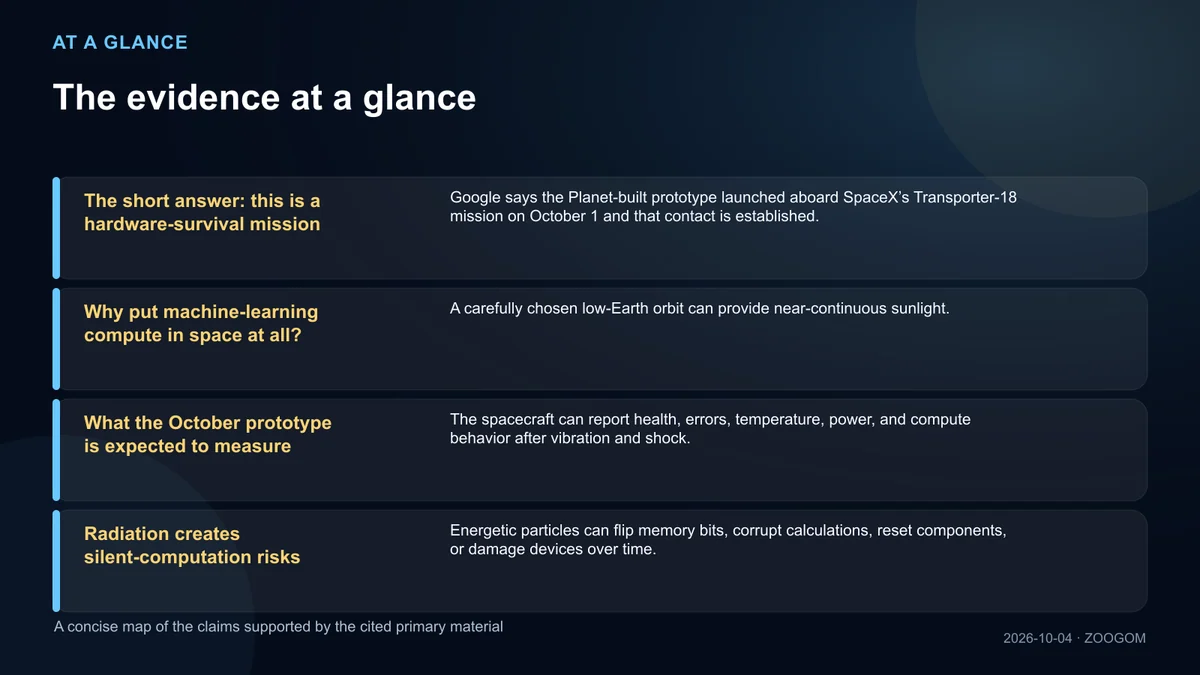
What the October prototype is expected to measure
The spacecraft can report health, errors, temperature, power, and compute behavior after vibration and shock. Engineers can observe whether radiation creates transient faults and whether the hardware can reject heat in vacuum while producing useful work.
Google says data collection will continue over the coming weeks. Early contact does not establish months of stability, useful throughput, or correct output under cumulative radiation exposure.
Radiation creates silent-computation risks
Energetic particles can flip memory bits, corrupt calculations, reset components, or damage devices over time. A rare undetected error is especially troublesome in training, where corruption may propagate without an obvious crash.
Ground proton-beam tests reduce uncertainty but cannot reproduce every orbital particle and time profile. Error correction, redundant calculation, checkpointing, and fault isolation belong in the performance design.
Vacuum removes ordinary convective cooling
Terrestrial data centers move heat through air and liquid. A spacecraft must ultimately radiate heat, linking accelerator density and duty cycle to radiator area, orientation, and spacecraft mass.
An orbit that maximizes sunlight may make thermal balance harder. The system can reduce water consumption yet still require large, expensive heat-rejection hardware.
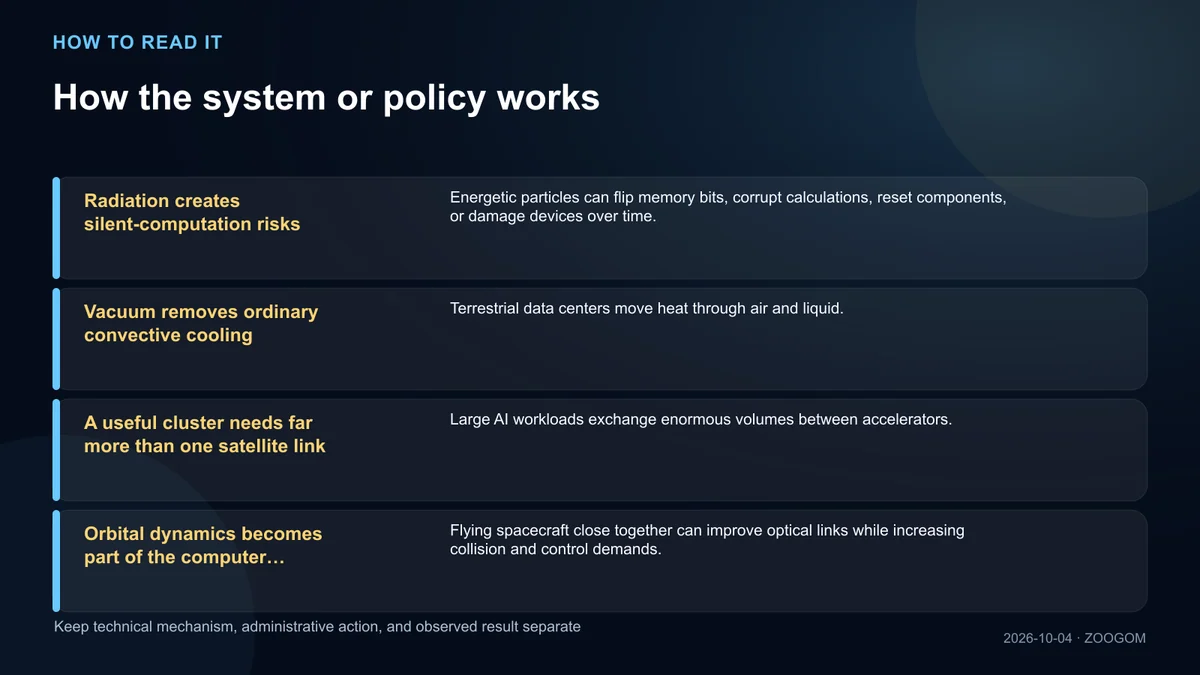
A useful cluster needs far more than one satellite link
Large AI workloads exchange enormous volumes between accelerators. The Suncatcher concept relies on free-space optical links among closely coordinated spacecraft to approach cluster-class bandwidth.
Laser pointing between moving satellites, link recovery, distributed scheduling, and downlink to Earth are separate engineering problems. Contact with a single prototype does not validate the inter-satellite fabric.
Orbital dynamics becomes part of the computer architecture
Flying spacecraft close together can improve optical links while increasing collision and control demands. Atmospheric drag and small orbital differences require navigation and propulsion.
Scaling compute therefore also scales conjunction management, launch windows, orbital slots, propellant, and end-of-life disposal. Capacity cannot be added like another rack in a building.
Economics will turn on refresh and utilization, not launch price alone
AI accelerators improve rapidly, while hardware in orbit is hard to upgrade or repair. A failed unit may remain unavailable, and spare capacity cannot necessarily be reassigned as flexibly as a terrestrial cloud rack.
A fair model includes spacecraft buses, radiation and thermal engineering, launch, insurance, ground stations, communications, orbital maintenance, replacement, and disposal. One optimistic assumption about solar power or launch cost is not enough.
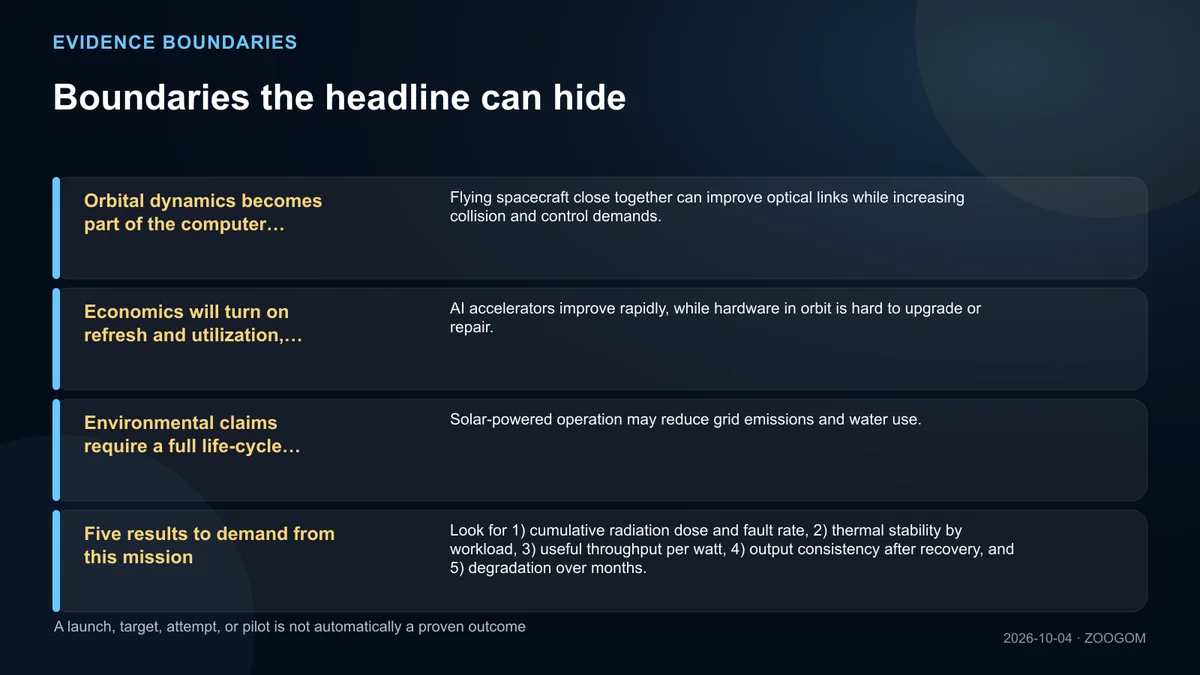
Environmental claims require a full life-cycle denominator
Solar-powered operation may reduce grid emissions and water use. Rocket manufacturing and launch, spacecraft production, replacement missions, and reentry create other impacts.
Compare emissions and material use per unit of useful, correct AI compute at equivalent availability—not simply per kilowatt-hour generated in orbit. A life-cycle study is needed before calling the system a green data center.
Five results to demand from this mission
Look for 1) cumulative radiation dose and fault rate, 2) thermal stability by workload, 3) useful throughput per watt, 4) output consistency after recovery, and 5) degradation over months.
Even strong results move the project to the next gate: multiple spacecraft, optical links, and distributed jobs. Each phase validates a different failure mode.
The fair verdict is that an ambitious concept has entered real testing
Project Suncatcher has moved beyond a paper design by placing relevant hardware in the environment it must survive. Google also points to a peer-reviewed Joule paper that lays out assumptions and engineering work.
No customer offering, service price, commercial operating region, or completion date has been announced. Future coverage should track mission data and the 2027 milestones without calling the prototype an operating space data center.
Copyright, trademark, and image notice
Company and product names may be trademarks of their respective owners. Unless otherwise credited, visuals are AI-generated conceptual backgrounds or original editorial designs and information graphics. Any quotations or third-party assets are identified with the applicable author, source, and usage information at the point of use or in the source list.
Sources and the next facts to verify
The links below are the primary and official materials used for fact-checking. Linking a source does not mean reproducing its prose, imagery, or page design.