What Korea’s K-Perf field test measures in real AI-chip deployments
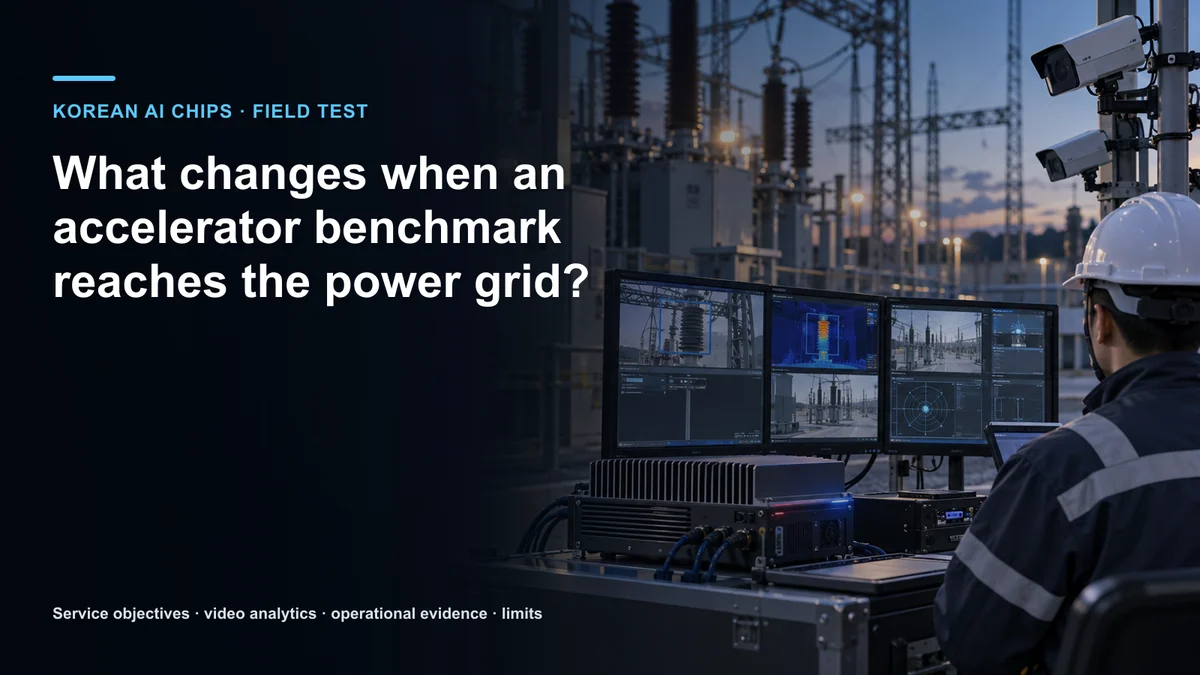
Korea’s Ministry of Science and ICT announced on October 2 2026 that K-Perf would be used for AI video analytics in electric-power operations. Korea Electric Power Corporation Rebellions and the Telecommunications Technology Association signed a technical-cooperation agreement. This guide separates confirmed events, attributed claims, technical limits, and the evidence still needed for a practical decision.
The short answer: K-Perf is moving from a chip score to a service test
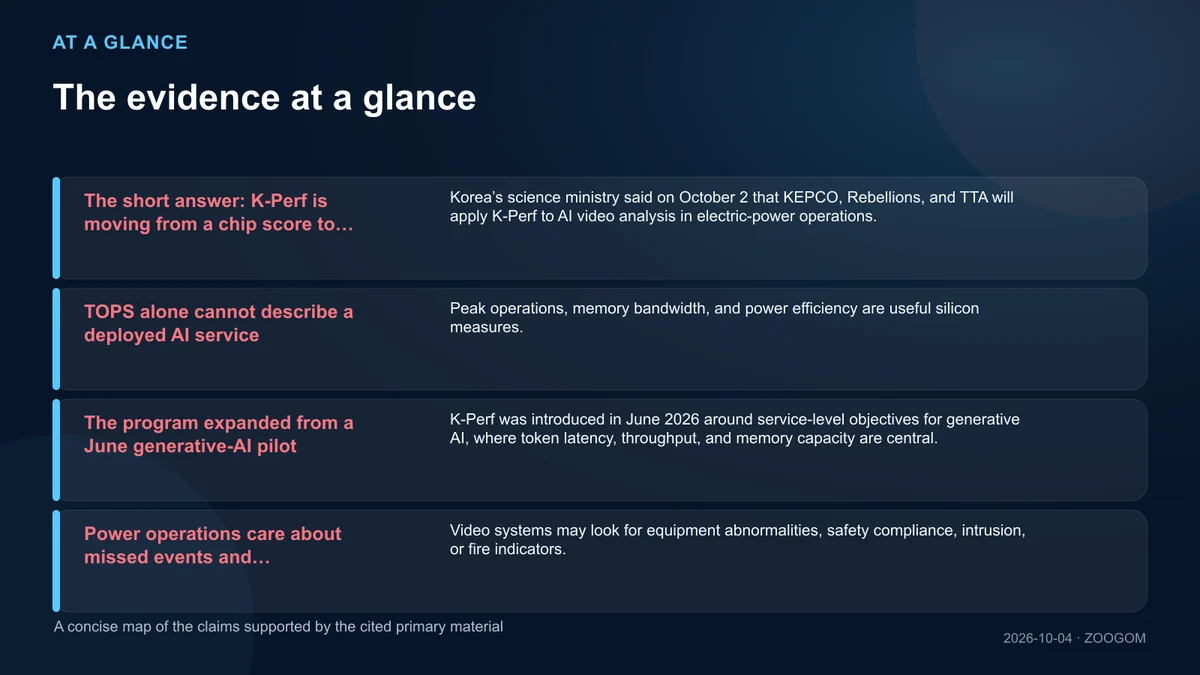
Korea’s science ministry said on October 2 that KEPCO, Rebellions, and TTA will apply K-Perf to AI video analysis in electric-power operations. The aim is to see whether a domestic accelerator can meet real service requirements in a public field setting.
The announcement does not say KEPCO has replaced its full fleet or committed to mass procurement. This is a validation step whose scope and results still matter.
TOPS alone cannot describe a deployed AI service
Peak operations, memory bandwidth, and power efficiency are useful silicon measures. A real service also depends on model loading, preprocessing, compiler quality, network behavior, tail latency, and recovery.
K-Perf’s service-level orientation asks whether users receive the required outcome. The same chip can look very different under another model, batch size, camera stream, or software release.
The program expanded from a June generative-AI pilot
K-Perf was introduced in June 2026 around service-level objectives for generative AI, where token latency, throughput, and memory capacity are central. The new agreement extends the approach to power-sector video analytics.
Video brings a different bottleneck: frames per second, concurrent streams, detection accuracy, and sustained edge operation have to be measured together.
Power operations care about missed events and worst-case delay
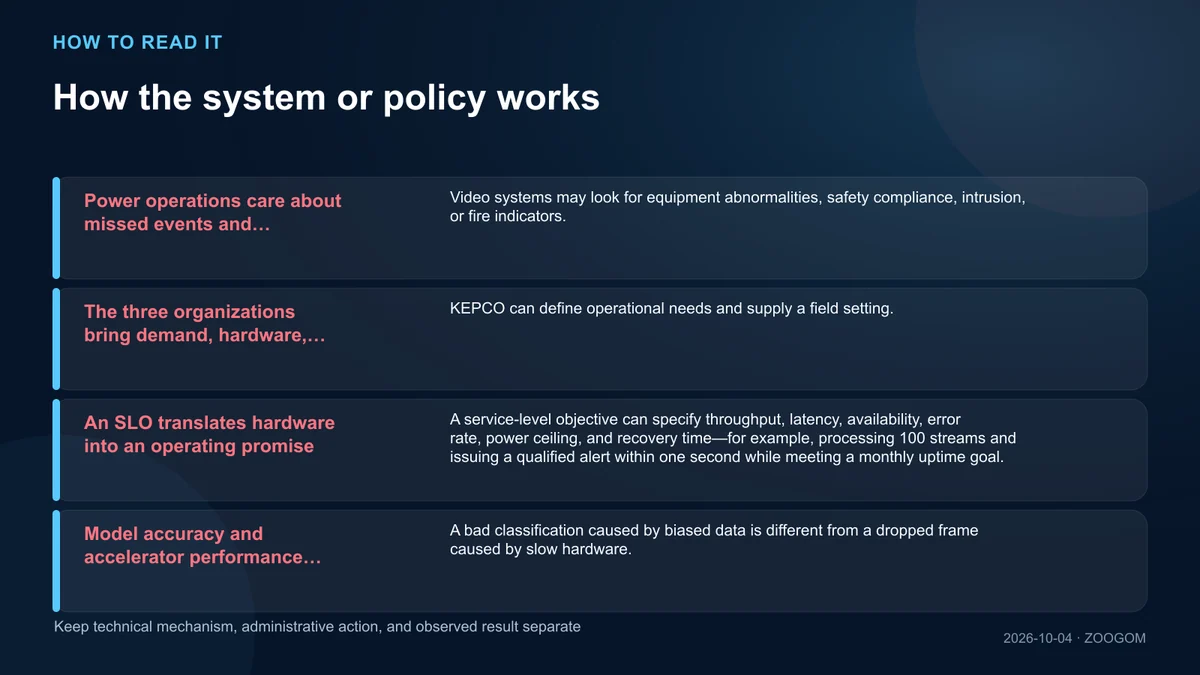
Video systems may look for equipment abnormalities, safety compliance, intrusion, or fire indicators. A brief missed frame or delayed alert can matter more than a strong average throughput number.
Tests should include false negatives, false positives, 99th-percentile latency, camera failure, network interruption, thermal throttling, and recovery under seasonal temperatures and dust.
The three organizations bring demand, hardware, and validation roles
KEPCO can define operational needs and supply a field setting. Rebellions provides the domestic accelerator and software stack. TTA can structure measurements, reproducibility, and conformance.
Clear separation reduces the risk that a supplier grades itself only on favorable criteria. Test design, raw-result access, and conflict management will determine credibility.
An SLO translates hardware into an operating promise
A service-level objective can specify throughput, latency, availability, error rate, power ceiling, and recovery time—for example, processing 100 streams and issuing a qualified alert within one second while meeting a monthly uptime goal.
Do not collapse every property into one composite score. Identify mandatory pass conditions and optimization metrics, and disclose the tradeoff between accuracy, latency, and energy.
Model accuracy and accelerator performance need separate diagnoses
A bad classification caused by biased data is different from a dropped frame caused by slow hardware. Camera angle, labeling, and domain shift will not be fixed by changing the accelerator.
A fair protocol first holds the model and preprocessing constant across systems, then separately reports each platform’s optimized best configuration. That preserves comparability without ignoring real optimization.
Domestic supply can add value beyond benchmark speed
A nearby supplier may adapt compilers, drivers, and support to a field problem more quickly. Local deployment can diversify procurement and improve leverage, data governance, and incident response.
Weak developer tools, model compatibility, or long-term support can still raise total cost. The field test should record engineering labor and operational burden as well as device price and power.
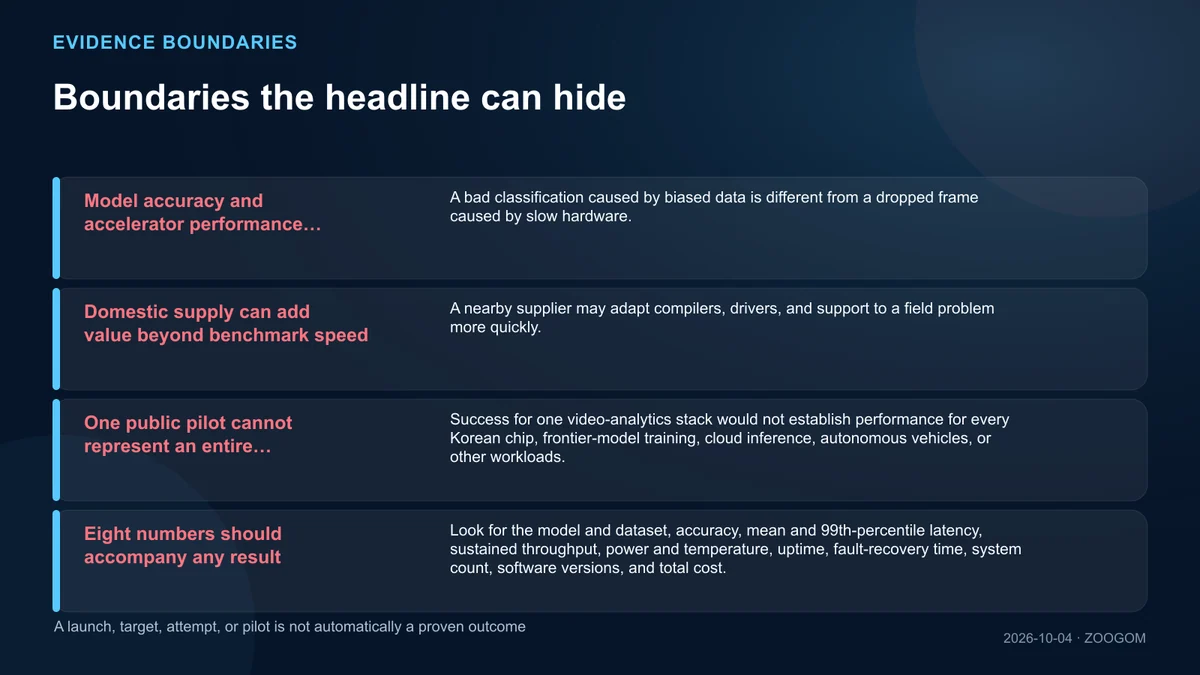
One public pilot cannot represent an entire national industry
Success for one video-analytics stack would not establish performance for every Korean chip, frontier-model training, cloud inference, autonomous vehicles, or other workloads. Each requires different tests.
The verbs matter too. “Will use K-Perf for validation” announces a test; it does not announce a high score, completed deployment, export win, or global lead.
Eight numbers should accompany any result
Look for the model and dataset, accuracy, mean and 99th-percentile latency, sustained throughput, power and temperature, uptime, fault-recovery time, system count, software versions, and total cost.
Operational video may be sensitive, but teams can still publish protocol, anonymized distributions, and failure categories without releasing protected footage.
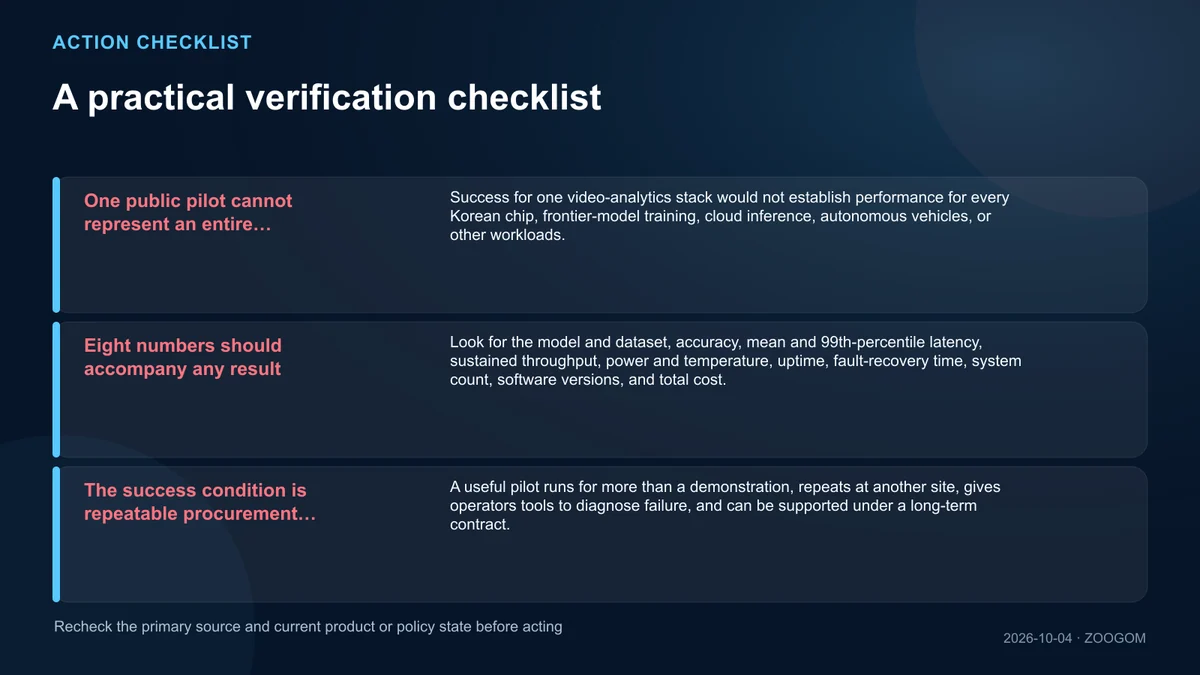
The success condition is repeatable procurement evidence
A useful pilot runs for more than a demonstration, repeats at another site, gives operators tools to diagnose failure, and can be supported under a long-term contract.
K-Perf will be valuable if it defines real service needs transparently—not if it becomes a protected score for domestic products. Independent review of the protocol and results is the bridge from field test to credible procurement.
Copyright, trademark, and image notice
Company and product names may be trademarks of their respective owners. Unless otherwise credited, visuals are AI-generated conceptual backgrounds or original editorial designs and information graphics. Any quotations or third-party assets are identified with the applicable author, source, and usage information at the point of use or in the source list.
Sources and the next facts to verify
The links below are the primary and official materials used for fact-checking. Linking a source does not mean reproducing its prose, imagery, or page design.