OpenAI DevDay 2026 Rumors: GPT-6 Cyber and a Dozen-Plus Product Launches


The most specific new reporting ahead of OpenAI DevDay 2026 points in two directions. OpenAI may ship a dozen or more products around the event, and it is reportedly preparing GPT-6 Cyber alongside a separate product for deploying cyber models more securely and automatically.
Both claims are newsworthy. Neither is an OpenAI announcement. Fortune’s September 24 report cites people familiar with the plans, and its timing language matters: the story was corrected from a possible launch within “days” to a preview in the coming weeks. A DevDay mention is plausible; a generally available September 29 launch is not confirmed.
This is a follow-up to our evidence-based DevDay schedule and platform preview. Instead of repeating every recent release, it focuses on the new model and feature rumors and grades them by the kind of evidence behind them.
Three takeaways
- Confirmed: DevDay is September 29 at Fort Mason. Sam Altman’s 10 a.m. Pacific keynote will stream free, which is 1 p.m. Eastern.
- Credibly reported: Fortune says a dozen-plus products are planned and that GPT-6 Cyber plus an unnamed secure deployment product are in preparation. OpenAI has not published those launch documents.
- Most plausible feature center: Agents API, Codex, secure sandboxes, tool operations, Realtime and image generation fit a developer event better than another immediate general-purpose flagship reveal.
Start with an evidence ladder, not a rumor list
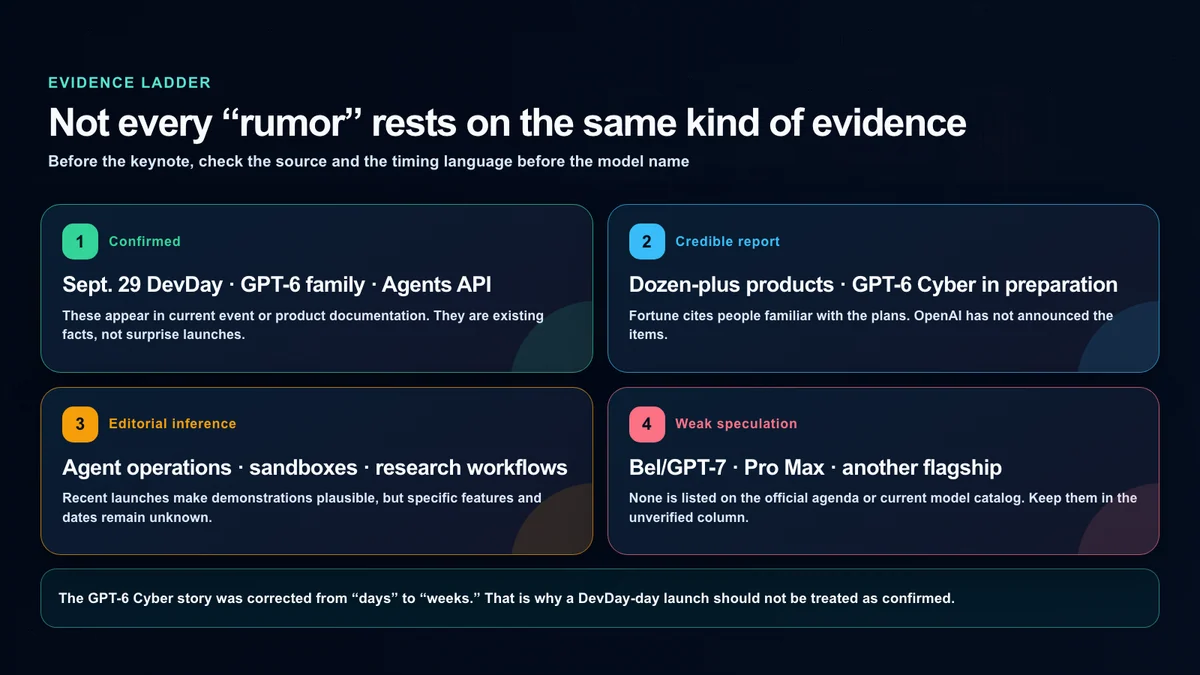
The first level is material that appears on OpenAI’s event pages, newsroom or developer documentation. The event schedule, GPT-6 Astra, Sol and Luna, Agents API, the Codex harness and current Realtime and image models belong here. These are existing facts, not surprise announcements.
The second level is credible source-based reporting. GPT-6 Cyber and the dozen-plus product slate belong here. The report may accurately describe internal plans, but names, prices, rollout regions and launch stages can change before publication.
The third level is editorial inference from the official product trajectory. More operational tooling for Agents API, Codex sandboxes, model routing, voice and image integration is plausible. OpenAI has not itemized those features on the DevDay agenda.
The fourth level is speculation amplified from anonymous posts, code strings or screenshots. Claims that Bel, GPT-7 or ChatGPT Pro Max will debut at DevDay remain in this category.
What OpenAI has officially scheduled
The official DevDay site says OpenAI will hold the event September 29 at Fort Mason in San Francisco. Sam Altman’s opening keynote starts at 10 a.m. Pacific, or 1 p.m. Eastern, and will stream free. Recorded sessions are expected to appear after the event.
OpenAI describes DevDay as a technical gathering for developers, founders, researchers and technical leaders, with API and tool sessions, hands-on demonstrations and workshops. That framing favors a platform story: how models, tools and execution environments work together. It does not rule out consumer news, but it makes a developer operating layer more likely to anchor the event.
What the “dozen or more products” report actually says
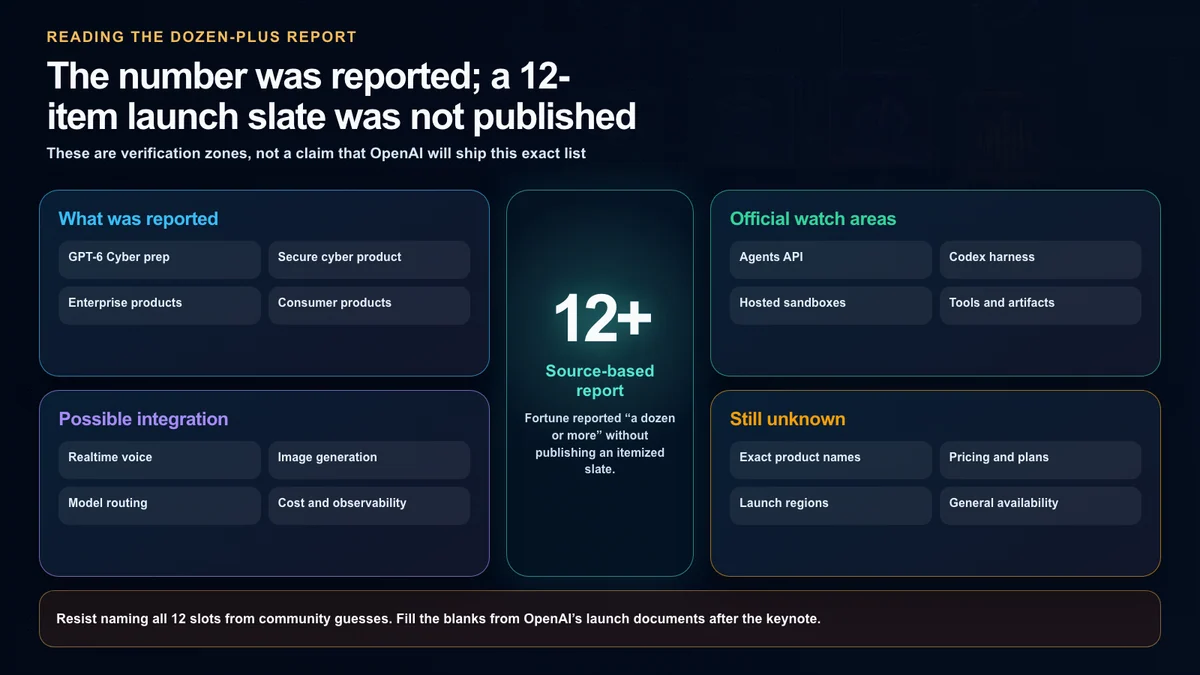
Fortune cites a separate source familiar with the program who says OpenAI plans to ship a dozen or more products at DevDay. Most reportedly are not cyber products, and the group is said to span both enterprise and consumer areas.
The number should not be confused with an itemized slate. No official list of 12 product names has been published. We do not know whether OpenAI counts a model, an API feature, a Codex workflow, an admin control and a regional rollout as separate products. A move from preview to general availability could also count as a launch.
The disciplined reading is narrow: there may be a large release bundle, with both business and consumer components. Filling all 12 slots with community guesses would turn a reported number into an invented roadmap.
The strongest model rumor: GPT-6 Cyber
Fortune reports that OpenAI is preparing to preview GPT-6 Cyber in the coming weeks. It also says a limited number of Daybreak Red customers already have alpha access. If accurate, the model would extend the GPT-6 generation into specialized, high-end security research.
As of September 26, however, the official OpenAI model catalog lists GPT-5.6 Cyber, not GPT-6 Cyber. There is no public GPT-6 Cyber model ID, price, context limit, system card or general-availability date. Absence from the catalog does not prove that an internal model does not exist. It does mean that readers should not treat it as a currently available product.
The corrected timeline is essential. Fortune changed the story from “days” to “weeks.” Because DevDay is only days away, converting that report into “launches at DevDay” would erase the correction. At least three outcomes remain possible:
- OpenAI previews the name and direction at DevDay while the limited alpha continues.
- The deployment product appears first, with model access opening weeks later.
- The cyber announcement happens separately after DevDay.
The unnamed cyber deployment product may matter more than the model
Fortune also reports a new, still-unnamed product intended to help customers deploy cyber models in a more secure and automated way. The described goal is to support automated vulnerability and patching workflows while giving OpenAI more visibility into use and safety.
If it launches, the decisive questions will be about operational boundaries, not a benchmark headline. Can an organization restrict an agent to approved repositories and systems? How are production-network access, secrets and outbound internet use controlled? Which actions require a human approval? Are tool calls fully auditable? Can a run be stopped and recovered without losing the evidence trail?
The current Daybreak announcement already separates Blue and Red access. Blue targets authorized defensive work with frontier general models, while Red provides purpose-trained cyber models for approved vulnerability research and security testing. OpenAI also describes identity verification, account security, monitoring, approved-use restrictions and legal attestations. A new deployment product could extend that structure, but its exact policy and architecture remain unknown.
Likely feature center No. 1: Agents API and Codex operations
The official Agents API overview already describes a managed Codex harness, durable sessions, orchestration, context compaction and recovery, hosted or self-hosted sandboxes, code and file execution, MCP support and artifacts.
Those are not DevDay rumors; they are current documented capabilities. What could be new is the operational layer around them: production templates for multi-agent work, resumable long-running jobs, sandbox network policies, project-level approvals, tracing, cost ceilings and tool-version controls.
For U.S. teams, a dramatic multi-agent demo is less useful than answers about accountability. A system that works once on stage is different from one that can safely recover when a subset of thousands of tasks fail. Watch for who can authorize each action, what the audit record contains and how an operator can roll back or contain a run.
Likely feature center No. 2: GPT-6 tools and model routing
The official GPT-6 developer guide documents asynchronous tool calls, mid-turn steering, reasoning-effort changes within a conversation, computer use, multi-agent orchestration, persisted reasoning and context compaction. Again, these capabilities already exist.
A useful DevDay launch would make them easier to operate. One possible pattern is routing short classification work to Luna, regular agent work to Sol and only hard or failed segments to Astra. Pair that with cache preservation, per-step latency and cost tracking, quality evaluation and fallback rules, and the GPT-6 portfolio becomes easier to deploy as a system rather than as three separate model IDs.
No official agenda promises an automatic router or a particular control plane. This is a high-value inference from the model portfolio and the problems production developers still have to solve.
Will OpenAI productize its automated “research intern”?
OpenAI said in a September 6 research post that it had reached its goal of an automated research intern able to perform well-defined research tasks under human direction, including tasks that might take a skilled researcher several days. That capability claim is official.
The product claim is not. OpenAI has not announced a separate model, public API, ChatGPT feature or Agents API template for the research intern. DevDay could include a demonstration or limited developer workflow, but internal research capability and external product availability are different milestones.
If a product appears, look for reproducibility and supervision details. Which data and tools can the system access? How are experiments rerun? How does it discard bad hypotheses? Where does a human decide whether to continue, scale or stop? “Multi-day research” should not be interpreted as an autonomous scientist without those controls.
Realtime and image announcements are more likely to be about integration
OpenAI’s current model catalog already includes GPT-Live, GPT-Realtime 2.1, Realtime Translate, GPT Image 2.5 Sunburst and Flare. A new voice or image model could appear, but there is not enough evidence to name one in advance.
The more grounded watch area is integration: an agent that listens in realtime, calls tools and returns an image, report or application artifact without switching products. Developers should test interruption handling, latency while tools run, multilingual speech, image-edit consistency, provenance records and safety controls rather than judging a polished English-language stage demo alone.
For U.S. deployments, the operational questions include call-recording consent, accessibility, sector-specific recordkeeping and what data is retained by each tool in the chain. A model announcement does not answer those implementation obligations.
Why Bel, GPT-7 and Pro Max remain weak rumors
There are signals that OpenAI uses internal research systems beyond GPT-6 Astra. But as our Bel evidence-chain review found, the core name and 10-trillion-parameter claim trace back to a single pseudonymous X account. The original post did not promise GPT-7 or a DevDay reveal.
Our ChatGPT Pro Max rumor review reaches a similar conclusion. Code or unreleased interface traces may point to experiments with a higher tier, but OpenAI has not confirmed the product name, a $500 monthly price, combined usage limits or a release date.
Another immediate general-purpose flagship is also less supported than the cyber and platform stories. OpenAI has only recently launched GPT-6 Astra, Sol and Luna, and the official model catalog is organized around that family. A surprise remains possible; the available evidence simply points elsewhere.
The U.S. launch-day verification checklist
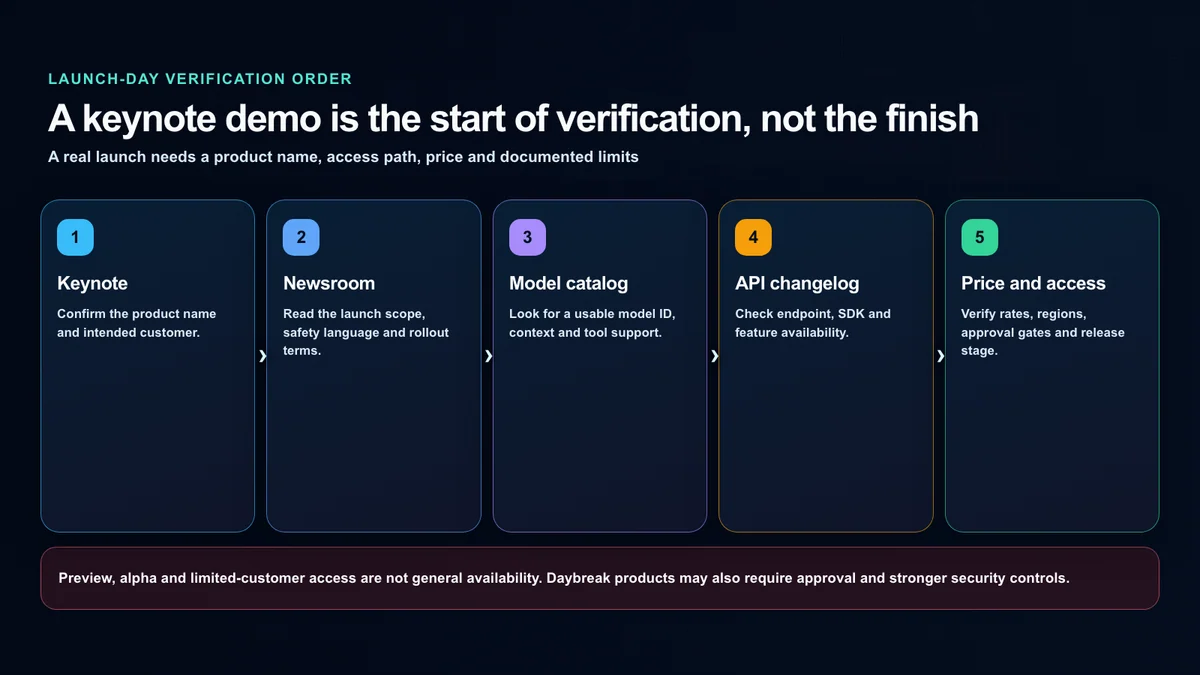
Do not move a production workload because a name appeared in a keynote slide. After the announcement, verify the release in this order:
- Read OpenAI’s newsroom launch post for the release stage and intended customer.
- Find the actual model ID, context limits and tool support in the model catalog.
- Check the API changelog for endpoint and SDK availability.
- Check the pricing page for rates, long-context multipliers and cache terms.
- Confirm region, approval, contract and data-handling requirements for your account.
The difference between preview, alpha, limited customer access and general availability is especially important for GPT-6 Cyber. A Daybreak Red alpha would not necessarily appear in the ordinary ChatGPT or Codex model picker.
Frequently asked questions
Is GPT-6 Cyber confirmed to launch at DevDay?
No. Fortune reports that OpenAI is preparing a preview in the coming weeks, and the story corrected its timing from days to weeks. A DevDay mention is plausible, but a September 29 general release is not confirmed.
Has the list of 12 products leaked?
No. The report says a dozen or more products are planned. It does not provide an official itemized list.
Could Bel or GPT-7 still appear?
They could, but the current official agenda, model catalog and strongest independent reporting do not support that prediction. They remain weak speculation.
What is the most important thing to watch?
GPT-6 Cyber and the secure deployment product are the most concrete new product reports. For developers, the larger practical impact may come from agent operations: sandbox boundaries, permissions, recovery, observability and cost controls.
Bottom line
DevDay 2026 may be a high-volume launch event. But a reported number is not permission to invent a 12-item roadmap. The strongest current reporting concerns GPT-6 Cyber and a secure cyber deployment product. The most coherent feature direction is a developer platform that connects Agents API, Codex, sandboxes, Realtime and image generation with stronger operational controls.
Bel, GPT-7 and Pro Max remain weakly supported. On September 29, watch the keynote—but judge each “launch” by the release document, model ID, price, region, approval gate and documented limits. It becomes a usable product only when those pieces line up.
Sources and use notice
- OpenAI DevDay 2026 official site
- OpenAI, official DevDay 2026 announcement
- Fortune, GPT-6 Cyber and dozen-plus DevDay product report
- OpenAI Developers, model catalog
- OpenAI Developers, GPT-6 guide
- OpenAI Developers, Agents API overview
- OpenAI, Daybreak and GPT-5.6 Cyber
- OpenAI, automated research intern and research acceleration
- OpenAI Developers, API changelog
OpenAI, GPT, ChatGPT, Codex and Daybreak names and marks belong to their respective owners. This independent article is not sponsored or endorsed by OpenAI. It separates official facts, source-based reporting, editorial inference and weak community speculation. It does not reproduce third-party news photography, event footage, product interfaces or X screenshots.