OpenAI’s Rumored “o” Agent: What Could Launch at DevDay—and What Is Still Unproven
OpenAI may be preparing an always-on assistant called o for DevDay, according to a rumor built on two different kinds of traces. One is an image that appears to show a ChatGPT Pro signup screen with the benefit o, your always-on assistant. The other is a reported client configuration containing display_name: "o" and email_suffix: "-o".
That is more evidence than a name posted by one anonymous account. It is not the same as an OpenAI announcement. As of September 27, 2026, neither the official DevDay announcement nor the event site names a product called o. The traces could reflect an unreleased product, a limited experiment, copy exposed too early or a fabrication.
The careful verdict is narrow: an always-on assistant named o appears more plausible than an ordinary one-post rumor, but a DevDay reveal, Pro eligibility, independent email identity, the alleged aeon model and final U.S. availability are all unconfirmed.
Three takeaways
- The name
oappears in both a user-facing Pro screen and a separate configuration trace. Those are meaningful clues, not official launch documents. - Agents API, ChatGPT Work, Workspace Agents and OpenAI’s proposed Ona acquisition provide a credible technical direction for persistent cloud agents. None proves that
ois the product combining them. - If OpenAI announces it, the decisive questions are execution location, app and email scope, approval gates, memory and log retention, stop controls, plan eligibility and rollout stage.
Start with an evidence ladder
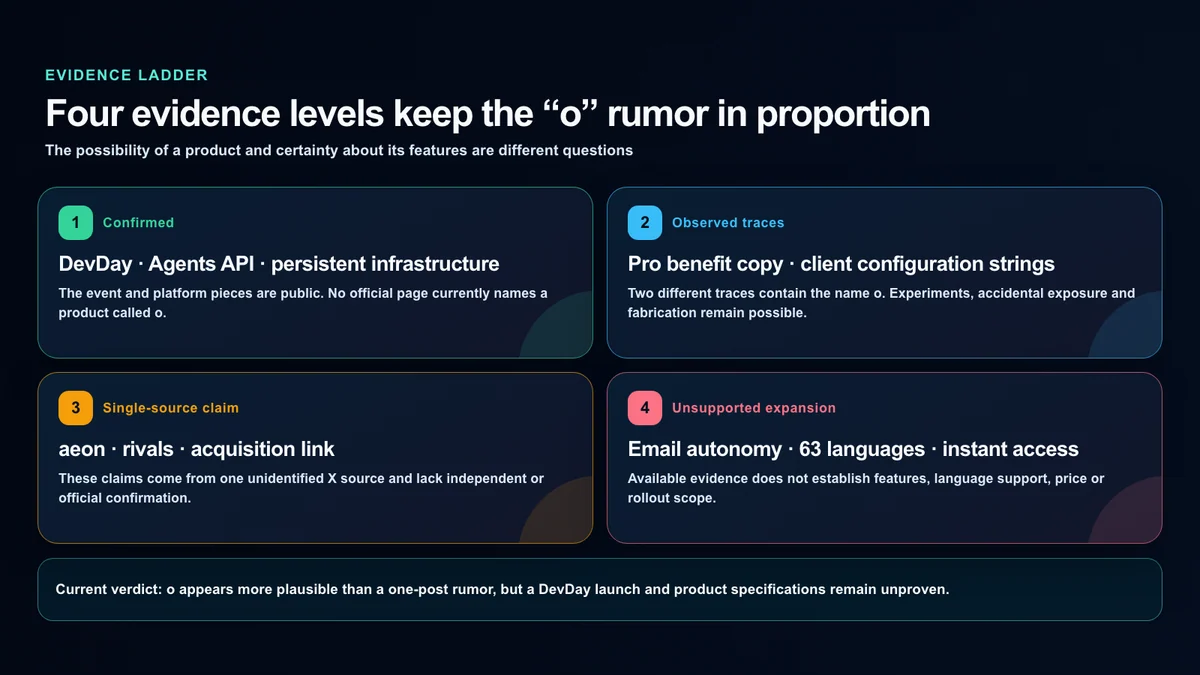
The first level is officially confirmed material. DevDay’s schedule, durable Agents API sessions, long-running ChatGPT Work projects, scheduled Workspace Agents and OpenAI’s proposed Ona acquisition are documented by OpenAI. None of those documents currently mentions o.
The second level is a trace reported from a real interface or client configuration. The Pro screen and configuration strings belong here. Seeing the same name in two different forms increases plausibility, but there is no public service log, reproducible rollout or OpenAI confirmation. A/B testing, accidental exposure, a canceled experiment and manipulation remain possible.
The third level is an unidentified single-source claim. The alleged aeon model, direct rivalry with Grok Bot and Hermes Agent, months of development and a particular acquisition link all come from this tier. They have not been independently confirmed.
The final level is unsupported expansion: 63-language support, a Cerebras-powered fast mode, automatic access for every Pro subscriber, fully autonomous email, a $500 plan or an OpenAI-owned @o X account. Available primary evidence does not establish any of those claims.
The strongest clue: one line on a ChatGPT Pro screen
On September 25, Jake Boggs posted an image that appears to show a ChatGPT Pro signup page. Under the $100 Standard option, the benefit list includes o, your always-on assistant. It is the most direct clue because it looks like customer-facing subscription copy rather than a speculative product mockup.
One screen still does not establish a launch. OpenAI could have exposed unreleased copy to an experiment cohort, connected the page to an internal product temporarily or shipped incorrect text. Without direct access to the original account state, outside observers also cannot eliminate manipulation.
The current ChatGPT pricing page and official Pro help article do not list o as a public benefit. The $100 figure makes a U.S. Pro experiment plausible, but it does not prove that every $100 subscriber would receive it, that the benefit would be unlimited or that the screen reflects final launch pricing.
The second clue: display_name and email_suffix
TestingCatalog separately published what it described as a client configuration fragment. It contained display_name: "o", email_suffix: "-o" and surrounding values including a numeric dynamic-configuration key, rule_id: "default", passed: false, id_type: "userID" and is_device_based: false.
That makes it more likely that o is a name used inside a product configuration rather than a label invented for an article. passed: false could mean the captured user did not qualify for the feature rule. It does not tell us whether the rule is current, whether the product will ship or what users can do with it. The original ChatGPT page or endpoint has not been publicly reproduced in a way that allows independent verification.
email_suffix requires even more restraint. It may support a distinct email alias for each agent, but it could also be a display suffix, routing value or internal identifier. A field name alone does not prove that the agent can read an inbox, send mail to outside parties or carry on an autonomous conversation.
The most specific—and weakest—claim is aeon
The X account @synthwavedd claims that o will be a major DevDay announcement, compete with Grok Bot and Hermes Agent, and use aeon, described as a GPT-6 Astra variant optimized for long-running work. A follow-up also says an unspecified OpenAI acquisition was made for the product.
The specificity should not be confused with verification. The post supplies no source, and there is no public aeon model ID, system card, pricing page or independent second report. RuntimeWire’s review also treats the story as a rumor and notes that the acquisition was not identified.
For now, aeon is best described as an alleged internal codename or community-circulated label. Calling it a confirmed GPT-6 Astra variant, the production engine behind o or a launchable model would go beyond the evidence.
A DevDay reveal makes sense, but it is not on the agenda
OpenAI DevDay 2026 takes place September 29 at Fort Mason in San Francisco. Sam Altman’s keynote begins at 10 a.m. Pacific / 1 p.m. Eastern and will stream free. The event site describes API and tool sessions, technical demonstrations and workshops, but its public agenda does not list o.
View OpenAI Developers’ official 72-hours-to-DevDay post on X
The official post says it is time to show what OpenAI has been building. It does not name an always-on assistant. TestingCatalog calls it an official o teaser, but the original text supports only the existence of upcoming DevDay announcements.
The timing is still notable. A developer event is a logical place to connect a consumer experience to Agents API, cloud execution, tools and permissions. A leak just days before the keynote could reflect a real launch sequence. Plausible timing is not a confirmed schedule.
Why the rumor fits OpenAI’s official direction
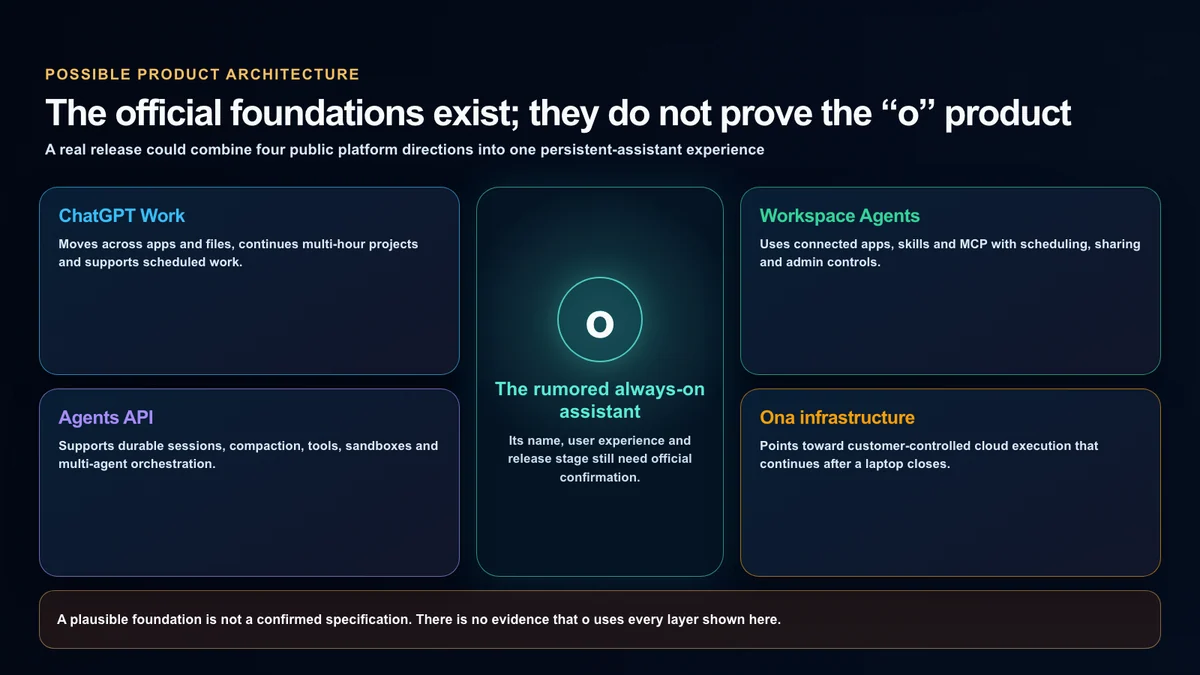
The rumor has momentum because OpenAI has already announced many of the components an always-on assistant would need. The four layers below could form a persistent personal-agent product. This is an editorial architecture hypothesis, not an OpenAI specification for o.
ChatGPT Work: projects that continue across apps and files
OpenAI’s ChatGPT Work introduction describes complex work across apps and files, projects that continue for hours, and scheduled tasks that can run once, recur, respond to a trigger or monitor for change. Users can inspect progress, redirect the work and approve important actions.
In that product direction, o could be an assistant layer that owns persistent goals rather than another standalone model. OpenAI has not said whether existing ChatGPT Work features will be renamed, bundled into a new product or remain separate.
Workspace Agents: shared, scheduled agents for organizations
The official Workspace Agents announcement describes agents for Business, Enterprise and Edu organizations. They can use connected apps, skills, files and MCP servers, run on a schedule or API trigger, be shared and operate under administrative controls. They can also continue in the cloud while the user is away.
That behavior resembles the phrase “always-on.” It does not establish that a consumer o product is the same system. The account type, data contract and administrative boundary may be substantially different.
Agents API: the developer infrastructure for durable work
OpenAI’s Agents API announcement and developer overview describe access to the harness and infrastructure behind Codex. Capabilities include durable sessions, context compaction, tool search, programmatic tool calls, multi-agent orchestration and preservation of files, code and intermediate results. Developers can use OpenAI-hosted sandboxes, their own infrastructure or partner sandboxes.
Those are core requirements for a product that keeps working after a browser closes. The API does not prove the o brand, consumer interface, subscription tier or release date.
Ona: cloud execution after the laptop closes
On June 11, OpenAI announced a plan to acquire Ona, emphasizing secure, customer-controlled cloud execution for long-running agents. The stated direction lets organizations control where work runs, what an agent can access, how credentials are handled, what is logged and how work is reviewed—even after a laptop closes.
That description overlaps strongly with an always-on assistant. It is therefore reasonable to ask whether the unidentified acquisition in the X claim meant Ona. The source did not name the acquisition, and OpenAI has not connected Ona to o. Ona is a plausible infrastructure ingredient, not proof of a product relationship.
o is not automatically GPT-6o or an o-series reasoning model
The one-character name creates obvious confusion. In the leaked-looking Pro copy, o is described as “your always-on assistant,” suggesting a product or agent identity. There is no evidence that it refers to the suffix in a model name such as GPT-6o or to OpenAI’s o-series reasoning models.
Even if the aeon claim proved accurate, o could be a service that combines a model with tools, memory, schedules and a sandbox. Selecting a model for one response and assigning a multi-day goal to a persistent assistant are different product experiences.
Tibo’s “o yes” is weak atmosphere, not product evidence
OpenAI’s Tibo used the phrase o yes… we’re back in action while announcing recovery from Codex and ChatGPT Work service issues. Because of the timing, some readers treated it as a hidden teaser. The complete context is a status update about service restoration, usage resets for paid users and a temporary spare Codex environment.
View Tibo’s original Codex and ChatGPT Work recovery post on X
The phrase may be playful word choice. It does not confirm the product, its features, its price or a DevDay reveal.
Three forms the product could take
The first is an always-on task control center. A user sets a goal and deadline; the agent continues web research, document work, code execution and monitoring in the cloud, requesting approval before consequential actions. This is the closest fit with ChatGPT Work plus Agents API.
The second is a persistent agent identity. If email_suffix maps to a real alias, each assistant could receive documents, scheduling requests or service notifications through a dedicated address. That remains a hypothesis; outbound mail authority is not established.
The third is a consumer version of Workspace Agents. OpenAI could simplify connected apps, scheduling and permission controls for individuals and include it in a Pro plan. The reported Pro screen fits that possibility, while the public pricing page does not yet confirm it.
These forms can overlap or roll out in stages. A limited scheduled-task preview could later gain multi-hour projects, a distinct identity and external actions. That is why the release stage and default permissions matter more than a polished keynote demo.
The real product test is permissions and stop controls
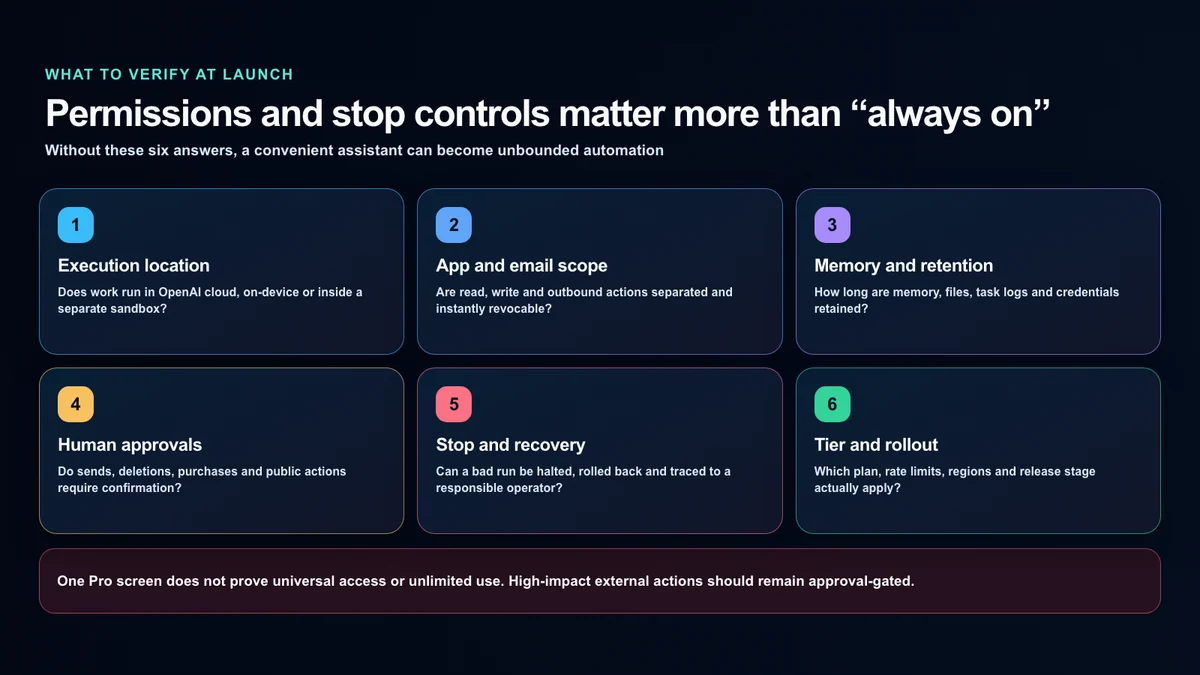
An always-on agent has a larger failure surface than a chatbot that produces one bad answer. It can continue from a wrong assumption, call multiple tools, modify shared material or communicate externally before a user notices. A credible launch needs answers to at least six questions.
- Does work run in OpenAI’s cloud, on the user’s device or in a distinct sandbox?
- Are email, calendar, drive and browser permissions separated into read, write and outbound-action scopes?
- How long are memory, task files, logs and credentials retained?
- Do sending, deleting, purchasing, publishing and inviting require human approval?
- Can a user halt a run immediately, revoke every token and recover or roll back affected work?
- Does the audit trail identify the model, tools, permissions and external actions used in each step?
“Always on” should not mean unbounded autonomy. A trustworthy agent is not the one that silently does the most. It is the one that can continue for a long time while staying inside a defined scope, budget and approval policy.
What U.S. users and teams should watch
The apparent $100 Pro screen must be compared with the final U.S. offer. OpenAI currently has public $100 and legacy $200 Pro context, and new signups or upgrades to the $200 tier have been paused since September 10. A launch document would need to state which tier receives o, whether existing $200 subscribers are treated differently, whether usage is metered and which features require Business or Enterprise controls.
Persistent identity also changes the privacy and security boundary. Teams should look for separate read and write scopes, credential vaulting, domain restrictions, per-agent budgets, retention settings, administrator kill switches and exportable audit logs. “Uses your apps” is not enough; buyers need to know which data each connector sends to the model and what remains after access is revoked.
Liability matters when an agent communicates or takes action. A service can draft an email with low risk, but sending it under a persistent identity creates reliance, consent and recordkeeping questions. Purchases, customer communications, public posts and regulated records should remain behind explicit approval gates unless an organization deliberately configures a narrower automated workflow.
The DevDay verification checklist
- Confirm whether the official name is exactly
oand whether it is a product, feature or experiment. - Distinguish general availability, public preview, limited beta and selected-customer alpha.
- Verify whether access belongs to the $100 Pro tier, legacy $200 tier, Business, Enterprise or another plan.
- Look for an actual model ID and whether
aeonappears in any official document. - Check execution location, maximum run duration, concurrency, usage caps and incremental charges.
- Determine whether
email_suffixcreates a real address or only an internal identifier. - Inspect approval defaults for sends, deletions, purchases, publishing and app changes.
- Verify audit logs, retention controls, revocation, data deletion, stop behavior and recovery.
Do not rely on one keynote slide. Compare the newsroom announcement, help center, pricing page, developer documentation and actual account controls. A feature is ready for production only when those sources agree.
Frequently asked questions
Has OpenAI confirmed o?
No. OpenAI’s public event pages, newsroom and product documentation do not announce a product called o as of September 27.
Does that mean the rumor is fake?
Not necessarily. The same name appears in two different types of reported traces: a customer-facing Pro screen and a client configuration fragment. Neither has been confirmed by OpenAI or fully reproduced independently.
Will every $100 Pro subscriber get it?
That is unknown. The phrase appeared on one reported $100 Pro screen, while the public pricing page does not currently list it. The screen could represent an A/B test, prelaunch copy or a limited cohort.
Will o have its own email address?
Unconfirmed. email_suffix is compatible with an alias, but it could be an internal display or routing value. Read, write and outbound sending authority must be verified separately.
Is aeon a new OpenAI model?
There is no official confirmation. The name comes from a single X account, with no public model ID, system card, pricing or independent second source.
Is the DevDay launch guaranteed?
No. The timing is plausible, but the official agenda does not mention o. OpenAI could announce it, preview it for a limited group, delay it or never ship the experiment represented by the traces.
Bottom line
The o rumor has enough substance to investigate. A customer-facing Pro screen and a configuration fragment point to the same name, while OpenAI’s public strategy has moved decisively toward durable, scheduled, cloud-executed agents.
The evidence still supports only a limited conclusion. It does not establish a DevDay launch, the aeon model, autonomous email, universal $100 Pro access, final U.S. pricing or a specific permission system. On September 29, the most important details will be scope, approvals, logs, stop controls, plan eligibility and rollout stage, not the one-letter brand.
The value of an always-on assistant will not be measured by how long it can run. It will be measured by whether it reliably stops at the user’s boundaries.
Sources and use notice
- OpenAI, official DevDay 2026 announcement
- OpenAI DevDay official event site
- OpenAI, introducing the Agents API
- OpenAI Developers, Agents API overview
- OpenAI, introducing Workspace Agents
- OpenAI, ChatGPT Work
- OpenAI, plan to acquire Ona
- TestingCatalog, OpenAI
oalways-on agent rumor - RuntimeWire, tracking the long-running
oagent rumor - Pasquale Pillitteri, analysis of the Pro screen and configuration trace
OpenAI, ChatGPT, Codex, Agents API and related names and marks belong to their respective owners. Zoogom.com is an independent editorial site and is not sponsored, endorsed or approved by OpenAI. This article separates official material, reported interface traces, a single-source X claim and editorial inference. It does not reproduce third-party article photography, actual product interfaces, company logos or X screenshots; X posts are displayed only through source links and the platform’s official embed method.