OpenAI DevDay 2026 Preview: What to Watch on September 29
OpenAI DevDay 2026 arrives September 29 at Fort Mason in San Francisco. The official DevDay site says Sam Altman’s keynote starts at 10 a.m. Pacific and will stream free online.
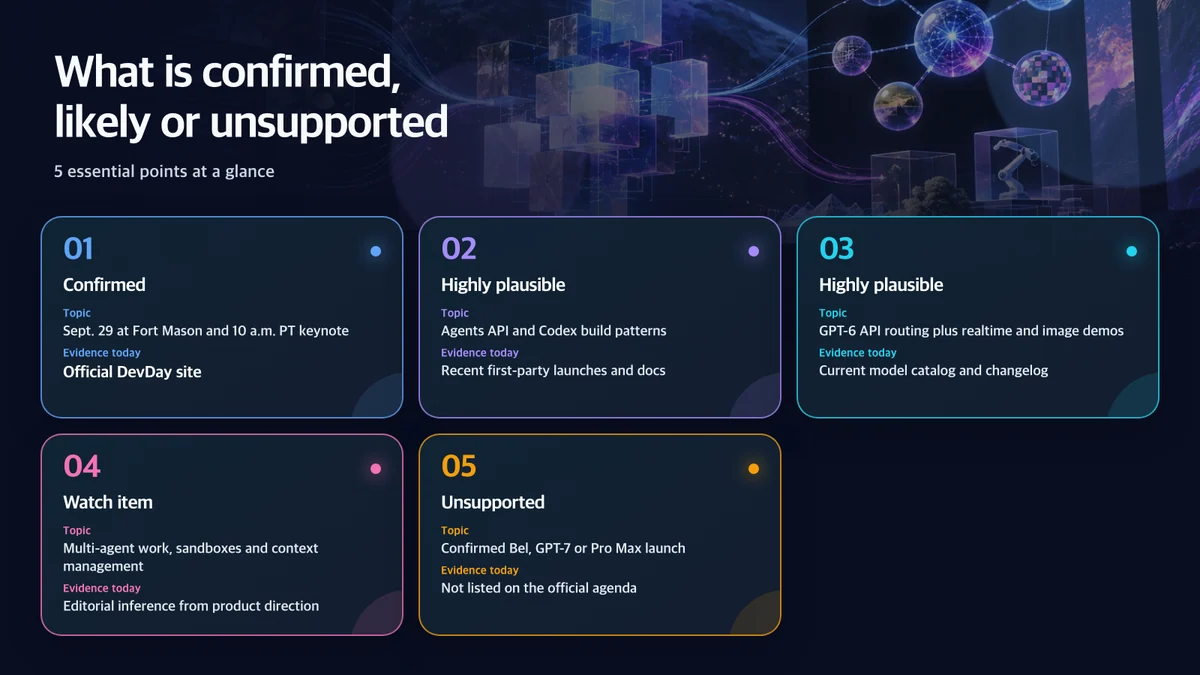
The useful preview is not a guessing contest for an unreleased model name. OpenAI has recently shipped GPT-6 Astra, Sol and Luna, the Agents API, expanded Codex infrastructure, GPT Image 2.5 and real-time voice models. DevDay is likely to explain how these pieces form a developer platform. Bel, GPT-7 and ChatGPT Pro Max, by contrast, do not appear on the official agenda.
Three takeaways
- Confirmed facts include the September 29 event, the 10 a.m. PT keynote, free stream and developer-centered program.
- The strongest evidence points to Agents API, Codex, GPT-6 developer workflows, Realtime and GPT Image 2.5 integration.
- Future internal model names and a new premium subscription remain rumors until OpenAI publishes them.
What is confirmed, likely or unsupported
The official program
OpenAI describes the event for developers, technical founders and researchers, with APIs, tools, hands-on sessions and demonstrations. In-person admission is listed at $650 for invited registrants, while the keynote is available without charge online. People outside the Bay Area should expect the stream and later session recordings to be the practical access route.
OpenAI also plans DevDay Exchange events in cities including Seoul. U.S. attendees may use the main event for launch details, then follow regional sessions for partner ecosystems and localized implementation examples. Dates and registration rules can change by city, so the event site remains the authoritative source.
Watch area 1: Agents API as the center of gravity
The Agents API announcement brings model calls, tool use and long-running work into an agent execution layer. The important DevDay questions are operational. Where does a failed task resume? How do multiple agents share tools without sharing every permission? How are costs, state and execution logs inspected?
OpenAI’s recent research scales coordination to thousands of agents, but most businesses need reliable separation among two to five roles before they need a giant swarm. Even if the keynote features an eye-catching multi-agent demo, practical value will come from retries, approval gates, durable state, cost caps and evaluation.

Watch area 2: Codex harnesses and hosted sandboxes
Codex has evolved from code completion toward repository-scale agents that read files, run terminals and iterate on tests. DevDay could clarify how developers assemble the same harness through APIs or send work into isolated hosted sandboxes.
The details to watch are outbound-network rules, secret injection, file persistence, execution limits, artifact return, approvals and audit logs. A polished successful demo is less informative than safe recovery from a failed command or partially completed migration.
Watch area 3: Routing across Astra, Sol and Luna
The OpenAI model catalog increasingly looks like a portfolio rather than a single universal model. A credible DevDay session could show Astra handling hard reasoning and complex agent runs, Sol covering general development and repeatable professional work, and Luna serving short latency-sensitive tasks.
U.S. teams should look beyond each model’s best benchmark. The operational questions are when a router escalates to a stronger model, how caching and context compression affect completed-task cost, and whether fallback behavior remains predictable during rate limits or model updates.
Watch area 4: Tool search and context compression
Sending descriptions of hundreds of tools with every request inflates input cost and can worsen tool selection. Loading only relevant tools and compressing older work history without losing constraints are foundational for long-running agents.
If OpenAI emphasizes context-window size, developers should ask for omission rates before and after compression, schema-change behavior, resolution of conflicting old and new instructions, and recovery when an agent writes a bad summary of its own work.
Watch area 5: GPT Image 2.5 and realtime voice
After the GPT Image 2.5 launch, image generation is becoming an output stage inside agents for reports, shopping, education and creative workflows. Developers need control over editing consistency, transparent backgrounds, latency, rights records and safety filters—not just impressive samples.
For GPT-Live-1 and Realtime systems, the practical tests are interruption handling, telephony integration, latency, and continuity while a tool runs. Teams deploying calls must also handle consent, recording disclosures, state privacy and escalation to a human operator.
Watch area 6: Enterprise controls and safety monitoring
Enterprise buyers need project budgets, key management, role-based access, retention controls, audit logs and incident response. In light of OpenAI’s multi-agent research and misalignment-monitoring work, execution-time classifiers and human approval for risky actions could be as consequential as a new model.
U.S. organizations should connect product claims to their own legal requirements. HIPAA, financial records, state privacy laws and contractual data restrictions are workflow-specific. An “enterprise” label does not determine whether a given dataset can be sent to the service.

How to treat Bel, GPT-7 and Pro Max claims
OpenAI has confirmed that an internal research model more capable than GPT-6 Astra exists. It has not confirmed that the model is named Bel, that it will launch as GPT-7 at DevDay, or that a ChatGPT Pro Max subscription will be announced.
Prelaunch speculation often mixes strings found in web code, social-media handles and anonymous posts. The verification order should be the DevDay agenda, OpenAI newsroom, developer changelog, model catalog and pricing page. A name absent from those sources remains an unverified claim, not a scheduled announcement.
A preparation checklist for U.S. developers
Before the keynote, record current model IDs and pricing, the most expensive workflow, failure rates and which tool actions require human approval. That baseline makes it possible to evaluate a launch rather than simply react to it.
- Preserve regression tests for streaming, tools and structured output.
- Recheck retention, regional processing and enterprise terms.
- Reproduce agent demos on internal test cases rather than vendor examples.
- Compare completed-task cost, including retries and review.
- Do not pin an announced model ID in production until the changelog and migration notes are available.
Frequently asked questions
Is the keynote free to watch?
Yes. The official site says the 10 a.m. PT keynote will stream free. Availability of every breakout session may differ.
Is GPT-7 confirmed?
No. OpenAI’s official event information and developer documentation do not confirm a GPT-7 announcement.
What would be the most consequential developer launch?
Reliable agent permissions, recovery, observability and sandboxing may matter more to production teams than a new model name. Realtime quality and enterprise data controls are also high-impact areas.
Bottom line
The evidence-based DevDay story is a platform story: models, tools, secure execution, realtime input and multiple agents working inside one development environment. OpenAI’s recent releases already point in that direction.
On September 29, the meaningful test will be how concrete the controls for building, auditing, recovering and budgeting these systems become. Bel and GPT-7 belong in the unsupported column until OpenAI moves them into an official announcement.
Sources and rights notice
- OpenAI DevDay 2026 official site
- OpenAI, Introducing the Agents API
- OpenAI Developers, API changelog
- OpenAI Developers, Models
- OpenAI, Introducing ChatGPT Images 2.5
OpenAI, GPT, ChatGPT and Codex names and marks belong to their respective owners. This independent editorial preview is not sponsored, endorsed or approved by OpenAI. It separates confirmed event facts, editorial watch areas and unsupported rumors. Its images are editorial concepts, not actual event or product imagery.